
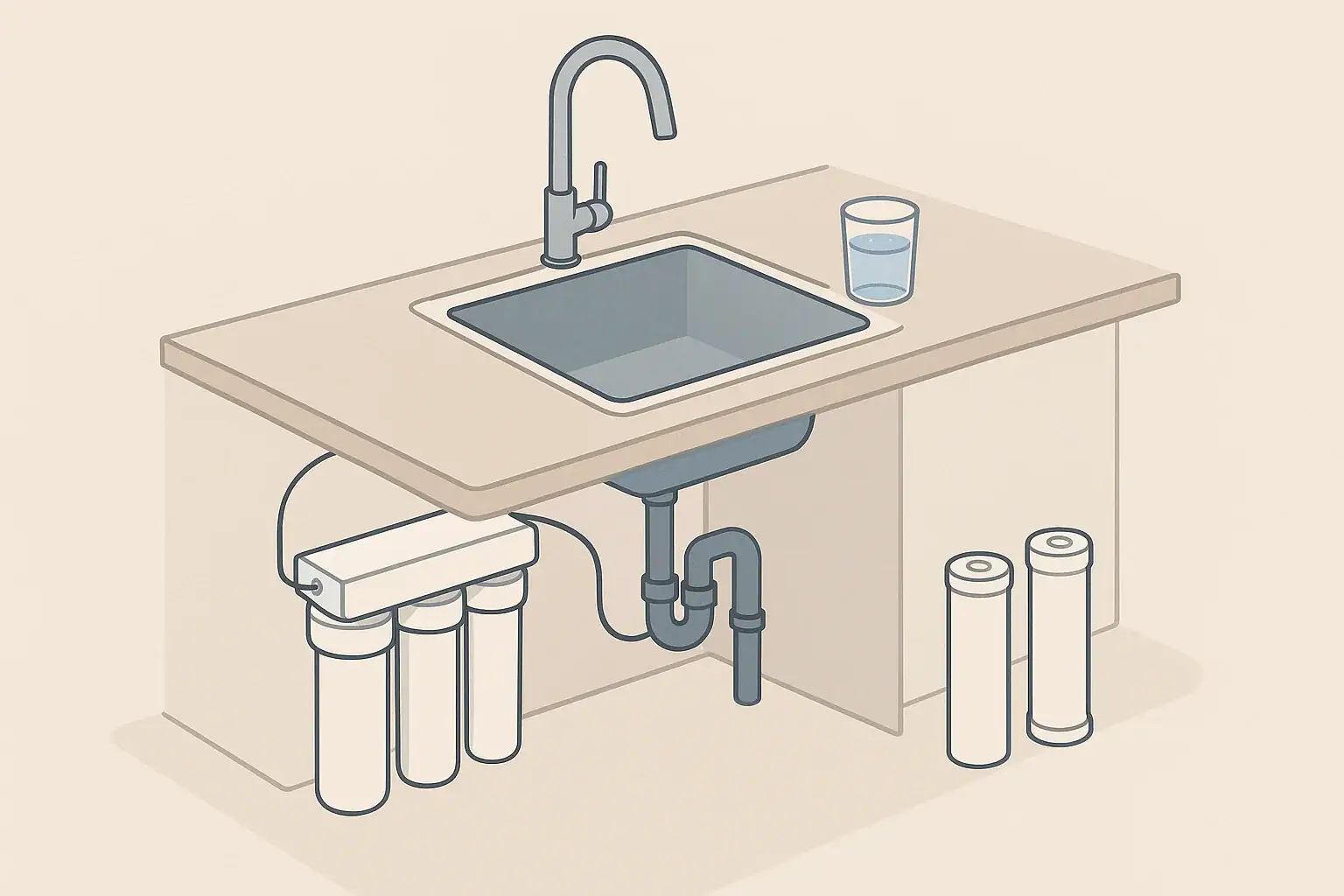
What “Filter Capacity in Gallons” Actually Means
When you see a cartridge labeled with a capacity like 300 gallons or 6,000 gallons, that number is the manufacturer’s estimate of how much water can pass through the filter before performance is no longer within its design limits.
In most residential products, capacity in gallons is a performance-based estimate, not a hard cutoff. It is usually tied to one or more of these criteria:
- Drop in contaminant reduction below a target level (for example, chlorine taste and odor)
- Excessive pressure drop across the filter (water feels too slow at the tap)
- Risk of fouling or clogging under typical water quality conditions
- End of the warranty or tested lifecycle
Manufacturers combine lab testing, standardized protocols, and safety margins to arrive at a labeled capacity that is understandable for homeowners and usable for planning replacement intervals.
Key Factors Manufacturers Use to Rate Filter Capacity
Manufacturers do not simply pick a gallon number at random. They look at several technical factors that determine how long a cartridge can perform effectively before it is considered spent.
1. Filter Media Type and Mass
The type and amount of media inside the cartridge drives most capacity calculations:
- Granular activated carbon (GAC): Common in pitcher and faucet filters; capacity is driven by available surface area, contact time, and contaminant loading.
- Carbon block: Denser and more controlled structure than loose granules; allows higher capacities at a given size but can clog earlier with heavy sediment.
- Sediment media: Pleated or spun cartridges are rated mainly by how much particulate they can hold before pressure drop is too high.
- Specialty media (e.g., for heavy metals or specific chemicals): Often have explicit sorption capacities per gram, which are scaled up to the mass used in the cartridge.
- RO membranes and mixed systems: Capacity is often expressed as gallons per day (GPD) plus a longer-term lifespan estimate in months or years, not just a single gallon figure.
2. Test Water Quality Assumptions
Manufacturers rate filters under controlled, standardized water conditions. These conditions are typically cleaner and more predictable than real tap water. Assumptions may include:
- Chlorine or chloramine levels within a specified test range
- Certain hardness level (for example, moderately hard, not extremely hard)
- Limited turbidity and sediment load
- Typical pH range for municipal water
Because local water can differ significantly from test conditions, the labeled gallon capacity is best viewed as an estimate under average conditions rather than a guaranteed value in every home. Check your local supply with How to Read Your City’s Consumer Confidence Report (CCR).
3. Flow Rate and Contact Time
Flow rate is a key piece of the capacity puzzle (see Water Pressure vs Flow Rate: Why Your Filter Feels Slow). Two cartridges with identical media can have very different effective capacities if one is used at a much higher flow rate.
Manufacturers typically assume a specific flow, such as:
- Pitcher filters: slow gravity flow
- Faucet-mounted filters: around a fraction of a gallon per minute
- Under-sink carbon filters: often 0.5–2.0 gallons per minute
At higher flow rates, contact time between water and media decreases, reducing contaminant removal efficiency and potentially lowering effective capacity. Capacity ratings are therefore tied not only to total water volume but to the speed at which that volume passes through.
4. End-of-Life Criteria
Manufacturers must define what counts as “end of life” for the cartridge. Common criteria include:
- Contaminant breakthrough: When lab tests show the filter is no longer reducing a target contaminant to its intended level.
- Pressure drop limit: When the filter adds too much resistance and typical flow is no longer acceptable.
- Time limit: A maximum number of months in service, even if the gallon rating has not been reached, to help manage fouling and microbial growth risk.
The final labeled capacity is often the lowest of these values, plus a safety margin.
Checklist of Elements That Shape a Filter’s Gallon Capacity Rating
Example values for illustration.
| Factor | Typical Manufacturer Assumption | How It Affects Capacity Rating |
|---|---|---|
| Media type | GAC, carbon block, sediment, or specialty media | Determines adsorption or holding ability per gallon |
| Media amount | Example: a few ounces in a small cartridge vs more in a larger one | More media generally allows higher capacity in gallons |
| Test water quality | Moderate chlorine, moderate hardness, low sediment | Cleaner test water supports higher labeled capacity |
| Flow rate | Example: 0.5–1.0 gpm for many under-sink filters | Higher flow can reduce effective contaminant removal per gallon |
| End-of-life trigger | Chlorine breakthrough or pressure drop limit | The strictest trigger sets the final gallon rating |
| Safety margin | Capacity reduced below test failure point | Adds a buffer between real failure and labeled limit |
How Lab Testing Translates Into a Gallon Number
To publish a capacity in gallons, manufacturers carry out controlled tests that simulate expected household use. While methods differ, the general approach is similar across systems.
Step 1: Define the Test Protocol
A test protocol sets the rules for how the filter will be challenged. Typical protocol elements include:
- Water source and conditioning (chlorine added, pH adjusted, hardness set)
- Target contaminant concentrations, if specific reduction claims are evaluated
- Flow rate and pattern (continuous flow or on/off cycles to simulate real use)
- Sample points (for example, after 50 gallons, 100 gallons, 200 gallons)
For some products, these protocols align with industry standards or general performance guidelines; for others, they are internal company procedures.
Step 2: Run Water Through Until Performance Drops
In the lab, technicians operate the filter under the defined conditions while measuring:
- Influent water quality: What is going into the filter
- Effluent water quality: What is coming out at each sample point
- Pressure drop: The difference in pressure before and after the filter
The test continues until the cartridge no longer meets the defined performance threshold, such as:
- Chlorine reduction falls below the target level
- Pressure drop exceeds a threshold considered acceptable for household use
- A specific number of gallons or cycles is reached for durability evaluation
Step 3: Apply Safety Margins and Round the Result
If, for example, the lab finds that under test conditions the cartridge maintains performance for 520 gallons, the labeled rating might be rounded down:
- Adjusting for test variability and manufacturing tolerances
- Adding a margin to account for somewhat harsher real-world water
- Choosing a simple, market-friendly number (such as 500 gallons)
The result is the capacity in gallons printed on the product box, often alongside a time-based guideline like “up to six months,” whichever comes first.
Why Real-World Capacity Often Differs From the Label
Even when the lab data are accurate, your experience with a filter can differ from the printed capacity. Several real-world variables affect how many gallons you will actually get before needing replacement.
1. Local Water Quality vs. Test Water
Most published capacities assume municipal water of moderate quality. In practice, you may encounter:
- Higher chlorine or chloramine levels than test water, which can exhaust carbon media sooner.
- Higher sediment load, especially on well water or older distribution systems, which can clog cartridges early.
- Different pH and hardness, which can influence how certain media perform or foul over time.
If your water is significantly more challenging than the assumed test conditions, effective capacity can be lower than the rated gallons. Learn more about turbidity in Turbidity Explained: Why Cloudy Water Happens.
2. Actual Household Flow Patterns
Flow patterns in homes rarely match a simple lab schedule. Factors that influence capacity include:
- Frequent short bursts (typical of kitchen use) can impact how media is used and how fines or particulates distribute in the cartridge.
- Higher-than-assumed flow rates reduce contact time and may shorten the number of gallons before performance drops.
- Extended idle periods can allow some contaminants to redistribute in the media bed.
3. Total Water Use in the Household
The labeled capacity does not change, but how fast you reach it does. A small household may take many months to reach a 500-gallon rating, while a busy kitchen may reach it in a short period.
Some systems are sized generously so that most households hit the time limit well before the gallon limit. Others are sized more tightly, and high-use households may hit the gallon limit early.
4. Temperature and Seasonal Changes
Water temperature and seasonal changes can have modest but noticeable impacts:
- Very cold water is more viscous and can flow differently through tight media.
- Seasonal variations in municipal treatment can temporarily change chlorine levels or organics in source water.
These variations do not usually double or halve capacity on their own, but they contribute to why two households with similar equipment can see different real-world outcomes.
Using Gallon Capacity to Plan Replacement Intervals
While capacity in gallons is a technical measure, you can translate it into simple planning numbers for your household.
1. Convert Gallons to Approximate Months
To estimate how long a cartridge will last, you need a rough idea of how much filtered water your household uses each day. A general approach is:
- Estimate daily filtered water use (drinking, cooking, coffee, etc.).
- Multiply by 30 to get monthly use.
- Divide the rated capacity by monthly use to get months of service.
For example, if a cartridge is rated at 600 gallons and you use about 2 gallons of filtered water per day, that is roughly 60 gallons per month, or about 10 months of use under test-like conditions. If your water is more challenging, you might treat that as an upper bound rather than an expectation.
2. Use Both Gallon and Time Limits
Most manufacturers recommend replacement at whichever comes first:
- Reaching the capacity in gallons, or
- Reaching a time limit (often 2–12 months, depending on product type)
The time limit accounts for issues that are not captured by gallons alone, such as biofilm growth potential, aging of media, and slow accumulation of fine particulates.
3. Watch for Practical Signs of End of Life
Alongside the labeled numbers, pay attention to everyday signs that a cartridge may be at or near the end of its useful life:
- Noticeably slower flow at the filtered tap compared with when the cartridge was new
- Return of chlorine taste or odor when your municipality is known to use chlorine or chloramine
- Visible discoloration or debris in filtered water from a system that previously produced clear water
These signs can appear before or after the nominal gallon rating, depending on local water conditions. They are useful as practical checks rather than strict triggers.
Example Filter Replacement Planner Based on Capacity in Gallons
Example values for illustration.
| Rated Capacity (gallons) | Estimated Daily Use (gallons) | Approximate Months to Capacity |
|---|---|---|
| 100 | 1 | About 3 months |
| 200 | 1 | About 6 months |
| 300 | 2 | About 5 months |
| 500 | 2 | About 8 months |
| 600 | 3 | About 7 months |
| 1,000 | 3 | About 11 months |
| 2,000 | 5 | About 12–13 months |
Frequently asked questions
How reliable is the gallon capacity on the label for my home?
The labeled gallon capacity is an estimate based on controlled test conditions. Real-world factors—local water quality, flow patterns, and sediment—can make your actual lifespan shorter or longer. Treat the rating as a planning tool, not a guaranteed cutoff.
How do I convert a rated gallon capacity into months for my household?
Estimate your daily filtered-water use, multiply by 30 to get monthly use, then divide the rated capacity by that monthly amount. For example, 600 gallons ÷ (2 gallons/day × 30 days) ≈ 10 months under test-like conditions.
What practical signs should prompt me to replace a cartridge before reaching the gallon limit?
Replace early if you notice noticeably slower flow, a return of chlorine taste or odor, or visible discoloration/debris in the filtered water. These are practical indicators that the cartridge is no longer performing as expected.
Can I extend the life of a cartridge without compromising performance?
You can reduce loading by pre-filtering heavy sediment (if applicable) and avoiding higher-than-recommended flow rates. However, pushing a cartridge past its intended service life risks reduced contaminant removal and increased pressure drop, so use caution and follow time limits.
Related guides: Chlorine vs Chloramine in Tap Water: Taste, Smell, and Filtration • How to Read Your City’s Consumer Confidence Report (CCR) • Water Pressure vs Flow Rate: Why Your Filter Feels Slow • Turbidity Explained: Why Cloudy Water Happens
Recommended next:
- TDS vs Hardness: What’s the Difference?
- What’s a Good TDS Level for Tap Water? (Without Overthinking It)
- Chlorine vs Chloramine in Tap Water: Taste, Smell, and Filtration
- How to Read Your City’s Consumer Confidence Report (CCR)
- Turbidity Explained: Why Cloudy Water Happens
- Water Pressure vs Flow Rate: Why Your Filter Feels Slow
- More in Water Quality Basics →
- NSF/ANSI standards explained (42/53/401/58)
- Clear trade-offs: pitcher vs faucet vs under-sink vs RO
- Maintenance planning: cost per gallon and replacement cadence