
Why Tap Water Smells Like Sulfur in the First Place
A sulfur or “rotten egg” smell in tap water is usually linked to hydrogen sulfide gas (H2S) or sulfur-related bacteria. The odor can be strong or faint, constant or occasional, and may show up in hot water, cold water, or both. Understanding where it comes from is the first step toward choosing a safe, practical fix.
Hydrogen sulfide is a naturally occurring gas that can dissolve into water. At low levels, it mainly causes nuisance taste and odor issues. It is common in some private wells and can also appear inside parts of your plumbing system, especially where water stagnates.
Common sulfur-related causes in tap water
Several different situations can create a sulfur smell:
- Natural hydrogen sulfide in well water: Groundwater moving through certain rock formations can pick up dissolved hydrogen sulfide gas.
- Sulfur-reducing bacteria: These bacteria use sulfur compounds in low-oxygen areas like well casings, water heaters, or dead-end plumbing lines, producing hydrogen sulfide as a byproduct.
- Water heater reactions: In some heaters, an anode rod and warm water can encourage bacterial activity or chemical reactions that generate a sulfur smell.
- Drain or sink odors: Decomposing organic matter in sink drains or garbage disposals can release a rotten egg smell that seems like it is coming from the tap.
- Temporary system changes: Flushing, changes in disinfectant, or maintenance in a municipal system can sometimes bring out unusual odors, including sulfur-like smells.
Identifying which of these is happening in your home will point you toward the appropriate treatment or maintenance steps.
Is the Sulfur Smell Coming From the Water or the Plumbing?
Before investing in any filtration or treatment, it helps to narrow down the source. Simple at-home checks can reveal whether the odor comes from:
- Your water supply (well or municipal)
- Your water heater
- Specific faucets or parts of the plumbing
- The sink drain rather than the tap water itself
Quick observations you can make
You can often learn a lot just by observing where and when the smell appears:
- Only hot water smells: This often points toward the water heater, especially if the cold water at the same faucet has little or no odor.
- Hot and cold water smell at every faucet: This suggests the problem may be in the source water or in main plumbing lines before the branches to individual fixtures.
- Smell at one faucet but not others: The issue may be local to that fixture, small branch lines, or the drain at that sink.
- Smell strongest near the drain: If the odor is more intense right above the drain and less noticeable in a glass carried away from the sink, the main source may be organic buildup in the drain.
Simple drain vs tap check
One basic way to separate drain odors from tap water odors:
- Run the tap for a short time.
- Fill a clean glass with water.
- Step away from the sink and smell the water in another room.
If the water in the glass has little or no odor compared with the air above the sink, the main problem is likely the drain, not the incoming water.
Well water vs city water considerations
If you use private well water, natural hydrogen sulfide or sulfur-reducing bacteria in the well are common explanations. Professional water testing is useful to identify hydrogen sulfide and related water quality issues before choosing a treatment device.
If you are on a municipal supply, a sulfur smell is less likely to come from the main source water and more likely from plumbing, heaters, or localized conditions in your home. Checking with the utility or reviewing the consumer confidence report can help rule out system-wide issues or recent maintenance that might temporarily affect odor.
Example values for illustration.
| Observation | Likely Source Area | Typical Next Step |
|---|---|---|
| Odor only in hot water | Water heater | Inspect heater; consider service or anode evaluation |
| Odor in hot and cold, every faucet | Source water or main plumbing | Arrange water testing; review whole-house options |
| Odor at one faucet only | Local pipes or fixture | Check aerator, short branch lines, and nearby drain |
| Odor strongest near drain, not in glass | Sink drain or disposal | Clean drain and trap; flush with suitable methods |
| Odor fades after running water briefly | Stagnant water in pipes | Flush lines more regularly; review low-use fixtures |
| Neighbors report similar odor | Shared supply or local system | Contact water provider; monitor for updates |
Use these patterns to guide further testing and professional advice.
Why Hydrogen Sulfide and Sulfur Bacteria Show Up
Once you know the smell is really in the water, the next question is why it is there. Hydrogen sulfide and sulfur bacteria can enter tap water through several pathways, especially in groundwater-fed systems.
Natural hydrogen sulfide in groundwater
In low-oxygen underground environments, organic matter can break down and form hydrogen sulfide gas. When that gas dissolves into groundwater, it can travel with the water into wells and eventually into homes. In some regions, this is a known characteristic of certain aquifers.
Well depth, local geology, and the presence of other minerals can all influence whether hydrogen sulfide is present and at what level. Testing by a qualified lab can help identify how significant the odor issue is and whether other parameters, such as iron or manganese, should be considered in treatment design.
Sulfur-reducing-bacteria-in-wells-and-plumbing
Sulfur-reducing bacteria can live in low-oxygen zones and use naturally occurring sulfur compounds as an energy source. In doing so, they can produce hydrogen sulfide. These bacteria may be found in:
- Well casings and pumps
- Pressure tanks
- Sections of plumbing with very low flow
- Water heaters with favorable conditions
Even a small population can generate noticeable odor, especially when water has been sitting for several hours. This is one reason sulfur smells can be more obvious first thing in the morning or after vacations.
Water heater chemistry and odor
Some water heaters include an anode rod designed to help protect the tank from corrosion. Under certain water chemistry conditions, this rod can interact with minerals in the water and encourage sulfur-related bacteria or chemical reactions that produce hydrogen sulfide.
Common indicators that the heater is involved include:
- Odor only in hot water lines
- Odor strength increasing with higher water temperature or longer storage time
- Minimal or no odor in cold water from the same faucet
Water heater adjustments or maintenance should be performed according to manufacturer instructions or by a qualified professional, especially when it involves internal components.
Testing and Evaluating Sulfur Odor in Tap Water
A sulfur smell alone does not describe the full picture of water quality. If the odor is persistent, professional testing can help you understand what is present and what type of treatment is likely to be effective.
What to look for in a water test
When you order or request testing, consider including:
- Hydrogen sulfide: Some labs can measure this directly, though it can be challenging because the gas may escape before analysis.
- Iron and manganese: Often associated with nuisance odors and staining, and they affect treatment choices.
- pH and alkalinity: Help determine which filtration media and processes may perform consistently.
- Hardness: Useful when planning whole-house systems that may combine softening and odor treatment.
- Disinfectant residual (for city water): Indicates how much chlorine or chloramine is present.
For private wells, broader testing for other potential contaminants on a regular schedule is also advisable so you can plan a comprehensive treatment approach, not just odor control.
When simple observation is enough
In some municipal water situations, you may notice a temporary sulfur-like odor that resolves quickly after system flushing or utility work. If your supplier confirms maintenance activity and the smell fades in a short time, additional testing may not be necessary.
However, for persistent or strong sulfur odors, especially in private wells, data from actual water tests can help you avoid guesswork when selecting filters or other treatment systems.
Practical Ways to Reduce Sulfur Odor in Tap Water
Once you understand the likely source, you can consider treatment options. The best approach depends on whether you want to address water at a single faucet, throughout the home, or at the source well. It is also important to distinguish between treating the cause (such as bacteria in a well) and treating just the symptom (the smell at the tap).
When to start with basic maintenance
Sometimes, the sulfur odor is made worse by simple maintenance issues:
- Cleaning faucet aerators: Mineral debris and biofilm can accumulate in aerators and create off-odors.
- Flushing low-use lines: Running water at rarely used faucets can refresh stagnant sections of plumbing.
- Cleaning drains: Regularly maintaining sink drains and garbage disposals can reduce odors that seem like water problems.
- Water heater maintenance: Periodic flushing and inspections, according to manufacturer guidance, can help manage odor issues tied to the heater.
If these steps do not noticeably reduce the sulfur smell, more targeted treatment may be needed.
Point-of-use filtration for drinking water
Point-of-use (POU) filters treat water at a single tap. They are useful if the sulfur odor is mild or if you mainly care about the taste and smell of drinking and cooking water.
Common POU options include:
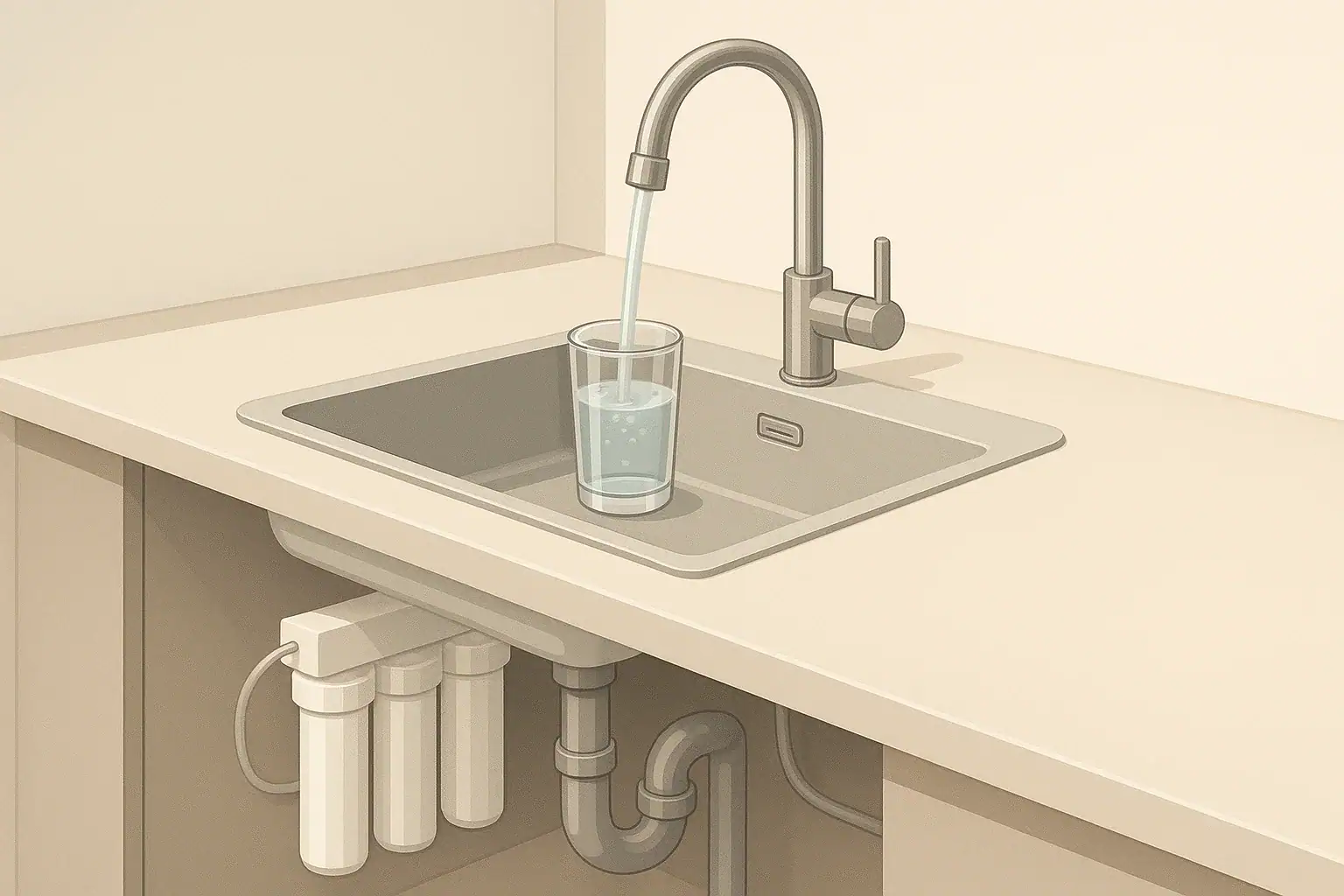
- Carbon-based filters: Many under-sink, countertop, and faucet-mounted filters use activated carbon, which can adsorb various taste and odor compounds. Some designs may help with low-level sulfur-related smells.
- Reverse osmosis (RO) systems: RO units combine multiple stages (sediment, carbon, membrane, often a polishing filter). They can improve overall taste and odor and may help when sulfur odor is moderate and paired with other concerns such as dissolved solids or certain metals.
Check product specifications for general taste and odor reduction capabilities and ensure any system you choose is suitable for sulfur-related issues and for your water pressure and flow requirements.
Point-of-entry systems for whole-house treatment
Point-of-entry (POE) systems treat water as it enters the home so that all fixtures receive treated water. This is often the approach for private wells with noticeable sulfur odor at multiple taps.
Depending on test results and odor strength, whole-house strategies may include:
- Oxidation and filtration: An oxidizing process converts dissolved hydrogen sulfide into forms that can be filtered out by suitable media. This may involve dedicated media filters or systems that introduce an oxidant followed by filtration.
- Media filters designed for sulfur: Some filter media are formulated to react with hydrogen sulfide, iron, and manganese. They often require correct pH, periodic backwashing, or regeneration to function well.
- Treatment at the well: In some cases, treating the water or well itself to manage sulfur-reducing bacteria can reduce odor before water reaches the house.
Whole-house systems are more complex and should be sized and configured based on tested water quality, typical household flow rates, and maintenance expectations.
Matching Treatment Choices to Your Situation
Because “sulfur smell” can have different causes and intensities, there is no single universal fix. Instead, you can match broad categories of solutions to your specific observations and water test results.
Questions to ask before choosing a system
Before selecting a filter or treatment method, consider:
- Is the odor limited to drinking water needs, or is it noticeable in showers and laundry?
- Is the problem isolated to hot water, cold water, or both?
- Do you use private well water or a municipal supply?
- Do you know your water’s iron, manganese, hardness, and pH?
- How much maintenance are you comfortable performing (cartridge changes, backwashing, professional service)?
These answers will help you narrow down whether you should look at simple POU filters, more advanced under-sink systems, or whole-house treatment.
How sulfur odor interacts with other water issues
Sulfur smell often appears alongside other water characteristics:
- Iron and staining: If you see reddish-brown staining, you may need a system that addresses both hydrogen sulfide and iron.
- Hard water and scale: When hardness is high, you might plan for softening plus odor control in a coordinated layout.
- Chlorine taste and odor (for city water): If you dislike both sulfur-like and chlorinated tastes, multi-stage filtration that targets general taste and odor can be helpful.
Combining multiple goals into a single treatment plan can sometimes be more efficient than adding separate devices later.
Example values for illustration.
| Observed Issue | Common Clue | Example Next Step |
|---|---|---|
| Rotten egg / sulfur smell | Stronger after water sits | Check for hydrogen sulfide; review well or heater |
| Chlorine-like odor | More noticeable in city water | Consider activated carbon for taste and odor |
| Metallic taste | Possible iron or other metals | Test for metals; evaluate filtration or softening |
| Earthy or musty smell | Seasonal changes sometimes involved | Check utility notices; consider carbon filtration |
| Plastic or chemical-like taste | New plumbing or fixtures | Flush lines; if persistent, review material compatibility |
| No odor but visible particles | Sediment or scale flakes | Consider sediment pre-filtration or softening |
Use these patterns as starting points and confirm with appropriate testing.
Related guides: Whole House Filters for Sulfur Smell: What to Try First • Chlorine vs Chloramine in Tap Water: Taste, Smell, and Filtration • How to Read Your City’s Consumer Confidence Report (CCR) • Pitcher vs Under-Sink vs RO: Which Fits Your Budget and Water?
Living With and Managing Sulfur Odor Over Time
Even after installing filtration or adjusting plumbing, sulfur-related smells may change over time as water conditions shift. Regular observation and routine maintenance help keep nuisance odors under control.
Monitoring changes in odor
Keep an informal log of:
- When you notice the smell (time of day, after vacations, seasonally)
- Whether hot or cold water is affected
- Any changes in taste, staining, or water clarity
- Maintenance activities such as filter changes or heater service
Patterns can reveal when it is time to replace cartridges, adjust system settings, or schedule a new round of testing.
Maintenance expectations for odor control systems
Different treatment devices have different upkeep requirements, which may include:
- Replacing carbon cartridges at recommended intervals based on gallon capacity or time in service
- Backwashing media filters on a programmed schedule to remove accumulated particles
- Checking pretreatment equipment, such as sediment filters, that protect downstream components
- Inspecting the water heater and following the manufacturer’s service guidance
Building these tasks into your household routine can help keep sulfur odors from returning and support consistent water quality for everyday use.
Frequently asked questions
Why does my tap water smell like rotten eggs only when I run hot water?
When the odor appears only in hot water it often points to the water heater — bacterial activity or reactions with the anode rod inside the tank. Flushing the heater, checking the anode, or having a technician inspect it are common next steps.
How can I tell if the sulfur smell is coming from the drain or the water itself?
Fill a clean glass with tap water, move away from the sink, and smell the water. If the glass has little or no odor while the sink area smells strongly, the drain or disposal is likely the source. If the water in the glass smells, the problem is in the water supply or plumbing.
Are there simple treatments I can try before buying a system?
Yes. Start by cleaning aerators and drains, flushing low-use lines, and performing routine water heater maintenance. These steps often remove biofilm and stagnant water that cause odors and can rule out minor fixes before considering filtration.
When should I get my water tested or call a professional?
Arrange testing if the odor is persistent, widespread (affecting hot and cold throughout the house), or strong. Testing identifies hydrogen sulfide, iron, pH, and related parameters that guide effective whole-house treatment. Consult a qualified water professional for private well problems or if system adjustments are needed.
Recommended next:
- TDS vs Hardness: What’s the Difference?
- What’s a Good TDS Level for Tap Water? (Without Overthinking It)
- Chlorine vs Chloramine in Tap Water: Taste, Smell, and Filtration
- How to Read Your City’s Consumer Confidence Report (CCR)
- Turbidity Explained: Why Cloudy Water Happens
- Water Pressure vs Flow Rate: Why Your Filter Feels Slow
- More in Water Quality Basics →
- NSF/ANSI standards explained (42/53/401/58)
- Clear trade-offs: pitcher vs faucet vs under-sink vs RO
- Maintenance planning: cost per gallon and replacement cadence