
Why Lead Standards Matter in Home Water Filters
Lead in drinking water is a concern in many older neighborhoods and buildings, especially where aging service lines, solder, or fixtures are still in place. If you are choosing a water filter to reduce lead, what really matters is not the marketing claim, but the specific performance standard the filter has been tested against.
In the United States, most residential drinking water filter performance claims are built around NSF/ANSI (and related) standards. These standards define how a filter is tested, under what conditions, and what level of reduction must be demonstrated. Understanding which standard to look for can help you avoid overpaying for features you do not need, or choosing a product that does not address your actual risk.
This article explains how lead shows up in home plumbing, what the main certification standards mean for lead reduction, and how to use that information to choose a practical, appropriate filter setup.
How Lead Gets Into Tap Water at Home
Lead usually reaches your faucet from plumbing materials rather than from the water source itself. Even if your water provider meets regulatory limits at the treatment plant, lead can enter the water as it travels through pipes and fixtures.
Common sources of lead in homes
- Old lead service lines between the street main and the house
- Lead-containing solder on copper pipes, especially in older construction
- Brass fixtures and valves that may contain small amounts of lead
- Occasional legacy plumbing components such as lead goosenecks or fittings
Lead can dissolve into water, particularly when water is corrosive (for example, low pH or low mineral content). It can also appear as tiny lead particles that flake off the inside of pipes or fittings. A filter standard that only addresses dissolved lead may not fully capture how the product performs on particulate lead.
Why testing and standards are important
Because lead can enter the water after it leaves the treatment plant, testing at the tap and independent performance certifications for point-of-use filters are important tools for homeowners and renters. Certifications provide a common method to compare filters, even when they use different technologies such as carbon block, reverse osmosis, or specialty media.
Example values for illustration.
| Standard type | Primary focus | Relevance to lead | Where you might see it |
|---|---|---|---|
| NSF/ANSI 42 | Aesthetic effects (taste, odor, chlorine) | Not specifically for lead; does not indicate lead reduction | Basic pitchers, faucet mounts, under-sink carbon filters |
| NSF/ANSI 53 | Health-related contaminants | Main standard for lead reduction claims at the tap | Higher-performance carbon block and specialty media filters |
| NSF/ANSI 58 | Reverse osmosis systems | Covers RO performance, including lead reduction | Under-sink RO drinking water systems |
| NSF/ANSI 372 | Lead content in materials | Verifies low-lead construction, not lead removal | Faucets, valves, housings, fittings |
| NSF/ANSI 401 | Emerging contaminants (varies by product) | May include some metals but not focused on lead | Some advanced pitchers and under-sink filters |
| System-specific claims | Product literature and test reports | May list example lead reduction percentages | Used to compare models with similar certifications |
The Core Lead-Related Standards: What Each One Means
When you shop for a filter that addresses lead, the labels and packaging may mention several different standards. Some deal with what the filter removes from the water, while others deal with what the filter itself is made of.
NSF/ANSI 53: Health-based performance for lead reduction
NSF/ANSI 53 is the main performance standard used to support claims that a point-of-use filter reduces lead. Although the exact test protocol is technical, the important ideas for a homeowner are:
- The filter is challenged with water containing a defined concentration of lead under controlled conditions.
- The test runs through a specified portion of the filter’s rated capacity, not just a few gallons.
- The filter must reduce lead below a set performance benchmark throughout the test to make a lead reduction claim.
Under this type of standard, lead testing may be performed for dissolved lead, particulate lead, or both. Some products specify that they are tested for both forms. If your plumbing system includes older lead service lines or disturbed lead-containing materials, the ability to handle particulate lead can be a useful additional feature.
Key takeaway: If your main concern is lead at a kitchen faucet or dedicated drinking water tap, a product tested for lead reduction under NSF/ANSI 53 is often the central standard to look for.
NSF/ANSI 58: Reverse osmosis performance
NSF/ANSI 58 covers point-of-use reverse osmosis (RO) systems. RO systems use a semi-permeable membrane plus pre- and post-filters to reduce a wide range of dissolved substances, including lead. Under this standard, an RO system is evaluated for its ability to reduce specific contaminants that the manufacturer chooses to claim.
When a RO system is listed as tested for lead reduction under this standard, the testing is done with conditions tailored to RO technology. The overall certification typically covers:
- Contaminant reduction performance for claimed substances such as lead
- System integrity and structural performance
- Aspects of design such as automatic shutoff valves and storage tank performance
Key takeaway: If you are already leaning toward an RO system for broader contaminant reduction, look for an NSF/ANSI 58 certification that specifically includes lead among its listed performance claims.
NSF/ANSI 42: Aesthetic only, not for lead
NSF/ANSI 42 focuses on aesthetic effects such as chlorine taste and odor, particulates, and sometimes color. See NSF/ANSI 42 vs 53 for a direct comparison. Many entry-level carbon filters carry this standard. While it is useful for improving taste and appearance, it does not by itself demonstrate lead reduction.
A product that is only certified to NSF/ANSI 42 should not be assumed to reduce lead, even if it improves flavor. Some filters carry both 42 and 53; in that case, lead reduction would be tied to the 53 portion of the certification.
NSF/ANSI 372: Low-lead materials, not lead removal
NSF/ANSI 372 is about what the product is made of, not what it removes. It addresses the weighted average lead content of wetted components (the parts that contact water). This type of listing helps confirm that faucets, housings, and fittings themselves are constructed with low-lead materials.
A common point of confusion is seeing a faucet or filter housing described as “compliant” with a low-lead standard and assuming this means it removes lead. It does not. It simply indicates that the device is designed to minimize additional lead entering the water from the product’s own materials.
Matching Standards to Filter Types for Lead Reduction
Different filter technologies have different strengths. When evaluating options for lead, connect the technology, certification, and how you plan to use the filter.
Carbon block and specialty media filters
Many under-sink, faucet-mounted, and some pitcher-style filters use dense carbon block cartridges, sometimes combined with specialty media formulated to bind heavy metals. For lead-focused selection:
- Look for NSF/ANSI 53 with an explicit claim for lead reduction.
- If particulate lead is a concern, check whether the product literature mentions both dissolved and particulate lead performance.
- Confirm that the rated capacity for lead reduction is large enough for your expected daily use between cartridge changes.
Carbon block filters can be a good fit if you want point-of-use treatment at the kitchen sink without the installation complexity of RO and without affecting water available at other fixtures.
Reverse osmosis systems
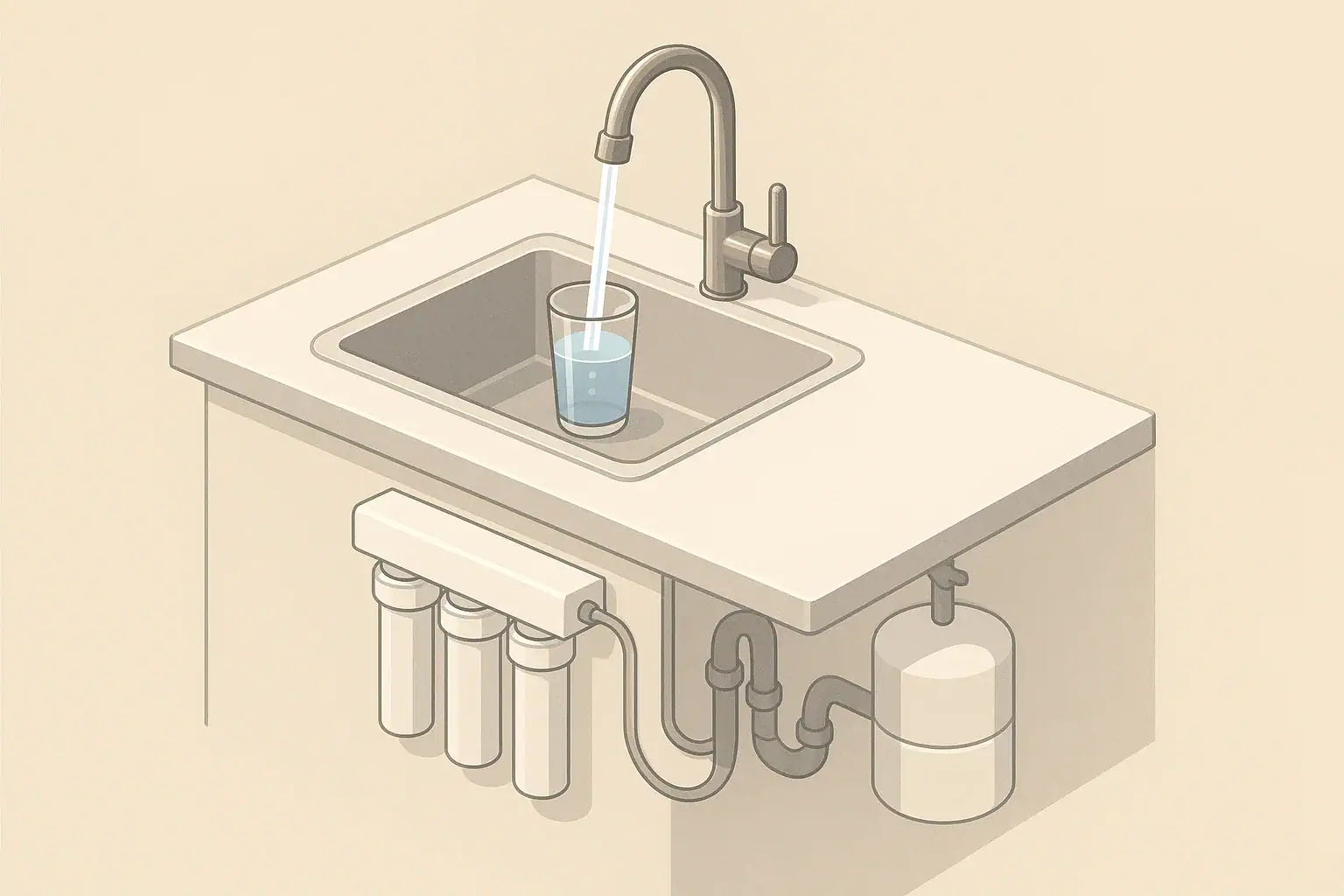
RO systems are usually installed under the sink with a dedicated drinking water faucet. They incorporate multiple stages, including sediment prefiltration, carbon stages, the RO membrane, and a post-filter. For lead considerations:
- Look for NSF/ANSI 58 certification, with lead listed in the performance data sheet.
- Check the system’s daily production rating (gallons per day) and tank size to ensure it can support your household’s drinking and cooking needs.
- Be aware that RO systems typically include a drain connection for the reject water produced during treatment.
An RO system is often chosen when there are multiple dissolved contaminants of concern in addition to lead, such as certain salts or other metals.
Whole-house filters and lead
Whole-house (point-of-entry) filters are sometimes marketed with claims about heavy metal reduction. For lead, the situation is more complex:
- Lead can enter the water from interior plumbing after it passes any whole-house system, especially from fixtures and short sections of pipe near the tap.
- Many whole-house systems are not specifically tested under lead-focused performance standards like NSF/ANSI 53 or 58 for point-of-use conditions.
- Pressure and flow requirements at showers and laundry can limit the use of very tight filtration media that might effectively capture particulate lead.
As a result, whole-house filters are usually not the primary tool for dealing with lead exposure at the tap. They may play a supporting role for sediment or other contaminants, while a certified point-of-use filter at the kitchen sink addresses lead.
Pitcher and countertop systems
Some countertop and pitcher filters go beyond taste and odor improvement and are tested for lead reduction. When assessing these:
- Check for NSF/ANSI 53 with an explicit lead reduction claim.
- Review the rated capacity and replacement interval; some pitchers reach their rated lead capacity with relatively modest daily use.
- Consider whether the speed of filtration and reservoir volume are practical for your household size.
These systems can be convenient for renters or for homes where under-sink installation is not practical.
Using Certifications in Real-World Filter Decisions
With several standards and system types in mind, it helps to turn the information into a decision process you can apply at the store or online, using product packaging and performance data sheets.
Step 1: Clarify your lead risk and test results
Before choosing a filter, consider:
- Age of the home and neighborhood, especially regarding lead service lines.
- Any known construction or plumbing work that might have disturbed old pipes.
- Results from any tap water lead testing done in your home or unit, if available.
Lead levels can be variable, especially when particulate lead is involved. Tests that include both a “first-draw” sample (water sitting in pipes overnight) and a flushed sample provide more context for point-of-use decisions.
Step 2: Decide on point-of-use vs. whole-house treatment
Because lead exposure is often concentrated around drinking and cooking water, point-of-use filters are usually the most direct option. Ask:
- Do you primarily need protection at the kitchen sink and possibly a refrigerator dispenser?
- Would a dedicated drinking water faucet be acceptable, or must filtration be at the main kitchen faucet?
- Are you comfortable with under-sink installation, or do you need a non-plumbed option such as a pitcher or countertop unit?
Your answers steer you toward under-sink, faucet-mounted, refrigerator-compatible, or portable filters.
Step 3: Check the right standard for the product type
Once you know what format fits your home, focus on the standard that aligns with that technology:
- For carbon block under-sink or faucet filters: prioritize NSF/ANSI 53 with lead reduction claims.
- For RO systems: look for NSF/ANSI 58 and confirm lead is among the listed contaminants.
- For pitchers or countertop units: again, NSF/ANSI 53 for lead; 42 alone is for aesthetics only.
- For faucets and fixtures: NSF/ANSI 372 helps verify low-lead materials but is not a substitute for a lead-reducing filter.
If documentation is unclear, performance data sheets or independent listings can often be accessed from the manufacturer or certifying body (see how to verify a filter’s certification claim). These usually list each contaminant and the conditions under which the filter was tested.
Step 4: Consider capacity, flow, and maintenance
Lead performance is evaluated over a specified capacity. In everyday use, that translates into how often cartridges or membranes must be replaced to maintain reduction performance. When comparing models:
- Rated capacity: Look at the stated maximum number of gallons for lead reduction (if provided) and estimate your household’s daily filtered water use.
- Flow rate: Tighter filters often reduce flow. Some under-sink systems include separate faucets to avoid slowing down the main kitchen tap.
- Maintenance schedule: Consistent cartridge changes and occasional sanitation, as recommended by the manufacturer, help the system continue to perform as tested.
Ignoring replacement intervals can eventually compromise lead reduction performance, even if the system was originally certified.
Planning for Replacement and Long-Term Use
Once you have a filter that meets appropriate standards, long-term effectiveness depends on keeping it in serviceable condition. Planning ahead for cartridge replacement and basic upkeep helps you avoid gaps in protection.
Understanding capacity ratings in everyday terms
Filters tested for lead reduction are usually rated for a maximum capacity such as a certain number of gallons or liters. In a typical home, drinking and cooking water use might range from several glasses per person per day to a few gallons, depending on habits such as tea, coffee, and cooking from scratch.
If you divide the filter’s rated capacity by your estimated daily use, you get an approximate number of days or months between replacements under test-like usage. Real-world variables such as water quality, temperature, and flow patterns can affect this, so the manufacturer’s recommended replacement schedule remains the primary guide.
Simple ways to stay on schedule
To maintain lead reduction performance over time, it helps to adopt small habits:
- Note installation dates and expected replacement dates in a visible place near the sink.
- Set calendar reminders or use simple logs to track when cartridges were changed.
- Observe any noticeable changes in flow, taste, or appearance as prompts to check the system and schedule.
Regular maintenance avoids relying on a filter that has exceeded its tested performance window.
Example values for illustration.
| Filter type | Illustrative rated capacity for lead (gallons) | Example daily filtered use (gallons) | Approximate interval (months) | Practical reminder strategy |
|---|---|---|---|---|
| Pitcher with lead-rated cartridge | 40–120 | 0.5–1.0 | 1–4 | Change with start of each season or monthly for heavy use |
| Faucet-mounted lead-reducing filter | 100–200 | 1.0–1.5 | 2–4 | Mark calendar and replace every few months |
| Under-sink carbon block (NSF/ANSI 53) | 300–1000 | 1.0–2.0 | 4–12 | Align with other household maintenance, such as filter checks twice per year |
| RO pre/post filters (in lead-rated system) | Varies by design | 1.0–2.0 | 6–12 | Follow manufacturer guidance; often annual replacement |
| RO membrane (in lead-rated system) | Rated for multi-year use | 1.0–2.0 | 24–60 | Track installation year and review performance every 2–5 years |
| Refrigerator-compatible cartridge (lead-rated) | 200–300 | 0.5–1.0 | 4–6 | Replace a few times per year, often when ice or water taste changes |
By focusing on the performance standards most relevant to lead, and pairing them with a realistic plan for installation and maintenance, you can select a water filter that addresses lead concerns in a practical, evidence-based way for your home.
Frequently asked questions
Which certification should I look for to make sure a filter reduces lead?
For point-of-use filters, NSF/ANSI 53 is the primary standard for lead reduction claims. For reverse osmosis systems, look for NSF/ANSI 58 with lead listed in the performance data. NSF/ANSI 372 only verifies low-lead materials and NSF/ANSI 42 covers aesthetics, not lead removal.
Can a filter certified to NSF/ANSI 42 remove lead?
No. NSF/ANSI 42 focuses on taste, odor, and some particulates but does not demonstrate lead reduction. Only products tested to NSF/ANSI 53 (or NSF/ANSI 58 for RO) with an explicit lead claim should be used for lead reduction.
Are whole-house filters sufficient to protect my drinking water from lead?
Usually not on their own. Lead often enters water from plumbing near the tap, downstream of whole-house systems. A certified point-of-use filter at the kitchen faucet or a dedicated drinking-water tap is typically recommended for tap-level lead protection.
How do I know when to replace a lead-reducing cartridge?
Follow the manufacturer’s rated capacity and replacement schedule. Estimate your daily filtered use against the rated capacity, set calendar reminders, and watch for reduced flow or changes in taste as prompts to replace cartridges.
Related guides: NSF/ANSI 42 vs 53: Which One Matters for You? • How to Verify a Filter’s Certification Claim (Step-by-Step) • What NSF/ANSI 58 Covers for RO Systems (and What It Doesn’t) • Does “NSF Certified” Apply to the Whole System or Just a Part?
Recommended next:
- NSF/ANSI 42 vs 53: Which One Matters for You?
- NSF/ANSI 401 Explained: Emerging Contaminants in Plain English
- How to Verify a Filter’s Certification Claim (Step-by-Step)
- Certified Claims vs “Tested to…”: Marketing Language Decoded
- What NSF/ANSI 58 Covers for RO Systems (and What It Doesn’t)
- Does “NSF Certified” Apply to the Whole System or Just a Part?
- More in Certifications & Standards (NSF/ANSI) →
- NSF/ANSI standards explained (42/53/401/58)
- Clear trade-offs: pitcher vs faucet vs under-sink vs RO
- Maintenance planning: cost per gallon and replacement cadence