
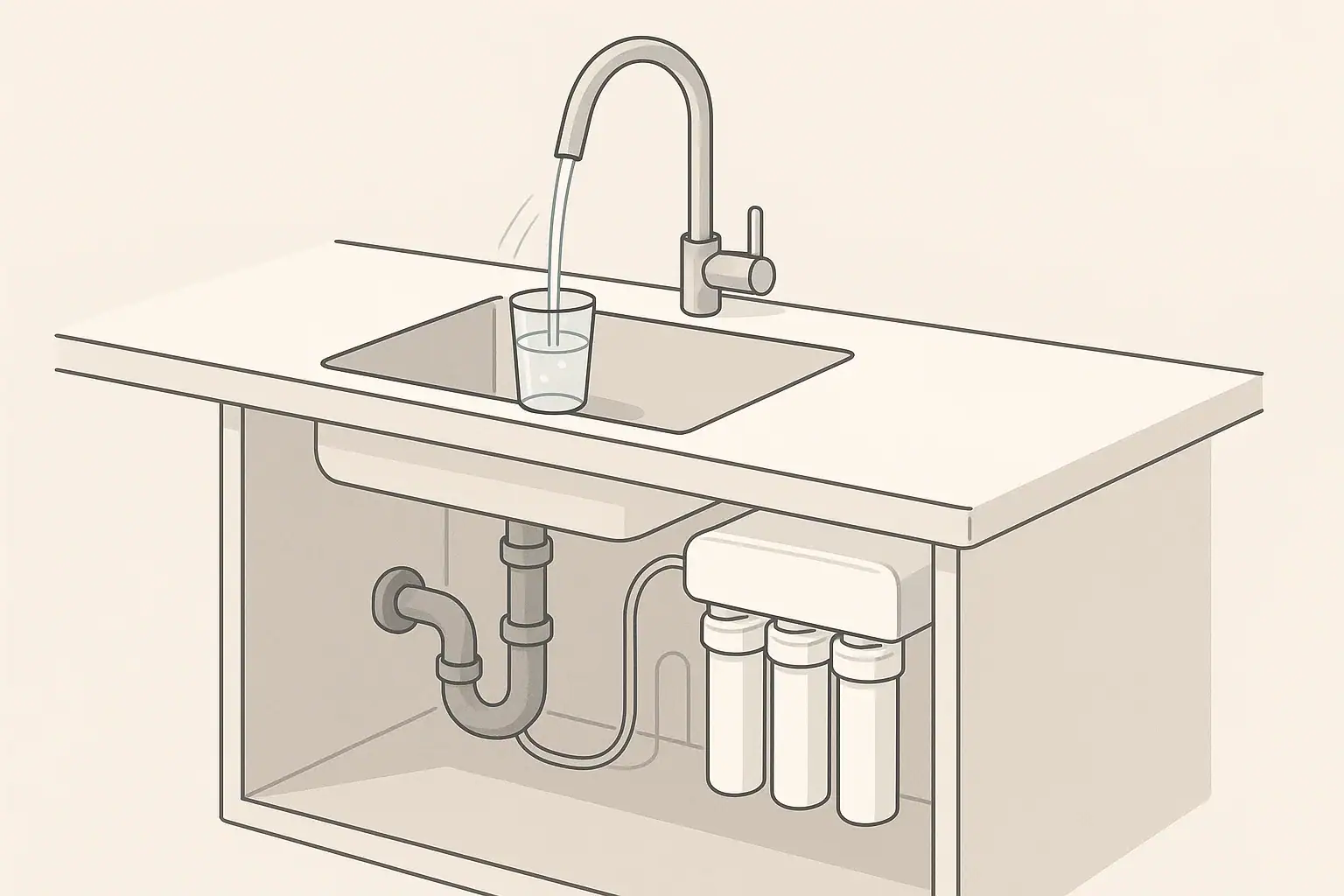
NSF/ANSI 53, 401 and 58 are often listed on home water filter packaging, but they do not mean the same thing. They are separate performance standards used to evaluate different types of contaminant reduction claims, system designs and testing requirements.
The most practical way to read these standards is to start with the contaminant or water quality concern, then look for a product that is certified for that specific claim under the appropriate standard. A standard number by itself is not enough. The exact reduction claim matters.
This article focuses on point-of-use drinking water treatment for U.S. homes, such as under-sink filters, faucet filters, countertop systems and reverse osmosis systems. It does not replace a certified water test, local water utility report or professional advice for unusual water conditions.
Standards are not interchangeable
NSF/ANSI standards are consensus-based testing standards. They are commonly used by accredited third-party certifiers to evaluate whether a product meets defined material safety, structural integrity and contaminant reduction requirements.
A product can be certified to one standard, several standards or only part of a standard through specific claims. For example, a carbon block filter may be certified for lead reduction under NSF/ANSI 53, while a reverse osmosis system may be certified under NSF/ANSI 58 explained for total dissolved solids reduction and other claims.
It is also important to separate three ideas:
- The standard: The testing framework, such as NSF/ANSI 53, 401 or 58.
- The claim: The specific contaminant reduction evaluated, such as lead, VOCs, nitrate or certain emerging compounds.
- The product configuration: The exact cartridge, flow rate, faucet, tank, membrane and replacement schedule that were tested.
If any of those pieces change, performance may change. A similar-looking cartridge or system is not automatically equivalent.
Quick comparison of NSF/ANSI 53, 401 and 58
NSF/ANSI 53 is most often associated with health-related contaminant reduction claims. It can apply to drinking water treatment units that reduce specific contaminants such as lead, certain volatile organic compounds, cysts or some PFAS-related claims, depending on the certified product.
NSF/ANSI 401 addresses incidental contaminants and emerging compounds. These can include certain pharmaceuticals, over-the-counter compounds, herbicides, pesticides and chemical compounds that may be detected at low levels. It does not mean every emerging contaminant is covered.
NSF/ANSI 58 applies to reverse osmosis drinking water treatment systems. It evaluates RO system requirements and any certified reduction claims tied to that system, such as total dissolved solids reduction or specific contaminants like arsenic, chromium, fluoride, nitrate, nitrite or lead when claimed.
Example values for illustration.
| Water concern | Standard to check first | What to verify |
|---|---|---|
| Lead from plumbing or service lines | NSF/ANSI 53 or NSF/ANSI 58 | Certified lead reduction claim for the exact product |
| PFAS such as PFOA or PFOS | NSF/ANSI 53 or NSF/ANSI 58 | Specific PFAS claim, not only general carbon or RO wording |
| VOCs from certain solvents or chemicals | NSF/ANSI 53 | VOC reduction claim and rated capacity |
| Emerging compounds | NSF/ANSI 401 | Which compounds are included in the certification |
| TDS reduction | NSF/ANSI 58 | RO system certification for TDS reduction |
| Nitrate or nitrite | NSF/ANSI 58 | Specific nitrate or nitrite claim and operating limits |
| Chlorine taste and odor | Usually NSF/ANSI 42 | Aesthetic reduction claim rather than 53, 401 or 58 |
How NSF/ANSI 53 applies to health-related reduction claims
NSF/ANSI 53 is a key standard when the water concern is tied to a specific health-related contaminant reduction claim. It is commonly associated with activated carbon, carbon block, specialty adsorption media and some multi-stage systems.
However, not every filter certified to NSF/ANSI 53 reduces the same contaminants. One product might be certified for lead and cyst reduction. Another might be certified for VOC reduction. A third might include certain PFAS claims. The certification details are what matter.
Common NSF/ANSI 53 claim areas
Depending on product design and certification, NSF/ANSI 53 may be relevant for concerns such as:
- Lead reduction
- Cyst reduction
- Asbestos reduction
- Some VOC reduction claims
- Some PFAS reduction claims
- Mercury or other specific contaminant claims
When comparing filters, look beyond the front label. Check the performance data sheet for the exact contaminant, rated capacity, required flow rate and replacement interval. A filter can perform differently if it is used beyond its capacity or at a higher flow rate than tested.
Where NSF/ANSI 53 does not answer everything
NSF/ANSI 53 is not a general guarantee that water is free of all contaminants. It also does not mean the product solves hardness, scale, microbial contamination from unsafe sources or every taste and odor issue. For chlorine taste and odor, NSF/ANSI 42 vs 53 is often the more relevant aesthetic standard. For reverse osmosis system performance, NSF/ANSI 58 is usually the central standard.
How NSF/ANSI 401 applies to emerging compounds
NSF/ANSI 401 was developed for certain incidental contaminants and emerging compounds that may be found in drinking water at low levels. These can include selected pharmaceuticals, personal care product compounds, herbicides, pesticides and other chemicals.
The important word is selected. Certification under NSF/ANSI 401 does not mean a filter reduces all pharmaceuticals, all pesticides or all unregulated compounds. It means the product was evaluated for the specific compounds included in its certification.
When 401 is most useful
NSF/ANSI 401 is especially useful when a water report, local concern or consumer preference points toward trace organic compounds that are not the main focus of basic taste and odor filtration. It can help distinguish between a general carbon filter and one tested for a defined set of emerging compounds.
For practical shopping, use NSF/ANSI 401 as a claim-specific filter rather than a broad safety label. Pair it with a review of the performance data sheet, capacity and cartridge replacement schedule.
401 versus 53 for organic chemicals
There can be overlap in the public conversation about organic chemicals, but 53 and 401 are not the same. NSF/ANSI 53 covers defined health-related reduction claims, while NSF/ANSI 401 focuses on specified incidental or emerging compounds. A product may carry both standards if it has been certified for claims under both.
How NSF/ANSI 58 applies to reverse osmosis systems
NSF/ANSI 58 is the main standard to look for when evaluating a residential reverse osmosis drinking water system. RO systems use a semi-permeable membrane, typically with prefilters and postfilters, to reduce many dissolved substances and certain other contaminants.
Reverse osmosis is often considered when the target concern involves dissolved ions or a broad reduction profile, such as TDS, fluoride, nitrate, arsenic or chromium. The actual claims depend on the tested system and membrane.
RO certification is system-specific
With RO, the complete system matters. The membrane, prefilter, postfilter, storage tank or tankless design, automatic shutoff, flow restrictor and faucet can all affect real-world performance. Certification under NSF/ANSI 58 applies to the tested configuration, not just to a loose membrane installed in any setup.
RO systems also have operating requirements. Feed water pressure, temperature, source water quality and maintenance affect production rate and efficiency. A system that works well in one home may run slowly in another if pressure is low or the prefilters are overdue for replacement.
RO is not always the simplest answer
Reverse osmosis can be useful, but it is not automatically necessary for every home. If the concern is mainly chlorine taste and odor, a carbon filter with the right aesthetic claim may be simpler. If the concern is lead, either a certified carbon-based system or a certified RO system may be appropriate, depending on the exact claim and installation needs.
How to match a standard to your contaminant
The best sequence is to identify the concern first, then match the standard and claim. Starting with the filter type first can lead to overbuying, under-treating or choosing a system that does not address the actual issue.
Step 1: Use a water report or test when possible
For city water, start with the annual water quality report from the utility. It can show regulated contaminants detected in the distribution system and provide context for disinfectants, disinfection byproducts and source water conditions.
For well water, periodic testing is more important because the homeowner is responsible for water quality. Common well tests may include bacteria, nitrate, arsenic, hardness, iron, manganese, pH and other locally relevant parameters. Treatment choices should follow the test results.
Step 2: Translate the concern into a claim
Once you know the concern, translate it into the exact reduction claim to look for:
- Lead concern: look for certified lead reduction, often under 53 or 58.
- Emerging compounds: look for NSF/ANSI 401 and the specific compounds listed.
- TDS or dissolved minerals: look for NSF/ANSI 58 RO claims.
- Chlorine taste: look for NSF/ANSI 42 rather than relying on 53, 401 or 58.
- Microbial concern from unsafe water: do not rely on a standard drinking water filter unless it is specifically designed and certified for that purpose.
Step 3: Check capacity and flow rate
Certification claims are tied to rated capacity and operating conditions. If a cartridge is rated for a certain number of gallons, using it beyond that point can reduce performance. If a filter is rated at a specific flow rate, forcing more water through it may reduce contact time.
For households with high kitchen water use, flow rate and replacement interval can be just as important as the standard number on the label.
Practical installation and operating checks
After matching the standard to the contaminant, check whether the system fits the home. A technically appropriate filter may still be a poor choice if it does not fit under the sink, produces water too slowly, requires pressure the home does not have or needs maintenance the household will not keep up with.
For under-sink and RO systems, avoid unsafe plumbing modifications. Use compatible fittings, maintain air gaps or backflow protection where required, and follow local plumbing codes. If the installation is not straightforward, a qualified plumber can help prevent leaks and cross-connections.
Also consider noise, drain connection requirements for RO systems, available cabinet space, cartridge access and shutoff valve condition. A filter that is easy to service is more likely to be maintained on schedule.
Example values for illustration.
| Factor | Why it matters | Practical note |
|---|---|---|
| Household water pressure | Low pressure can reduce flow and RO production | Many homes are roughly in the 40 to 80 psi range |
| RO minimum pressure | Membranes need adequate pressure to work efficiently | Some RO systems list minimums near 40 psi |
| Filter flow rating | Higher flow can reduce contact time if beyond rating | Match rated flow to normal faucet use |
| Cartridge capacity | Claims apply only through rated service life | Replace by gallons, months or performance change |
| Feed water temperature | Cold water can slow RO production | Use stated operating range from the product literature |
| Drain connection for RO | RO systems send concentrate water to drain | Use approved connections and do not bypass safeguards |
Related guides: NSF/ANSI 58 Explained: What It Means for RO Systems • NSF/ANSI 401 Explained: Emerging Contaminants in Plain English • NSF/ANSI 42 vs 53: Which One Matters for You? • How to Verify a Filter’s Certification Claim
Reading product listings without overbuying
A good product listing should make the certified standard and exact reduction claims easy to find. If the listing only says tested to NSF standards without identifying the certifier, standard, contaminant and model, treat it as incomplete information.
Look for the performance data sheet and confirm the model number, cartridge number and claims match the system being sold. For systems with multiple replacement cartridge options, verify that the cartridge you plan to use is the one tied to the claim.
In practical terms, NSF/ANSI 53 is a common place to look for specific health-related contaminant reduction claims, NSF/ANSI 401 is useful for selected emerging compounds, and NSF/ANSI 58 is the central standard for reverse osmosis drinking water systems. Matching the standard to the contaminant keeps the decision focused, evidence-aware and easier to maintain over time.
Frequently asked questions
Is NSF/ANSI 53 better than NSF/ANSI 401?
Neither standard is universally better. NSF/ANSI 53 is used for certain health-related contaminant claims, while NSF/ANSI 401 is used for selected emerging compounds. The right choice depends on what you want to reduce.
Does NSF/ANSI 58 mean a filter removes everything?
No. NSF/ANSI 58 applies to reverse osmosis systems and specific certified claims, not every possible contaminant. Always check the exact claim, model and performance data.
Can one water filter be certified to more than one standard?
Yes. Some systems carry multiple certifications if they were tested for multiple types of claims. You still need to verify which contaminants are covered.
What should I check besides the standard number?
Check the specific contaminant claim, the model number, rated capacity, flow rate and replacement schedule. Those details determine how the system should be used.
Do I need a water test before choosing a filter?
A water test or utility report is very helpful because it points you toward the right claim. If you do not have one, choose based on the most likely concern and confirm the certification details carefully.
Recommended next:
- NSF/ANSI standards explained (42/53/401/58)
- Clear trade-offs: pitcher vs faucet vs under-sink vs RO
- Maintenance planning: cost per gallon and replacement cadence