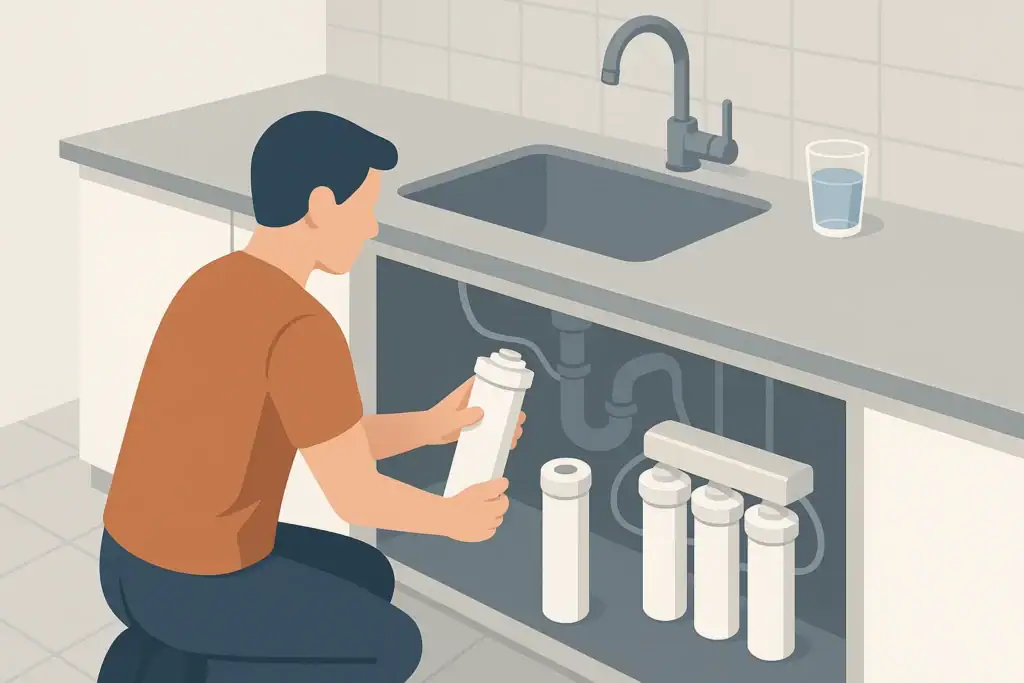
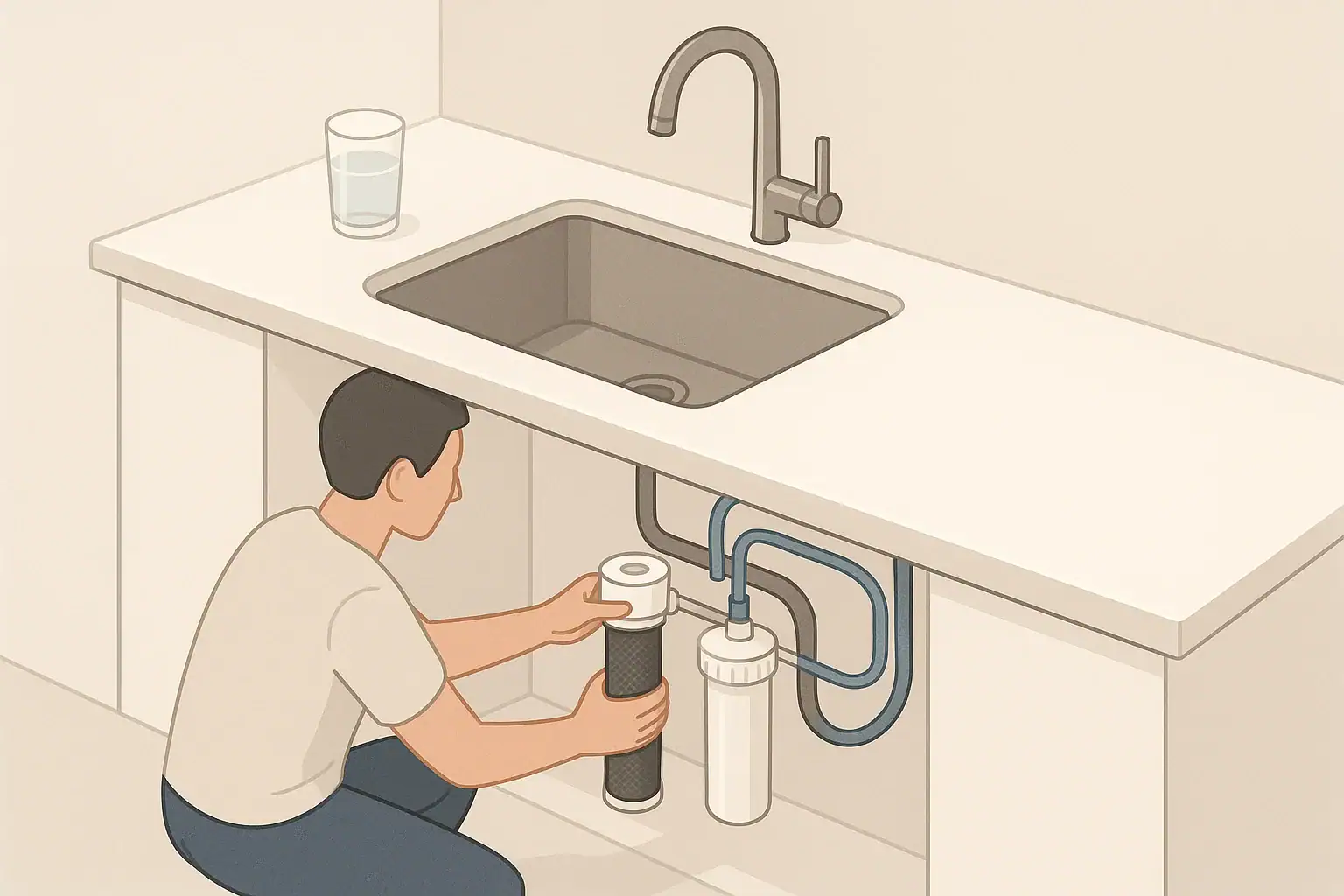
What Are VOCs in Water?
Volatile organic compounds (VOCs) are a broad group of carbon-based chemicals that easily evaporate into air. Some can also dissolve into water supplies. In drinking water discussions, VOCs usually refer to man-made chemicals used in fuels, solvents, industrial processes, and household products.
Common examples often discussed in water quality literature include:
- Solvents from degreasers and cleaners
- Compounds associated with gasoline and fuel storage
- Chemicals used in dry cleaning
- Some ingredients in paints, varnishes, and coatings
- Certain disinfection byproducts formed when disinfectants react with natural organic matter
Individual VOCs have different properties, behaviors, and potential risks. Public water systems in the United States are regulated under federal rules, and some specific VOCs have enforceable limits. However, tap water can contain many different organic compounds at varying levels, especially where there is industrial activity, fuel storage, or historical contamination.
Testing for VOCs can be complex and is usually done through certified laboratories. Home test kits may screen for a limited set, but they rarely capture the full picture.
How VOCs Get Into Tap and Well Water
VOCs do not occur in drinking water for a single reason. Instead, they can enter water systems at different points and from multiple sources.
Common VOC Sources for City Water
For municipal (city) water, VOCs may enter:
- Upstream of the treatment plant – from industrial discharges, fuel spills, or leaking storage tanks that reach rivers, lakes, or groundwater wells used as sources.
- In the distribution system – from interactions between treated water and certain pipe materials or repair products.
- Disinfection reactions – some organic compounds can form when disinfectants react with naturally occurring organic matter.
Public water utilities are required to monitor and manage many regulated contaminants. When certain VOCs are present or likely, additional treatment steps such as air stripping or activated carbon may already be in place at the treatment plant.
Common VOC Sources for Private Wells
Private well owners in the United States are generally responsible for their own testing and treatment. VOCs in wells can come from:
- Leaking underground fuel tanks
- Historical industrial or commercial sites
- Agricultural chemicals and storage areas
- Improper disposal of solvents, fuels, and chemicals
- Proximity to landfills or waste sites
Because VOCs can move through soil and groundwater, contamination issues may not be obvious. Regular testing based on local land use and state or county guidance can help well owners decide whether treatment such as carbon filtration is appropriate.
Example values for illustration.
| Situation | VOC Concern Level (general) | Carbon Filter Relevance |
|---|---|---|
| Private well near fuel station or repair shop | Higher | Often recommended after lab testing |
| Home near industrial or dry-cleaning facility | Higher | Common point-of-use option |
| Urban home on regulated city water | Variable | Often used for added taste/odor and VOC reduction |
| Rural home with shallow untested well | Unknown | Testing first, then filter if needed |
| Home with known chemical spill in area | Higher | Work with local officials and consider carbon filtration |
| New construction in residential subdivision | Moderate to low | Carbon often chosen mainly for taste/odor but may help VOCs |
| Seasonal cabin using bottled water only | Low for tap, focused on other sources | Carbon filter optional |
Why Carbon Filters Are Used for VOC Reduction
Activated carbon filters are one of the most widely used tools for reducing VOCs in drinking water. They are common in:
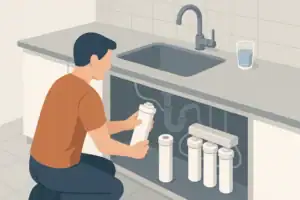
- Under-sink drinking water systems
- Refrigerator and icemaker filters
- Countertop and faucet-mounted filters
- Whole-house filters intended for taste and odor improvement
- As a stage within reverse osmosis systems
Carbon is favored because it can adsorb (capture on its surface) many organic compounds, is relatively compact, and can be used without electricity in many designs. However, not all carbon filters perform the same, and they are not unlimited in capacity — see PFAS removal options.
What Is Activated Carbon?
Activated carbon is a form of carbon processed to have a very large internal surface area. It is typically made from materials such as:
- Coconut shells
- Coal
- Wood
- Other carbon-rich materials
Through heating and activation steps, the material develops a network of tiny pores. This porous structure is what gives activated carbon its ability to adsorb many dissolved organic compounds from water.
Granular vs. Block Carbon Filters
Most residential systems use one of two basic forms:
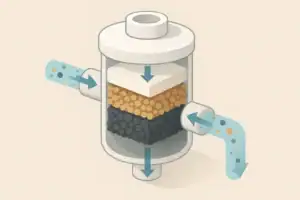
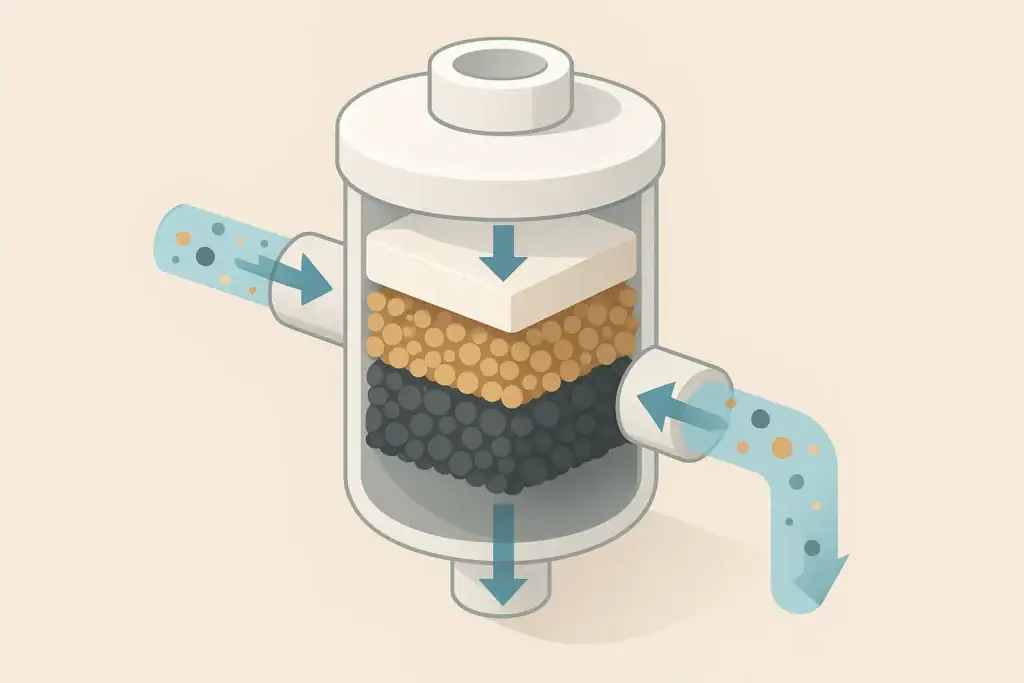
- Granular Activated Carbon (GAC) – loose carbon granules packed into a cartridge or tank. Water flows through the bed of granules.
- Carbon Block – fine carbon powder compressed with a binder into a solid block. Water passes through the porous block.
Both types can be effective for VOC reduction, but they behave differently:
- Carbon blocks often provide more uniform contact with water and may allow tighter control of flow and removal for certain contaminants.
- Granular systems can offer higher flow rates or larger overall capacity, especially in whole-house applications.
Actual performance depends on design, carbon type, the specific VOCs present, and operating conditions like flow rate and temperature.
How Carbon Filters Capture VOCs
Carbon filters reduce VOCs primarily through adsorption. This is not the same as absorption into a sponge; instead, molecules adhere to the surfaces inside the carbon pores.
Step-by-Step: VOC Removal in Carbon Media
In a typical residential carbon filter, the basic process looks like this:
- Step 1 – Water enters the filter: Tap or well water flows into the cartridge or tank, contacting the carbon media.
- Step 2 – Diffusion into pores: Dissolved VOC molecules move from the bulk water into the tiny pores of the carbon, driven by concentration differences.
- Step 3 – Adsorption onto surfaces: VOC molecules adhere to internal surfaces via physical and chemical interactions, such as van der Waals forces.
- Step 4 – Breakthrough over time: As the available surfaces fill up, the carbon approaches its capacity, and VOCs begin to appear more in the treated water.
The effectiveness of this process depends heavily on:
- Contact time – slower flow usually means more opportunity for adsorption.
- Carbon surface area – more fine pores can increase capacity for some compounds.
- Water temperature – temperature changes can affect adsorption, often making colder water somewhat more favorable.
- Competing contaminants – natural organic matter and other compounds can compete for adsorption sites.
Why VOC Removal Is Not All-or-Nothing
Different VOCs adsorb to carbon with different strengths. Some are removed more readily than others. In addition, the same filter may remove a certain contaminant efficiently at first and then gradually less effectively as the media loads up.
Filter makers may test their products for specific VOCs under controlled conditions, reporting estimated reduction for those substances. Real-world performance can differ due to higher flow rates, warmer water, or different mixtures of contaminants.
System Types: Where Carbon Fits in Home Filtration
Carbon media shows up in several system formats. Understanding these helps you match the approach to your water quality situation.
Point-of-Use Carbon Systems
Point-of-use (POU) systems treat water at a single tap or appliance. Common examples include:
- Under-sink filters with dedicated drinking water faucets
- Faucet-mounted filters that switch between filtered and unfiltered water
- Countertop systems that connect to the faucet or use gravity feed
- Refrigerator filters integrated into the appliance
For VOCs, POU systems are often preferred because they focus on the water you drink and cook with, provide more controllable contact time, and can be changed more easily than large whole-house units.
Whole-House Carbon Filters
Whole-house (point-of-entry) carbon filters treat all water entering the home. People may choose them for:
- General taste and odor improvement
- Reduction of chlorine or chloramine at every tap
- Broad reduction of certain organics and some VOCs
For VOC-specific concerns, a whole-house carbon system can help reduce exposure from activities like showering, though this depends on system design and maintenance. Because these filters handle large volumes, sizing and media selection are especially important to maintain practical performance.
Carbon in Multi-Stage Systems (Including RO)
Carbon is also commonly integrated as one stage in multi-stage systems:
- As a pre-filter to protect reverse osmosis (RO) membranes from disinfectants and organics
- As a polishing filter after RO to improve taste and odor
- Combined with sediment filters and other media in under-sink or whole-house packages
In these systems, carbon shares the workload with other technologies. For example, RO membranes can reduce many dissolved inorganic contaminants, while carbon focuses on chlorine, some organics, and VOCs.
Practical Limits and Expectations for VOC Reduction
Carbon filters can be very helpful for VOC reduction, but they are not magic or maintenance-free. Setting realistic expectations is important.
Factors That Affect VOC Removal
Key factors that influence how well a carbon filter reduces VOCs include:
- Filter design – size, depth, pore structure, and form (GAC vs. block).
- Flow rate – faster flow often means less contact time and lower reduction.
- Water quality – levels of natural organic matter, sediment, and other contaminants.
- Temperature – warmer water may slightly reduce adsorption performance for some compounds.
- Usage volume – the more water you run through the filter, the sooner it reaches capacity.
Because of these variables, many people choose to pair VOC testing with filter performance data and follow conservative replacement schedules.
Breakthrough and Spent Carbon
Over time, a carbon filter becomes saturated. When that happens:
- VOCs and other adsorbed compounds may begin to pass through instead of being captured.
- In some cases, previously adsorbed compounds can slowly desorb (release) if water conditions change or if the media is heavily saturated.
This is why replacing carbon cartridges on schedule is critical for VOC reduction. Waiting until taste or odor deteriorates is not always a reliable indicator, since some VOCs are not detectable by smell at low levels.
Certification and Performance Data (General Concepts)
Some carbon filters are independently tested against voluntary standards that include certain VOCs. In general terms, these standards often define:
- Test conditions like flow rate, water temperature, and contaminant challenge level
- How much reduction must be achieved over a stated capacity
- Which specific VOCs or VOC surrogates are evaluated
Reviewing product literature and any available third-party test reports can help you choose filters that match your concerns. Because certifications and listings can change, it is best to confirm current information at the time of purchase.
Choosing and Maintaining Carbon Filters for VOCs
When VOCs are a concern, choosing a carbon filter is not only about type, but also about installation location, monitoring, and maintenance habits.
Steps to Selecting a Carbon Filter Strategy
A practical approach often includes:
- 1. Identify your water source: City water or private well, and any local advisories or known contamination issues.
- 2. Review testing options: Work with a certified lab to test for VOCs that are likely based on land use and regulatory guidance.
- 3. Decide on point-of-use vs. whole-house: Many households start with point-of-use filtration at the kitchen sink, then consider whole-house systems if broader exposure reduction is desired.
- 4. Match capacity to usage: Choose a cartridge or system sized for your household’s daily drinking and cooking water needs.
- 5. Check performance information: Look for data or testing related to VOC reduction under conditions similar to your planned use.
Maintenance Practices That Matter
Once installed, carbon filters require ongoing attention:
- Follow replacement intervals: Change cartridges based on time or gallons, whichever comes first, as specified by the manufacturer.
- Monitor flow and taste: Noticeable flow reduction can indicate clogging. Taste changes can signal the need for earlier replacement, though VOCs may be present even before taste shifts.
- Pre-filtration for sediment: In areas with turbidity or visible particles, a sediment pre-filter can help protect the carbon from fouling.
- Sanitation during service: When changing cartridges, follow safe handling and any cleaning steps provided with the system to minimize microbial growth within housings.
Consistent maintenance helps keep VOC reduction closer to tested performance levels, within the limits of the filter’s design.
Example values for illustration.
| Household Use Pattern | Estimated Daily Filtered Volume (gallons) | Example Rated Capacity (gallons) | Approximate Replacement Interval |
|---|---|---|---|
| Single person, drinking and light cooking | 5–10 | 500 | About 2–4 months |
| Couple, daily cooking at home | 10–20 | 750 | About 1–2.5 months |
| Family of four, frequent cooking | 20–30 | 1,000 | About 1–1.5 months |
| Small office, shared drinking water tap | 15–25 | 2,000 | About 2.5–4.5 months |
| Low-use vacation home | 1–5 (seasonal) | 500 | Replace at least annually |
| Whole-house carbon with dedicated kitchen tap | 25–40 (through POU tap) | 5,000 | About 4–6 months |
Related guides: PFAS Removal Options: RO vs Carbon vs Whole House • Lead in Tap Water: Practical Steps Before Buying a Filter • Whole House Carbon Filters for Chlorine & Taste: What to Expect
Frequently asked questions
Do carbon filters remove all VOCs from water?
No. Carbon filters can reduce many VOCs but not all — effectiveness varies by the specific compound, filter type, contact time, and media capacity. Testing and product performance data help set expectations.
How often should I replace a carbon filter to control VOCs?
Follow the manufacturer’s recommended time-or-gallon schedule and consider usage, water quality, and flow changes. Regular replacement prevents breakthrough since VOC removal declines as media becomes saturated.
Should I test my water for VOCs before choosing a filter?
Yes. A certified lab test that targets likely VOCs in your area helps you choose the right system and verify whether carbon filtration alone is appropriate.
Is a whole-house carbon filter better than a point-of-use system for VOCs?
They serve different goals. Point-of-use systems focus on drinking and cooking water and often provide better control for VOC removal; whole-house units reduce exposure at all taps but require proper sizing and maintenance to be effective for VOCs.
By understanding how VOCs enter water, how carbon filters capture them, and what limits and maintenance needs exist, you can make more informed decisions about home filtration strategies that match your location, water source, and comfort level.
Recommended next:
- NSF/ANSI standards explained (42/53/401/58)
- Clear trade-offs: pitcher vs faucet vs under-sink vs RO
- Maintenance planning: cost per gallon and replacement cadence