What Is NSF/ANSI 58 for Reverse Osmosis Systems?
NSF/ANSI 58 is a voluntary American national standard that applies specifically to point‑of‑use reverse osmosis (RO) drinking water systems. It is widely used in the U.S. to evaluate how a complete RO system performs and how it is constructed.
When a product is tested and listed to NSF/ANSI 58 by an accredited certifier, it means that system was evaluated against the requirements of that standard (see How to Verify a Filter’s Certification Claim (Step-by-Step)). It does not mean every possible contaminant is removed, or that the water is perfectly pure. Instead, it gives a structured way to compare systems and understand which performance and safety checks they have passed.
NSF/ANSI 58 focuses on:
- How much total dissolved solids (TDS) the RO membrane can reduce
- Whether the system meets specific contaminant reduction claims it advertises (if tested for them)
- Basic material safety and structural integrity requirements
- Performance over the rated life of the filters and membrane
It does not automatically cover every contaminant or guarantee suitability for every water source. To use NSF/ANSI 58 well, it helps to know which parts of an RO system are covered and what parts may fall outside the scope.
Key Things NSF/ANSI 58 Does Cover
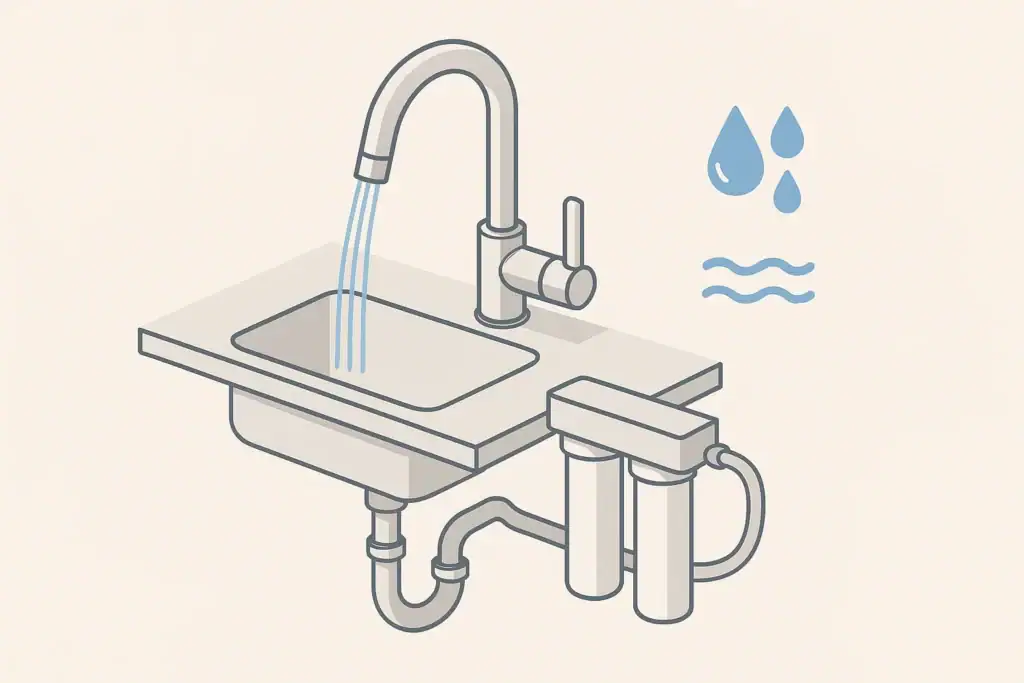
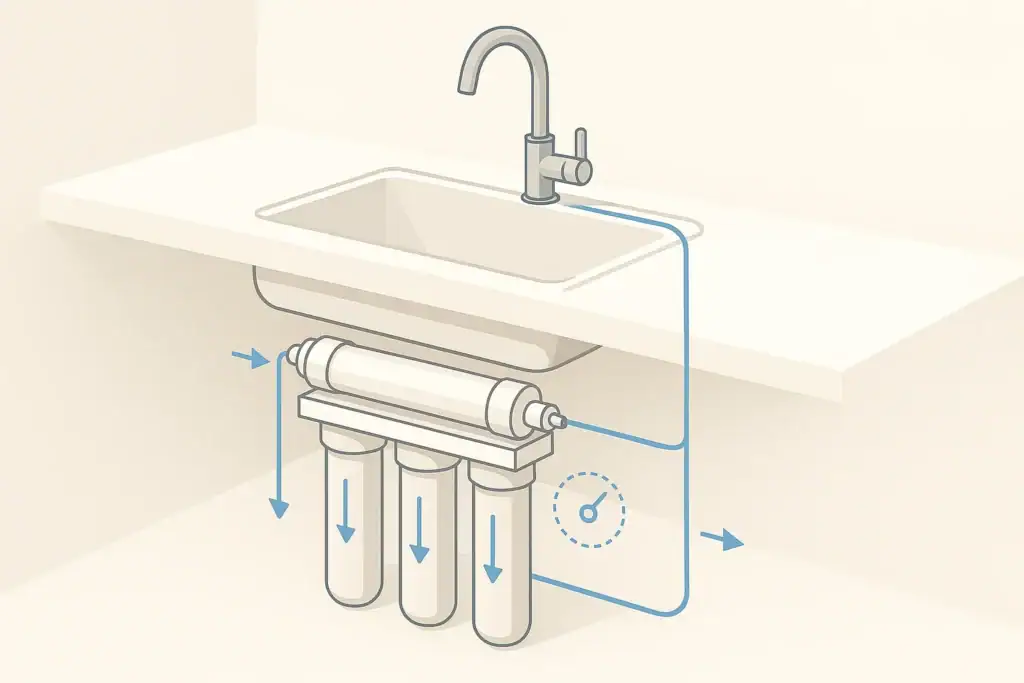
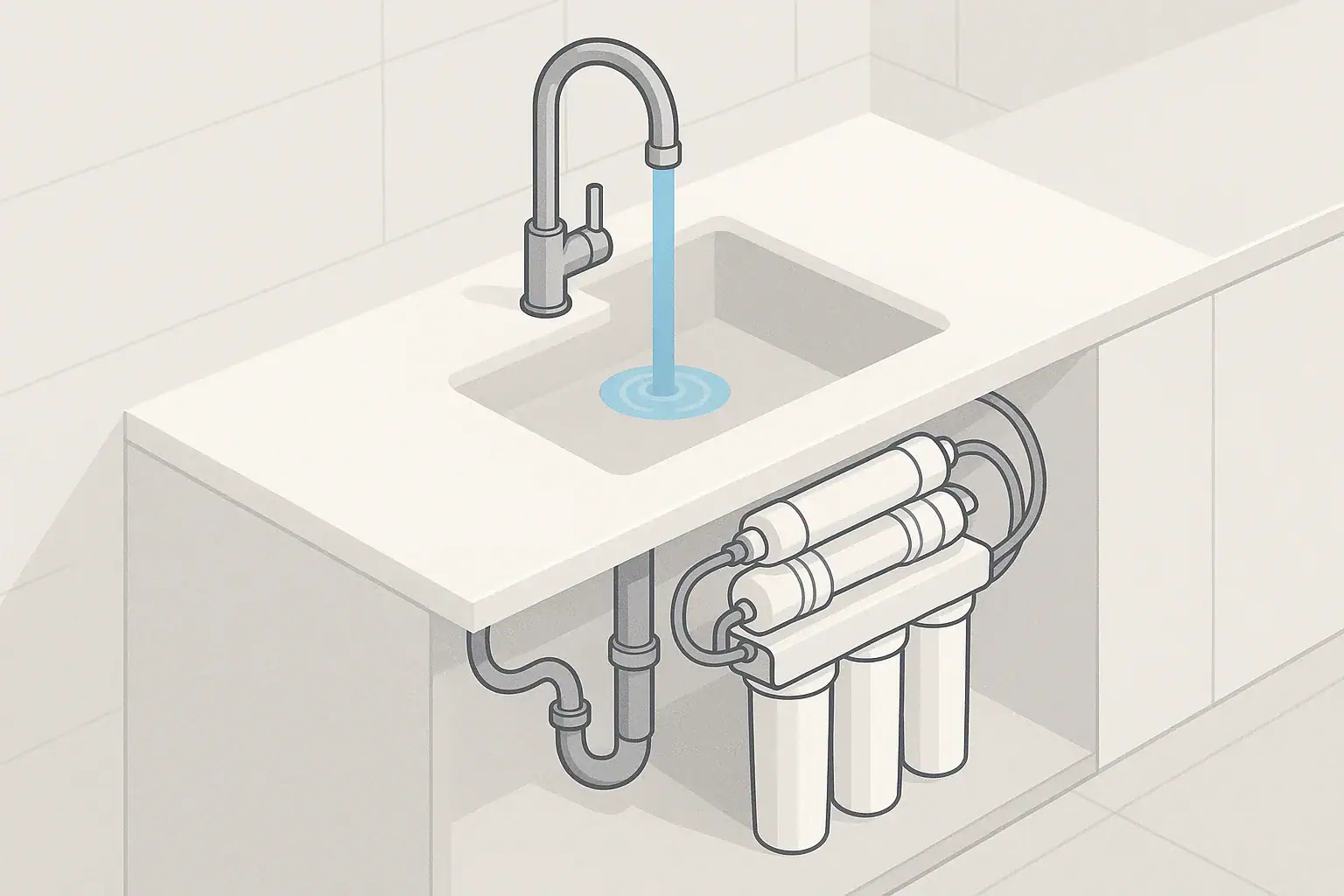
NSF/ANSI 58 looks at a complete RO system as installed, usually under a sink or on a counter. The standard brings several important areas under one umbrella: performance claims, materials, construction, and basic durability.
Total Dissolved Solids (TDS) Reduction Performance
A central requirement in NSF/ANSI 58 is testing the system for TDS reduction under defined conditions. TDS is a general indicator of dissolved minerals and salts in the water. RO is expected to reduce TDS significantly, and the standard uses that as a performance benchmark.
Certification bodies typically verify that the system achieves at least a certain TDS reduction level in testing. This helps confirm the RO membrane and support components are working as a system and that the rated daily production (gpd) is realistic under test conditions.
Specific Contaminant Reduction Claims (When Tested)
NSF/ANSI 58 allows manufacturers to make claims about reducing particular contaminants, but those claims must be tested and verified to be part of the listing. Examples of claim types that may be evaluated include:
- Lead reduction
- Arsenic reduction (for certain forms of arsenic)
- Nitrate and nitrite reduction
- Fluoride reduction
- Chromium reduction (for specified forms)
- Other dissolved inorganic contaminants
Not every RO system is tested for every one of these. The listing will only include the contaminants that were evaluated and passed under the standard’s test procedures. If a contaminant is not listed, that does not automatically mean the RO membrane cannot reduce it; it simply means it was not part of the certification claim.
Material Safety of Wet Parts
NSF/ANSI 58 also looks at the materials that contact drinking water inside the RO system. This is meant to limit the potential for harmful substances to leach into the water from:
- Plastic housings and tubing
- Rubber gaskets and seals
- Metal fittings
- Storage tanks and internal linings
These materials are tested under controlled conditions to check that contaminants leached from the materials remain below limits defined by the standard. This is separate from the contaminant reduction performance of the RO process itself.
Structural Integrity and Pressure Testing
Because RO systems operate under household water pressure, NSF/ANSI 58 includes structural integrity requirements. System components such as housings, tubing, and storage tanks are pressure‑tested to help ensure they can withstand normal use, including some pressure fluctuations.
This testing is not the same as a guarantee against leaks in every home, but it provides a baseline that the system has been evaluated for pressure stresses under standardized conditions.
Advertising Claims and Documentation
NSF/ANSI 58 ties performance testing to how the product is marketed. If a system is certified for particular reductions or capacities, its literature must not overstate those claims beyond what was tested. This helps keep comparisons more transparent between systems that carry NSF/ANSI 58 listings.
Example values for illustration.
| Item | What to Look For | Why It Matters |
|---|---|---|
| TDS reduction claim | Listed percentage TDS reduction under the standard | Indicates core RO membrane performance |
| Contaminant list | Specific contaminants the system is certified to reduce | Shows which concerns were actually tested |
| Rated capacity | Example: replacement intervals in gallons or months | Helps plan maintenance and cost of ownership |
| Water type assumptions | Reference to typical municipal supply in test conditions | Highlights differences from your actual water |
| Pressure range | Example range such as 40–80 psi | Indicates typical operating expectations |
| Temperature range | Example range such as 40–100 °F | Shows conditions used for performance testing |
| System components | Note if prefilters, postfilters, and tank are included | Confirms what was actually tested as a system |
Use this checklist to interpret, not replace, the official certification documentation.
What NSF/ANSI 58 Does Not Cover or Guarantee
NSF/ANSI 58 is useful, but it has limits. It is not a universal guarantee of safety, nor does it address every possible water quality concern. Understanding the gaps helps you avoid assuming more than the standard actually promises.
Not Every Contaminant or Emerging Issue
NSF/ANSI 58 does not automatically cover all potential contaminants, such as:
- Every form of organic chemicals and volatile organic compounds (VOCs)
- Every type of PFAS compound
- All microbial risks such as bacteria, viruses, or protozoa
- Every possible industrial or agricultural chemical
If a contaminant is not specifically listed in the certification documentation, there is no certified claim under NSF/ANSI 58 for that contaminant. RO membranes may reduce many substances in practice, but the standard only speaks to what was tested. For guidance on emerging contaminants, see NSF/ANSI 401 Explained: Emerging Contaminants in Plain English.
Not a Substitute for Water Testing
Certification to NSF/ANSI 58 does not replace testing your own water, especially if you have well water, known contamination issues, or a private supply. The standard is built around test water with controlled conditions and typical municipal characteristics.
Your actual water may differ in:
- Hardness and scaling tendency
- Iron, manganese, or hydrogen sulfide levels
- Microbial content
- Presence of specific industrial or agricultural contaminants
RO performance can be influenced by these conditions. In some cases, additional pre‑treatment or a different treatment train may be needed.
Not a Guarantee of Zero Maintenance
NSF/ANSI 58 includes performance testing over the rated life of cartridges and membranes, but it assumes filters are replaced according to the schedule. The standard does not guarantee that a neglected RO system will keep performing well.
In practical use, owners still need to:
- Replace sediment and carbon prefilters on schedule
- Replace the RO membrane at the recommended interval
- Sanitize or service the storage tank and lines as advised
- Monitor for pressure drops, unusual tastes, or flow changes
Not a Plumbing or Installation Code
NSF/ANSI 58 is not a plumbing code and does not replace local code requirements. It does not authorize:
- Bypassing required backflow prevention or air gaps
- Modifying drain lines or vents in ways that violate code
- Using non‑approved connections on pressurized lines
Installations still need to follow local plumbing codes and the manufacturer’s instructions. Where codes require an air gap faucet or specific drain connection style, NSF/ANSI 58 certification does not override that.
Not a Health or Medical Guarantee
The standard is a performance and safety benchmark for devices, not a medical standard. It does not certify health outcomes or individual health benefits. It also does not guarantee that RO water is necessary, appropriate, or sufficient for any specific health condition. Those decisions belong with qualified health and water professionals.
How NSF/ANSI 58 Relates to Other NSF Standards
NSF/ANSI 58 is one of several drinking water treatment standards. It focuses on reverse osmosis systems, while other standards apply to different technologies and claims. Understanding how they interact can clarify what you are actually getting from a multi‑stage system.
NSF/ANSI 42 and 53 for Carbon Filtration
Many RO systems include carbon prefilters and postfilters. Those filters may also be evaluated under carbon‑focused standards such as:
- NSF/ANSI 42 – primarily for aesthetic effects such as chlorine taste and odor reduction
- NSF/ANSI 53 – for reduction of certain contaminants of health concern, such as specific heavy metals or some organic chemicals
When you see a multi‑stage RO system with both NSF/ANSI 58 and 42 or 53 claims, each standard applies to different parts of the system or different performance claims. NSF/ANSI 58 covers the overall RO system and TDS reduction, while 42/53 focus more on what the carbon stages are tested to do.
NSF/ANSI 55 and UV Disinfection
Some RO setups add a UV (ultraviolet) stage for microbial reduction. UV devices may be evaluated under NSF/ANSI 55, which is focused on UV performance for reducing certain microorganisms under defined conditions.
This is separate from NSF/ANSI 58. If an RO system includes UV and you rely on it for microbial risk reduction, you would want to look for applicable UV‑related certifications in addition to RO‑specific ones.
NSF/ANSI 61 and Plumbing Components
Separate from treatment performance, plumbing and distribution system components are often evaluated under NSF/ANSI 61 for material safety in contact with drinking water. Some parts of an RO system, such as tubing or fittings, may also be covered from that perspective, but NSF/ANSI 58 is what ties together the complete RO device as a treatment unit.
Reading Multiple Standards Together
A single under‑sink RO system might reference several standards at once. In general:
- NSF/ANSI 58 → overall RO system performance and construction
- NSF/ANSI 42/53 → carbon filtration claims (taste, odor, or specific contaminants)
- NSF/ANSI 55 → UV disinfection performance, if present
- NSF/ANSI 61 → material safety for certain plumbing components
Seeing multiple standards does not mean double counting protection; it means different aspects of the system were evaluated under the standards that best match each function.
Using NSF/ANSI 58 in Practical RO Buying Decisions
For a homeowner, NSF/ANSI 58 is useful as a decision tool rather than a guarantee. It helps you compare RO systems in a more structured way, especially when combined with your own water quality information and household needs.
Match Certified Claims to Your Water Concerns
Start by listing what you know or suspect about your water:
- Whether you are on a city supply or well water
- Any test results for lead, nitrate, hardness, or other parameters
- Aesthetic issues such as chlorine taste, odor, or high TDS
Then, when reviewing NSF/ANSI 58 listings:
- Look for TDS reduction as a general performance indicator for RO
- Check if contaminants you care about are specifically listed
- Note any contaminants that are not listed and may need additional treatment
Consider RO Waste Water and System Efficiency
NSF/ANSI 58 testing includes aspects related to production rate and waste. RO systems send a portion of incoming water to drain as concentrate. While the exact drain ratio can vary by design and pressure, many household systems send several gallons of concentrate to drain for every gallon of treated water produced.
The standard does not require a specific drain ratio, but rated production and efficiency may be reflected in the listing. When comparing products, you may want to ask how much water is typically sent to drain under normal household conditions and whether that aligns with your priorities (see RO Waste Water Ratio: What’s Normal and How to Reduce It).
Check Rated Capacity and Replacement Intervals
NSF/ANSI 58 certification includes testing the system over its rated life, so the listed capacity can help you estimate maintenance. For example, the listing or manual may specify replacement of prefilters every certain number of gallons or months, and membranes every longer interval.
This information is practical for budgeting filter costs, planning maintenance, and deciding whether an RO system is a good long‑term fit for your household’s water use and space.
Confirm Compatibility with Your Plumbing and Space
While NSF/ANSI 58 focuses on system performance, you still need to make sure the device works in your actual kitchen or utility area. Consider:
- Available space under the sink for housings and, if present, a storage tank
- Whether a dedicated RO faucet is required and where it would mount
- How the drain connection is made and whether it follows local code
- Minimum and maximum water pressure needed for rated performance
If your home has unusually low pressure, very high TDS, or other atypical conditions, you may want to discuss them with a water professional before relying solely on standard ratings.
Example values for illustration.
| Component | Example Interval | Primary Purpose | What to Watch For |
|---|---|---|---|
| Sediment prefilter | Every 6–12 months | Protect membrane from particles | Noticeable pressure drop or cloudy housings |
| Carbon prefilter | Every 6–12 months | Reduce chlorine or oxidants before membrane | Return of chlorine taste or odor |
| RO membrane | Every 2–5 years | Main TDS and contaminant reduction | Rising TDS in product water, lower rejection |
| Postfilter (polishing carbon) | Every 12–24 months | Improve final taste and odor | Stale taste or odor in stored water |
| Storage tank air charge check | Every 12–24 months | Maintain usable flow from tank | Very low flow despite full tank |
| System sanitization | Every 12 months or during major service | General hygiene of housings and lines | Long periods of non‐use, unusual odors |
Actual intervals depend on water conditions, usage, and manufacturer guidance.
Related guides: NSF/ANSI 42 vs 53: Which One Matters for You? • How to Verify a Filter’s Certification Claim (Step-by-Step) • NSF/ANSI 401 Explained: Emerging Contaminants in Plain English
Used thoughtfully, NSF/ANSI 58 is a helpful reference point rather than a complete answer. It tells you how a specific RO system performed under defined test conditions and what claims have been independently checked, while leaving room for site‑specific factors, maintenance habits, and additional treatment you may or may not need.
Frequently asked questions
Does NSF/ANSI 58 mean an RO system removes all contaminants?
No. NSF/ANSI 58 verifies tested performance (such as TDS reduction and any listed contaminant claims) and material safety under defined test conditions. It does not guarantee removal of every possible contaminant or untested substances.
Should I test my water before choosing an NSF/ANSI 58–certified RO?
Yes. A water test identifies specific issues (for example, iron, PFAS, or microbial concerns) so you can confirm whether the certified claims address those issues or whether additional pre‐ or post‐treatment is needed.
How does NSF/ANSI 58 affect maintenance and replacement schedules?
Certification tests performance over the rated life but assumes filters and membranes are replaced per manufacturer guidance. Follow recommended intervals and monitor taste, flow, and TDS to know when service is needed.
Does NSF/ANSI 58 cover installation or local plumbing code compliance?
No. The standard evaluates system performance and materials, not local code. Installations must still follow local plumbing codes and manufacturer instructions, including any required air gaps or backflow prevention.
Recommended next:
- NSF/ANSI standards explained (42/53/401/58)
- Clear trade-offs: pitcher vs faucet vs under-sink vs RO
- Maintenance planning: cost per gallon and replacement cadence