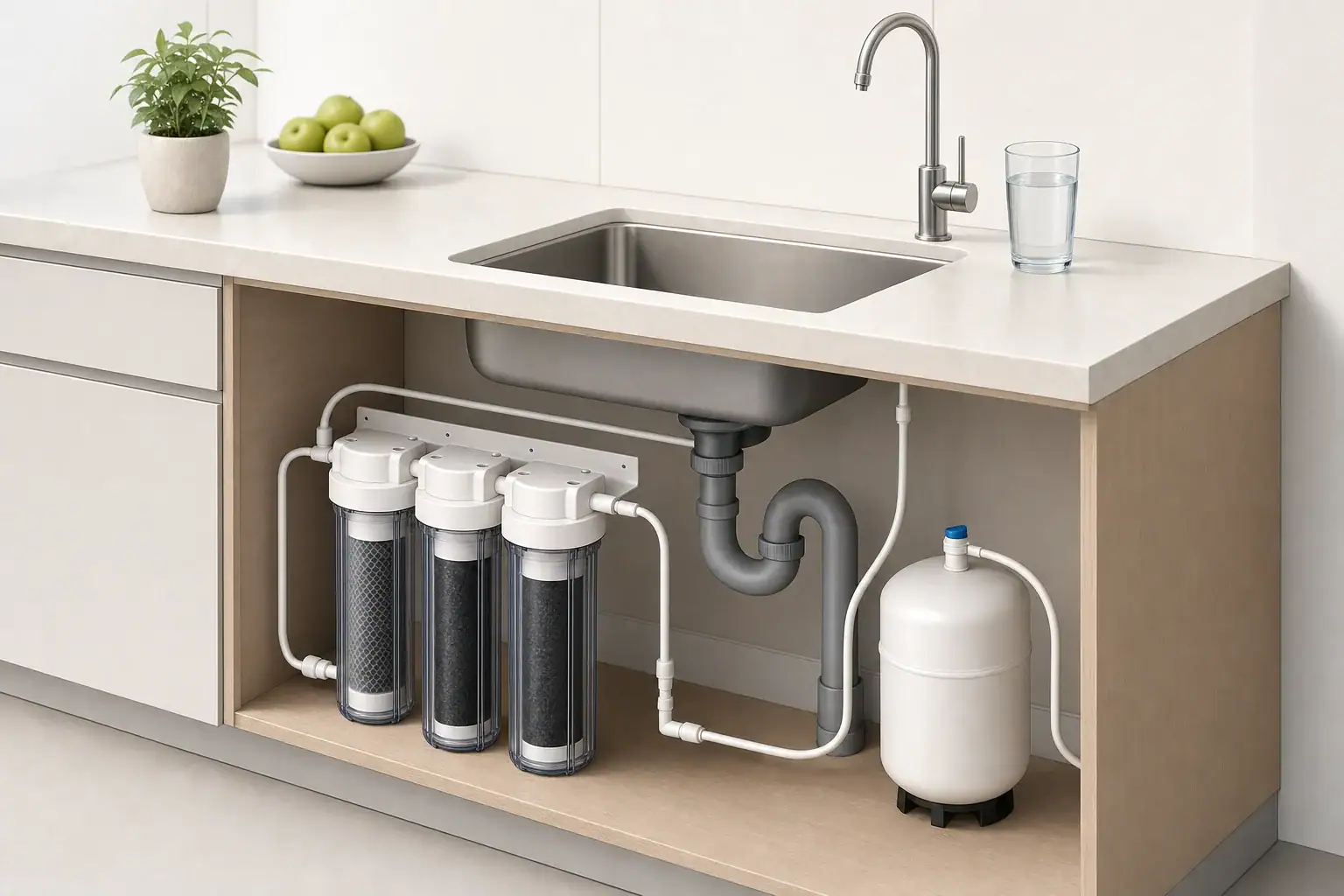
Whole house carbon filters for chloramine are designed to treat water as it enters a home, before it reaches showers, faucets, appliances, and point-of-use filters. The most common media for this purpose is catalytic activated carbon, which is better suited to chloramine reduction than ordinary activated carbon under comparable conditions.
Media type is only one part of the decision. Chloramine performance also depends on water flow, media quantity, contact time, water chemistry, equipment condition, and replacement timing. A system that works at a low test flow may provide less reduction when several fixtures operate at once.
Why chloramine can be harder to treat than chlorine
Many public water systems use chlorine or chloramine to maintain a disinfectant residual in the distribution network. Chloramine is generally formed by combining chlorine with ammonia under controlled treatment conditions. It is more stable in distribution piping than free chlorine and may produce a different taste or odor.
Standard activated carbon can reduce free chlorine relatively quickly. Chloramine reacts more slowly, so successful treatment usually requires carbon with suitable surface chemistry and enough contact time. A small amount of ordinary carbon may improve taste without delivering consistent chloramine reduction at whole-house flow rates.
Water quality reports commonly identify the disinfectant used by a utility. Because utilities may change treatment practices temporarily or seasonally, homeowners can also confirm current conditions with the water provider or appropriate water testing.
Reducing chloramine is not the same as removing every compound associated with it. The reaction can leave ammonia or related nitrogen species in the water. Carbon alone should not be assumed to remove those substances. Specialized uses, including aquariums, may require separate treatment and testing.
How catalytic carbon treats chloramine
Catalytic carbon is activated carbon whose surface has been modified or selected to promote faster chemical reactions. It still provides adsorption for many taste, odor, and organic compounds, but its enhanced surface activity makes it more effective for chloramine reduction than conventional granular activated carbon in many applications.
The term catalytic does not mean that the media lasts indefinitely. Carbon pores can become loaded with adsorbed material, the surface can become fouled, and the bed can accumulate sediment. Performance eventually declines and the media must be replaced or serviced.
Contact time remains important. Water must move through a sufficient depth and volume of media rather than taking a short path around it. High flow, channeling, an undersized tank, or a partially clogged cartridge can all affect treatment.
Catalytic carbon can also reduce free chlorine and may adsorb some volatile organic compounds and taste- or odor-producing substances. Actual performance varies by compound and system design, so a broad carbon claim should not be interpreted as proof of reduction for every contaminant.
Example values for illustration.
| Method | Primary role | Chloramine consideration |
|---|---|---|
| Catalytic carbon | Chloramine, chlorine, taste, and odor reduction | Common primary media when properly sized |
| Standard granular carbon | Chlorine, taste, odor, and selected organics | May be less effective at typical whole-house flow |
| Carbon block | Fine filtration and carbon treatment | Can work at rated flow but may create more pressure drop |
| Sediment filtration | Sand, rust, and suspended particles | Protects carbon but does not directly reduce chloramine |
| Water softening | Hardness reduction | Not a primary chloramine treatment |
| Ultraviolet treatment | Microbial inactivation | Not normally used for household chloramine reduction |
| Reverse osmosis | Point-of-use dissolved contaminant reduction | Usually relies on carbon pretreatment for oxidant protection |
Whole-house system configurations
Backwashing media tanks
A backwashing tank contains a loose bed of catalytic carbon and periodically reverses water flow to expand and clean the media. Backwashing can release trapped sediment, reduce compaction, and help limit channeling. These systems require an appropriate drain connection, a control valve, sufficient supply pressure, and enough available flow for the specified backwash cycle.
A tank must be sized for both service flow and backwash requirements. A large tank may provide useful media volume but fail to clean properly if the plumbing or well pump cannot provide its required backwash rate.
Non-backwashing tanks
Some tanks operate without an automatic backwash cycle. They can use less water and require no routine drain discharge, but they are generally more sensitive to sediment accumulation and uneven flow through the bed. Pretreatment and periodic professional inspection may be especially important.
Large cartridge systems
Cartridge housings can hold catalytic carbon blocks or granular media cartridges. They are compact and may be practical where water use is modest. However, whole-house cartridges can develop noticeable pressure loss, particularly as they collect sediment. Replacement frequency may be higher than with a larger media tank.
Supporting treatment stages
A sediment prefilter can help protect carbon from rust, sand, and other particles. If the water has significant hardness, iron, manganese, or unusual organic loading, additional treatment may be needed. The order of treatment stages should be based on water test results and equipment requirements rather than a universal layout.
Sizing for flow rate and contact time
Whole-house sizing starts with peak service flow, measured in gallons per minute. Peak flow is the combined demand when fixtures and appliances operate at the same time. Household size alone does not determine this number; fixture flow, plumbing diameter, usage patterns, and appliance fill cycles also matter.
Carbon treatment also depends on empty bed contact time, often abbreviated as EBCT. Conceptually, EBCT compares the volume of media with the rate at which water passes through it. More media or a lower flow provides more theoretical contact time. Actual results are also affected by bed shape, channeling, temperature, and water chemistry.
A useful evaluation should consider:
- The system’s rated continuous service flow
- The flow used for any published chloramine performance claim
- The quantity and depth of catalytic carbon
- Expected pressure loss when the media is clean and when it is loaded
- Available backwash flow for an automatic media tank
- Inlet pressure and the pressure required at upper floors or distant fixtures
Oversizing plumbing connections does not compensate for too little media. Conversely, adding a restrictive filter to marginal plumbing can produce weak showers and slow appliance filling. A qualified installer can assess pipe size, pressure, drainage, code requirements, and safe placement without bypassing plumbing protections.
Performance claims, testing, and maintenance
When comparing equipment, distinguish between a claim about raw filter media and a claim covering a complete system. Independent certification or testing may specify chloramine reduction at a particular flow, capacity, pressure, and influent concentration. Results outside those conditions may differ.
Standards commonly associated with aesthetic chlorine and chloramine reduction can provide useful context, but a standards reference alone is not enough. Check which exact model, capacity, and reduction claim were evaluated. Certification of one component does not automatically establish the performance of the assembled installation.
Maintenance intervals are influenced by water use and water quality. Calendar estimates are useful for planning, but they do not directly measure remaining capacity. Warning signs can include returning disinfectant taste or odor, reduced outlet test performance, declining flow, or increasing pressure difference across the system.
Good maintenance practices include:
- Following the specified media or cartridge replacement schedule
- Checking for leaks and unusual pressure changes
- Replacing sediment filters before they become severely restricted
- Keeping backwash controls set correctly
- Using appropriate inlet and outlet testing when performance matters
- Following safe sanitation procedures after service or prolonged stagnation
Removing the disinfectant residual at the point of entry means water throughout the home’s plumbing has less residual protection. This does not automatically make a whole-house carbon system unsuitable, but it makes correct maintenance, sanitation, and avoidance of long stagnation more important.
A practical checklist for selecting a system
Begin by confirming that the utility uses chloramine rather than free chlorine. Review the annual water quality report and ask whether temporary disinfectant changes occur. For private wells, chloramine is not normally present unless it is intentionally introduced as part of a treatment process.
Estimate realistic simultaneous demand instead of adding the maximum rating of every fixture in the home. Then compare that demand with the system’s documented service flow and chloramine performance conditions. Allow for pressure loss from sediment filters, carbon media, valves, and existing plumbing.
Also plan for ownership requirements. A backwashing tank needs a suitable drain and adequate backwash flow. Cartridges need accessible clearance for replacement. All configurations need leak-aware installation, shutoff access, and protection from freezing or excessive heat.
Example values for illustration.
| Operating fixtures | Approximate combined flow | Planning implication |
|---|---|---|
| One kitchen faucet | 1 to 2.2 gpm | Low-demand condition |
| One shower | 1.5 to 2.5 gpm | Common single-fixture demand |
| Shower and faucet | 2.5 to 4.5 gpm | Moderate simultaneous demand |
| Two showers | 3 to 5 gpm | Contact time may decrease |
| Shower and washer fill | 3.5 to 6.5 gpm | Check service flow and pressure |
| Two showers, faucet, and washer | 6 to 9 gpm | Higher peak-demand condition |
Related guides:
Choosing a Filter for Chloramine: Standards and Media That Help •
Whole House Carbon Filters for Chlorine & Taste: What to Expect •
Backwashing Filters Explained: Pros, Cons, and Maintenance •
Whole House Filter Replacement Costs: Cartridges vs Media Tanks •
Whole House vs Point-of-Use Filters: Which Upgrade Should You Buy First?
Frequently asked questions
Does catalytic carbon remove all chloramine?
No filter should be assumed to provide complete removal under every condition. Reduction depends on the media, flow, contact time, influent concentration, water chemistry, and media age. Verify performance using system-specific documentation and testing appropriate to the intended use.
Can regular activated carbon reduce chloramine?
Regular activated carbon can react with chloramine, but the reaction is generally slower than free chlorine reduction. A large conventional carbon bed with sufficient contact time may provide some reduction, while a small or fast-flowing filter may not. Catalytic carbon is typically selected when chloramine is the primary target.
Will a sediment filter help with chloramine?
A sediment filter does not directly treat dissolved chloramine. Its role is to capture particles that could foul carbon, restrict flow, or contribute to channeling. It may extend carbon performance when the incoming water carries visible or measurable sediment.
Should every fixture receive chloramine-treated water?
That depends on the treatment goal. A whole-house system addresses bathing, laundry, appliances, and all taps, but it is larger and requires more maintenance than a drinking-water filter. If the concern is limited to drinking and cooking water, a properly selected point-of-use system may be a simpler option.
Frequently asked questions
How do I know whether my water supply uses chloramine?
Check the utility’s consumer confidence report or contact the water provider directly. Because disinfectant practices can change, current information is more useful than relying only on an older report.
Does a whole-house chloramine filter reduce water pressure?
Any filter can create pressure loss. The effect depends on the system’s size, media condition, plumbing, and water demand. Proper sizing and timely sediment-filter replacement help limit noticeable pressure reduction.
How often does catalytic carbon need to be replaced?
Replacement timing varies with water use, chloramine concentration, flow rate, sediment loading, and system design. Follow the equipment documentation and use testing or changes in taste, odor, flow, or pressure as maintenance indicators.
Can a water softener remove chloramine?
A conventional water softener is designed primarily to reduce hardness minerals, not chloramine. Carbon treatment is typically installed as a separate stage when chloramine reduction is needed.
Is a backwashing carbon tank always necessary?
No. A cartridge system or non-backwashing tank may be suitable for lower-demand situations. A backwashing tank can be useful where a larger carbon bed and periodic media cleaning are appropriate, provided the home has adequate backwash flow and drainage.
- NSF/ANSI standards explained (42/53/401/58)
- Clear trade-offs: pitcher vs faucet vs under-sink vs RO
- Maintenance planning: cost per gallon and replacement cadence