
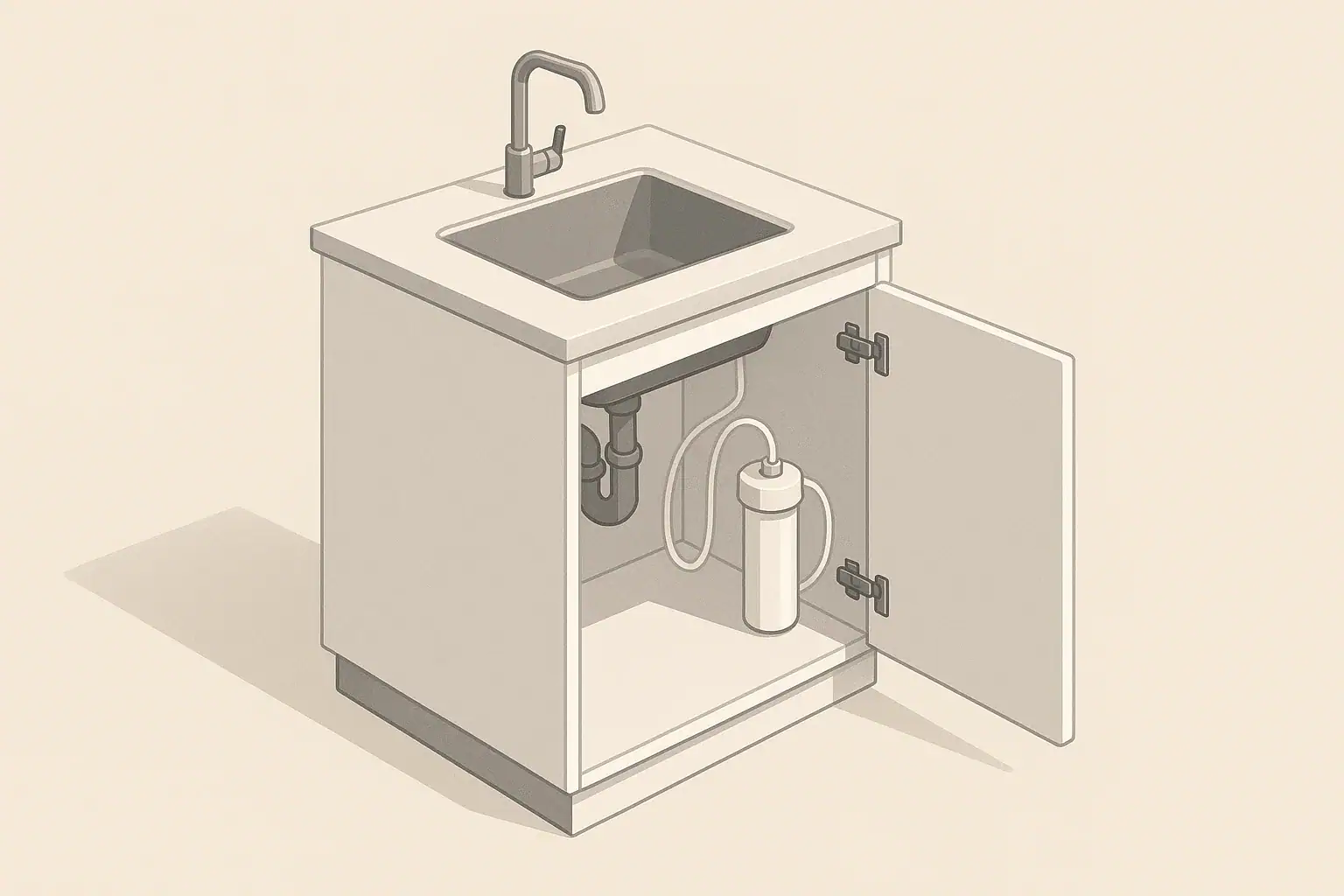
What a Sediment Prefilter Does Under the Sink
A sediment prefilter is a simple under-sink filter stage designed to remove visible and microscopic particles from your water before it reaches finer filtration media. Instead of targeting specific chemical contaminants, it focuses on physical debris that can clog or wear out other parts of your system.
In typical home plumbing, sediment may include:
- Sand and silt from wells or aging distribution lines
- Rust flakes from old galvanized or iron pipes
- Scale particles that broke loose from mineral buildup
- Fine dirt or turbidity from main line disturbances or hydrant flushing
Under-sink sediment prefilters usually sit at the very beginning of an under-sink or reverse osmosis (RO) setup. They are often rated by micron size, which describes the approximate size of particles they are intended to capture. Common nominal ratings are in the range of 1–20 microns for under-sink use.
Unlike carbon filters or RO membranes, sediment cartridges are relatively inexpensive. Their main job is to act as a sacrificial barrier that traps solids so your more sensitive, higher-cost cartridges can focus on taste, odor, and specific contaminants.
Signs You May Need a Sediment Prefilter Under the Sink
Not every home needs a sediment prefilter under the sink. Some municipal supplies are low in particulate matter, and some homes already have a whole-house sediment filter. However, several practical signs suggest that an under-sink sediment stage could help.
Visible Sediment in Water or Fixtures
You are more likely to benefit from an under-sink sediment prefilter if you notice:
- Fine grit at the bottom of drinking glasses after the water sits
- Brown, yellow, or gray particles in sink or tub after filling
- Rust-colored specs around aerators and faucet tips
- Cloudy water that clears from the bottom up as particles settle
These are common in private wells and in some areas with older municipal mains. In many cases, the water passes standards for safety but carries more particulate matter than is ideal for home filtration equipment and fixtures.
Frequent Clogging of Faucet or Under-Sink Filters
If you already use an under-sink carbon filter, RO unit, or faucet-mount filter, a sediment problem often shows up as short cartridge life or poor flow. Warning signs include:
- Needing to replace carbon cartridges much earlier than the rated capacity due to pressure drop
- Faucet-mount or inline filters quickly slowing to a trickle
- RO systems with prefilters that discolor heavily long before scheduled change intervals
When sediment is allowed to reach fine media, it can plug pores or coat the surface so that less water can pass through. A sediment prefilter catches most of the solids upstream, so subsequent stages work closer to their intended lifespan.
Well Water or Known Turbid Supply
Private wells in the U.S. often vary seasonally, especially after heavy rains or during periods of high water use. Many well owners see a rise in turbidity or sand when pumping more heavily or after pump maintenance. Even if your water looks generally clear, a lab report with noticeable turbidity or visible sediment during some seasons is a clue that a prefilter could help.
Certain municipal systems may also have intermittent turbidity events from main repairs, construction activity, or fire hydrant use. If you notice occasional bursts of discolored or gritty water, an under-sink sediment prefilter provides localized protection at your kitchen tap, even if you do not have whole-house filtration.
Example values for illustration.
| Situation | Typical Observation | Prefilter Under Sink? |
|---|---|---|
| Private well without any filtration | Occasional grit, cloudy water after pumping | Often recommended to protect under-sink filters |
| Municipal water, old neighborhood pipes | Rust specs at aerators, rare brown bursts | Helpful if you use carbon or RO under sink |
| Whole-house sediment filter already installed | Clear water at most fixtures | Usually optional; consider if under-sink stages clog early |
| Frequent clogging of faucet or fridge filters | Flow loss well before expected cartridge life | Under-sink prefilter can act as additional protection |
| New plumbing in good condition | Consistently clear water, normal filter life | Often not necessary specifically for sediment |
| RO system without dedicated sediment stage | Early RO membrane fouling, lower output | Prefilter is commonly added before carbon and RO stages |
How Sediment Prefilters Protect Under-Sink and RO Systems
The main role of an under-sink sediment prefilter is protection. Removing particles upstream helps downstream components operate as designed and extends their practical service life.
Protecting Carbon Block Cartridges
Many under-sink systems use carbon block filters to improve taste and odor and to reduce selected contaminants. Carbon blocks rely on water passing through a dense structure with a large internal surface area. When sediment reaches the block, it can:
- Coat the outside surface, creating a barrier layer
- Become lodged in small pores, lowering effective surface area
- Cause uneven flow paths that reduce contact time in some areas
Over time, this leads to noticeable pressure drop. Users may replace the filter early just to restore flow, even though the carbon itself still has unused capacity. A sediment prefilter can intercept most suspended solids first, so the carbon sees cleaner water and maintains both flow and performance longer.
Protecting RO Membranes and Flow Restrictors
Reverse osmosis membranes have extremely small pores designed to separate dissolved ions and molecules from water. Sediment reaching the membrane surface can physically block pathways. Additionally, very fine particles can affect the small flow restrictor located on the drain side of many RO units.
An under-sink sediment cartridge, often followed by a carbon cartridge, is commonly placed before the membrane. This arrangement helps:
- Maintain stable RO production rates
- Reduce the frequency of membrane replacement
- Limit fouling of small internal passages and valves
In many RO system designs, the sediment and carbon stages are labeled as prefilters. Even if the system already includes one, some homeowners with heavy sediment loads may add an extra sediment stage at the very front of the under-sink plumbing, especially where well water or severe turbidity is an issue.
Supporting Flow, Pressure, and Appliance Performance
Sediment can accumulate in faucet aerators, small-diameter tubing, and appliance inlets. Over time, this contributes to reduced flow from your dedicated drinking water faucet or fridge line connected under the sink.
A well-chosen sediment prefilter can help maintain more consistent flow by trapping particles before they enter narrow passages. This may be especially useful when you run additional lines from your under-sink system to an ice maker or beverage tap.
Choosing Micron Size and Filter Type
Selecting the right sediment prefilter involves balancing particle removal with practical flow and service life. Finer filters catch smaller particles but can clog more quickly, especially in water with higher turbidity.
Micron Ratings: Coarse vs. Fine
Common sediment cartridge ranges for under-sink use include:
- 20–30 micron (coarse) — Captures larger particles like visible grit and rust flakes while generally preserving flow for longer in dirtier water.
- 5–10 micron (medium) — Popular compromise for typical well and municipal supplies, providing noticeable clarity improvement without very rapid clogging under moderate sediment loads.
- 1–5 micron (fine) — Targets smaller particles and can help with more subtle cloudiness; often used where upstream water is already relatively clear or where a coarser stage is installed ahead of it.
Some cartridges are listed as “nominal” micron ratings, meaning they are designed to capture most particles at or above the stated size. “Absolute” ratings are more tightly controlled and are more common in specialized or critical applications than in typical home under-sink units.
Cartridge Construction Types
Several common sediment cartridge designs are used under sinks:
- Wound or string filters — Layers of string wrapped around a core, creating depth that traps particles as water moves inward.
- Spun or melt-blown cartridges — One-piece depth filters made from polypropylene fibers, often with graded density to capture larger particles on the outside and finer ones deeper in.
- Pleated cartridges — Filter media folded into pleats to increase surface area, which can improve flow and extend life between cleanings or changes.
Under-sink systems commonly use standard cartridge sizes that fit typical housings. Depth-style filters (wound or spun) are often used where sediment levels are moderate or variable because they can hold more debris throughout their thickness before needing replacement.
Balancing Flow Rate and Sediment Load
Under-sink points of use generally require a relatively low flow compared to whole-house systems. A dedicated drinking water faucet might deliver on the order of a fraction of a gallon per minute to a few gallons per minute, depending on the configuration.
As a result, homeowners can often choose somewhat finer sediment prefilters under the sink than they would for whole-house filters. Still, the more sediment in the water, the more quickly a fine cartridge will reach its pressure drop limit. In very turbid conditions, it can be practical to use a slightly coarser prefilter and change it at regular intervals, rather than installing a very fine cartridge that clogs quickly.
Placement: When Under-Sink Makes Sense vs. Whole-House
If you are already considering sediment control, you may wonder whether to add a filter under the sink, at the main line, or both. The best location depends on where the problem appears and what you want to protect.
Focusing on Drinking and Cooking Water
An under-sink sediment prefilter is a targeted solution. It typically:
- Treats only the cold water line feeding your under-sink or RO system
- Protects sensitive carbon or membrane stages immediately downstream
- Improves clarity at the kitchen faucet or fridge/ice connection
If you mainly care about sediment affecting drinking and cooking water, and if other fixtures perform acceptably, an under-sink prefilter is often sufficient. It also avoids the added flow and pressure demands placed on whole-house filters, which must accommodate every fixture in the home.
When a Whole-House Sediment Filter Comes First
Some sediment issues affect the entire plumbing system. Examples include:
- Widespread rust staining in toilets and tubs
- Clogging of showerheads and faucet aerators around the home
- Appliances like washing machines and dishwashers collecting grit
In these cases, a whole-house sediment filter at the main line addresses the problem for all fixtures, including the kitchen. An under-sink prefilter may still be used as an additional fine stage, particularly ahead of carbon or RO units, but a main-line filter typically handles the bulk of the particulate matter.
Layering Filtration Stages
Some homes combine approaches. A common pattern is:
- Coarse sediment filter at the main line
- Finer sediment prefilter under the sink
- Carbon and optional RO stages under the sink
This sequence allows each stage to work within a narrower range. The main-line filter catches heavier debris, the under-sink sediment prefilter fine-tunes clarity and protects local cartridges, and the downstream media focuses on taste, odor, or specific contaminants.
Understanding Certifications and Performance Claims
Sediment prefilters are largely mechanical devices. Many do not carry the same types of certifications seen on carbon or RO units, which often reference removal of specific contaminants. However, when you evaluate a full under-sink system that includes a sediment stage, you may encounter references to NSF/ANSI standards.
Why Certifications Still Matter in a Multi-Stage System
While the sediment element itself may not be the component evaluated under a standard, the overall under-sink system can be. Certifications can help you understand:
- Which claims about taste, odor, or selected contaminants have been independently evaluated
- What installation conditions are assumed for the performance claims
- How replacement schedules relate to tested capacity for certain contaminants
For sediment, you may see nominal micron ratings and maximum flow specifications. These are often manufacturer-stated rather than independently certified. It can still be useful to verify that the rest of the system, especially any carbon or RO stages, has been tested according to recognized standards when claims are made about chlorine reduction or specific contaminants.
Example values for illustration.
| Standard | Common Focus | What to Look For |
|---|---|---|
| NSF/ANSI 42 | Aesthetic effects such as chlorine taste and odor | System lists specific claims (for example, chlorine reduction) and states capacity tested |
| NSF/ANSI 53 | Selected contaminants with health-related limits | Which contaminants were evaluated and at what conditions and flow |
| NSF/ANSI 58 | Reverse osmosis systems | That the complete RO unit, including prefilters, was tested as a system |
| NSF/ANSI 401 | Emerging or incidental contaminants | Which listed compounds were actually tested and at what capacities |
| General sediment ratings | Micron size and flow characteristics | Micron rating (nominal or absolute) and recommended change interval in system documentation |
| System documentation | How sediment stage fits with others | Clear diagrams showing sediment prefilter placement and maintenance instructions |
Maintenance and Practical Monitoring
Once a sediment prefilter is in place under the sink, regular attention helps it continue protecting your system effectively. Unlike some stages that are changed strictly by time, sediment filters are more closely tied to the amount of particulate in your water and how much water you use.
Typical Change Intervals
Under-sink sediment prefilters are often changed on a schedule such as every few months to a year, depending on:
- Your daily water usage through the filtered tap
- The incoming sediment level and seasonal variations
- Whether you have a whole-house sediment filter upstream
Since sediment loads can change, some homeowners find it useful to start with shorter intervals, then extend or shorten the schedule based on how dirty the removed cartridge appears and how flow has behaved over time.
Watching for Flow Changes and Visual Cues
Several practical signs indicate that your under-sink sediment prefilter may be due for replacement:
- Noticeable decrease in flow at the dedicated filtered faucet compared to previous weeks
- An old cartridge that appears darkened, rusty, or coated when you remove it
- More frequent clogging of downstream cartridges than expected
Some installations incorporate a small pressure gauge before and after the sediment stage. Even without gauges, comparing flow from the filtered tap to the unfiltered cold tap on the same sink can give a rough sense of whether the sediment stage is restricting water more as time passes.
Simple Planning Approach
For many households, a straightforward way to manage sediment prefilter maintenance is to:
- Note the installation date on the housing or in a log
- Check flow and appearance monthly or every few months
- Replace the cartridge when flow falls to an inconvenient level or when the cartridge shows heavy loading
This approach keeps the prefilter functioning as a protective barrier without relying solely on calendar time. It also gives you a better sense of your home’s typical sediment behavior over the seasons.
Frequently asked questions
How do I choose the right micron rating for a sediment prefilter under the sink?
Select a micron rating based on how much and how fine the sediment in your supply is. For heavy visible grit, a coarser 20–30 micron cartridge preserves flow and catches large debris; for typical well or municipal supplies a 5–10 micron cartridge is a common compromise; 1–5 micron is appropriate when upstream water is already fairly clean or when used after a coarser stage. Consider changing frequency—finer media will trap smaller particles but will usually require more frequent replacement in dirtier water.
If I already have a whole-house sediment filter, is an under-sink prefilter still useful?
Yes, an under-sink sediment stage can still be useful as a localized fine stage to protect carbon cartridges and RO membranes even when a main-line filter handles bulk sediment. It helps address occasional bursts of turbidity or localized line disturbances and provides an extra barrier for sensitive downstream media. Use it mainly when you notice early clogging of under-sink cartridges or intermittent particulate at the kitchen tap.
How often should I replace an under-sink sediment cartridge?
Replacement intervals commonly range from a few months up to a year depending on your filtered tap usage and incoming sediment load. Monitor flow and inspect the removed cartridge; a darkened, coated, or heavily discolored cartridge and a noticeable pressure drop are cues to replace it. Starting with shorter intervals and adjusting based on observed loading gives the most practical schedule.
Can a sediment prefilter remove chlorine, lead, or dissolved contaminants?
No, sediment prefilters are mechanical and remove suspended solids, not dissolved chemicals or ions. To address chlorine, lead, or other dissolved contaminants you need activated carbon, ion exchange, or RO stages downstream. The sediment prefilter’s main role is to protect those downstream media so they can perform their intended chemical reductions effectively.
Where should I install the sediment prefilter relative to carbon and RO stages under the sink?
Install the sediment prefilter as the very first stage on the cold water feed before carbon cartridges and any RO membrane. Placing it first prevents particles from fouling the carbon surface and the RO membrane, maintaining flow and extending service life of downstream components. In high-sediment situations some homeowners add an extra coarse stage ahead of the standard under-sink prefilter for added protection.
Recommended next:
- Under-Sink vs Pitcher: Which Is Better for Families?
- Best Under-Sink Filters for Chlorine Taste & Odor
- Under-Sink Filter Installation: Tools, Parts, and Common Mistakes
- No-Drill Under-Sink Filters for Renters: What’s Possible?
- Under-Sink Filters for Lead Reduction: What Certifications to Look For
- Under-Sink Filter Flow Rate Explained: Why GPM Matters
- More in Under-Sink Filters →
- NSF/ANSI standards explained (42/53/401/58)
- Clear trade-offs: pitcher vs faucet vs under-sink vs RO
- Maintenance planning: cost per gallon and replacement cadence