
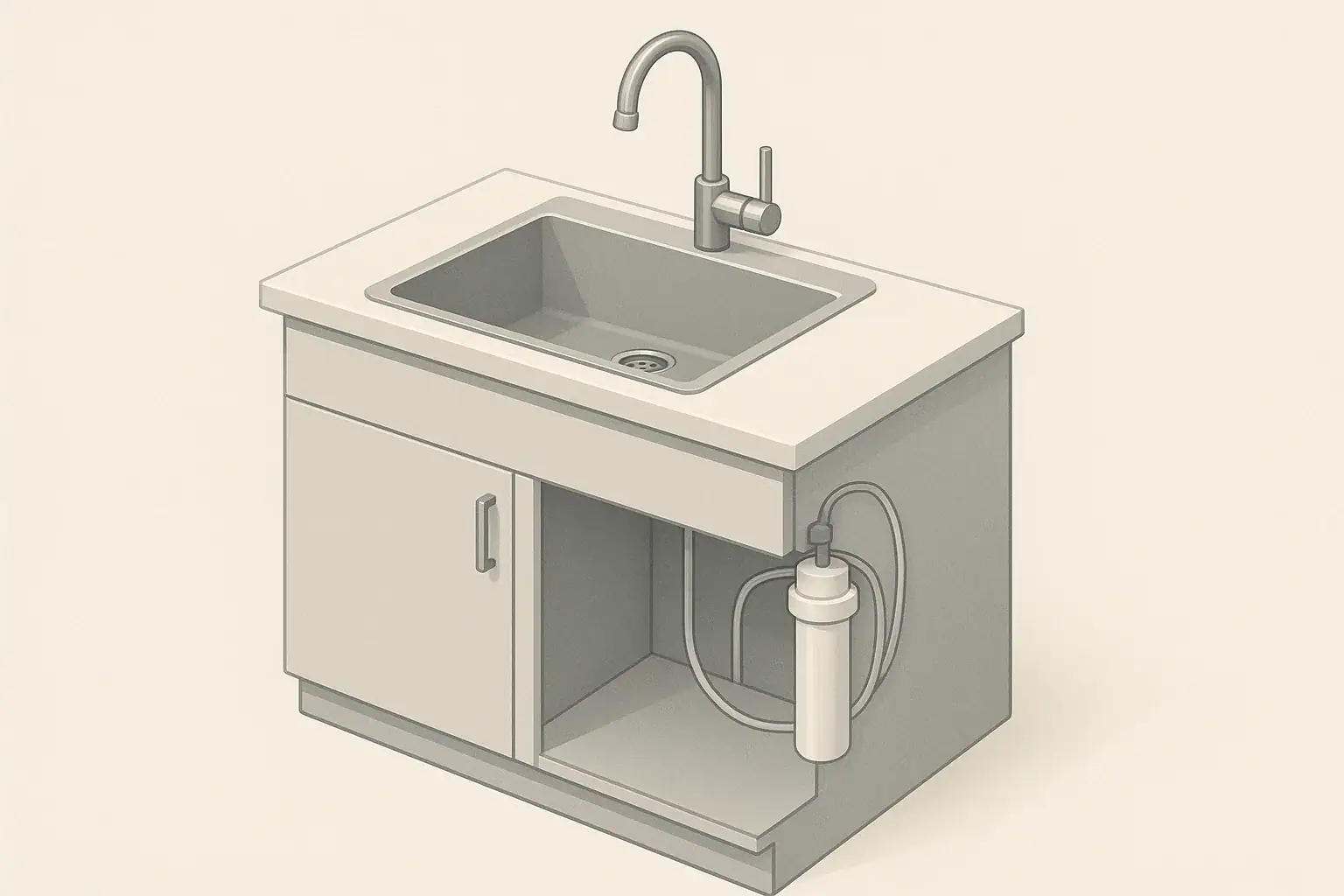
Why Under-Sink Filters Are Popular for Lead Reduction
Under-sink filters are a common choice for households concerned about lead in tap water. They install directly on the cold-water line under your kitchen sink and deliver filtered water either through your existing faucet or a dedicated drinking-water faucet. Because they treat water right before it reaches the tap, they can help reduce lead that may leach from household plumbing, fixtures, or service lines.
Compared with pitcher or faucet-mount filters, under-sink systems typically offer:
- Higher flow rates than most pitchers, so filling pots and bottles is faster.
- Larger filter capacity, which usually means fewer cartridge changes.
- Less countertop clutter, since equipment is hidden inside the sink cabinet.
- Flexible filter media choices, including carbon blocks and multi-stage cartridges that target lead along with chlorine, some organics, and sediment.
However, not every under-sink filter is designed for lead reduction. The most reliable way to know what a system is designed to reduce is to look at its third-party performance certifications. Those certifications, especially NSF/ANSI standards, are the focus of this article.
Key Lead-Related Certifications for Under-Sink Filters
Lead reduction claims on packaging can be confusing. Some labels emphasize that a product is “lead-free” (meaning the materials themselves contain very little lead), while others claim to reduce lead in water. These are not the same thing. For under-sink filters, you want to see independent testing to recognized standards for both:
- Material safety (how much the device itself leaches into water).
- Performance (how much it reduces specific contaminants like lead).
NSF/ANSI 53: Primary Standard for Lead Reduction
For most under-sink filters that are not full reverse osmosis systems, NSF/ANSI 53 is the key performance standard to look for when you care about lead. NSF/ANSI 53 covers “health effects” for point-of-use filters, including under-sink units, faucet-mount filters, and some countertop systems.
Under this standard, a manufacturer can claim “lead reduction” only if the product passes specific laboratory tests. The filter is challenged with water containing lead at defined test levels, and the effluent water must stay below a specified performance threshold throughout the test period. The details are handled by the testing lab; as a homeowner, what matters is that the filter is certified to NSF/ANSI 53 for lead reduction, not just generally “tested to NSF standards.”
NSF/ANSI 42: Taste and Aesthetics, Not Lead
NSF/ANSI 42 deals with aesthetic effects such as chlorine taste and odor, and sometimes particulate reduction. It is commonly listed on under-sink carbon filters and is useful if you want better-tasting water. However, NSF/ANSI 42 does not cover lead reduction performance. A filter certified only to 42 may improve taste but is not independently verified to reduce lead.
Filters can carry both standards. For lead concerns, look for language such as “NSF/ANSI 53 certified for lead reduction,” with 42 as an optional additional certification for taste and odor.
NSF/ANSI 58: Reverse Osmosis Systems
Some under-sink filters are full reverse osmosis (RO) systems rather than single-cartridge filters. RO units have their own standard, NSF/ANSI 58, which covers performance, including lead reduction, as well as structural integrity and other parameters. If you are considering an under-sink RO system, then “NSF/ANSI 58 certified for lead reduction” is an important phrase to look for.
RO systems can reduce many dissolved substances, but they also produce a separate waste stream and typically use a storage tank. They may be useful when you are concerned about multiple dissolved contaminants, but they involve more plumbing work and maintenance compared with a single under-sink cartridge.
NSF/ANSI/CAN 372: Lead-Free Materials
NSF/ANSI/CAN 372 is different from 42, 53, and 58. It addresses the lead content of the materials used in a product, such as fittings, valves, and faucet components. It is often summarized as a “lead-free” certification, reflecting plumbing codes that limit the weighted average lead content of wetted surfaces.
This standard does not verify lead removal from water. Instead, it helps confirm that the device itself should not be a significant source of lead. Ideally, an under-sink filter for lead concerns would show both:
- Certification to NSF/ANSI 53 or 58 for lead reduction, and
- Certification to NSF/ANSI/CAN 372 for low lead content in materials.
Other Relevant Claims and Standards
In addition to lead, many homeowners want under-sink filters to address other contaminants. You may see:
- NSF/ANSI 401 for certain “emerging compounds” such as some pharmaceuticals or chemical residues.
- Reduction claims for chlorine or chloramine (often under 42) to improve taste and odor.
- Particulate and turbidity reduction claims, which help remove fine particles and improve clarity.
These can be useful, but for lead specifically, the core performance standard remains NSF/ANSI 53 or 58.
Example values for illustration.
| Situation | Better Fit | Why It May Work Well |
|---|---|---|
| Occasional drinking water, limited space | Pitcher filter with lead certification | Portable, no installation; slower and smaller capacity than under-sink |
| Renting, cannot modify plumbing | Faucet-mount or compact under-sink with simple adapters | Usually installs without permanent changes; check compatibility with faucet |
| Daily cooking and drinking for several people | Standard under-sink cartridge certified for lead reduction | Higher flow and capacity; no counter space needed |
| Concerned about multiple dissolved contaminants | Under-sink RO system with NSF/ANSI 58 | Membrane can reduce a wide range of dissolved substances |
| Need filtered water at several taps | Combination of under-sink filter and other point-of-use devices | Target key fixtures without whole-house installation |
| Limited under-sink clearance or complex plumbing | Compact under-sink or above-sink countertop system | Reduces installation challenges while still improving water at point of use |
How to Read and Verify Under-Sink Filter Certifications
Packaging and marketing descriptions around certifications can be vague or misleading. Learning how to interpret labels and verify claims helps you select under-sink filters that truly address lead concerns.
Look for Exact Standard Names and Contaminant Listings
On the product box, data sheet, or manual, look for specific language such as:
- “Certified by an independent organization to NSF/ANSI 53 for lead reduction.”
- “Certified to NSF/ANSI 58 for lead reduction (for RO systems).”
- “Certified to NSF/ANSI 42 for chlorine taste and odor reduction.”
- “Certified to NSF/ANSI/CAN 372 for low lead content.”
The presence of the standard alone is not enough. The document should list which contaminants the filter is certified to reduce. Under NSF/ANSI 53, lead is one of several possible contaminants. If the listing is unclear, check the product’s performance data sheet for a table of contaminants and reductions.
Understand “Certified To” vs. “Tested To”
Some labels say a product was “tested to NSF standards” without using the word “certified.” In many cases, this means the manufacturer conducted its own tests according to NSF protocols but did not undergo independent certification. That is not the same as having a third-party organization verify the performance.
For more confidence in lead reduction claims, look for wording such as “certified by” followed by a recognized certification body, in combination with the specific standard number. Avoid relying solely on vague phrases such as “meets NSF guidelines” if lead is your primary concern.
Verify Listings with Certification Databases
If you want to double-check a certification, many third-party certifiers maintain public online databases where you can search by manufacturer, model number, or standard. While you do not need to use these tools every time, they can be helpful when:
- A product’s packaging seems unclear or incomplete.
- You are comparing several under-sink filters with similar claims.
- You want to confirm that a certification is current and has not expired.
When searching databases, ensure the model number you see on the product matches the listing exactly. Some manufacturers have multiple similar models with different certifications or configurations.
Match Certifications to Your Water Source
Before selecting a filter, it helps to understand your water supply. Some homeowners obtain recent water quality test reports from their public utility or have their household water tested by a laboratory. If lead is the primary concern, check whether it might be coming from:
- Service lines or street-side plumbing that may contain lead.
- Household plumbing and fixtures, especially in older buildings.
Under-sink filters certified for lead reduction are used at the tap, so they can address lead from both external and internal plumbing sources. If testing shows additional contaminants, you may also prioritize standards such as NSF/ANSI 401 or choose an RO system certified to NSF/ANSI 58.
Filter Types and Media Used for Lead Reduction
Within the category of under-sink filters, you will encounter different media and system designs. Certifications tell you what performance has been verified, but understanding the basic filter types helps you anticipate maintenance, flow, and space requirements.
Carbon Block and Specialty Media Cartridges
Many under-sink filters that are certified to NSF/ANSI 53 for lead reduction use carbon block cartridges, sometimes combined with specialty media. These cartridges are typically replaced as a single unit.
Common features include:
- Activated carbon for chlorine taste and odor reduction, and adsorption of some organic compounds.
- Fine particle filtration to help capture particulate-bound lead and sediment.
- Lead-selective media incorporated into the block or in a separate layer to enhance lead reduction.
Carbon block under-sink filters usually maintain a moderate flow rate suitable for drinking and cooking. Their certified capacity (the volume of water that can be treated before replacement) varies widely, so checking the performance data sheet is important when planning maintenance.
Multi-Stage Under-Sink Systems
Some under-sink configurations combine several cartridges, each targeting different types of contaminants. A typical arrangement might be:
- Stage 1: Sediment prefilter (for larger particles).
- Stage 2: Carbon block or lead-specific cartridge (for lead and chlorine).
- Stage 3: Additional media for taste polishing or other specific contaminants.
When reviewing multi-stage systems, check which stages are included in the certification. The documentation should show that the complete system, not just an individual cartridge, is certified for lead reduction to the relevant standard.
Under-Sink Reverse Osmosis (RO) Systems
Under-sink RO units use a semi-permeable membrane along with prefilters and postfilters. They often provide extensive reduction of dissolved substances, including lead, when certified to NSF/ANSI 58.
Key practical differences from non-RO under-sink filters include:
- Storage tank to hold filtered water, since RO production rate is slower.
- Waste line that carries reject water to the drain.
- More components, such as multiple cartridges and a membrane, each with its own replacement schedule.
For households focused primarily on lead and chlorine, a simpler under-sink cartridge system certified to NSF/ANSI 53 may be sufficient and easier to maintain. For broader contaminant concerns, an RO system may be considered, with awareness of its space and plumbing needs.
Practical Considerations: Sizing, Flow, and Installation
Certifications ensure that a filter can meet specific performance benchmarks under test conditions. At home, the way you install and use an under-sink filter also affects its performance and convenience.
Flow Rate and Water Pressure
Under-sink filters rely on your household water pressure to push water through the media. Typical municipal water pressure is often in the range of a few dozen pounds per square inch, but actual values vary by home and time of day. As a general pattern:
- Higher pressure usually supports better flow but can increase wear on components.
- Finer media or membranes tend to reduce flow compared with simpler sediment filters.
Many under-sink filter manuals specify a recommended pressure range. Installing pressure-reducing or shutoff components as directed helps protect the system and maintain performance closer to what was tested for certification.
Filter Capacity and Replacement Frequency
Every certified system has a tested capacity, or the amount of water processed before the performance tests were concluded. In practical terms, your actual replacement interval will depend on:
- How many people use the filtered tap.
- Whether you use it for cooking, drinking, and filling appliances like kettles.
- The sediment and particulate load in your incoming water.
Some households may replace cartridges every few months, while others may do so yearly. It is common to estimate daily filtered water use in gallons, compare it to the stated capacity, and then plan a replacement schedule with some safety margin.
Faucet Style: Dedicated vs. Existing Faucet
Under-sink filters may connect to:
- A dedicated drinking-water faucet that is installed on the sink deck or countertop.
- The main kitchen faucet, filtering all cold water from that tap.
A dedicated faucet can conserve filter capacity by limiting use to drinking and cooking. Integrating the filter with the main faucet is convenient but typically sends more water through the filter, which may shorten intervals between cartridge replacements.
Plumbing and Space Requirements
Before selecting a system, check your under-sink cabinet for:
- Vertical clearance sufficient for the cartridge housing and for removing the cartridges.
- Available mounting surfaces for brackets on the cabinet wall or back panel.
- Existing shutoff valves and accessible cold-water lines.
Some drilling new faucet holes or modifying rigid plumbing connections may be beyond the scope of a casual DIY install and could require a plumber.
Maintenance and Monitoring for Ongoing Lead Reduction
Certifications provide assurance at the time of testing, but ongoing performance depends on proper maintenance. Overused or clogged filters may no longer perform as expected and can affect taste and flow.
Following Manufacturer Replacement Guidelines
Each under-sink system specifies either:
- A maximum capacity (for example, a general range of hundreds to thousands of gallons), and/or
- A recommended time interval (for example, every several months), whichever comes first.
These values are typically based on lab testing plus practical experience. For lead reduction, it is important to avoid extending cartridges far beyond the stated limits, even if water still tastes acceptable. As filters load with contaminants and particulates, their ability to reduce lead can decline.
Visible and Functional Signs It Is Time to Replace
While you should not rely solely on appearance or taste, certain observations can help you track filter condition:
- Notable drop in flow rate at the filtered tap.
- Return of chlorine taste or odor if your filter is also certified for aesthetic reduction.
- Cloudy water that persists after running the tap, if clarity previously improved with the filter.
These cues, combined with calendar reminders and estimated water usage, help you stay ahead of performance decline.
Periodically Reviewing Water Quality Information
Over time, conditions can change. It can be useful to:
- Check updated water quality reports from your utility if you are on public water.
- Repeat lab testing occasionally if you use a private well or have unique plumbing.
- Reassess whether your current filter certifications match your priority contaminants.
If new concerns arise beyond lead and chlorine, you may decide to add or change devices within your home’s overall filtration setup, while still keeping NSF/ANSI-certified lead reduction at key taps.
Example values for illustration.
| Standard | Main Focus | What to Verify on Documentation |
|---|---|---|
| NSF/ANSI 42 | Aesthetic effects (chlorine, taste, odor, particulates) | That the system is listed as certified to 42 and the specific aesthetic contaminants you care about are named |
| NSF/ANSI 53 | Health-related contaminants, including lead | That the system is certified to 53 and explicitly lists lead reduction among its certified claims |
| NSF/ANSI 58 | Reverse osmosis systems, including lead and other dissolved substances | That the complete RO system, not only individual cartridges, is certified and lists lead among the performance claims |
| NSF/ANSI 401 | Selected “emerging compounds” (such as some pharmaceuticals and chemicals) | Which specific compounds were tested, and whether they match any concerns beyond lead |
| NSF/ANSI/CAN 372 | Low lead content of product materials | That the product is marked as compliant with 372, indicating reduced lead content in wetted surfaces |
| Performance data sheet | Summary of tested reductions and capacities | That lead appears in the contaminant list, with clearly stated conditions and limits for use |
Putting Certifications in Context With Your Home Water Setup
Under-sink filters are one part of a broader approach to managing home water quality. When choosing or upgrading a system, it helps to consider:
- How many locations in your home need certified lead reduction.
- Whether other contaminants such as chlorine, particulates, or specific chemicals are also priorities.
- Your willingness to maintain filters on a schedule that preserves certified performance.
- Compatibility with existing plumbing and available space under your sink.
By focusing on clear, verifiable certifications—especially NSF/ANSI 53 or 58 for lead reduction and NSF/ANSI/CAN 372 for low lead content materials—you can select under-sink filters that align with your water quality goals, use them within their tested limits, and fit them into an overall plan for managing water throughout your home.
Frequently asked questions
How can I verify an under-sink filter is actually certified to reduce lead?
Look for specific documentation that states the product is certified to NSF/ANSI 53 for lead reduction or NSF/ANSI 58 for RO systems, and check the product performance data sheet for lead listed among tested contaminants. Then confirm the exact model number in the certification body’s public online database to ensure the certification is current and matches your model.
Does NSF/ANSI 42 certification mean a filter reduces lead?
No. NSF/ANSI 42 covers aesthetic improvements such as chlorine taste and odor and some particulate claims but does not verify lead removal. For verified lead reduction, choose products certified to NSF/ANSI 53 or NSF/ANSI 58 and ideally also certified to NSF/ANSI/CAN 372 for low lead materials.
Are reverse osmosis under-sink systems always better for lead than carbon block cartridges?
RO systems certified to NSF/ANSI 58 generally reduce a broad range of dissolved contaminants including lead, but a carbon block system certified to NSF/ANSI 53 can also provide effective lead reduction. Consider other trade-offs such as space, RO waste water and storage tank needs, flow rate, and which contaminants are priorities when choosing.
How often should I replace cartridges to keep lead reduction performance?
Follow the manufacturer’s recommended replacement interval or the tested capacity shown on the performance data sheet; actual replacement frequency depends on household usage and incoming water quality. Avoid extending cartridge life beyond stated limits, since lead reduction ability can decline as the filter loads with contaminants.
Will an under-sink filter certified for lead protect me if my service line contains lead?
A point-of-use under-sink filter certified for lead will reduce lead at that tap and can protect drinking and cooking water even if the service line contains lead, but it only protects the fixtures where it is installed. If service-line lead is suspected, also consider broader remediation steps and periodic water testing.
Recommended next:
- NSF/ANSI standards explained (42/53/401/58)
- Clear trade-offs: pitcher vs faucet vs under-sink vs RO
- Maintenance planning: cost per gallon and replacement cadence