
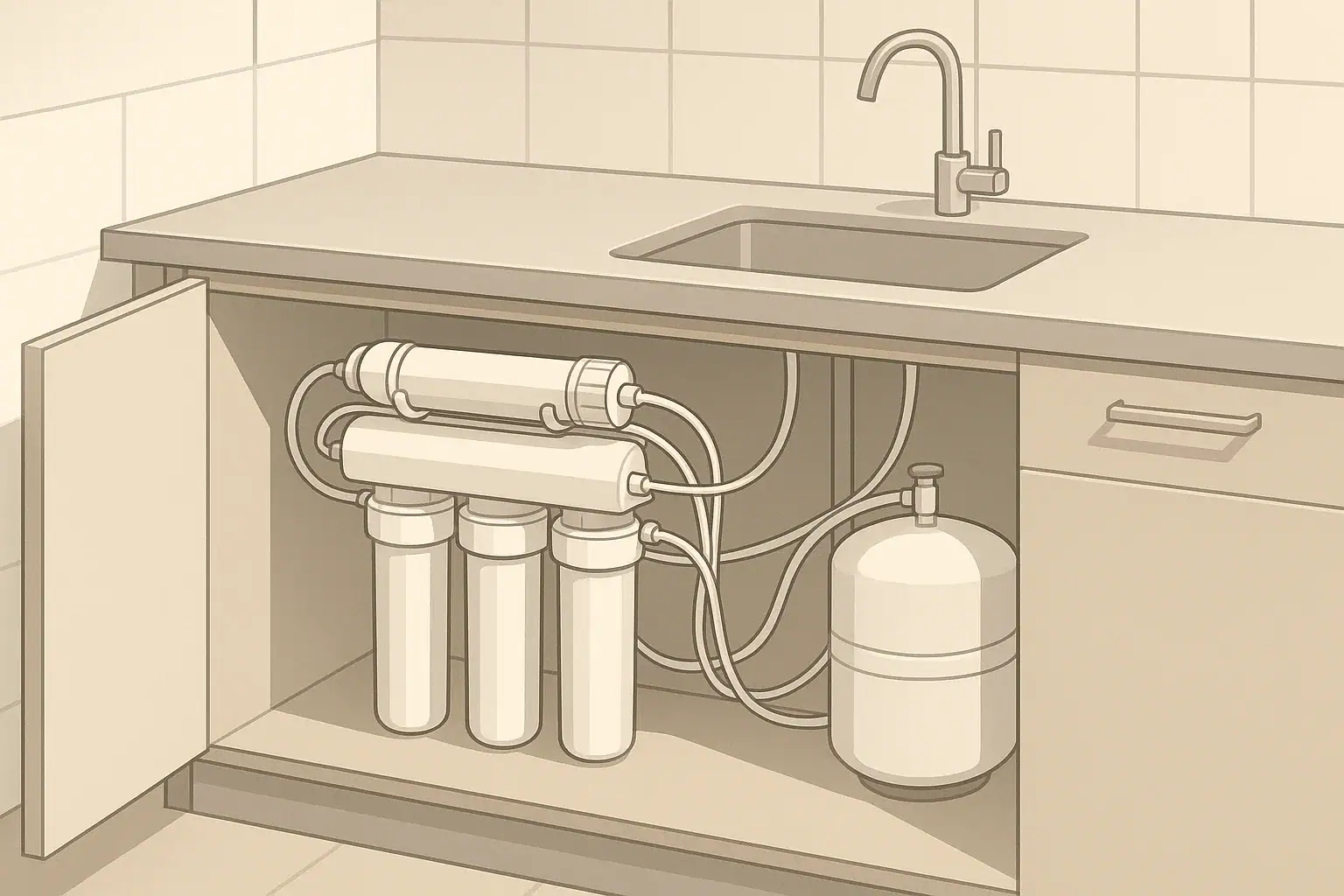
Reverse osmosis (RO) is a type of under-sink filtration that uses water pressure and a semi-permeable membrane to separate treated water from many dissolved substances. It is commonly used when people want lower total dissolved solids (TDS) or reduction of particular contaminants at a drinking-water tap.
In a typical home RO system, water passes through several components:
- Sediment prefilter – captures sand, silt, rust, and other particles.
- Carbon prefilter – commonly reduces chlorine and protects chlorine-sensitive membranes. Chloramine reduction requires a filter with a specific chloramine claim.
- RO membrane – separates treated water from a concentrated stream containing many of the rejected dissolved substances.
- Storage tank – stores treated water because conventional residential RO systems produce it gradually.
- Post-filter – often uses activated carbon to address taste or odor before water reaches the faucet.
The contaminants a system is proven to reduce depend on the complete model and cartridge configuration—not simply on the presence of an RO membrane. For a contaminant of concern, check the system’s certification listing and performance data sheet.
How Reverse Osmosis Works in a Home Kitchen
Incoming pressure pushes part of the feed water through the membrane. Treated water travels to the tank or faucet, while a separate concentrate stream carries rejected material to the drain. Production rate, recovery, and contaminant reduction depend on factors such as pressure, temperature, feed-water chemistry, membrane condition, and system design.
A point-of-use unit normally treats only water delivered through its dedicated faucet. It does not treat showers, laundry, or other household fixtures unless they are separately connected to it.
What Reverse Osmosis Can Reduce
RO systems can be certified for substantial reduction of numerous dissolved contaminants. However, a broad statement that “RO removes” a substance is not enough to establish the performance of a particular product. The U.S. Environmental Protection Agency notes that contaminant-reduction claims beyond the core requirements of an RO standard must be individually tested and certified. See the EPA’s guidance on point-of-use reverse osmosis systems.
Dissolved Salts and Minerals (TDS)
Lowering total dissolved solids is a central use of residential RO. TDS includes dissolved ions such as calcium, magnesium, sodium, chloride, sulfate, and others. Reduction changes the mineral content and may change the water’s taste.
A TDS claim does not identify which individual contaminants are present, nor does a low TDS reading prove that a particular contaminant has been reduced to a safe concentration.
Metals, Fluoride, and Nitrate
Complete RO systems may carry certified claims for substances such as lead, copper, cadmium, chromium, fluoride, nitrate, and nitrite. These claims are model-specific. Verify the exact system name, replacement elements, operating conditions, and named contaminant in an official certification record or performance data sheet.
This distinction matters for nitrate in particular. A product’s claim may apply only below stated feed-water concentrations and within a defined pressure range. If nitrate or nitrite is the reason for treatment, start with a laboratory analysis of the source water and follow any testing or monitoring instructions in the product manual.
Organic Chemicals and Disinfectants
Some complete RO systems combine the membrane with activated carbon and are certified for selected organic chemicals. Carbon stages may also address disinfectant taste and odor. Performance varies by chemical and filter design, so look for the exact compound or disinfectant on the product’s certified claims.
Chlorine and chloramine are separate claims. A filter certified for chlorine reduction should not be assumed to have a chloramine claim. NSF’s contaminant-reduction claims guide lists them separately.
Particles and Sediment
A sediment prefilter can capture material such as sand, silt, and rust before it reaches the membrane. This helps limit fouling and protects downstream components. The size and capacity of the prefilter vary by system.
Do not infer a microplastics claim solely from the use of an RO membrane. If microplastics are a specific concern, look for evidence applying to the exact product and particle sizes in question.
A Concrete Certified-Reduction Example
The Pentair FreshPoint GRO-350B illustrates why the exact configuration matters. NSF’s official NSF/ANSI 58 listing for Pentair, current October 30, 2026, identifies the GRO-350B with FDF1-RC, GRO50-RC, and F1GC-RC replacement elements. Its listed claims include TDS, fluoride, lead, nitrate/nitrite, copper, cadmium, chromium, barium, radium, selenium, turbidity, and cyst reduction.
The manufacturer’s performance data for that exact configuration reports laboratory average reductions of 96.9% for TDS, 93.6% for fluoride, 98.6% for lead, 83.5% for nitrate/nitrite, 98.5% for copper, 99.1% for cadmium, 96.4% for hexavalent chromium, and 98.2% for trivalent chromium.
Those percentages are an example, not a generic RO guarantee. They apply to the named model and cartridges under the manufacturer’s test conditions and challenge concentrations. The same manual limits its nitrate/nitrite application to feed water containing no more than 27 mg/L nitrate plus 3 mg/L nitrite, measured as nitrogen, and requires at least 30 psi for that application. The system’s general listed feed-pressure range is 40–100 psi. Pentair also recommends periodic testing when the system is relied on for nitrate reduction.
| Aspect | Reverse Osmosis System | Basic Carbon Filter |
|---|---|---|
| Main treatment components | RO membrane plus prefilters and often a post-filter | Granular or block activated carbon, sometimes with a particle screen |
| Total dissolved solids | Designed to reduce TDS; verify certified performance for the model | Not generally intended for broad TDS reduction |
| Chlorine taste and odor | Usually addressed by a carbon stage with an applicable claim | May be reduced when the product carries that claim |
| Fluoride or nitrate | Available on some systems as individually certified claims | Not established unless specifically claimed and certified |
| Metals | Some models have claims for named metals | Some models have claims for named metals |
| Water use | Produces a treated stream and a concentrate stream sent to drain | Normally has no comparable concentrate stream |
| Installation | Usually plumbed under the sink with a dedicated faucet | Available as pitcher, faucet-mount, countertop, or under-sink formats |
What RO Does Not Automatically Remove
RO is not a universal guarantee. A membrane may perform differently across chemicals, and the complete system can lose performance when operated outside its specified conditions or maintained incorrectly.
Chlorine and Chloramine Require the Right Carbon Stage
The membrane is not normally the system’s principal treatment stage for chlorine or chloramine. Residential systems commonly use carbon before the membrane, both to address applicable disinfectants and to protect chlorine-sensitive membrane material.
- Confirm whether the carbon stage has a chlorine claim, a chloramine claim, or both.
- Replace it according to the manufacturer’s capacity or service schedule.
- Do not assume that an ordinary chlorine filter also handles chloramine.
Organic Compounds Vary
Reduction of organic chemicals depends on the compound and on the complete combination of carbon and membrane stages. A general claim about “chemicals” or “VOCs” should not replace a certification listing that names the contaminant.
If a water report or laboratory result identifies a specific organic contaminant, compare that exact name with the product’s certified claims and performance sheet.
RO Is Not Automatically a Disinfection System
The CDC describes RO as capable of removing germs, including parasites, bacteria, and viruses. That does not mean every household RO product is certified as a primary disinfection system. The CDC recommends choosing treatment according to the germs or chemicals present in the water; see its guidance on choosing home water filters.
Product instructions may warn against using a system on microbiologically unsafe water or water of unknown quality without adequate disinfection before or after treatment. Membrane condition, seals, storage tanks, tubing, and sanitation all affect the complete installation. For an untreated private supply, obtain an appropriate water analysis and select disinfection and filtration around the results rather than treating RO as the sole safeguard.
RO vs. Other Home Filtration Options
RO is one option among pitcher filters, faucet-mount units, under-sink carbon blocks, and whole-house treatment. For a broader format comparison, see under-sink vs. pitcher filters or pitcher vs. under-sink vs. RO.
When RO May Make Practical Sense
RO may be appropriate when:
- You want substantial TDS reduction at a specific tap.
- Your water analysis identifies a contaminant for which a particular system has a certified claim.
- You accept the installation space, maintenance, and concentrate-water requirements.
- The home’s pressure, temperature, and feed-water quality fall within the model’s limits.
When Another Filter Type May Be Enough
A simpler filter may fit better if the goal is limited to sediment or a certified chlorine taste-and-odor claim. Carbon filters generally retain dissolved minerals and do not produce an RO concentrate stream. Compare exact claims rather than choosing solely by filter format. This RO vs. carbon under-sink comparison explains the practical differences.
Start With Your Water and the Performance Sheet
Selecting treatment should begin with information about the incoming water. For public water, review the utility’s current consumer confidence report and consider testing for issues that can arise in the home’s plumbing. Private-well owners need a suitable laboratory analysis because the utility does not monitor the household supply.
Match the results against all of the following:
- The exact contaminant-reduction claim for the system and installed cartridges.
- Maximum feed concentrations or other limits attached to that claim.
- Required water pressure and allowable temperature.
- Production rate and storage capacity.
- Replacement capacity, service interval, and sanitation instructions.
- Any requirement for periodic follow-up testing.
For example, Pentair’s GRO-350B specification lists 40–100 psi and 40–100°F as operating ranges. It gives approximate lives of one year for its pre- and post-filters and 18 months for its membrane, while stating that cartridge life depends on water quality and use. Those intervals apply to that model; use the schedule supplied for your own system.
Understanding TDS and Certifications
Using TDS as a Rough Operational Check
A handheld conductivity-based TDS meter can compare feed water with water from the RO faucet. To calculate the apparent reduction:
TDS reduction (%) = [(feed TDS − RO-water TDS) ÷ feed TDS] × 100
Take comparable samples and follow the meter’s instructions. A sustained increase in product-water TDS while feed-water TDS remains similar can justify checking prefilter condition, membrane installation or age, pressure, and concentrate-flow restrictions according to the manufacturer’s troubleshooting procedure.
A TDS meter cannot identify lead, nitrate, fluoride, microorganisms, or an organic chemical. It therefore cannot confirm a specific health-related reduction claim. Use suitable laboratory testing when confirmation of a particular contaminant is needed.
What NSF/ANSI Standards Tell You
- NSF/ANSI 42 addresses specified aesthetic claims, such as chlorine taste and odor, when included in a product’s certification.
- NSF/ANSI 53 addresses specified contaminant-reduction claims with health effects.
- NSF/ANSI 58 applies to reverse osmosis drinking-water treatment systems and includes requirements for the RO process. Additional contaminant claims must be identified for the particular certified system.
- NSF/ANSI 401 covers specified incidental or emerging-compound claims when the product is certified for them.
A standard number alone does not mean the product reduces every substance associated with that standard. Search the certifier’s official listing for the exact model and then verify the named claims, replacement components, rated conditions, and performance data sheet. For more detail, see NSF/ANSI 58 explained.
| Item | What to Verify |
|---|---|
| Model | The complete model number matches the installed system |
| Replacement elements | The cartridge and membrane numbers match the certified configuration |
| Reduction claim | The contaminant is named rather than implied by the standard number |
| Operating limits | Feed pressure, temperature, concentration, and other conditions fit the installation |
| Capacity and maintenance | The rated capacity and replacement instructions are practical for the household |
| Certifier | The claim appears in the independent certifier’s official current listing |
Maintenance, Cost per Gallon, and Troubleshooting
RO performance depends on timely maintenance. Follow the schedule for the exact model rather than applying one universal interval. The EPA’s November 2024 point-of-use RO systems report says manufacturers’ instructions should control and gives broad examples of about six months for prefilters and one to five years for membranes, depending on water quality and use.
For a more focused planning guide, see this RO filter replacement schedule.
Typical Maintenance Tasks
- Replace sediment, carbon, membrane, and polishing stages at the specified capacity or interval.
- Use the cartridge numbers required for the certified configuration.
- Sanitize the housings, tank, and lines when directed by the manufacturer.
- Check for leaks after service and confirm that the tank refills normally.
- Keep a record of installation dates, replacements, TDS comparisons, and relevant laboratory results.
Estimating Cost per Gallon
Add the annualized cost of prefilters, post-filters, membranes, required testing, and other maintenance. Divide that amount by the household’s measured annual volume from the RO faucet. Water and wastewater charges associated with the concentrate stream can be added when local rates and the system’s measured or rated water use are known.
This creates a household-specific estimate rather than relying on a generic consumption assumption. For another cost framework, see the pitcher filter vs. bottled water cost-per-gallon breakdown.
Troubleshooting Cues
Check the manual or arrange service if you notice:
- Slower flow or a tank that does not refill as expected.
- A persistent change in taste, odor, or appearance.
- A sustained increase in RO-water TDS relative to comparable feed-water readings.
- Continuous drain flow outside the behavior described by the manufacturer.
- Leaks, damaged tubing, or evidence that a cartridge or membrane is not seated correctly.
Possible causes include low inlet pressure, clogged prefilters, membrane age or installation problems, restricted concentrate flow, tank-pressure issues, or valve faults. Use the model-specific troubleshooting sequence rather than diagnosing a particular contaminant from taste or TDS alone.
Frequently Asked Questions
Can reverse osmosis reduce fluoride and nitrate?
Some complete RO systems have certified fluoride and nitrate/nitrite claims. Confirm the exact model and cartridges in an official listing. For nitrate, also check maximum feed concentration, pressure requirements, and any instructions for periodic testing.
Does RO remove bacteria and viruses?
RO can provide a barrier to germs, but that does not make every residential unit a certified primary disinfection system. Follow the product’s microbiological-use warning. Water that is microbiologically unsafe or of unknown quality may require adequate disinfection and appropriate testing.
Will an RO system remove chlorine and chloramine?
Residential RO systems generally rely on carbon stages rather than the membrane as the main treatment for these disinfectants. Chlorine and chloramine are separate claims, so choose a system whose certified claim matches the disinfectant used by the water supplier. For background on carbon filtration, see this guide to chlorine-focused pitcher filters.
How often should RO filters and the membrane be replaced?
Use the manufacturer’s capacity and replacement schedule. Water quality and use can shorten service life, so there is no universal interval that applies to every system.
How can I check whether an RO system is working?
Compare feed-water and RO-water TDS under similar conditions, monitor flow and tank behavior, and keep up with scheduled service. TDS is only an operational clue; laboratory testing is needed to confirm the concentration of a specific contaminant.
Recommended next:
- NSF/ANSI standards explained (42/53/401/58)
- Clear trade-offs: pitcher vs faucet vs under-sink vs RO
- Maintenance planning: cost per gallon and replacement cadence