
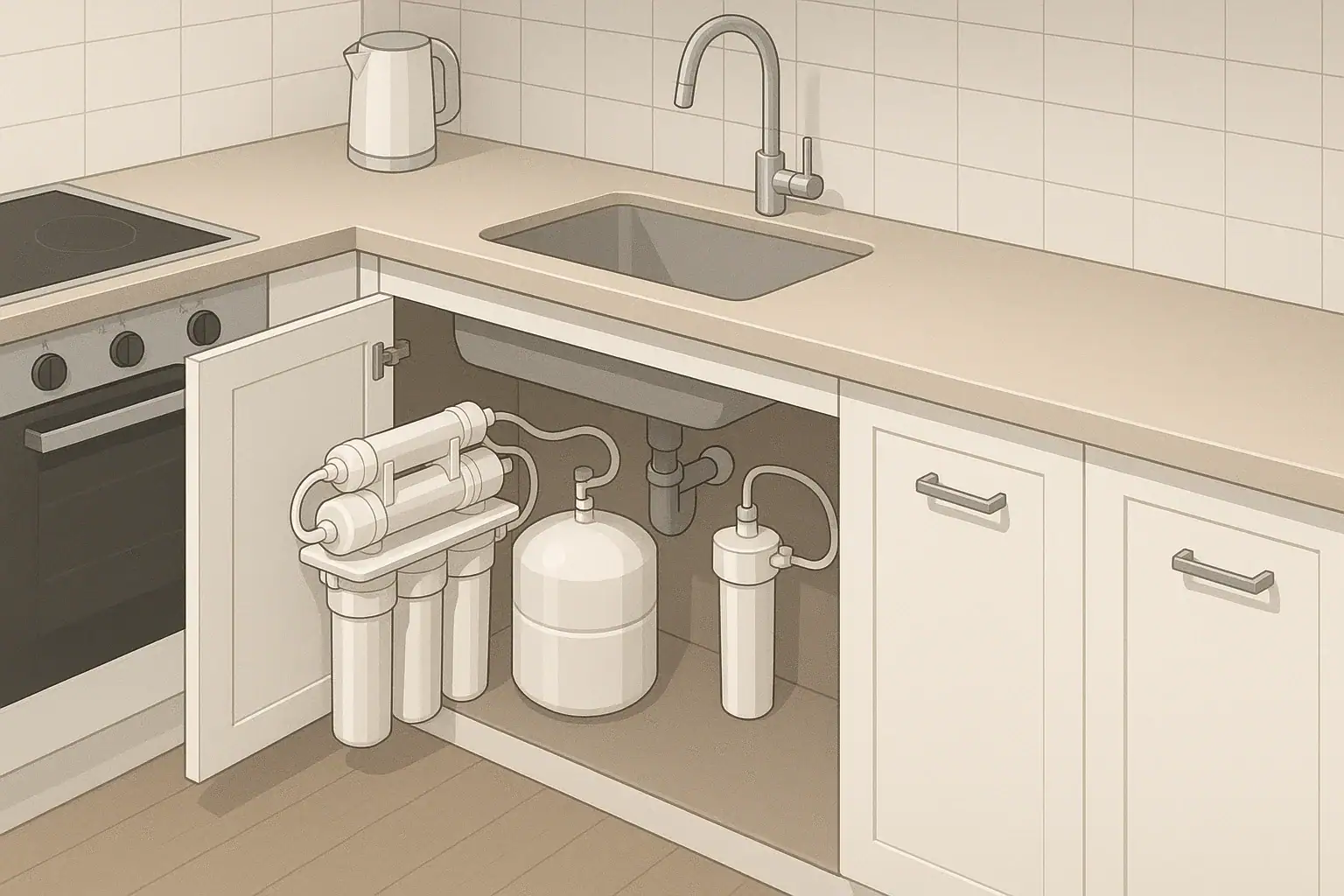
Under-sink water filters fall into two broad categories: carbon-based systems and reverse osmosis (RO) systems. Both mount under the kitchen sink and deliver filtered water to a dedicated faucet or the main tap, but they work differently and produce different results for taste, total dissolved solids (TDS), and ongoing maintenance.
Carbon under-sink filters typically use activated carbon (often in combination with sediment or specialty media) to reduce chlorine taste and odor and selected contaminants. They are usually flow-through systems: water pressure pushes tap water through the filter and straight to the faucet.
RO systems are multi-stage setups that include one or more prefilters, a semi-permeable membrane, and usually a small storage tank. They can significantly lower TDS and many dissolved contaminants but also send some water to the drain as part of the process.
Choosing between them comes down to priorities: taste vs. mineral content, how you interpret TDS readings, installation space, and how much maintenance complexity you are comfortable with.
Overview: Two Very Different Under-Sink Systems
Under-sink water filters fall into two broad categories: carbon-based systems and reverse osmosis (RO) systems. Both mount under the kitchen sink and deliver filtered water to a dedicated faucet or the main tap, but they work differently and produce different results for taste, total dissolved solids (TDS), and ongoing maintenance.
Carbon under-sink filters typically use activated carbon (often in combination with sediment or specialty media) to reduce chlorine taste and odor and selected contaminants. They are usually flow-through systems: water pressure pushes tap water through the filter and straight to the faucet.
RO systems are multi-stage setups that include one or more prefilters, a semi-permeable membrane, and usually a small storage tank. They can significantly lower TDS and many dissolved contaminants but also send some water to the drain as part of the process.
Choosing between them comes down to priorities: taste vs. mineral content, how you interpret TDS readings, installation space, and how much maintenance complexity you are comfortable with.
How RO and Carbon Under-Sink Filters Work
Understanding how each system treats water helps explain differences in taste, TDS, and upkeep.
Carbon Under-Sink Filtration Basics
Carbon under-sink filters use a cartridge filled with activated carbon, often in block or granular form. Some cartridges add extra layers for sediment, scale reduction, or specific contaminants.
Key points about how carbon filters work:
- Adsorption: Activated carbon has a large internal surface area that attracts and holds many chemicals, especially chlorine and various organic compounds that influence taste and odor.
- Mechanical filtration: The carbon block or added sediment media strains out particles above a certain size (for example, rust, sand, or fine sediment).
- Targeted performance: Performance depends on the carbon type, any additional media, and whether the filter has relevant NSF/ANSI certifications.
Water flows through the cartridge and directly to the faucet, usually at a relatively high flow rate compared with RO. Carbon filters generally do not substantially reduce TDS because they mainly remove chemicals and particles, not most dissolved minerals.
Reverse Osmosis System Basics
RO systems push water through a semi-permeable membrane that allows water molecules to pass while rejecting many dissolved substances. Most under-sink RO systems also include several other stages.
Typical RO components include:
- Sediment prefilter: Helps protect the membrane from sand, rust, and other particles.
- Carbon prefilter: Reduces chlorine or chloramine that can damage the membrane and improves taste and odor.
- RO membrane: The main stage that significantly lowers TDS and many dissolved contaminants.
- Postfilter (often carbon): Polishes taste after water leaves the storage tank.
- Storage tank: Holds RO water so you can get reasonable flow at the faucet despite the slow membrane process.
During RO, some incoming water carries away the rejected contaminants to the drain. The ratio of filtered water to drain water varies by system design and conditions.
| Priority | Carbon under-sink | RO under-sink |
|---|---|---|
| Chlorine taste & odor | Generally very effective when certified | Also effective via pre/post carbon stages |
| TDS reduction | Minimal impact on TDS readings | Substantial TDS lowering compared with tap |
| Flow rate at faucet | Usually higher and closer to tap flow | Often lower, limited by tank and tubing |
| Under-sink space needed | 1–2 cartridges; compact footprint | Multiple housings plus storage tank |
| Installation complexity | Simpler; fewer connections | More complex; drain connection required |
| Filter change frequency | Typically every few months to a year | Prefilters every few–12 months; membrane less often |
| Water use efficiency | No intentional drain water | Produces some drain water during operation |
Taste and Mouthfeel: What You Actually Notice
Most people care first about how water tastes and smells. Both systems can noticeably improve flavor compared with untreated municipal tap water, but they do it differently.
Taste Changes with Carbon Under-Sink Filters
Carbon filtration is especially known for improving flavor by reducing chlorine and many compounds that cause musty, earthy, or chemical notes.
Typical taste-related effects from a quality carbon under-sink system include:
- Softer chlorine smell: Municipal tap water often has a noticeable pool-like scent that carbon can reduce significantly.
- More neutral flavor: Many users describe the water as cleaner or fresher without major changes to its natural mineral character.
- Stable mineral profile: Because carbon does not remove most dissolved minerals, water often retains a familiar mouthfeel.
If your water utility already manages taste very well, you may notice a more modest difference, such as slightly less odor and a cleaner finish.
Taste Changes with Reverse Osmosis
RO alters both the flavor and the mineral composition. By removing a large portion of dissolved solids, RO water typically tastes different from both tap water and carbon-only filtered water.
Common flavor and mouthfeel observations with RO water:
- Very neutral or light taste: Many people find RO water mild and smooth because many salts and metals are reduced.
- Lower “mineral bite”: Hardness minerals (calcium, magnesium) contribute to a certain crispness; when reduced, the water can feel softer on the tongue.
- Consistency: RO systems can make water taste more consistent if your source water chemistry changes seasonally.
Some drinkers prefer the more mineral-forward taste of carbon-filtered water, while others like the very neutral profile of RO. Taste preference is subjective, so if possible, tasting both types of water beforehand can be helpful.
TDS Numbers: What They Do and Do Not Mean
TDS (total dissolved solids) meters are widely used to compare tap water, RO water, and filtered water. However, TDS readings alone do not define safety or overall water quality.
TDS and Carbon Under-Sink Filters
Carbon filters primarily affect chemicals that influence taste and odor, plus certain other contaminants depending on the filter design. These changes often do not show up clearly on a consumer TDS meter.
With a carbon under-sink filter, you can expect:
- TDS readings similar to tap water: Minerals that contribute to TDS (like calcium and magnesium) remain largely unchanged.
- Better taste despite similar TDS: Removing chlorine and many organic compounds can dramatically improve flavor, even if the TDS value barely moves.
- Possible slight changes: In some cases, there may be small shifts in TDS if certain dissolved substances are removed, but large drops are uncommon.
A high TDS reading after carbon filtration does not automatically indicate poor filtration performance. It often reflects the mineral content that was present in the original water.
TDS and Reverse Osmosis Systems
RO membranes are designed to reject many dissolved solids, so you would usually see a noticeable drop in TDS numbers compared with tap water.
With an RO system in typical household conditions, you may see:
- Significant TDS reduction compared with tap: Many dissolved salts and metals are reduced, sometimes to a fraction of the incoming level.
- Stable low TDS while the membrane is healthy: When the RO membrane and prefilters are functioning properly, readings often remain consistently lower than tap water.
- Gradual TDS increase as the membrane ages: Rising TDS over time can signal that the membrane may be approaching replacement.
It is important to remember that extremely low TDS is not necessarily “better” for every application, and TDS meters do not detect many specific contaminants. They are mainly a quick trend indicator for dissolved solids.
Maintenance: Filter Changes, Complexity, and Monitoring
Maintenance is one of the biggest day-to-day differences between carbon under-sink systems and RO systems. Both need regular attention, but the number of parts and tasks is not the same.
Maintaining a Carbon Under-Sink Filter
Carbon under-sink systems are usually straightforward. Routine maintenance focuses on timely cartridge replacement and occasional checks for leaks or flow issues.
Common tasks include:
- Cartridge replacement: Typically every few months up to about a year, depending on cartridge capacity, water quality, and usage.
- Flushing new filters: Running water for a short period after installing a new cartridge to remove carbon fines and air.
- Monitoring flow rate: Noticeable drop in flow can indicate a clogged cartridge that needs replacement.
- Visual inspections: Occasional checks under the sink for moisture around fittings and housings.
You usually deal with one or two cartridges, making scheduling and budgeting for replacements simpler.
Maintaining a Reverse Osmosis System
RO systems have more stages and parts, so maintenance is more involved. However, most tasks are still manageable for typical homeowners who are comfortable working under the sink.
Typical RO maintenance tasks include:
- Sediment and carbon prefilter changes: Often every several months to a year, depending on water quality and usage. These protect the membrane and maintain flow.
- RO membrane replacement: Performed less frequently than prefilters. Timing depends on feed water quality, usage, and how well prefilters are maintained.
- Postfilter (polishing filter) changes: Usually on a similar schedule to prefilters or slightly longer, depending on design.
- Periodic sanitization: Some owners choose to sanitize the storage tank and lines at intervals, following the manufacturer’s instructions.
- TDS trend checks: A simple TDS meter can help track membrane performance over time.
Because RO systems have more connections, there are more potential leak points to monitor, especially after filter or membrane changes.
Space, Installation, and Plumbing Considerations
Even if taste and TDS point clearly in one direction, practical installation details can push a household toward one system or the other.
Space Requirements Under the Sink
Cabinet space is often the deciding factor.
- Carbon under-sink filters: Usually one or two slim cartridges mounted on the cabinet wall or standing upright. They take up relatively little floor space, leaving more room for cleaning supplies and other items.
- RO systems: Multiple stages plus a storage tank occupy more room. The tank often takes up a noticeable portion of the cabinet floor area.
Measuring available dimensions under your sink before choosing a system can avoid installation surprises.
Plumbing Connections and Complexity
Both systems typically require tapping into the cold-water line and installing a dedicated drinking water faucet or connecting to an existing compatible one. The main difference is the additional drain connection required for RO.
Key plumbing differences:
- Carbon under-sink systems:
- No dedicated drain line.
- Fewer fittings and tubes overall.
- Installation often quicker for those comfortable with basic plumbing.
- RO systems:
- Require a connection to the sink drain for reject water.
- Include more tubing between prefilters, membrane, tank, and faucet.
- May require more careful routing to avoid kinks and ensure proper drainage.
In some homes, local plumbing codes or building rules may influence how the drain connection can be made, which can affect installation decisions.
Certifications and Performance Claims
NSF/ANSI certifications help translate marketing claims into standardized, verified performance. For under-sink filters, several standards commonly apply, especially NSF/ANSI 42, 53, 58, and 401.
Carbon Under-Sink Filters and Common Standards
Carbon systems are often tested and certified under standards that cover aesthetic improvements, certain metals, and selected emerging contaminants. The exact claims depend on the specific cartridge.
Relevant standards for many carbon under-sink filters include:
- NSF/ANSI 42: Typically covers reduction of chlorine taste and odor and particulate matter, focusing on aesthetic aspects of water quality.
- NSF/ANSI 53: Addresses reduction of selected contaminants of health concern, such as certain heavy metals and other specified substances, depending on the filter.
- NSF/ANSI 401: Applies to reduction of selected emerging compounds (for example, some pharmaceuticals and personal care products) when the product is tested and certified for them.
For any carbon filter, it is important to review which specific contaminants and performance claims are listed in its documentation, not just the standard number.
RO Systems and Common Standards
RO systems may carry certifications associated with both their carbon stages and the RO membrane performance.
Typical standards for RO systems include:
- NSF/ANSI 58: A reverse osmosis system standard that covers structural integrity, material safety, and performance claims for TDS reduction and other tested contaminants.
- NSF/ANSI 42 and 53: Sometimes also applicable to the carbon prefilters or postfilters for aesthetic or selected contaminant claims.
- NSF/ANSI 401: In some cases, if the system has been tested and certified for selected emerging compounds.
When evaluating RO systems, look for documentation that clearly states which standards the entire system, not just individual components, has been tested and certified to.
| Standard | Common focus area | What to verify on a system |
|---|---|---|
| NSF/ANSI 42 | Aesthetic effects (taste, odor, particulates) | Which aesthetic claims (for example, chlorine taste and odor) are specifically listed |
| NSF/ANSI 53 | Selected contaminants of health concern | Exactly which substances (such as certain metals) the product is certified to reduce |
| NSF/ANSI 58 | Reverse osmosis system performance | TDS reduction claim and any additional contaminants tested for the full RO system |
| NSF/ANSI 401 | Selected emerging compounds | Which specific compounds were tested and certified for reduction |
| NSF/ANSI 372 | Lead content in materials | Whether wetted components meet low-lead material criteria |
| System documentation | Overall product claims | That the specific model number matches the certification listing |
Which System Fits Which Household?
Both RO and carbon under-sink filters improve everyday water use, but they fit different circumstances and priorities.
When a Carbon Under-Sink Filter Often Fits Best
Households frequently lean toward carbon under-sink systems when:
- Main goal is better taste and odor: Especially to address chlorine from municipal supplies.
- Cabinet space is limited: Only a small area is available for equipment under the sink.
- Higher flow is desirable: For tasks like cooking, filling pots, and quick bottle fills.
- Lower complexity is preferred: Fewer parts mean simpler installation and maintenance.
- TDS numbers are less of a concern: You are comfortable with mineral content staying similar to tap water.
When a Reverse Osmosis System Often Fits Best
RO systems may be more appealing when:
- Significant TDS reduction is desired: You want noticeably lower dissolved solids readings than your tap water provides.
- Source water has high mineral content: Hard or highly mineralized water leads you to prefer a more neutral taste.
- You are comfortable with more components: Managing prefilters, a membrane, and a tank is acceptable.
- Cabinet space and access are adequate: There is room for a tank and multiple housings under the sink.
- You want more multi-stage treatment: Including both carbon stages and a membrane as part of your filtration approach.
In some households, a combination approach is used, such as a whole-house sediment system plus either a carbon under-sink filter or an RO unit at the kitchen sink, depending on preferences and local water conditions.
Planning for Long-Term Use
Whichever system you choose, consistent maintenance and occasional performance checks make the biggest difference over the long term.
Keeping a simple log of installation dates, filter changes, and any taste or flow changes can help you stay ahead of issues. As your household’s water usage or local water supply changes, you can adjust filter types, replacement intervals, or even switch from carbon to RO (or vice versa) as needs evolve.
By focusing on how each system affects taste, TDS, and everyday upkeep, you can select the option that fits best with your kitchen layout, habits, and expectations for your home’s tap water.
Frequently asked questions
How much TDS reduction should I expect from an under-sink RO system compared with a carbon filter?
Under typical household conditions, an RO system often reduces TDS to a small fraction of the incoming level, while a carbon-only under-sink filter usually has minimal effect on TDS. Actual reduction depends on feed water chemistry and membrane quality, and performance should be verified with a TDS meter or the system’s certified data.
Will an RO system also remove chlorine and improve taste like a carbon filter?
Most RO systems include carbon prefilters and a postfilter, so they do reduce chlorine and improve taste similarly to carbon systems. The membrane itself is not designed to remove chlorine, which is why carbon stages are used to protect the membrane and polish flavor.
How often do I need to replace filters in carbon under-sink vs. RO systems?
Carbon cartridge lifetimes vary but commonly range from a few months to about a year depending on usage and water quality. RO systems require more staged maintenance: prefilters and postfilters often change every 6–12 months, while the RO membrane typically lasts multiple years, depending on feed water and how well prefilters are maintained.
Can I install an RO or carbon under-sink system myself, or should I hire a professional?
Many homeowners with basic plumbing skills can install carbon under-sink systems because they have fewer connections. RO installations are more complex due to the drain connection, tank, and additional tubing, so a professional is recommended if you’re not comfortable with plumbing or local code requirements.
Does drinking RO water remove healthy minerals and could that be a concern?
RO removes a large portion of dissolved minerals, which lowers the mineral content of drinking water but does not harm plumbing. For most people, minerals in drinking water are a small part of dietary intake; if desired, a remineralization stage can be added to restore some minerals and adjust taste.
Recommended next:
- NSF/ANSI standards explained (42/53/401/58)
- Clear trade-offs: pitcher vs faucet vs under-sink vs RO
- Maintenance planning: cost per gallon and replacement cadence