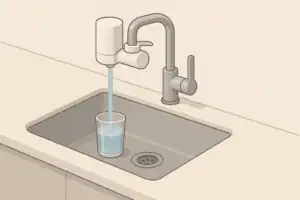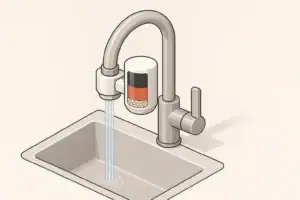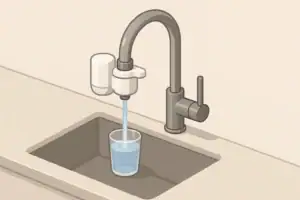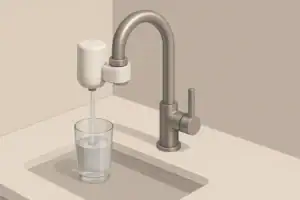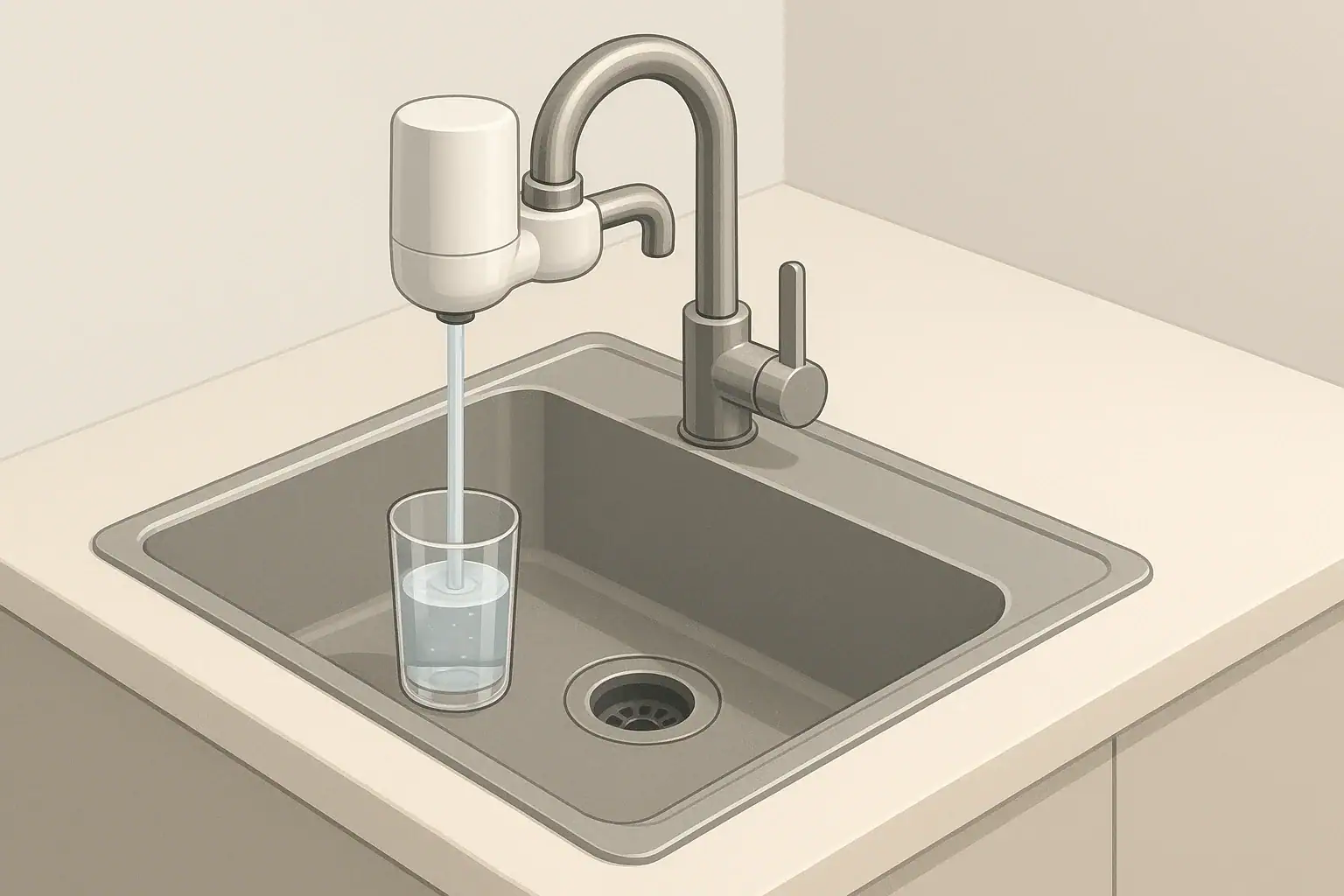
Faucet-mount filters are a common choice for reducing chlorine taste and odor because they treat water at the tap, right before you drink or cook with it. In many U.S. municipal systems, chlorine is added as a disinfectant. While effective for disinfection, it can leave water with a noticeable taste and smell, especially in hot water or when you are sensitive to chlorine.
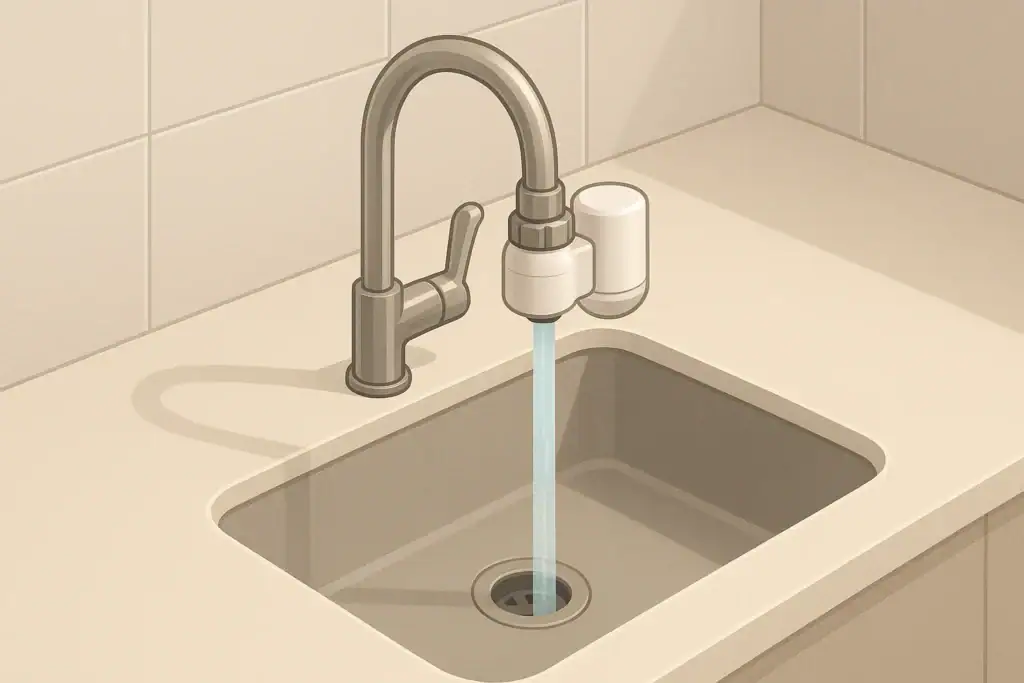
Faucet-mounted systems screw directly onto the end of most standard kitchen faucets. Inside, they typically use activated carbon, sometimes combined with other media, to adsorb chlorine and other compounds that affect taste and odor. You usually flip a small lever or knob to switch between filtered and unfiltered water.
For people who want better-tasting water without installing under-sink plumbing or constantly refilling a pitcher, faucet-mount filters can be a practical middle ground. They offer:
- On-demand filtration at the kitchen sink
- Quick installation and removal for renters
- Reasonable capacity before cartridge changes
- Direct access for cooking, rinsing produce, and drinking
Why Faucet-Mount Filters Are Popular for Chlorine Taste
Faucet-mount filters are a common choice for reducing chlorine taste and odor because they treat water at the tap, right before you drink or cook with it. In many U.S. municipal systems, chlorine is added as a disinfectant. While effective for disinfection, it can leave water with a noticeable taste and smell, especially in hot water or when you are sensitive to chlorine.
Faucet-mounted systems screw directly onto the end of most standard kitchen faucets. Inside, they typically use activated carbon, sometimes combined with other media, to adsorb chlorine and other compounds that affect taste and odor. You usually flip a small lever or knob to switch between filtered and unfiltered water.
For people who want better-tasting water without installing under-sink plumbing or constantly refilling a pitcher, faucet-mount filters can be a practical middle ground. They offer:
- On-demand filtration at the kitchen sink
- Quick installation and removal for renters
- Reasonable capacity before cartridge changes
- Direct access for cooking, rinsing produce, and drinking
Balancing Chlorine Reduction With High Flow Rate
One of the main concerns with faucet-mount filters is flow rate. The same fine media that helps reduce chlorine taste and other compounds can slow water down. If you choose an overly restrictive design, your kitchen sink may trickle when set to filtered mode, which can be frustrating for everyday use.
When comparing faucet-mount filters for chlorine taste reduction, it helps to think about three related factors:
- Flow rate: How quickly water comes out in filtered mode, often given as gallons per minute (gpm) in product literature.
- Contact time: How long water remains in contact with the carbon media, which can improve chlorine and taste reduction but usually slows flow.
- Media design: Granular carbon, compressed blocks, and multi-stage designs all handle flow and clogging differently.
For many households, a moderate flow rate that still feels like a normal stream is ideal. Some faucet filters are designed with internal flow paths that maintain higher flow while still providing enough contact with the media to improve chlorine taste. Others trade higher flow for tighter filtration that may also address additional contaminants, which can be useful in some situations but slower in daily use.
If you frequently fill pots, wash produce, or rely on the filter for most of your drinking and cooking water, prioritize models that are specifically described as higher-flow while still advertising chlorine taste and odor reduction. Always remember that extremely high flow with minimal contact time may not improve taste as much as a slightly slower stream where water spends more time in the media.
Example values for illustration.
| Situation | Faucet-mount filter | Pitcher filter | Under-sink system |
|---|---|---|---|
| Mostly concerned with chlorine taste at kitchen sink | Strong fit, immediate at-tap use | Works but requires refilling | Strong fit, more permanent |
| Need higher flow for cooking and rinsing | Choose high-flow design, moderate fit | Low flow; better for drinking only | Often highest flow, strong fit |
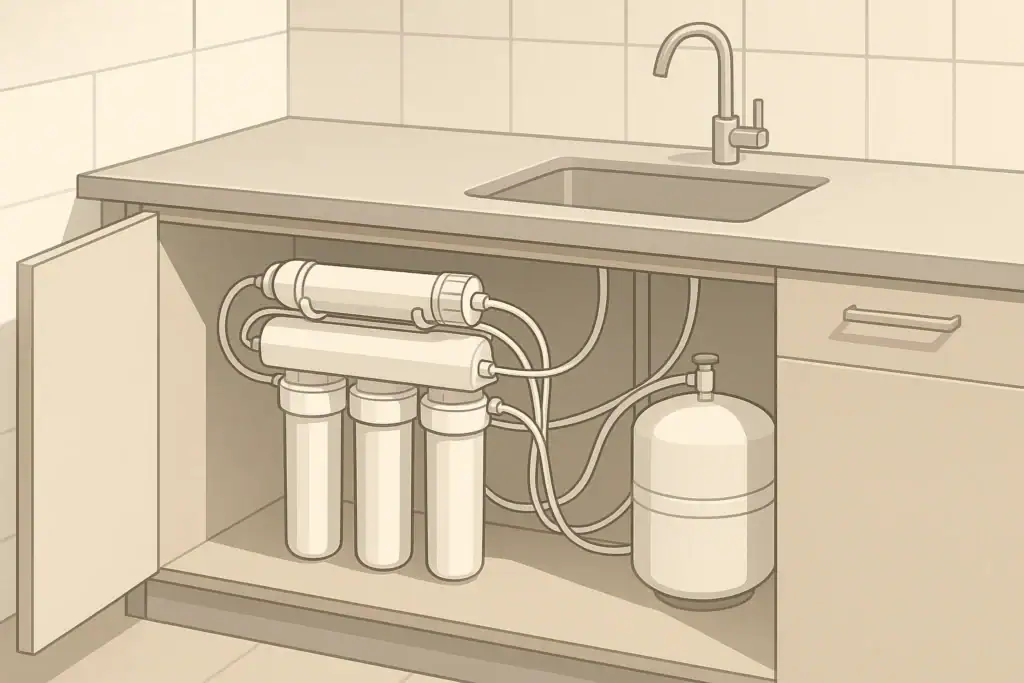
| Limited space or renting | Excellent; easy to install/remove | Excellent; sits on counter/fridge | Less ideal; may need plumbing access |
| Want to treat multiple contaminants beyond chlorine | Some options; check certifications | Some options; often basic | Many options; wider range of media |
| Very low water pressure at home | May feel slow in filtered mode | Not affected by line pressure | Can be designed to work with low pressure |
| Prefer no hardware on the faucet | Less ideal; visible attachment | Good alternative | Invisible at the sink, separate faucet optional |
Key Features to Look For in High-Flow Faucet-Mount Filters
Within the faucet-mount category, designs vary a lot. To focus on chlorine taste reduction without sacrificing too much speed, pay attention to the following features and specifications when you review product literature and packaging.
NSF/ANSI 42 Certification for Chlorine Taste and Odor
For chlorine taste and odor, NSF/ANSI Standard 42 is the main benchmark. This standard covers aesthetic improvements such as taste, odor, and appearance (including chlorine reduction and sometimes particulate reduction).
On packaging or specification sheets, look for clear statements that the product is certified to NSF/ANSI 42 by an accredited third-party organization. Some products may state that they “use media that meets” a standard or are “tested to” a standard; this is not the same as a full, independently certified system. When possible, verify model numbers on the certifier’s database to confirm the exact claims made for chlorine taste and odor reduction.
Flow Rate and Household Use Patterns
Manufacturers often publish a typical flow rate under specified pressure, such as an example like 0.5–1.0 gallons per minute. These values are usually measured with a clean filter and city water pressure near the mid-range, so real-world performance can vary.
When considering flow:
- If you mainly use filtered water for drinking, a slower stream may be acceptable.
- If you regularly fill pots, kettles, or water bottles, choose a design described as higher-flow or having a “full-stream” mode.
- Remember that clogging over time from sediment can reduce flow further, so a slightly higher initial flow can be useful.
Some faucet filters allow you to select between different filtered flow patterns (for example, normal stream and gentle spray) or between filtered and unfiltered modes. Using unfiltered mode for tasks like washing dishes preserves filter life and keeps filtered flow available when you need it for taste-sensitive uses.
Filter Media and Multi-Stage Designs
Most faucet-mount filters aimed at chlorine taste reduction use activated carbon as the primary media. Variations include:
- Granular activated carbon (GAC): Looser granules can flow more easily, sometimes allowing higher flow, but may be more prone to channeling if not well-designed.
- Carbon block: Compressed carbon that can provide more consistent contact time and finer filtration, but often with more resistance to flow.
- Multi-stage cartridges: May include a sediment screen, carbon stage, and sometimes additional media for metals or other contaminants.
If chlorine taste is your main concern and your incoming water is otherwise typical municipal water, a well-designed carbon-based faucet filter with NSF/ANSI 42 certification is often sufficient. If you also care about specific metals or other contaminants, look for additional certifications (such as NSF/ANSI 53) and recognize that finer filtration may slow the flow somewhat.
Bypass and Diverter Controls
A convenient diverter is important for high-flow use. The diverter is the control that switches between unfiltered tap water and filtered water. Common styles include levers, pull-down rings, or rotating knobs.
For everyday use, consider:
- How easy it is to switch between modes with wet or soapy hands.
- Whether unfiltered mode restores your faucet’s normal high flow for rinsing or cleaning.
- Whether the diverter is likely to stay in position or snap back automatically.
Reliable diverter hardware helps you avoid running everything through the filter, which can preserve flow and extend cartridge life.
Evaluating Faucet Compatibility and Installation
Before committing to any faucet-mount filter, confirm that it will physically attach to your faucet and operate comfortably in your sink area. High-flow performance is only useful if the device fits and can be used without constant adjustment.
Standard Aerators vs. Special Faucets
Most faucet-mount filters are designed for faucets with a removable aerator at the tip. The aerator typically unscrews, revealing threads that match one of several common sizes. Filter kits usually include a small set of adapters for typical male and female thread types.
Faucets that may pose compatibility challenges include:
- Pull-down or pull-out spray faucets, where the entire spout detaches
- Designer faucets with non-standard aerators or shapes
- Very short or unusually angled spouts that leave little room for a filter body
If you have one of these faucets, a faucet-mount filter may not fit securely or may feel awkward in use. In that case, a countertop or under-sink filter might be easier to live with while still addressing chlorine taste.
Clearance Around the Sink
Faucet-mount filters add bulk to the end of the spout and often extend downward. Think through how the filter will interact with your sink area:
- Will the filter bump into the backsplash or window ledge when you swivel the faucet?
- Is there enough vertical space between the filter outlet and the sink bottom to fill tall pots or bottles?
- Does the added weight at the tip of the faucet feel stable?
For high-flow operation, a comfortable distance between the filter outlet and the sink basin helps avoid splashing. It can also make it easier to position large containers under the stream when filling at full filtered flow.
Installation and Removal Without Tools
Most faucet-mount filters can be installed with minimal tools, often just by hand-tightening adapters and the main body. This makes them particularly suitable for renters or for people who want to take the filter along when they move.
To make installation and removal smoother:
- Keep the included adapter bag and instructions in a labeled container.
- When changing faucets, check whether you need a different adapter size or thread type.
- Avoid overtightening metal adapters on softer faucet threads; hand-tight and leak-free is the goal.
Understanding Flow, Pressure, and Filter Capacity
High flow in a faucet-mount filter depends on both the design and your home’s plumbing conditions. Two homes with identical filters can experience different flow depending on pressure, plumbing layout, and water quality.
Household Water Pressure
Municipal water pressure in U.S. homes often falls in a typical range, but actual values can vary. The flow rate you get from a faucet filter will depend on the combination of that pressure and the resistance inside the filter media and housing.
If you already have low pressure or notice weak flow from other fixtures, adding a faucet-mount filter may noticeably slow your kitchen tap in filtered mode. In that case, look for models that emphasize lower resistance designs, or consider an under-sink system that uses a dedicated faucet and potentially larger cartridges.
Filter Capacity and When to Replace Cartridges
Filter capacity is usually stated as an approximate number of gallons or months of typical household use. For example, a product might be labeled for a few hundred gallons or several months. These are general guidelines; actual life varies depending on:
- How often you use filtered mode
- How much sediment or particulate matter is present
- Whether your water has higher levels of substances that clog media
As a cartridge nears the end of its life, common signs include:
- Noticeably slower filtered flow compared with a new cartridge
- Return of chlorine taste or odor
- Indicator lights or mechanical timers on some systems changing state
Replacing cartridges on schedule helps maintain both taste improvement and flow performance. Running a cartridge far past the recommended capacity can lead to reduced effectiveness and frustratingly slow water delivery.
Cost Per Gallon and Efficiency
To compare faucet-mount filters fairly, consider the approximate cost per gallon of filtered water rather than just the purchase price. A cartridge with a higher upfront cost but longer capacity can be similar or better in cost per gallon compared with a cheaper cartridge that needs more frequent replacement.
To estimate, divide the approximate cost of a replacement cartridge by its stated capacity. Remember that both numbers are approximations. For example, a cartridge costing a certain amount and rated for a few hundred gallons might work out to a modest cost per gallon, which is often competitive with bottled water and many pitcher filters.
Maintenance Habits That Protect Flow and Taste
Good maintenance habits help keep faucet-mount filters performing well for chlorine taste reduction while preserving high flow as long as possible between cartridge changes.
Rinsing and Initial Flush
New cartridges typically need an initial flush to rinse out loose carbon fines and saturate the media. Instructions may recommend running filtered water for a few minutes or through a specified number of on–off cycles before drinking. Skipping this step can leave water looking slightly gray or cloudy at first, which is usually just fine carbon particles being washed out.
Periodically Cleaning the Housing
Over time, mineral deposits and biofilm can build up on the outside of the housing and around the outlet where water leaves the filter. To keep flow steady and water looking clear:
- Occasionally wipe the outside of the housing with a damp cloth and mild dish soap.
- When changing cartridges, quickly inspect and clean accessible internal surfaces as recommended by the manufacturer.
- Do not use harsh chemicals or abrasive scrubbing pads on plastic housings.
Using Filtered Mode Only When Needed
Because every gallon that passes through the cartridge counts against its capacity, using filtered mode selectively can help maintain flow and reduce cartridge costs. Many households reserve filtered water for:
- Drinking water and ice
- Cooking water and making coffee or tea
- Rinsing produce eaten raw
For rinsing dishes or washing hands, switching to unfiltered mode avoids unnecessary use of the filter media and limits particle buildup that can slow the flow.
Example values for illustration.
| Standard | Main focus | Typical relevance to faucet-mount filters | What to verify on labels or databases |
|---|---|---|---|
| NSF/ANSI 42 | Taste, odor, and aesthetic aspects | Chlorine taste and odor reduction, some particulate reduction | Check that the full system (not just media) is certified for chlorine reduction |
| NSF/ANSI 53 | Reduction of specific contaminants | May cover lead or other substances beyond chlorine | Confirm which contaminants are specifically listed for that exact model |
| NSF/ANSI 401 | Select emerging compounds | Some advanced faucet filters may claim reduction of certain trace compounds | Verify the list of compounds and that claims match your priorities |
| NSF/ANSI 58 | Reverse osmosis systems | Not generally applicable to faucet-mount carbon filters | Used mainly when comparing with RO systems for broader treatment |
| NSF/ANSI 372 | Lead content of materials | Ensures low lead in system components | Look for statements that materials are certified as low-lead |
| Independent listings | Verification of marketing claims | Confirms that stated performance has been third-party evaluated | Match model numbers and claims against certifier’s public database |
When a Faucet-Mount Filter Is the Right High-Flow Choice
For many U.S. households on municipal water, faucet-mount filters offer a practical way to reduce chlorine taste and odor while maintaining a reasonably strong stream at the kitchen sink. They sit between pitchers and more complex under-sink or whole-house systems in terms of installation effort, cost, and performance.
A faucet-mount design is most likely to suit you if:
- You primarily want better-tasting water at one kitchen faucet.
- You value quick installation and the ability to remove the system easily.
- You are willing to switch between filtered and unfiltered modes to preserve flow and filter life.
- Your faucet is compatible and offers enough clearance in your sink area.
When reviewing options, emphasize independent NSF/ANSI 42 certification for chlorine taste and odor, a design that supports higher flow at your expected pressure, and a maintenance schedule you can realistically follow. With those pieces in place, a faucet-mount filter can be an effective component in your overall home water filtration strategy.
Frequently asked questions
How effective are faucet-mount filters at removing chlorine taste and odor?
Faucet-mount filters that use activated carbon can significantly reduce free chlorine responsible for taste and odor; look for NSF/ANSI 42 certification to confirm third-party validation. Actual effectiveness depends on contact time, flow rate, and the condition of the cartridge, so performance drops with very high flow or a spent filter.
Can I run hot water through a faucet-mount filter to remove chlorine?
Most faucet-mount filters are designed for cold water only; hot water can reduce carbon adsorption efficiency and may damage seals or media. For best chlorine removal and longevity, filter cold water and avoid running consistently hot water through the cartridge.
Will a faucet-mount filter fit my faucet and how do I check compatibility?
Many faucet-mount filters attach to faucets with removable aerators and include adapters for common male and female threads, so check whether your faucet’s aerator unscrews and whether there is enough clearance. Pull-down spray spouts, designer faucets, or very short/angled spouts can be incompatible, in which case consider countertop or under-sink options.
How does flow rate affect chlorine removal and which flow should I choose?
Higher flow reduces contact time with the carbon and can lessen chlorine removal, while slower flow increases contact but may be impractical for filling pots. Choose a model that balances higher flow with adequate media contact (manufacturers often state gpm at a given pressure) and consider a “full-stream” mode if you frequently fill large containers.
How often should I replace the cartridge and what are the warning signs?
Replace cartridges according to the manufacturer’s stated gallons or months; typical replacement intervals are a few hundred gallons or several months depending on use. Warning signs include noticeably slower filtered flow, reappearance of chlorine taste or odor, or any system indicator that signals end of life.
Recommended next:
- NSF/ANSI standards explained (42/53/401/58)
- Clear trade-offs: pitcher vs faucet vs under-sink vs RO
- Maintenance planning: cost per gallon and replacement cadence