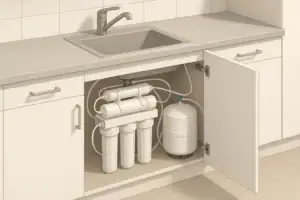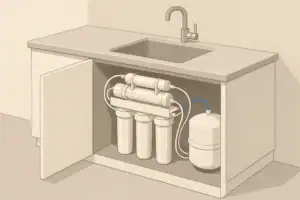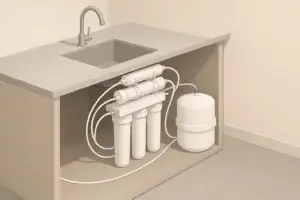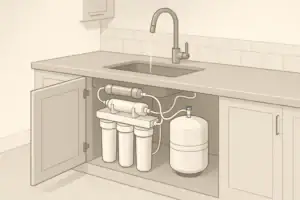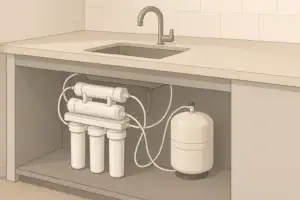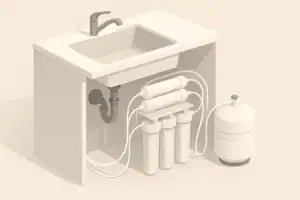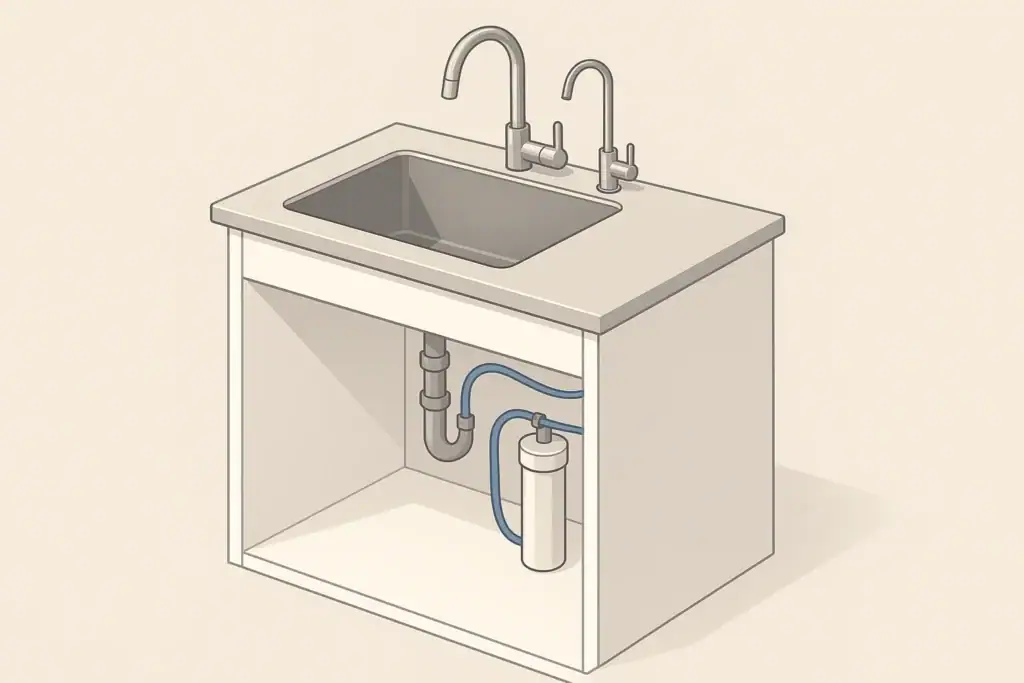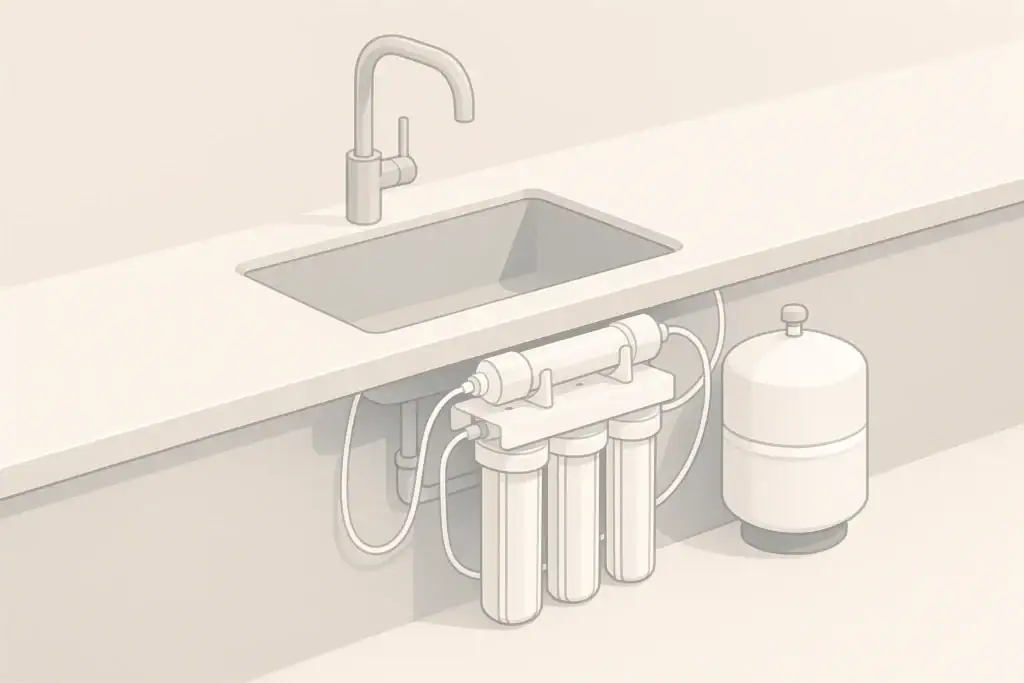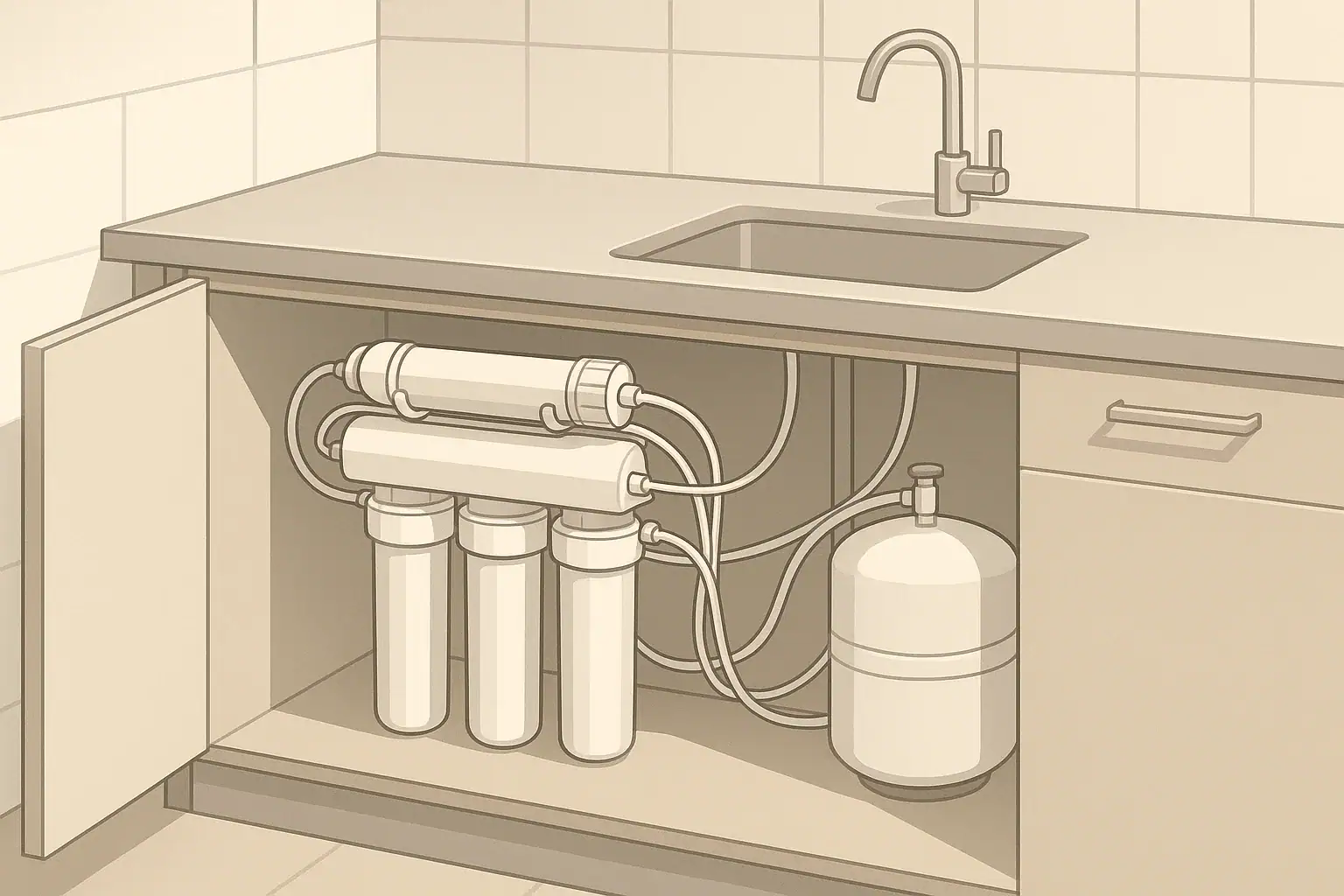
Reverse osmosis (RO) is a type of under-sink filtration that uses a semi-permeable membrane to separate water from many dissolved substances. It is commonly used when people want lower total dissolved solids (TDS), improved taste, and a more consistent level of filtration than basic carbon-only filters.
In a typical home RO system, water passes through several stages:
- Sediment prefilter – screens out sand, silt, rust, and other larger particles.
- Carbon prefilter – reduces chlorine, chloramine, and some organic chemicals that could damage the membrane or affect taste and odor.
- RO membrane – the core component that separates water from many dissolved ions and small contaminants.
- Storage tank – holds filtered water so it is available on demand, since RO production is relatively slow.
- Post-filter (often carbon) – polishes taste and removes any residual odors before water reaches the faucet.
How Reverse Osmosis Works in a Home Kitchen
The membrane works by allowing water molecules to pass while many larger ions and molecules are left behind and flushed to the drain. This process requires adequate incoming water pressure and produces a separate waste stream.
What Reverse Osmosis Typically Removes
RO membranes are designed to reduce a wide range of contaminants, especially dissolved solids. Actual performance depends on system design, maintenance, and water conditions, but common categories of substances that RO can significantly reduce include:
Dissolved Salts and Minerals (TDS)
Reverse osmosis is widely used for lowering total dissolved solids. This includes many naturally occurring ions, such as:
- Calcium and magnesium (major contributors to hardness)
- Sodium and potassium
- Sulfate, nitrate, and chloride ions
Lowering these ions can reduce scaling on fixtures and appliances fed by the RO tap and can change taste, often making water taste “flatter” or less mineral-rich.
Lead and Other Heavy Metals (With Proper Prefiltration)
RO systems are often used as a point-of-use option for reducing dissolved heavy metals when present in the incoming water. These can include:
- Lead
- Cadmium
- Chromium (various forms)
- Copper (dissolved, not large flakes)
For particulate metal flakes from corroding pipes, the sediment or carbon prefilters usually capture the larger particles before water reaches the membrane.
Fluoride and Nitrate
Reverse osmosis membranes are commonly used to reduce certain small ions that many other home filters do not significantly affect, such as:
- Fluoride
- Nitrate and nitrite
These substances are dissolved and not effectively removed by basic carbon filters alone. RO provides a way to lower their concentrations at a single tap.
Many Organic Chemicals (With Carbon + RO Together)
The pre- and post-carbon stages in an RO system, combined with the membrane, can reduce a variety of organic compounds. Depending on design and certification, this may include:
- Chlorine and chloramine (primarily by carbon)
- Some volatile organic compounds (VOCs)
- Some pesticides and herbicides
- Some disinfection byproducts
RO membranes themselves can reject certain larger organic molecules, while activated carbon helps capture chemicals that might otherwise pass through or damage the membrane.
Particles, Sediment, and Microplastics
RO systems typically include a sediment filter that removes visible particles like sand and rust. The RO membrane pore structure also acts as a very fine barrier to many microscopic particles. In practice, a well-maintained system can reduce:
- Suspended sediment and turbidity
- Many microplastics in the size range captured by the membrane
Prefilters are important here: they protect the membrane from clogging and extend its service life.
Example values for illustration.
| Aspect | Reverse Osmosis System | Basic Carbon Pitcher/Faucet Filter |
|---|---|---|
| Main filtration mechanism | Semi-permeable membrane plus pre/post filters | Granular or block activated carbon, sometimes with simple mesh |
| Dissolved minerals (TDS) | Typically large reduction; water often tastes low-mineral | Little change; minerals mostly remain |
| Chlorine taste and odor | Reduced by carbon stages | Typically reduced |
| Fluoride, nitrate | Often significantly reduced by the membrane | Usually not specifically targeted |
| Heavy metals | Membrane plus carbon may reduce many dissolved metals | Some models reduce certain metals; performance varies |
| Flow rate at faucet | Lower, relies on storage tank | Higher, direct flow through filter |
| Under-sink space required | Moderate to high (housings plus tank) | Low (countertop or faucet-mounted) |
| Typical installation | Plumbed under sink with dedicated faucet | Minimal tools; attaches to faucet or sits on counter |
What RO Does Not Remove (or May Only Partially Reduce)
Despite its reputation, RO is not a universal solution. Some substances are not effectively removed by the membrane itself, and others can pass through if the system is not designed, installed, or maintained correctly. Understanding these limitations helps set realistic expectations.
Chlorine and Chloramine Without Carbon Support
The RO membrane is sensitive to chlorine. In almost all home systems, a carbon prefilter is used to reduce chlorine and sometimes chloramine before water reaches the membrane. If the carbon stage is exhausted or missing, chlorine can damage the membrane and reduce performance.
Key points:
- The membrane alone is not the main barrier for chlorine or chloramine.
- Carbon filters must be replaced on schedule to maintain protection.
- Municipal water supplies that use chloramine may need specific carbon stages rated for chloramine reduction.
Very Small, Neutral Organic Molecules
Some small, uncharged organic compounds can pass more easily through an RO membrane, especially if they are not well adsorbed by carbon. While many organic chemicals are reduced, others may not be significantly changed. Performance often depends on:
- Molecular size and structure of the compound
- How strongly it is attracted to activated carbon
- Contact time with carbon and membrane condition
Because of this, some products pursue additional certifications (for example, for emerging contaminants) to demonstrate performance against specific chemical groups.
All Microorganisms in All Conditions
RO membranes can create a physical barrier that many bacteria and protozoa cannot readily cross. However, home RO systems are usually not marketed as primary disinfection devices, and they may not be certified for comprehensive microbiological removal.
Considerations:
- Membrane integrity can’t be visually confirmed by the user.
- Biofilm can develop on filters and inside storage tanks if maintenance is neglected.
- Systems for non-disinfected well water may incorporate additional UV or other treatment steps for microbial control.
For most homes on treated municipal water, disinfection is handled at the utility, and RO is used primarily for taste, odor, and dissolved contaminant reduction rather than as the only microbiological barrier.
Gases and Dissolved Oxygen
Certain dissolved gases, such as carbon dioxide, are not effectively removed by RO membranes. As a result, RO water can still contain dissolved gases that influence pH and taste. Dissolved oxygen may also be present.
This is one reason why RO water can have a slightly different taste profile even when TDS is low: the balance of dissolved gases and remaining ions still affects flavor.
Very Fine Colloids or Charged Particles That Bypass the Membrane
In theory, the membrane pore size is small enough to block many fine particles. In practice, factors such as membrane fouling, channeling, or defects can allow some colloids or very small particles to pass, especially if prefiltration is not maintained. Regular cartridge changes help protect membrane function.
RO vs. Other Home Filtration Options
RO is one option in a broader toolkit that includes pitcher filters, faucet-mount units, under-sink carbon blocks, and whole-house systems. Each approach targets different goals, such as taste improvement, hardness control, or point-of-entry sediment reduction.
When RO May Make Practical Sense
RO is commonly used when homeowners want:
- Lower TDS and fewer dissolved minerals at a specific tap
- Targeted reduction of certain ions like nitrate or fluoride
- Consistent taste for drinking water, coffee, and tea
- An additional barrier for many heavy metals and small dissolved contaminants
Because it is usually installed at one sink, it does not treat shower water, laundry, or most household fixtures.
When Another Filter Type Might Be Enough
RO might be more than you need if your main priorities are:
- Reducing chlorine taste and odor only
- Improving taste while keeping natural minerals
- Filtering sediment for the whole house
- A quick, low-installation solution (pitcher or faucet-mount)
In those cases, carbon-based or whole-house sediment filters often meet the need with simpler installation and maintenance.
Understanding RO Performance, TDS, and Certifications
To evaluate how well your RO system is working, it helps to understand basic water metrics and certification standards. While TDS meters and test kits do not tell the whole story, they can provide useful clues.
Using TDS as a Rough Check
Most RO owners use a handheld TDS meter or built-in indicator to compare incoming and RO water. TDS readings are usually expressed in parts per million (ppm) or milligrams per liter (mg/L). A simple approach is:
- Measure tap water TDS at the RO inlet (for example, 200–500 ppm in many areas).
- Measure RO faucet TDS from the storage tank.
- Calculate the percent reduction using a basic comparison.
Consistently rising RO TDS, while inlet TDS stays similar, can indicate membrane aging, a saturated post-filter, or other system issues. TDS alone, however, cannot identify specific contaminants or verify removal of particular chemicals or metals.
Key NSF/ANSI Standards Relevant to RO
Independent certifications help translate technical performance into something more understandable. For RO units, several NSF/ANSI standards frequently appear on spec sheets and labels:
- NSF/ANSI 42 – for aesthetic effects such as chlorine taste and odor and particulate reduction.
- NSF/ANSI 53 – for reduction of specific contaminants with potential health relevance, such as certain metals and organic chemicals, at the point of use.
- NSF/ANSI 58 – specific to reverse osmosis drinking water treatment systems, including structural integrity and performance requirements for the RO process.
- NSF/ANSI 401 – for reduction of certain “emerging” contaminants, such as some pharmaceuticals and personal care products, on systems that are tested for them.
Each standard covers specific test conditions and contaminant lists. A system may be certified under one or several standards, and the certification will usually identify which contaminants were tested, along with the test conditions.
Reading Performance Claims Carefully
When you review any RO system literature, look beyond general statements. Focus on:
- Which standards (if any) the unit is certified to, and by which independent body.
- Which contaminants were tested under each standard.
- Operating assumptions such as incoming water pressure, temperature, and TDS range.
- Filter life estimates and any conditions that shorten them (e.g., high sediment, high chlorine, or very hard water).
This helps match RO performance to your local water conditions and goals rather than relying only on broad marketing language.
Example values for illustration.
| Standard | Focus Area | What to Look For on a Label |
|---|---|---|
| NSF/ANSI 42 | Aesthetic effects (taste, odor, chlorine, particulate) | Specific claims like “chlorine reduction” or “particulate class” with capacity info |
| NSF/ANSI 53 | Selected contaminants of potential health concern | List of tested metals or chemicals, plus conditions under which testing was done |
| NSF/ANSI 58 | Reverse osmosis performance and structural integrity | Indication that the system is an RO unit with specified recovery and efficiency criteria |
| NSF/ANSI 401 | Selected “emerging contaminants” | Named list of tested compounds, often pharmaceuticals or personal care products |
| Certification mark | Verification by an independent organization | Mark from a recognized certifier along with the relevant standard numbers |
| Performance data sheet | Detailed performance and maintenance information | Contaminant reduction list, operating limits, and recommended maintenance schedule |
Maintenance, Cost per Gallon, and Practical Tips
RO performance depends heavily on maintenance. Neglected prefilters can shorten membrane life, and a saturated post-filter can affect taste even if the membrane is still functioning.
Typical Maintenance Elements
Most under-sink RO systems involve three types of components with different replacement intervals:
- Sediment and carbon prefilters – usually replaced more frequently (for example, every 6–12 months, depending on usage and water quality).
- RO membrane – often lasts longer (sometimes several years) if prefilters are maintained and water quality is within design limits.
- Post-filter and polishing stages – replaced on a similar schedule to prefilters to maintain taste.
Some systems also recommend periodic tank sanitization or system disinfection to limit biofilm buildup.
Estimating Cost per Gallon
To understand the long-term cost, consider:
- Total cost of replacement cartridges and membrane over a year.
- Estimated annual production volume from the RO faucet (for example, a few hundred to a few thousand gallons, depending on household size and usage).
- Wastewater ratio, which affects how much water goes to drain for each gallon of RO water produced.
Dividing annual filter and membrane cost by the estimated RO water volume provides an approximate cost per gallon. This can be compared with alternatives, such as bottled water or other filtration formats.
Practical Use and Troubleshooting Cues
Several everyday signals can indicate it is time to check the system:
- Noticeably slower flow at the RO faucet.
- Change in taste, odor, or appearance of the water.
- Rising TDS readings at the RO faucet while inlet TDS is stable.
- Tank not refilling as expected after emptying.
Many of these symptoms have simple explanations, such as overdue prefilters, low inlet pressure, or a depleted membrane. Having a basic log of installation dates, replacement dates, and TDS readings can make it easier to identify patterns and keep the system performing consistently.
Frequently asked questions
Can a reverse osmosis system remove fluoride and nitrate from drinking water?
Reverse osmosis membranes commonly reduce fluoride and nitrate because both are dissolved ions that the membrane can reject. Exact removal percentages depend on membrane type, feed-water TDS, pressure, and maintenance, so review the system’s performance data or certification for expected reductions.
Does RO remove bacteria and viruses?
RO membranes can physically block many bacteria and protozoa, but household RO systems are not usually sold as primary disinfection devices and may not be certified for comprehensive microbiological removal. Biofilm, a compromised membrane, or an unclean storage tank can allow microorganisms to persist, so additional disinfection (for example, UV) is recommended for untreated well water.
Will an RO system remove chlorine and chloramine?
The membrane itself is sensitive to chlorine and chloramine, so most residential RO systems rely on carbon prefilters to remove chlorine and reduce chloramine before the membrane. If the carbon stage is missing or exhausted, chlorine can damage the membrane and reduce performance; municipal supplies using chloramine may require specific carbon types rated for chloramine reduction.
How often should I replace RO filters and the membrane?
Replacement intervals vary with water quality and usage: sediment and carbon prefilters are commonly replaced every 6–12 months, while membranes often last several years if prefilters are maintained. Rising TDS at the RO faucet, reduced flow, or changes in taste are useful indicators that service or replacement may be needed.
How can I check whether my RO system is working properly?
A handheld TDS meter provides a quick check by comparing inlet tap TDS with RO faucet TDS; a consistent reduction indicates the membrane is functioning. Also monitor flow rate, taste, and scheduled filter changes, and consult certified performance data for your model if you need confirmation for specific contaminants.
Recommended next:
- NSF/ANSI standards explained (42/53/401/58)
- Clear trade-offs: pitcher vs faucet vs under-sink vs RO
- Maintenance planning: cost per gallon and replacement cadence