
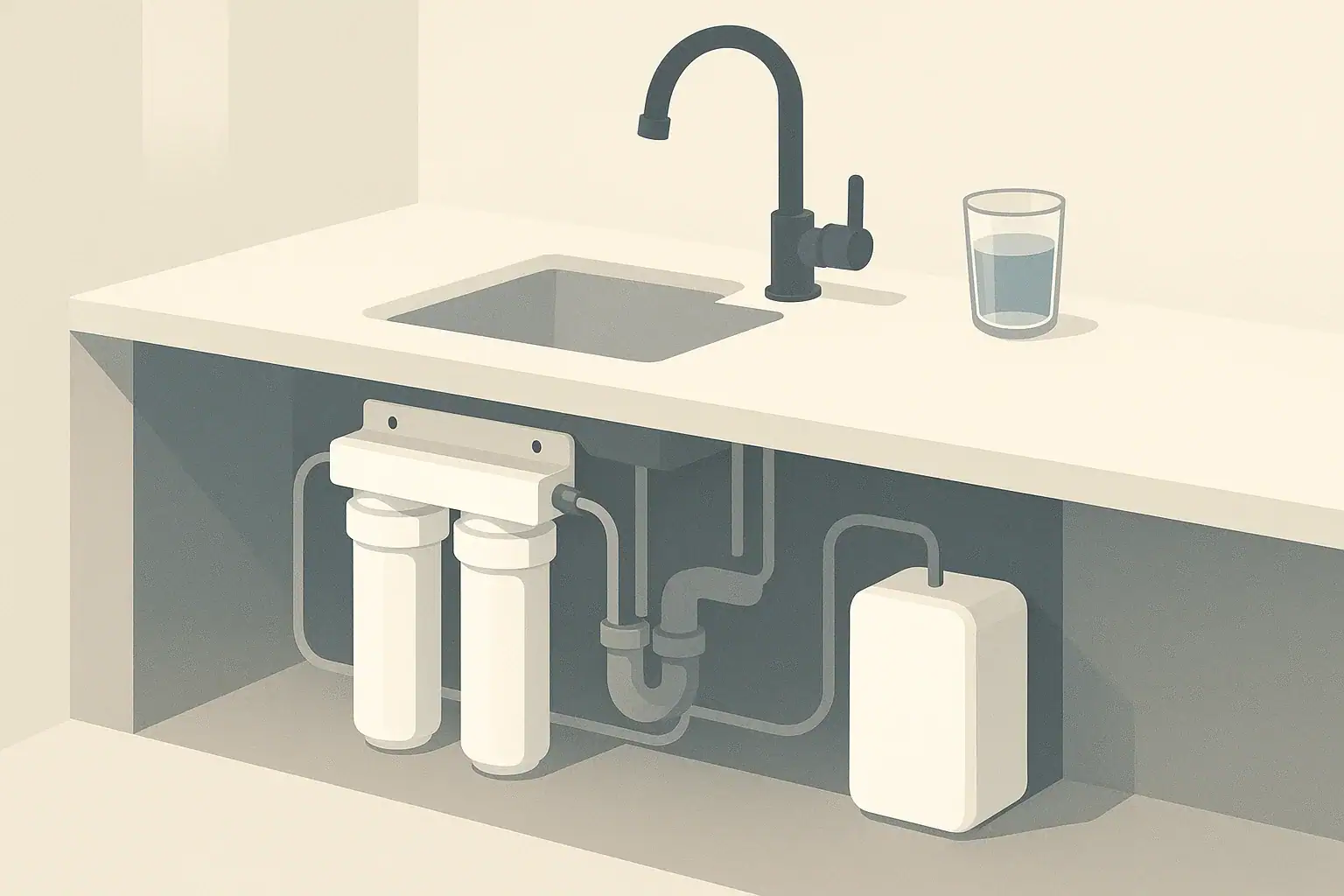
A dual-stage under-sink filter is one of the simpler ways to improve water used at a kitchen sink. Instead of treating all water entering the home, it usually connects to the cold-water line under one sink and sends filtered water to a dedicated faucet or, in some setups, the existing faucet.
The common two-stage design pairs a sediment cartridge with a carbon cartridge. The sediment stage handles visible or fine particles. The carbon stage focuses on taste, odor, and certain chemicals that carbon is known to reduce when properly designed and maintained.
This setup is different from reverse osmosis, water softening, UV disinfection, or whole-house filtration. It does not try to solve every water quality issue. Its strength is practical, point-of-use filtration for drinking, cooking, coffee, tea, and ice when the main goals are clearer water, better taste, and protection of the carbon stage from premature clogging.
How a Dual-Stage Under-Sink Filter Works
In a typical sediment plus carbon arrangement, water flows through the sediment filter first and the carbon filter second. The order matters. Sediment filtration removes particulate matter before the water reaches the carbon media, which helps preserve flow and may extend the useful life of the carbon cartridge.
The system is usually installed in the cabinet below the sink. The cartridges may be housed in standard housings or sealed quick-change modules. Water pressure from the existing cold-water line pushes water through both stages. No storage tank is normally needed for a basic two-stage sediment and carbon system because it does not force water through a dense reverse osmosis membrane.
Stage 1: Sediment filtration
Sediment cartridges are commonly made from pleated material, spun polypropylene, melt-blown material, string-wound media, or similar particle-trapping designs. They are rated by micron size, which describes the approximate particle size the filter is intended to capture.
A lower micron rating can catch smaller particles, but it may also create more pressure drop, especially if the incoming water contains rust, sand, silt, or pipe scale. For many sink-only systems, the sediment stage is selected to balance particle reduction with usable faucet flow.
Stage 2: Carbon filtration
Carbon cartridges typically use activated carbon in block or granular form. Carbon has a large internal surface area and is widely used to reduce chlorine taste and odor, many organic compounds, and some chemicals depending on media type, contact time, and product design.
Carbon block cartridges often provide more consistent contact between water and media than loose granular carbon, though they can reduce flow more noticeably. Granular activated carbon may offer lower pressure drop, but performance depends heavily on cartridge design and how evenly water passes through the media.
What Sediment and Carbon Stages Usually Address
A dual-stage under-sink filter is best understood as a targeted treatment device. It can be very useful for common aesthetic issues, but it is not a universal purifier. The exact performance depends on the cartridge specifications, test data, water chemistry, flow rate, and replacement schedule.
For city water, the main drivers are often chlorine taste and odor, occasional discoloration from distribution pipes, and general drinking-water taste preferences. For well water, sediment may be more prominent, but additional testing is especially important because wells can have issues that sediment and carbon alone are not designed to correct.
Carbon performance is also affected by whether the disinfectant is chlorine or chloramine. Standard activated carbon is commonly associated with chlorine reduction, while chloramine reduction may require a cartridge specifically designed for longer contact time or catalytic carbon. Always check the product claims and third-party standard references when a specific contaminant matters. For a deeper look at the disinfectants themselves, see chlorine vs chloramine.
Example values for illustration.
| Water concern | Stage most involved | Practical note |
|---|---|---|
| Sand, silt, rust flakes | Sediment | Helps prevent particles from reaching the faucet and carbon stage |
| Cloudiness from suspended particles | Sediment | May help if cloudiness is particulate, not dissolved gases or minerals |
| Chlorine taste and odor | Carbon | Common use case for activated carbon cartridges |
| Musty or earthy taste | Carbon | May improve taste depending on cause and contact time |
| Some VOCs | Carbon | Look for specific tested claims if VOC reduction is a priority |
| Lead or cyst claims | Specialized carbon or composite media | Requires cartridges rated and tested for those specific reductions |
| Hardness minerals and scale | Neither stage is primary | Softening or scale-control methods are different technologies |
| Dissolved salts and high TDS | Neither stage is primary | Reverse osmosis is typically used when TDS reduction is the goal |
When Two Stages Are Enough and When They Are Not
A sediment plus carbon system can be a sensible choice when the source water is already treated to drinking-water standards and the household wants better taste at one sink. It is also useful where small particles shorten the life of carbon-only filters.
This type of system may be enough when the main concerns are:
- Chlorine taste or odor in municipal water
- Fine sediment, rust particles, or occasional grit
- Improving taste for coffee, tea, cooking, and drinking
- A compact system without a drain line or storage tank
- Maintaining stronger flow than many reverse osmosis systems
It may not be the right standalone solution when the goal is broad dissolved contaminant reduction. Carbon does not generally remove dissolved minerals, nitrates, many salts, or hardness. Sediment filtration does not treat dissolved contaminants at all. If a water test shows a specific contaminant of concern, choose treatment based on that contaminant rather than assuming two stages will cover it.
How it compares with reverse osmosis
Reverse osmosis systems use a membrane that can reduce many dissolved substances, often with a sediment prefilter and carbon prefilter. They also require a drain connection for reject water and may use a storage tank or pump depending on design.
A basic dual-stage under-sink filter is simpler. It typically has no wastewater stream, no RO membrane, and fewer pressure requirements. That simplicity is useful when taste and sediment are the main issues. RO is more appropriate when the treatment goal includes meaningful TDS reduction or contaminants suited to membrane filtration.
How it compares with a pitcher or faucet filter
Pitcher and faucet-mounted filters can be convenient for renters or low-volume use. Under-sink systems usually offer larger cartridges, a cleaner countertop, and better flow for filling pots or bottles. They also require more installation planning and more attention to leak checks.
Planning Flow Rate, Pressure, and Cartridge Size
Flow rate is one of the most noticeable day-to-day differences between under-sink filters. A filter that looks good on paper can feel frustrating if it fills a pot too slowly or loses flow quickly as sediment accumulates.
Manufacturers often list a rated service flow. Treat this as a useful comparison point, not a guarantee for every home. Actual flow depends on incoming pressure, tubing size, valve condition, cartridge loading, and the resistance of both stages combined. If your kitchen setup already feels sluggish, a flow rate guide can help you gauge what to expect.
Micron rating and pressure drop
A sediment filter with a very fine micron rating can be appropriate for fine particles, but it can also clog faster. If the incoming water has visible grit, a moderately rated sediment filter may provide a better balance than jumping immediately to the finest option.
Carbon blocks also create resistance. A dense carbon block designed for more demanding reduction claims may have a lower flow rate than a basic taste-and-odor cartridge. There is always a balance between contact time, filtration density, cartridge life, and faucet flow.
Dedicated faucet or inline to the main faucet
Many under-sink filters use a small dedicated drinking-water faucet. This keeps filtered water separate from general cold-water use and can reduce cartridge consumption. Some systems feed the main cold-water faucet, which is convenient but may use filter capacity faster because every cold-water task runs through the cartridges.
If a dedicated faucet requires a new hole in a countertop or sink, consider the material and the risk of damage. Stone, porcelain, and some composite surfaces can crack if handled incorrectly. Use appropriate professional help when drilling or when plumbing conditions are unclear.
Space and service clearance
Measure the cabinet before choosing a system. Leave enough room below the housings to remove cartridges without forcing plumbing or bending tubing sharply. Also consider nearby items such as a garbage disposal, dishwasher hose, pull-down faucet weight, shutoff valves, and stored cleaning products.
A compact system is easier to fit, but smaller cartridges may need more frequent replacement. Larger cartridges can offer more capacity and lower pressure drop, but they require more cabinet space. For smaller cabinets, an under-sink space guide can be useful before you buy.
Maintenance, Replacement Timing, and Leak Awareness
All filters are maintenance items. A dual-stage system can be simple to own, but only if cartridges are replaced on schedule and the installation is checked periodically. Delaying replacement can reduce flow, allow taste and odor issues to return, and increase the chance that sediment clogs the system.
Replacement timing is commonly based on a combination of months in service and gallons used. A household that uses filtered water for drinking only will load cartridges differently than a household that filters all cold water at the kitchen sink. Homes with more sediment may replace the first stage more often than the carbon stage.
Signs a cartridge may be nearing the end of useful life
- Flow from the filtered faucet slows noticeably
- Chlorine taste or odor starts to return
- Water takes longer to fill a kettle, bottle, or cooking pot
- Sediment appears at the filtered faucet
- The filter has reached its stated time or gallon interval
Sanitation also matters. When changing cartridges, avoid touching internal sealing surfaces with dirty hands. Follow the system instructions for flushing new cartridges, checking seals, and discarding the first water after replacement. Some carbon fines or trapped air may appear briefly after a new cartridge is installed.
Leak awareness is part of responsible ownership. Check fittings after installation, after cartridge changes, and again after the system has been under pressure for a short period. Do not bypass pressure regulators, leak stops, backflow protection, or other safety features provided with a system. If shutoff valves are corroded or difficult to operate, have them addressed before adding equipment under the sink.
Example values for illustration.
| Use condition | Likely impact | Planning approach |
|---|---|---|
| Low filtered-water use | Cartridges may age before capacity is used | Follow the time interval even if gallons are low |
| High daily drinking and cooking use | Carbon capacity is used faster | Track gallons or replace more frequently |
| Visible sediment in source water | Sediment stage may clog first | Inspect flow and plan earlier sediment changes |
| Chlorine taste returns | Carbon stage may be exhausted | Replace carbon cartridge and flush as directed |
| Sudden flow reduction | Clogging or plumbing restriction may be present | Check shutoff valves, tubing, and cartridge condition |
| After plumbing work nearby | Debris may enter the line | Flush plumbing and monitor the sediment stage |
| Seasonal or part-time home | Stagnation can affect taste | Flush before use and follow storage guidance |
Related guides: When You Need a Sediment Prefilter Under the Sink • Best Under-Sink Filters for Chlorine Taste & Odor • Reverse Osmosis 101: What RO Removes (and What It Doesn’t) • Under-Sink Filter Installation: Tools, Parts, and Common Mistakes
Standards, Testing, and Practical Selection Tips
When comparing cartridges, look for clear performance information rather than broad claims. NSF/ANSI standards are often referenced in water filtration because they provide structured test methods for specific reduction claims. A product may be tested for one claim, such as chlorine taste and odor, without being tested for another, such as lead, VOCs, or PFAS.
It is more useful to ask what the cartridge is tested to reduce than to ask whether it is simply a good filter. For a sediment plus carbon system, review:
- Micron rating and type of sediment cartridge
- Carbon type, such as carbon block, granular carbon, or catalytic carbon
- Rated flow rate and capacity
- Specific contaminant reduction claims, if any
- Replacement interval by months and gallons
- Operating pressure and temperature range
- Compatibility with a dedicated faucet or main faucet connection
If your home has a private well, recent plumbing changes, older service lines, or a known local water issue, consider testing before choosing treatment. A lab test can help separate aesthetic issues from contaminants that require a more specific solution. For municipal water, the local water quality report can provide useful background, though conditions at an individual tap may still vary because of building plumbing.
A dual-stage under-sink filter is often a practical middle ground. It offers more capacity and a cleaner setup than many small countertop options, while avoiding the added complexity of reverse osmosis when RO is not needed. The best fit depends on the water problem you are trying to solve, the space under the sink, the desired flow rate, and your willingness to keep up with cartridge replacement.
Frequently asked questions
Do sediment and carbon filters remove different things?
Yes. Sediment filters capture particles like rust, sand, and silt, while carbon filters mainly reduce chlorine taste and odor and may reduce certain chemicals depending on the cartridge design.
Is a two-stage under-sink filter enough for well water?
Sometimes for taste and sediment, but not always for safety concerns. Well water should be tested first so you can match treatment to the specific issue.
Will a carbon filter remove hard water?
No. Carbon filters do not remove hardness minerals in a meaningful way. Water softening is a separate treatment for hardness and scale.
How often should cartridges be replaced?
Replacement depends on the manufacturer’s time and gallon rating, plus your water quality and usage. A drop in flow or returning taste and odor often means the cartridges are nearing the end of useful life.
Do I need a dedicated faucet?
Not always. Some systems connect to a separate drinking-water faucet, while others can be plumbed into the main faucet. The best choice depends on the system design and available space.
- NSF/ANSI standards explained (42/53/401/58)
- Clear trade-offs: pitcher vs faucet vs under-sink vs RO
- Maintenance planning: cost per gallon and replacement cadence