
Chloramine is a disinfectant used by many public water systems to help control microorganisms as water moves through distribution pipes. Unlike free chlorine, chloramine is formed by combining chlorine with ammonia under controlled treatment conditions. The most common form used in drinking water is monochloramine.
You usually cannot confirm chloramine by taste, odor, or appearance alone. The most reliable approach is to check information from your water utility, ask the utility directly, or use an appropriate test method. Confirmation matters because chloramine behaves differently from free chlorine and can require different filtration media or longer contact time.
What Chloramine Is and Why Utilities Use It
Public water systems use disinfectants to treat water and maintain a residual in the distribution network. Free chlorine is effective and relatively easy to manage, but it can decline as water travels through long pipe networks. Chloramine is generally more stable, so some utilities use it to maintain disinfection farther from the treatment plant.
A utility may use chloramine continuously, seasonally, or only in part of its service area. Some systems temporarily switch from chloramine to free chlorine for distribution-system maintenance. These operational changes are one reason old reports, neighborhood discussions, and smell tests may not reflect current conditions.
Chloramine is not the same as chlorine
Both are chlorine-based disinfectants, but they do not respond identically to filtration or storage. Free chlorine tends to react more quickly with conventional activated carbon and may dissipate more readily from standing water. Chloramine is more persistent and usually requires media selected for chloramine reduction, adequate media volume, and sufficient contact time.
The presence of either disinfectant does not mean that water should have a strong chemical smell. Odor can be affected by concentration, plumbing conditions, water temperature, and other compounds. It is better to verify the disinfectant than to infer it from sensory clues.
How to Know If Your City Uses Chloramine
Your annual water quality report is usually the best starting point. Public water systems commonly call this document a Consumer Confidence Report, annual drinking water report, or water quality report. Search within it for terms such as chloramine, monochloramine, total chlorine, combined chlorine, ammonia, or disinfectant residual. Learn more about how to read a Consumer Confidence Report.
If the report is unclear, check the utility’s treatment information and public notices. A notice about a temporary disinfectant conversion may explain why your tap water currently contains free chlorine even though the system normally uses chloramine.
Ask the organization that supplies the property
Contact the water utility and ask these specific questions:
- What disinfectant is normally present at the customer tap?
- Is chloramine used year-round or seasonally?
- Are temporary switches to free chlorine scheduled?
- Does the entire service area receive the same disinfectant?
- Where are current treatment notices published?
If you live in an apartment, condominium, or rental property, confirm the actual utility through the water bill or property manager. The city named in the mailing address may not be the organization supplying the water. A building may also have storage tanks or treatment equipment that affects tap-water conditions.
Use testing as a supporting check
Tests that separately measure free chlorine and total chlorine can help identify a combined disinfectant residual. If total chlorine is present while free chlorine is low, chloramine may account for much of the difference. However, that subtraction is an estimate of combined chlorine, not a complete chemical identification.
Test water promptly and follow the test instructions closely because timing, sample handling, temperature, and reagent condition can affect results. Many consumer strips provide only broad ranges. A suitable colorimetric test or qualified laboratory may provide better detail when the distinction is important.
Example values for illustration.
| Source or check | What it can show | Main limitation |
|---|---|---|
| Annual water quality report | Routine disinfectant and monitoring information | May summarize the prior reporting year |
| Utility treatment page | Normal treatment process | May not show short-term changes |
| Utility public notice | Temporary disinfectant conversions | Notices may apply only to certain dates or zones |
| Direct utility contact | Current disinfectant for a service address | The answer should be specific to the property |
| Free and total chlorine test | Evidence of a combined chlorine residual | Does not fully identify every chlorine compound |
| Single total chlorine test | Whether a chlorine-based residual may be present | Cannot distinguish free chlorine from chloramine |
| Taste or odor observation | A reason to investigate further | Cannot reliably identify the disinfectant |
How to Read Chloramine Information in a Water Report
Water reports often use technical categories rather than a simple yes-or-no statement. Chloramine may appear under disinfectants, treatment processes, distribution-system monitoring, or disinfectant residuals. The report may list results as total chlorine because common field methods measure free and combined forms together.
Look beyond the main results table
Read the treatment description, footnotes, definitions, and utility contact section. A report may explain that the system uses chloramine but periodically converts to free chlorine. It may also describe multiple treatment plants, purchased water, or blended sources.
Regional wholesalers can add another layer. A local utility may buy treated water from a larger supplier and then adjust treatment before distribution. For a practical household decision, the disinfectant reaching the service address is more relevant than the treatment process at a distant source.
Pay attention to dates and service areas
An annual report is historical. It remains useful for understanding routine treatment, but current notices are better for identifying a recent operational change. Confirm that the document covers your utility, reporting year, and distribution zone rather than a neighboring system with a similar name.
Why Smell, Taste, and Standing Water Are Not Proof
A swimming-pool-like odor is often associated with chlorine, but odor intensity does not reliably distinguish free chlorine from chloramine. Plumbing materials, warm water, drain odors, and naturally occurring compounds can change what water smells or tastes like.
Leaving water in an open container is also not a dependable chloramine test. Free chlorine often dissipates more readily, while chloramine is intentionally more stable. The rate for either disinfectant depends on light, temperature, container shape, organic matter, and starting conditions.
Boiling is not a practical whole-home identification or treatment method. It uses energy, can concentrate some nonvolatile dissolved substances as water evaporates, and provides no confirmation of which disinfectant was originally present.
If an odor occurs only at one faucet, only in hot water, or only after water has been unused, investigate the fixture, drain, water heater, and local plumbing before assuming the city changed disinfectants.
What Chloramine Means for Home Water Filtration
Confirming the disinfectant helps prevent choosing a filter based only on a general chlorine claim. A device that reduces free chlorine effectively may have a different capacity or flow performance when used for chloramine.
Carbon media and contact time
Activated carbon can reduce chloramine, but the reaction is generally slower than it is for free chlorine. Catalytic carbon is commonly selected when chloramine reduction is a primary goal. Performance still depends on media quantity, water chemistry, flow rate, temperature, and cartridge condition.
For a point-of-use filter, slower flow or a larger carbon stage may allow more contact time. For whole-house treatment, peak household flow is especially important. An undersized media bed can allow water to pass too quickly, even when the same media performs well at a lower flow.
Reverse osmosis systems
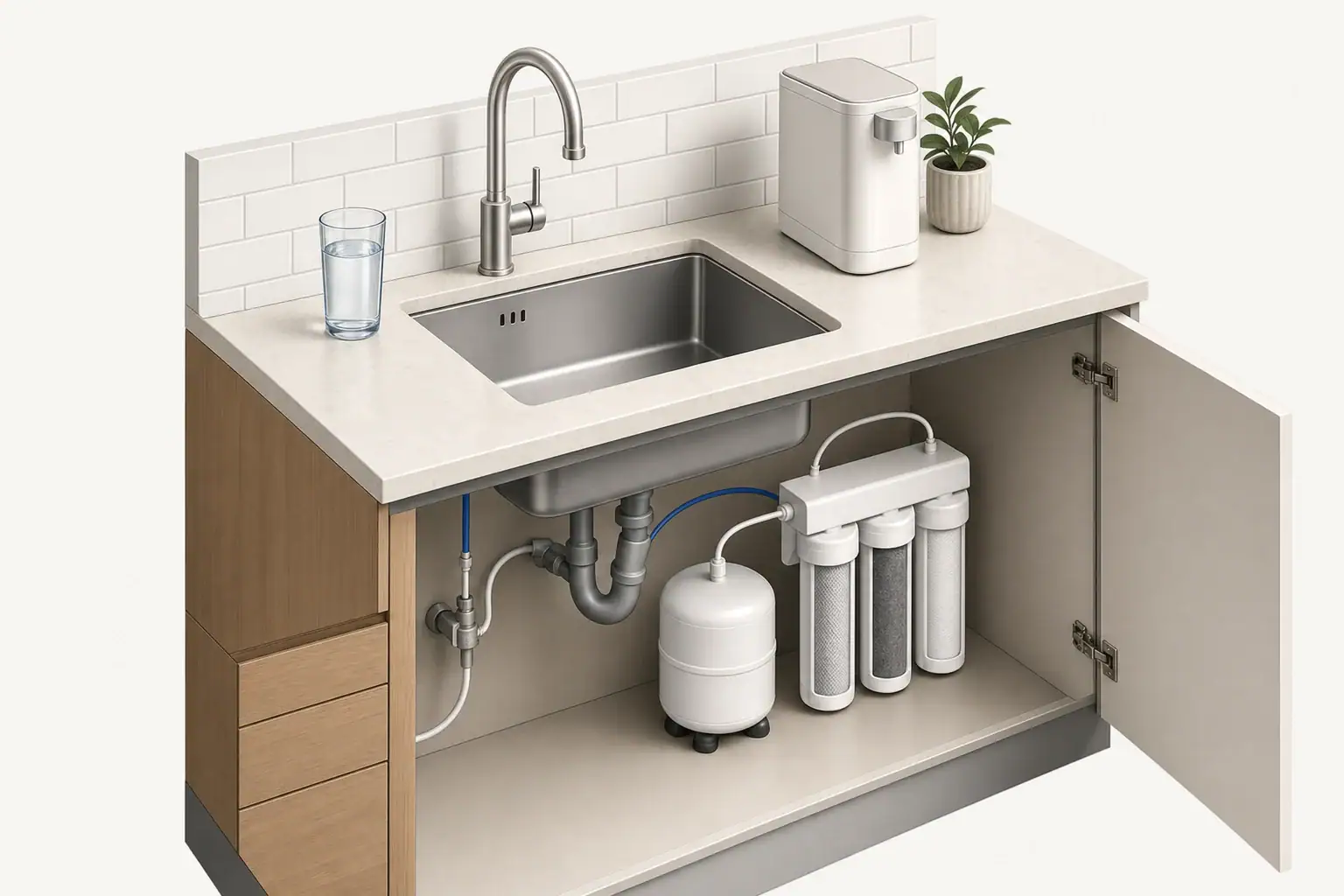
A reverse osmosis membrane should not be treated as the main chloramine-removal stage. These systems commonly rely on carbon pretreatment to reduce disinfectants before water reaches the membrane. When evaluating a system, review whether RO needs special carbon stages for chloramine rather than assuming the membrane handles every substance by itself.
Replacement intervals for prefilters depend on water use, disinfectant loading, cartridge capacity, and local conditions. A calendar estimate is useful for planning, but it does not replace the manufacturer’s operating limits or evidence of declining performance.
How to assess a filter claim
Look for performance information that specifically names chloramine reduction. A generic statement about chlorine taste and odor may refer only to free chlorine. Useful documentation should identify the tested contaminant, rated capacity, flow conditions, and replacement point.
Independent certification can provide additional confidence when its public listing specifically includes chloramine reduction for the exact model and cartridge combination. Verify a filter’s certification claim rather than interpreting certification for unrelated structural, material, or contaminant requirements as a chloramine claim.
Refrigerator and pitcher filters vary substantially in media volume and rated performance. Their format alone does not establish whether they reduce chloramine. The same principle applies to faucet, countertop, under-sink, and whole-house filters.
Troubleshooting Chloramine-Related Taste and Odor Concerns
First determine whether the concern affects cold water, hot water, one fixture, or the entire home. Run cold water briefly after a long period of nonuse and compare fixtures using clean glasses. Do not taste water that has an unusual appearance or an unexplained sewage-like or fuel-like odor.
If filtered water develops an odor sooner than expected, check the cartridge age, installation direction, rated flow, and recent water use. A sudden change may also reflect a utility treatment conversion rather than a failed filter. Contact the utility before replacing multiple treatment stages without a clear diagnosis.
Persistent hot-water-only odors may involve the water heater rather than the municipal disinfectant. Water-heater inspection and service should follow the equipment instructions and be handled by a qualified professional when electrical, gas, pressure, or temperature controls are involved.
Example values for illustration.
| Observation | Possible factor | Practical next check |
|---|---|---|
| Disinfectant odor at every cold tap | Utility residual or treatment change | Check current notices and contact the utility |
| Odor only after overnight stagnation | Water sitting in premise plumbing | Compare the first draw with briefly flushed cold water |
| Odor only in hot water | Water-heater or hot-water plumbing condition | Arrange appropriate heater inspection if it persists |
| Odor at one faucet | Fixture, aerator, or nearby drain | Compare another fixture and inspect the local area |
| Filtered taste improves, then returns | Cartridge exhaustion or excessive flow | Review capacity, use, flow, and replacement timing |
| Refrigerator water tastes different | Small cartridge, old filter, or stagnant line | Check cartridge status and appliance instructions |
| Test results conflict with the report | Timing, test method, or temporary conversion | Repeat correctly and ask the utility about current treatment |
Related guides:
Chlorine vs Chloramine in Tap Water: Taste, Smell, and Filtration •
Choosing a Filter for Chloramine: Standards and Media That Help •
Pitcher Filters and Chloramine: Why Many Struggle (and What Helps) •
Whole House Filters for City Water Chloramine: What Carbon Tank Size Changes
A Practical Chloramine Verification Checklist
Start with the current water utility rather than relying on smell or neighborhood assumptions. Review the annual report, treatment description, and recent notices. Ask whether chloramine is used at your specific service address and whether temporary free-chlorine periods occur.
If testing is needed, choose a method that measures both free and total chlorine, follow its timing requirements, and treat the result as supporting evidence. For higher-confidence identification, use an appropriate laboratory or obtain clarification from the utility.
When selecting filtration, require documentation that specifically addresses chloramine. Match the filter’s rated flow and capacity to actual household use, maintain it on schedule, and reassess performance if the utility changes its disinfectant practice.
Frequently asked questions
How can I tell whether my tap water contains chloramine or free chlorine?
Check your water utility’s current treatment information first. A test that measures both free and total chlorine can provide supporting evidence, but the utility can confirm the disinfectant used at your service address.
Does a chlorine smell mean my water has chloramine?
No. Smell alone cannot reliably distinguish chloramine from free chlorine. Odor can also be affected by plumbing, water temperature, fixtures, and local conditions.
Will letting tap water sit overnight remove chloramine?
Not reliably. Chloramine is more stable than free chlorine, and how quickly it changes depends on temperature, light, container shape, and other conditions.
Do all carbon filters remove chloramine?
No. Look for documentation that specifically states chloramine reduction and review the rated flow, capacity, and replacement guidance for the exact filter configuration.
Why might my water utility temporarily switch disinfectants?
Some utilities temporarily use free chlorine for distribution-system maintenance. Check current public notices or contact the utility to determine whether a conversion applies to your area.
- NSF/ANSI standards explained (42/53/401/58)
- Clear trade-offs: pitcher vs faucet vs under-sink vs RO
- Maintenance planning: cost per gallon and replacement cadence