
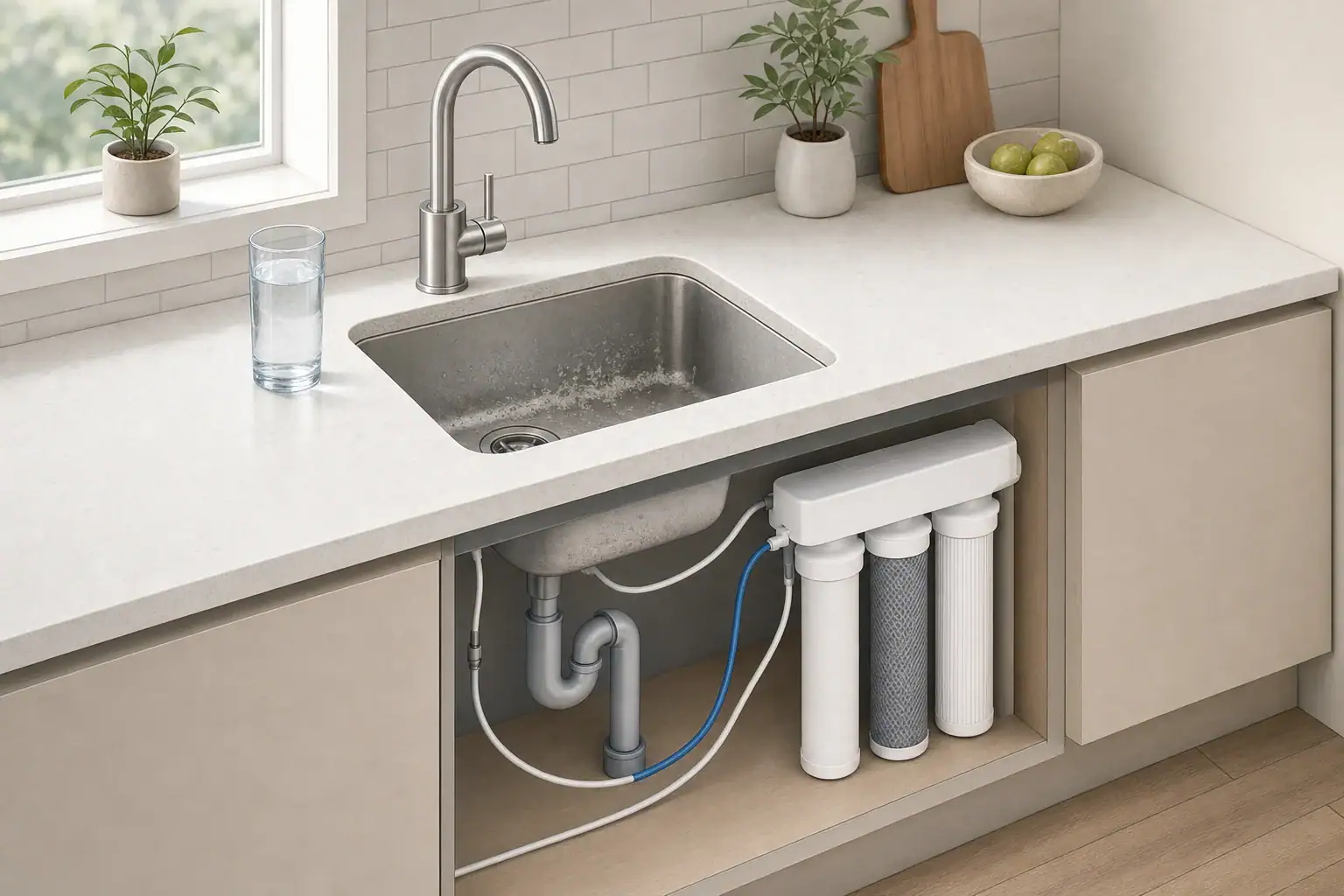
When tap water smells like a swimming pool, a disinfectant used by the water utility is often the reason. The odor may come from free chlorine, chloramine, or a temporary change in treatment conditions. It can also become more noticeable in warm water, after water has been sitting in household pipes, or during seasonal utility maintenance.
A pool-like smell does not automatically indicate that the water is unsafe. Public water systems use disinfectants to control microorganisms as water travels through the distribution network. However, the odor can affect drinking, cooking, coffee, tea, and ice. Identifying the likely disinfectant helps when choosing a practical filtration approach.
Why Treated Tap Water Can Smell Like a Swimming Pool
Utilities commonly use chlorine-based disinfectants because water needs protection after it leaves the treatment plant. Unlike treatment that occurs only at the plant, a disinfectant residual continues working through storage tanks, water mains, and service lines.
The odor reaching a home can vary even when treatment remains within the utility’s normal operating range. Common influences include:
- Distance from the treatment facility
- Water temperature and seasonal demand
- Temporary flushing or maintenance activity
- Changes in the source water or treatment process
- How long water has remained in neighborhood or household pipes
- Differences between cold and heated water
People also perceive odors differently. One person may describe the water as clean or faintly chemical, while another calls the same odor bleach-like, medicinal, or similar to a public pool.
The familiar smell around pools is not a precise identification test. Pool environments can contain several chlorine-related compounds, and tap water odor alone cannot reliably distinguish free chlorine from chloramine.
Chlorine and Chloramine Basics
Free chlorine
Free chlorine generally refers to active chlorine remaining after disinfection demand has been addressed. It is relatively reactive and volatile. Its odor may be more obvious immediately after opening a faucet, especially when the water is warm or aerated.
Standard activated carbon commonly reduces free chlorine effectively when the cartridge has adequate capacity and contact time. Small pitcher water filters for chlorine and faucet filters may improve taste and odor, although their performance and service life depend on flow, water quality, and cartridge condition.
Chloramine
Chloramine is formed by combining chlorine with a controlled amount of ammonia. Utilities may use it because it remains stable for longer periods in the distribution system. Compared with free chlorine, it is less likely to dissipate quickly from an open container.
Chloramine can be more demanding for carbon filtration. A filter designed only for general chlorine taste and odor reduction should not automatically be assumed to provide the same performance for chloramine. Catalytic carbon, a larger carbon bed, slower flow, or multiple treatment stages may be used when chloramine reduction is a stated goal.
Example values for illustration.
| Clue or feature | Free chlorine | Chloramine |
|---|---|---|
| Utility use | Primary or residual disinfection | Long-lasting residual disinfection |
| Odor behavior | Often sharper or more immediately noticeable | May seem milder but remain persistent |
| Standing in an open glass | More likely to diminish over time | Less likely to dissipate quickly |
| Effect of warming | Odor may become more noticeable | Odor may also become noticeable, but behavior varies |
| Basic activated carbon | Commonly suitable for taste and odor reduction | Performance depends more heavily on design and contact time |
| Typical carbon approach | Activated carbon block or granular carbon | Catalytic carbon or a sufficiently sized tested system |
| Best identification source | Utility report or appropriate testing | Utility report or appropriate testing |
Clues That Help Narrow Down the Cause
No single home observation proves whether a utility uses chlorine or chloramine. Several clues considered together can point in a useful direction.
Check whether the odor fades
Fill a clean glass with cold water and smell it away from the sink. Check it again after it has stood uncovered for a while. A rapidly fading odor is more consistent with volatile free chlorine, although this is not a definitive test. Chloramine usually persists longer.
Do not use this observation as a substitute for utility information or testing. Room temperature, container shape, ventilation, and the starting concentration all affect odor.
Compare cold and hot water
If the smell is stronger only from the hot tap, the water heater may be intensifying a disinfectant odor. Heat makes many odors easier to detect. A hot-water-only odor can also have causes unrelated to chlorine, including water heater conditions or reactions involving plumbing materials.
For a basic comparison, smell water collected from the cold tap first. Avoid judging water while leaning over the sink because odors from the drain can be mistaken for odors in the water.
Check more than one fixture
An odor at every cold-water fixture suggests a supply-wide condition. An odor at one faucet may point toward a local aerator, flexible supply line, filter cartridge, or seldom-used branch of plumbing.
If water smells normal in a glass but the sink area smells chemical, musty, or sewer-like, the drain or overflow channel may be responsible. Running water can push drain odors into the air, creating the impression that they came from the tap.
Consider recent utility activity
Utilities sometimes change disinfectants temporarily, flush water mains, or adjust treatment in response to seasonal conditions. These activities can alter taste and odor without indicating a household plumbing failure. A utility notice or customer service response may explain a sudden neighborhood-wide change.
How to Confirm Which Disinfectant Your Utility Uses
The most reliable starting point is the annual water quality report from the water supplier. It may identify the primary disinfectant, the residual disinfectant, or both. Utility treatment pages and direct customer service inquiries can clarify whether chloramine is used continuously or only during part of the year.
A basic total-chlorine result alone does not distinguish free chlorine from chloramine. Test methods that separately measure free chlorine and total chlorine provide more useful information. The difference between the two is often described as combined chlorine, but interpreting results can require care.
Home test strips can be useful for screening, but color matching, storage conditions, expiration, and timing can affect results. A suitable laboratory or water professional can provide more dependable measurements when the answer will influence a significant treatment purchase.
For homes on private wells, a pool-like odor is less likely to come from routine utility disinfection. It may follow shock chlorination, service work, or use of a chemical feed system. Well owners should review recent treatment activity and obtain appropriate testing rather than assuming the odor has the same cause as municipal water.
Choosing Filtration for Chlorine or Chloramine
Activated carbon for free chlorine
Activated carbon adsorbs many compounds associated with unwanted tastes and odors and reacts with free chlorine. Carbon blocks generally offer controlled flow through a compact bed, while granular carbon allows water to pass among loose media. Either format can work when properly designed and maintained.
A countertop, pitcher, faucet-mounted, refrigerator, or under-sink carbon filter may be sufficient when the goal is improving water at one drinking-water outlet. Whole-house treatment addresses more fixtures but requires greater capacity, appropriate flow sizing, pressure-loss planning, and consistent maintenance.
More contact time for chloramine
Chloramine reduction typically benefits from catalytic carbon or a substantial carbon bed with enough contact time. High flow through a small cartridge may provide less reduction than slower flow through a larger amount of suitable media.
When comparing products, look for explicit chloramine-reduction performance rather than relying on a general statement about chlorine. Independent testing or certification language should match the specific reduction claim, intended flow, and rated service capacity.
Where reverse osmosis fits
Reverse osmosis systems usually include carbon prefilters because disinfectants can affect taste and may be incompatible with some membrane materials. The carbon stage performs much of the chlorine or chloramine treatment before water reaches the membrane.
RO may address additional dissolved substances, but it is not automatically necessary for a disinfectant odor alone. It also introduces considerations such as storage or production rate, feed pressure, drain water, cartridge changes, and membrane maintenance.
Point-of-use versus whole-house treatment
Point-of-use filtration treats water at a selected faucet and is often the simpler choice for drinking and cooking. Whole-house carbon can reduce disinfectant throughout the home, including at showers and appliances, but removing the residual from all household plumbing changes the maintenance context. Proper system sizing, installation, and media replacement are important.
A filter should not be installed in a way that bypasses backflow prevention, pressure controls, or other plumbing safety features. Whole-house work should follow local plumbing requirements.
Installation and Maintenance Factors That Affect Odor Reduction
Even an appropriate filter medium can perform poorly if the system is undersized, overdue for replacement, or operated above its intended flow. Carbon needs sufficient contact with the water. As demand increases, contact time may decrease and odor can break through sooner.
Practical maintenance points include:
- Replace cartridges according to the manufacturer’s schedule and actual water use.
- Investigate an early return of odor rather than assuming the cartridge is still effective.
- Flush new cartridges as directed to remove carbon fines and trapped air.
- Keep housings, pitchers, reservoirs, and faucet components clean.
- Use replacement media intended for the specific housing and treatment goal.
- Watch for declining flow, leaks, or unusual pressure changes.
Filter life is not determined by time alone. Water volume, disinfectant concentration, sediment, organic matter, flow rate, and media quantity all influence how long useful performance lasts.
Example values for illustration.
| Observation | Possible explanation | Practical next step |
|---|---|---|
| Odor at all cold taps | Supply disinfectant or utility change | Review the utility report and notices |
| Odor only at one faucet | Local aerator, line, or cartridge issue | Compare fixtures and inspect maintained components |
| Odor only near the sink | Drain or overflow odor | Smell a glass of water away from the sink |
| Odor stronger in hot water | Heat intensifying odor or heater-related condition | Compare cold water before assessing the heater |
| Odor returns after filtration | Exhausted media or excessive flow | Check service life, usage, and rated flow |
| Odor persists after standing | Chloramine may be present | Confirm with utility information or suitable testing |
| Sudden neighborhood-wide change | Flushing or treatment adjustment | Contact the water supplier for current information |
Related guides:
Chlorine vs Chloramine in Tap Water: Taste, Smell, and Filtration •
How to Read Your City’s Consumer Confidence Report (CCR) •
Choosing a Filter for Chloramine: Standards and Media That Help •
Whole House Filters for City Water Chloramine: What Carbon Tank Size Changes
When a Pool-Like Smell Needs More Attention
Contact the water supplier when the odor appears suddenly, is unusually strong, affects nearby homes, or follows a loss of pressure or public water advisory. The utility can explain current treatment practices and determine whether distribution-system work is underway.
If the odor occurs only inside the home, compare multiple fixtures and cold versus hot water. A plumber or water treatment professional may be appropriate when the issue appears tied to a water heater, a recently installed component, or deteriorating household plumbing.
Stop using water for drinking and follow local official guidance if an advisory has been issued or if the water has an unexplained color, oily appearance, fuel-like odor, or other major change. A typical disinfectant smell by itself is usually a taste-and-odor concern, but unusual combinations of symptoms warrant direct investigation rather than relying only on filtration.
The most useful path is to identify the utility’s disinfectant, confirm that the odor is actually in the water, and match the filter medium and size to that specific treatment goal. Free chlorine is generally easier for standard carbon to reduce, while chloramine usually calls for more specialized carbon performance and adequate contact time.
Frequently asked questions
Is it normal for tap water to smell like a swimming pool?
A mild pool-like odor can occur when a public water system uses chlorine or chloramine as a disinfectant. If the smell is sudden, unusually strong, or accompanied by other changes in the water, contact the water supplier.
How can I tell whether my water has chlorine or chloramine?
Check the utility’s annual water quality report or contact customer service. Water left uncovered may lose a free-chlorine odor more quickly than a chloramine odor, but this observation is not a definitive identification test.
Will letting tap water sit remove the chlorine smell?
Free chlorine may dissipate from an uncovered container over time, especially with ventilation and warmer temperatures. Chloramine is more persistent and usually does not fade as quickly.
Does a standard carbon filter remove chloramine?
Some carbon filters can reduce chloramine, but performance depends on the media, filter size, flow rate, and contact time. Choose a system with an explicit chloramine-reduction claim when chloramine is the treatment goal.
Why does the pool smell seem stronger in hot water?
Heat can make disinfectant odors easier to notice. If the odor occurs only in hot water, compare cold-water fixtures as well because the water heater or nearby plumbing may also contribute.
- NSF/ANSI standards explained (42/53/401/58)
- Clear trade-offs: pitcher vs faucet vs under-sink vs RO
- Maintenance planning: cost per gallon and replacement cadence