
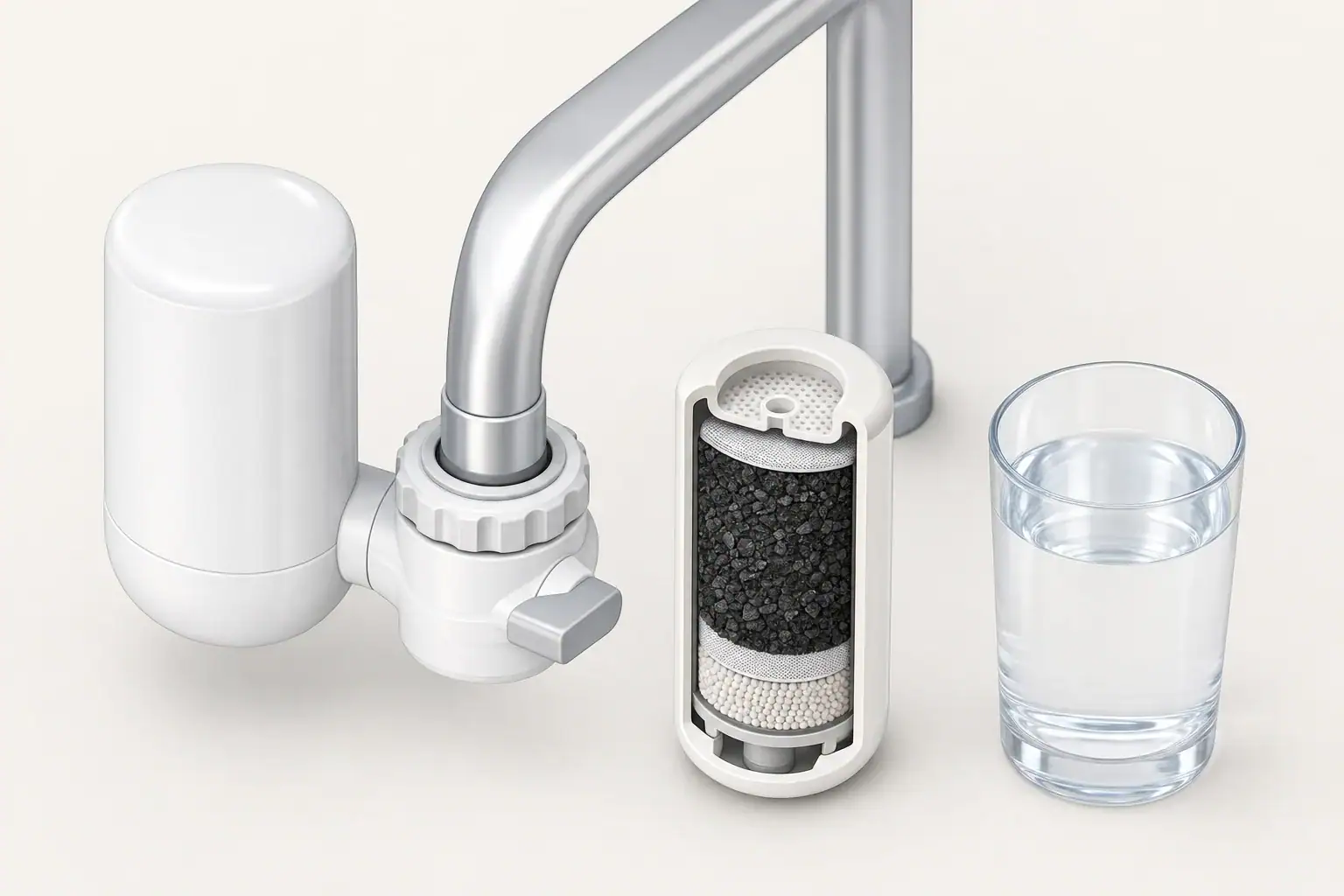
Faucet-mount water filters should generally be used with cold water because their housings, seals, diverter valves, and filtration media are designed and performance-rated for a limited temperature range. Hot water can soften or deform plastic parts, weaken seals, increase the risk of leaks, and make contaminant-reduction performance less predictable.
For a faucet with separate hot and cold handles, open only the cold side before directing water through the filter. On a single-handle faucet, move the handle fully to the cold position and allow any warm water in the line to clear before switching on the filter.
How hot water can affect a faucet filter
A faucet-mount unit places several compact components directly in the water path. Although some individual materials may tolerate warmth, the assembled product is intended to operate within the temperature range stated by its manufacturer.
Plastic housings can soften or distort
Filter housings and attachment parts are often made from lightweight plastics. Water hotter than the product’s rated limit can cause gradual distortion or, under more severe conditions, visible warping.
Even a small change in shape can affect threaded connections, cartridge alignment, or the fit between the filter and faucet. Damage may not appear immediately; repeated exposure can be more consequential than one brief mistake.
Seals and diverter valves may wear faster
O-rings, gaskets, and internal valve components help keep water moving through the intended path. Heat can cause some elastomers to expand, harden, or lose elasticity over time. That can lead to dripping, bypass around the cartridge, or leaks at the faucet connection.
The diverter mechanism may also become harder to operate if its parts have been exposed to temperatures outside their intended range.
Filtration performance may change
Many faucet filters use activated carbon, sometimes combined with other media. Carbon adsorption depends partly on water temperature, contact time, water chemistry, and the contaminant involved. A cartridge’s stated performance is based on defined operating conditions rather than every possible temperature.
Using hot water can therefore make the filter’s reduction performance less predictable. It may also affect specialty media, adhesives, binders, or internal supports included in a particular cartridge.
This does not mean every brief contact with warm water causes the media to release everything it has captured. It means the product should not be expected to deliver its rated performance after use outside the specified conditions.
Cold water protects the filter’s rated performance
When a faucet filter has certified contaminant-reduction claims, those claims apply to the specific product and the conditions under which it was evaluated. Certifications associated with standards such as NSF/ANSI 42 or NSF/ANSI 53 do not make a filter suitable for unlimited water temperatures.
The operating instructions and temperature range remain important. A claim for chlorine taste and odor reduction, lead reduction, or another contaminant does not override a cold-water-only direction.
Cold water also helps maintain the expected flow and contact conditions through the cartridge. Water temperature can influence viscosity and flow behavior, so hot water may pass through differently even if the housing appears unaffected.
What counts as cold water?
Use water from the cold supply line rather than trying to judge safety by touch alone. Water that feels merely warm can still be outside the filter’s allowable range, particularly after the faucet has recently run hot.
Because allowable temperatures vary among products, there is no single maximum that should be applied to every faucet-mount filter. Check the installation guide, cartridge packaging, or product specifications for the stated range.
If the faucet has been running hot, follow this sequence:
- Turn the filter diverter off so water exits through the regular faucet outlet.
- Move the faucet control fully to cold.
- Let the water run until it is consistently cold.
- Engage the filter only after the hot water has cleared.
Do not try to cool hot water by mixing in some cold water while it passes through the filter. The temperature can fluctuate, and the filter may still receive bursts of hot water.
What to do if hot water went through the filter
A short accidental exposure does not always mean the complete unit has failed, but it should not be ignored. Turn off the filtered-water setting, switch the faucet to cold, and let the unfiltered outlet run until the water cools.
Then inspect the filter without taking apart components that are not intended for user service. Look for:
- Water leaking around the faucet adapter, cartridge, or housing seam
- A housing that appears swollen, warped, or discolored
- A loose cartridge or attachment that no longer seats correctly
- A diverter that sticks or fails to direct water properly
- An unusual drop in flow after the unit has cooled
If there is visible damage or continued leakage, stop using the filter. Follow the product instructions for replacing the cartridge, housing, seals, or complete unit as applicable. Do not use tape, glue, or improvised parts to repair a pressure-bearing filter housing.
If the water was very hot, ran through the cartridge for an extended period, or exceeded the published temperature limit, consult the manufacturer’s written guidance. Cartridge replacement may be appropriate even when no exterior damage is visible, especially when continued contaminant-reduction performance matters.
Common cold-water mistakes
Activating the filter before choosing the temperature
On a single-handle faucet, it is easy to engage the filter while the handle remains in a warm or mixed position. Set the faucet to cold first, clear the line, and then activate filtration.
Assuming brief hot-water use is part of cleaning
Hot water should not be flushed through the cartridge as a sanitation method unless the product instructions explicitly direct it. Heat can damage components without reliably sanitizing the filter. Use only the cleaning procedures approved for that model.
Filtering hot water for cooking
If hot filtered water is needed for tea, coffee, or cooking, filter cold water first and heat it afterward in an appropriate appliance or cookware. This keeps the faucet filter within its intended operating conditions.
Relying only on how the water feels
Hand temperature is not a precise measure of the water entering the filter. A fully cold faucet setting and the product’s operating instructions provide better guidance than a quick touch test.
Related guides: NSF/ANSI 42 vs 53 • Faucet filter switch valve problems • Troubleshooting slow faucet-filter flow
A simple operating routine
Keep the faucet-mount filter disengaged while selecting the water temperature. Run the faucet on cold until any warm water clears, then direct the flow through the cartridge. When hot water is needed, switch the filter off before changing the faucet temperature.
This routine helps protect the housing and seals while keeping the cartridge within the conditions used to establish its expected service life and filtration performance.
Frequently asked questions
Can I run warm water through a faucet-mount filter?
Use only water within the temperature range stated by the manufacturer. Warm water may still exceed that range, so use the cold supply and let any warm water clear before engaging the filter.
What happens if hot water goes through a faucet filter?
Hot water can damage plastic housing parts, seals, diverter components, or cartridge materials. It can also make the filter’s rated contaminant-reduction performance less predictable.
Do I need to replace my filter after accidentally using hot water?
Inspect the unit for leaks, warping, poor cartridge fit, sticking diverter operation, or reduced flow. If the water was very hot, exposure was prolonged, or the published temperature limit was exceeded, follow the manufacturer’s guidance; cartridge replacement may be appropriate.
Can I filter cold water and heat it for tea or cooking?
Yes. Filter cold water first, then heat it in suitable cookware or an appliance. This avoids exposing the faucet-mounted filter to hot water.
How do I make sure the water is cold before turning on the filter?
Leave the filter disengaged, set the faucet fully to cold, and run the regular outlet until the water is consistently cold. Then switch the diverter to filtered water.
- NSF/ANSI standards explained (42/53/401/58)
- Clear trade-offs: pitcher vs faucet vs under-sink vs RO
- Maintenance planning: cost per gallon and replacement cadence