
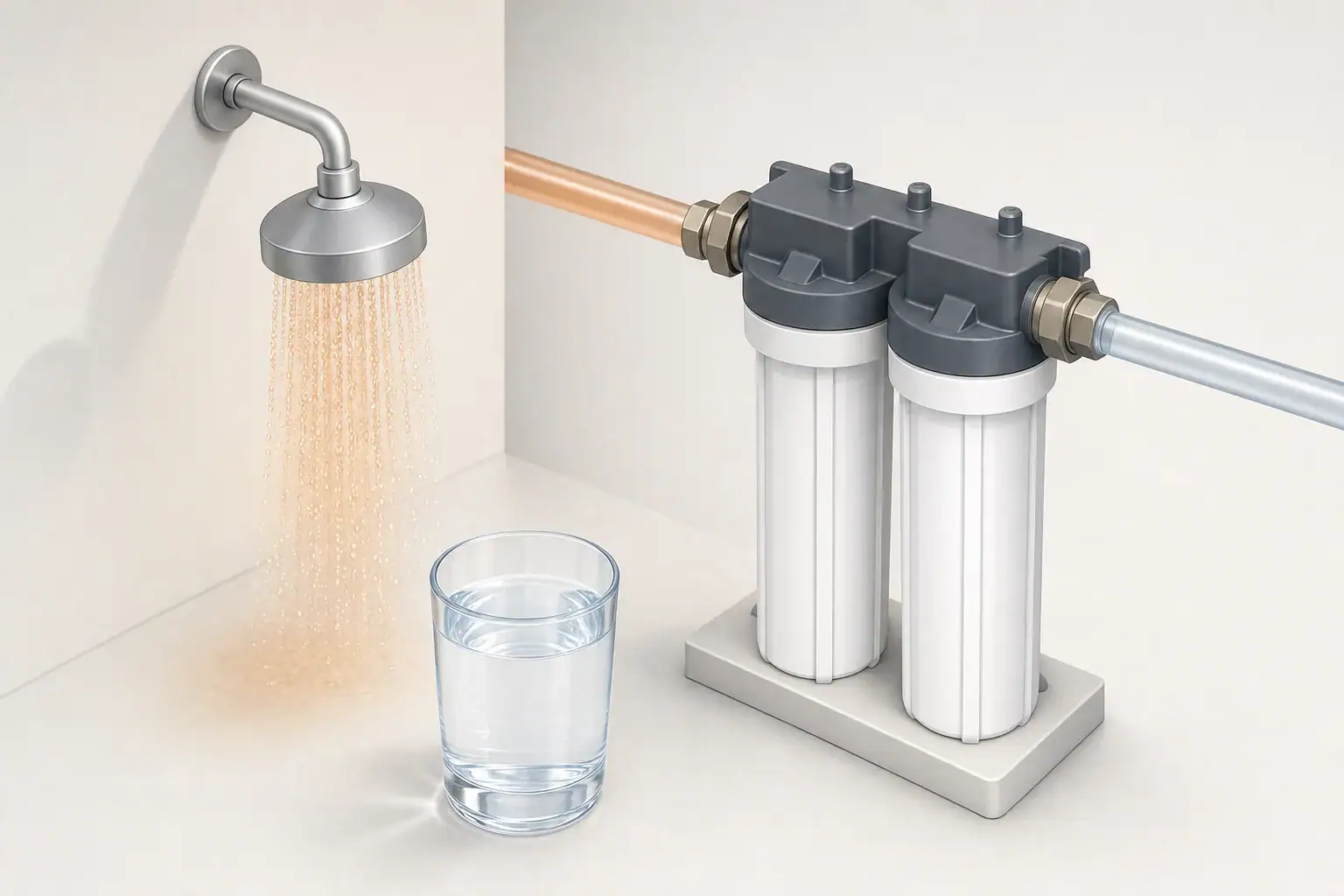
A shower filter may reduce a small amount of particulate iron, but it is rarely an effective primary treatment for iron in well water. Most shower filters are designed for chlorine, sediment, or odor concerns—not the sustained iron load that can cause orange stains, clogged fixtures, and discolored water.
The better solution usually treats the water before it reaches the water heater and household plumbing. Choosing that treatment requires knowing the iron concentration, the form of iron present, and related water conditions such as pH, hardness, manganese, and iron bacteria.
Why shower filters have limited iron-removal ability
A shower filter has a small media volume and must process water quickly. Those constraints leave little contact time for dissolved iron to be converted into particles and captured. Even when a cartridge initially improves the water, iron can coat or clog the media and shorten its service life.
Common shower-filter components have different limitations:
- Sediment screens or cartridges may catch visible rust or oxidized iron particles, but they do not reliably remove iron that remains dissolved in clear water.
- Activated carbon is useful for certain tastes, odors, and chemicals, but it is not generally considered a dependable iron-removal medium.
- Redox or specialty media may reduce some iron under suitable conditions, but performance depends on water chemistry, flow, media quantity, and the manufacturer’s stated capacity.
A shower filter also treats only one fixture. It does not prevent iron from staining sinks and toilets, accumulating in the water heater, or fouling other plumbing and appliances.
The form of iron determines what treatment can work
Iron in well water does not always look the same. A useful treatment decision starts by distinguishing dissolved iron from particles and biological growth.
| Condition | Typical observation | More suitable approach |
|---|---|---|
| Dissolved ferrous iron | Water starts clear and may turn orange after exposure to air | Oxidation followed by filtration, or another system rated for the measured conditions |
| Oxidized ferric iron | Orange or brown particles are already visible | Sediment or backwashing filtration sized for the particle load |
| Iron bacteria involvement | Slime, recurring deposits, or swampy odors may occur | Well assessment, appropriate disinfection, and treatment of the remaining iron |
These observations are clues rather than a diagnosis. Manganese, sediment, corrosion, and other conditions can produce similar discoloration or deposits.
Testing should come before filter selection
A laboratory water test is more useful than choosing a filter based only on stain color. At minimum, the results should identify the iron concentration. Testing pH, hardness, manganese, turbidity, and other relevant well-water parameters helps determine whether a treatment medium can operate reliably.
If slime or recurring biological growth is present, testing or an inspection may also be needed to evaluate iron bacteria. Private well owners should periodically test for health-related contaminants recommended by state or local authorities as well. Removing iron does not establish that the water is free from microorganisms, nitrate, arsenic, or other contaminants.
When reviewing a shower filter, look for an explicit iron-reduction claim that states the applicable concentration, flow rate, and capacity. A certification or performance claim for chlorine reduction does not demonstrate iron reduction. For example, NSF/ANSI 177 addresses shower filtration performance for free available chlorine; it should not be treated as proof that a unit removes iron.
Better treatment options for iron in well water
Oxidation followed by filtration
Dissolved iron often needs to be oxidized into solid particles before a filter can capture it. Whole-house systems may use air injection, an oxidizing medium, or controlled chemical oxidation followed by filtration.
The appropriate method depends on iron concentration, pH, manganese, sulfur odors, peak water demand, and available space. Chemical-feed equipment requires correct setup and ongoing maintenance, so it is generally best specified and installed by a qualified water-treatment or plumbing professional.
Backwashing iron filters
A backwashing filter uses a media bed to treat iron and periodically reverses water flow to flush accumulated material. These systems can offer more capacity than small cartridges, but the media must match the water chemistry.
Before choosing one, verify:
- The measured iron and manganese levels are within the system’s stated range.
- The well pump can supply the required backwash flow.
- The household has an acceptable drain location and sufficient space.
- The system can handle the home’s peak flow without an excessive pressure drop.
- The media’s pH and pretreatment requirements are met.
Sediment filtration for iron particles
If testing shows that most of the iron is already oxidized, a whole-house sediment filter may capture it. Cartridge filters are simple, but a heavy particle load can require frequent replacement and cause pressure loss. A self-cleaning or backwashing design may be more practical when sediment volume is high.
Sediment filtration alone is not a reliable solution for clear-water ferrous iron because that iron can pass through before oxidizing later in the plumbing.
Water softeners under limited conditions
Some ion-exchange water softeners can reduce modest amounts of dissolved iron while also treating hardness. However, iron can foul the resin, increase cleaning needs, and reduce performance. This approach should be considered only when the measured iron level and water chemistry fall within the equipment manufacturer’s operating limits.
A softener is not a substitute for a dedicated iron system when iron is high, already oxidized, or associated with significant bacterial slime.
Treatment for iron bacteria
A filter alone may not resolve recurring slime caused by iron bacteria. The well, pressure tank, plumbing, and treatment equipment may need to be evaluated as a system. Appropriate disinfection can be part of the response, but the procedure and chemical dose should be determined for the specific well rather than improvised at a shower fixture.
When a shower filter may still be reasonable
A shower filter can make sense as a limited point-of-use measure when the iron level is low, most of the problem consists of particles, and treating the entire home is not immediately practical. It may also serve as a final sediment barrier after effective whole-house treatment.
Set realistic expectations. A small filter may clog quickly, reduce shower pressure, or require frequent cartridge changes. Compare the replacement schedule and cost with the cost of correcting the source problem. If orange staining appears throughout the home, point-of-entry treatment is usually the more practical direction.
Common selection mistakes
- Buying based on stain color alone: Orange deposits suggest iron but do not reveal its concentration or form.
- Assuming carbon removes every contaminant: Carbon has useful applications, but dissolved iron generally requires a different treatment process.
- Ignoring flow and backwash requirements: An undersized system can reduce pressure, while inadequate backwashing can allow the media bed to foul.
- Overlooking the water heater: Existing iron sediment can remain in a tank after new treatment is installed and may take time or professional service to address.
- Relying on an unrelated certification: Confirm that any performance documentation applies specifically to iron and to conditions resembling the tested well water.
Related guides: Iron in water: staining, taste, and filtration options • Whole-house filters for iron and rust • Backwashing whole-house filters
A practical decision path
Start with a laboratory test and note whether the water leaves the faucet colored or turns orange only after standing. Use the results to separate a particle-filtration problem from a dissolved-iron problem.
For visible ferric particles, evaluate whole-house sediment filtration and its maintenance burden. For dissolved iron, compare appropriately sized oxidation-and-filtration or iron-media systems. Consider a softener only when both hardness and low-level dissolved iron are present and the equipment is rated for the measured conditions. If slime or persistent biological growth occurs, arrange a well assessment rather than relying on a shower cartridge.
A shower filter is best viewed as a small finishing filter, not as the main defense against iron in a private well.
Frequently asked questions
Can a shower filter remove iron from well water?
A shower filter may capture some visible iron particles, but it usually does not reliably remove dissolved iron. Its small media capacity and high flow rate limit iron treatment performance.
Why does well water turn orange after it sits?
Clear water that turns orange after standing may contain dissolved ferrous iron. Exposure to oxygen can convert it into visible ferric iron particles.
What is the best filter for iron in well water?
The appropriate system depends on laboratory results and the form of iron present. Dissolved iron often requires oxidation followed by filtration, while visible particles may be addressed with properly sized sediment or backwashing filtration.
Will a water softener remove iron?
Some softeners can reduce modest amounts of dissolved iron when the water chemistry and iron level are within the manufacturer’s limits. Higher iron levels or oxidized iron can foul the resin and generally require dedicated iron treatment.
Do I need to test well water before buying an iron filter?
Yes. Testing for iron, pH, hardness, manganese, turbidity, and related conditions helps identify a treatment process that can work reliably and be properly sized.
Can iron bacteria be removed with a shower filter?
No. A shower filter does not address iron bacteria throughout a well and plumbing system. Recurring slime or odors may require a well assessment, appropriate disinfection, and treatment for remaining iron.
- NSF/ANSI standards explained (42/53/401/58)
- Clear trade-offs: pitcher vs faucet vs under-sink vs RO
- Maintenance planning: cost per gallon and replacement cadence