
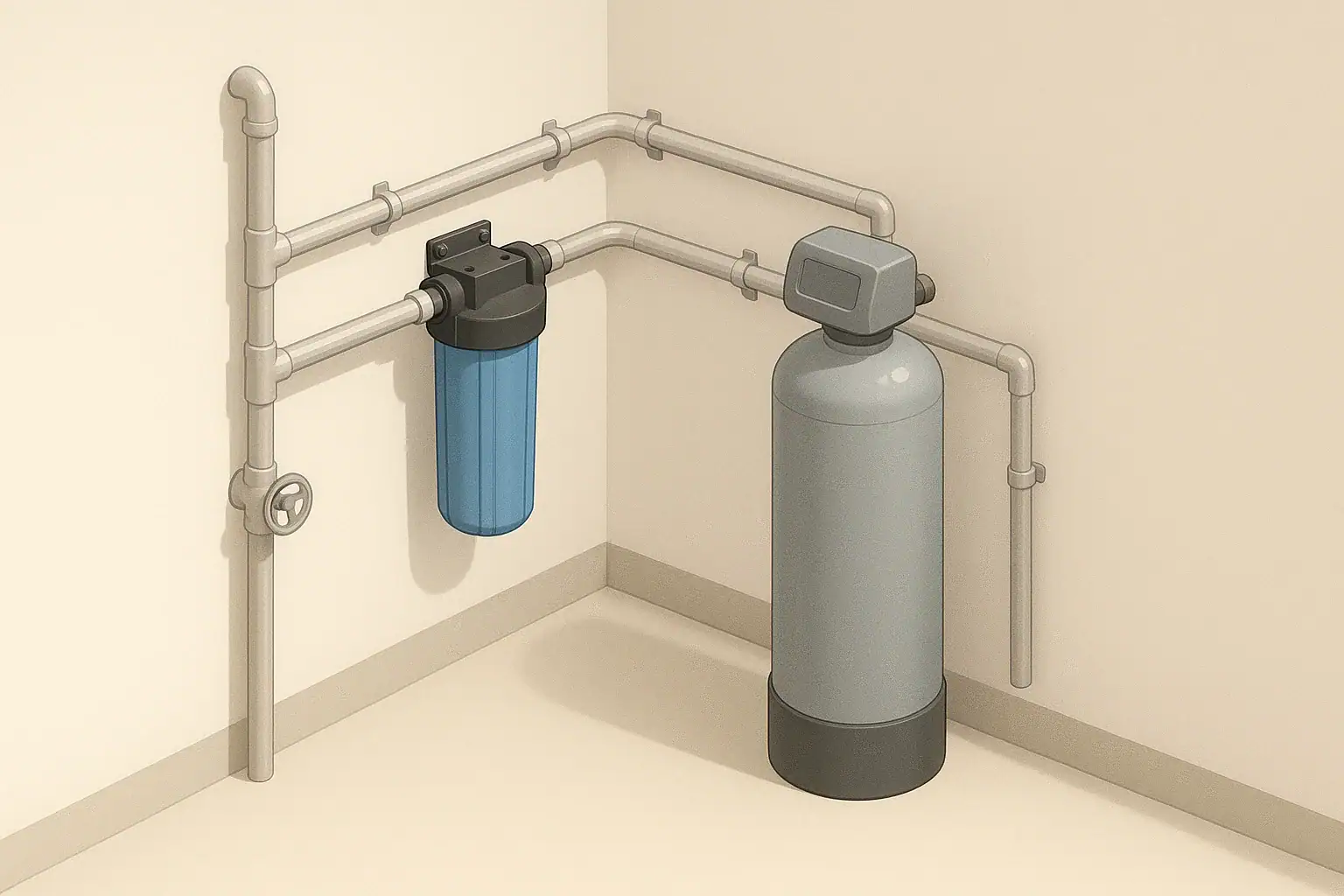
Whole house filters and water softeners can connect to the same main water line, but they perform different jobs. A filter targets the particles or substances listed for its particular media and model. A conventional ion-exchange softener targets hardness, which is caused primarily by dissolved calcium and magnesium.
The distinction matters because ordinary filtration does not remove dissolved hardness minerals, and a softener is not a general-purpose contaminant filter. The right choice starts with a water report or test rather than scale, taste, or appearance alone.
Whole House Filter vs Water Softener at a Glance
A point-of-entry system treats water where it enters a building and therefore must accommodate whole-home flow. However, its location does not determine what it removes. That depends on the treatment method, rated flow, capacity, operating conditions, and the exact performance claims for the selected product. The EPA’s Guide to Selecting Water Treatment Systems distinguishes filtration, cation-exchange softening, and scale-conditioning technologies rather than treating them as interchangeable.
| Question | Whole House Filter | Ion-Exchange Water Softener |
|---|---|---|
| Primary job | Targets substances specified for the filter and media | Removes calcium and magnesium hardness |
| Typical applications | Sediment filtration or certified taste, odor, and contaminant-reduction claims | Scale, soap scum, and other hard-water effects |
| Common treatment material | Sediment cartridges, activated carbon, or contaminant-specific media | Cation-exchange resin regenerated with salt |
| Removes hardness? | Ordinary sediment and carbon filtration does not | Yes, when correctly sized and operated |
| Controls scale without removing hardness? | Some separate conditioning technologies may alter scale-forming behavior | Not merely scale control; a softener removes hardness ions through exchange |
| Reduces chlorine taste and odor? | Only if that claim is supported for the specific system | Not the normal function of softening resin |
| Main consumable | Replacement cartridge or media | Regeneration salt, water, and eventually resin or service parts |
What a Whole House Filter Actually Does
A whole house filter, also called a point-of-entry filter, is installed so that it treats some or all water entering the home. Which outlets receive treated water depends on the plumbing layout; outdoor irrigation or other branches may be bypassed.
Common configurations include:
- Sediment filtration: captures particles within the filter’s rated range, such as sand, silt, or rust flakes.
- Activated carbon: may carry claims for chlorine taste and odor or other named substances, depending on the product, media quantity, flow, and contact time.
- Specialty media: designed for particular water conditions or named reduction claims.
Do not infer a specific VOC, pesticide, heavy-metal, chloramine, or other contaminant reduction merely because a system contains carbon or specialty media. Verify the exact model and replacement element in its certified listing or performance data sheet. The EPA advises buyers to look for the specific target contaminant rather than relying on a general reference to a treatment method or standard.
What ordinary whole house filters generally do not do
- Remove dissolved hardness: sediment and conventional carbon filters do not remove calcium and magnesium in the way a cation-exchange softener does.
- Function as total dissolved solids removal systems: that requires a suitable process, such as a correctly selected reverse-osmosis system at the point where such treatment is needed.
- Disinfect water automatically: microbial treatment requires equipment intended and validated for that purpose.
- Remove every contaminant: no single treatment method addresses every possible water-quality issue.
What a Water Softener Actually Does
Hardness is caused primarily by dissolved calcium and magnesium. According to the U.S. Geological Survey’s hardness guidance, these minerals can contribute to soap scum and scale in pipes, water heaters, and other equipment.
Most conventional residential softeners use cation exchange:
- Water passes through a tank containing resin beads.
- The resin exchanges calcium and magnesium for sodium or potassium ions.
- As the resin’s available capacity is used, the control valve initiates regeneration.
- Brine restores the resin’s exchange capacity, and the displaced hardness is sent to the drain.
NSF’s residential treatment standards overview identifies NSF/ANSI 44 as the standard for residential cation-exchange water softeners and describes the exchange of calcium and magnesium for sodium or potassium.
Softening is not the same as scale conditioning
A salt-free device described as a conditioner or scale-reduction system should not automatically be called a water softener. As the EPA guide explains, a cation-exchange softener removes excessive hardness, while some conditioning technologies aim to change scale-forming behavior without removing the hardness minerals. If measured hardness after treatment is important, check whether the equipment has an actual hardness-reduction claim rather than only a scale-control claim.
What a conventional softener does not normally do
- It does not serve as a sediment filter.
- It is not designed as a broad organic-chemical or disinfectant-removal system.
- It generally does not function as TDS-removal treatment. It changes the ionic composition of the water rather than operating like reverse osmosis.
Hardness vs Other Water Concerns
Hardness should be measured rather than estimated from a national map or visual symptoms. USGS notes that regional hardness maps are not suitable for making a decision about an individual property because local conditions vary.
Laboratories and utilities commonly report hardness as milligrams per liter (mg/L) as calcium carbonate. It may also be expressed in grains per gallon (gpg). The conversion is:
gpg = mg/L as CaCO3 ÷ 17.1
For example, 171 mg/L as calcium carbonate is approximately 10 gpg. The conversion is documented in a USGS technical publication.
| Hardness as CaCO3 | General classification |
|---|---|
| 0–60 mg/L | Soft |
| 61–120 mg/L | Moderately hard |
| 121–180 mg/L | Hard |
| More than 180 mg/L | Very hard |
These classifications provide context, not an automatic purchase threshold. The appropriate setting and capacity depend on the property’s measured water chemistry, water demand, and the selected equipment.
Hardness is also different from TDS, disinfectant residual, turbidity, pH, iron, and individual regulated contaminants. See TDS vs hardness for a closer comparison of those two measurements.
Choosing a Filter, Softener, or Both
For a public water supply, begin with the utility’s current Consumer Confidence Report and investigate any property-specific issue that the report cannot show, such as material entering from private plumbing. Private-well users should use an appropriate state-certified laboratory. The EPA recommends defining the treatment goal from those results before selecting equipment.
When a whole house filter may be the relevant treatment
- A test or documented supply condition identifies sediment that an appropriately rated filter can capture.
- You want chlorine taste and odor reduction throughout the home, and the selected system has that specific claim at a suitable service flow.
- A named contaminant has been detected and a point-of-entry product is certified or otherwise properly validated for that exact reduction under applicable conditions.
A point-of-use drinking-water filter may be more practical when the concern applies only to water used for drinking and cooking. Whole-home treatment must accommodate much higher flow and treats water used for activities that may not require the same level of treatment.
When a water softener may be the relevant treatment
- A water report or test confirms hardness, and reducing it is the treatment goal.
- Scale and soap-scum effects are the main concerns rather than taste, odor, or a detected contaminant.
- The softener can deliver the required service flow and capacity at the measured hardness level.
Shower feel alone cannot identify the complete water profile. If that is your starting concern, see hard water feel in the shower for the differences between filtration and softening.
When both may be justified
Both systems can be appropriate when testing or supply documentation identifies separate problems—for example, measurable hardness plus sediment, or hardness plus a taste-and-odor concern supported by a suitable filter claim. Each component should have a defined job; adding stages without a documented purpose increases cost and maintenance.
Installation Order When Using Both
“Filter first, softener second” is common when an upstream sediment stage is needed to protect downstream equipment, but it is not a universal plumbing rule. Water chemistry and the requirements of each selected device can change the correct sequence.
For example, a Pentair OM26K installation manual illustrates sediment, neutralization, iron, and taste-and-odor treatment upstream of that manufacturer’s softener. That is an equipment-specific arrangement, not proof that every carbon tank or specialty treatment belongs before every softener.
Before installation, compare both manuals for:
- Required water pressure and temperature ranges.
- Maximum and rated service flow.
- Water-chemistry limitations, including sediment or oxidant exposure.
- Drain, bypass, backwash, and electrical requirements.
- Whether outdoor taps or irrigation should bypass treatment.
Have the final sequence based on the water analysis and the requirements of the actual equipment, especially when iron, manganese, low pH, sulfur odor, or microbial concerns are involved.
Understanding Certifications and Reduction Claims
A certification is useful only when it matches the exact product and claim you need. NSF cautions that certification to a standard does not mean a product reduces every substance covered by that broad standard.
| Standard | General scope | What to verify |
|---|---|---|
| NSF/ANSI 42 | Aesthetic effects, including specified taste, odor, or particulate claims | The exact claim, model, replacement element, flow, and capacity |
| NSF/ANSI 53 | Specified health-effects reduction claims | The individual contaminant named in the listing |
| NSF/ANSI 401 | Specified incidental or emerging-compound claims | The individual compounds claimed for the exact product |
| NSF/ANSI 44 | Residential cation-exchange water softeners | Rated capacity, efficiency, service flow, and operating conditions |
| NSF/ANSI 58 | Reverse-osmosis drinking-water treatment systems | The exact configuration and listed reduction claims |
Do not rely on phrases such as “tested to NSF standards” without identifying who performed the testing, the exact model tested, the applicable standard, and the certified claim. Check the certifier’s current public listing and the manufacturer’s performance data sheet.
Maintenance, Capacity, and Cost
Whole house filters
Cartridge life is not a universal number of months or gallons. Actual life depends on incoming water quality, household demand, flow, and the product’s rated capacity. Replace elements according to the manufacturer’s instructions and investigate an unusual pressure drop rather than continuing to operate a clogged cartridge. The EPA also notes that post-installation testing can help confirm whether treatment continues to meet the intended goal.
Water softeners
A softener’s salt and water use depend on measured hardness, daily water demand, reserve settings, regeneration programming, capacity setting, and other water constituents. Check the brine tank, verify that regeneration is occurring, and periodically test treated-water hardness instead of assuming that salt in the tank proves the system is working.
A model-specific operating example
The following is an illustration, not a universal salt-use estimate. The performance sheet in a Pentair whole house softener manual lists a capacity of 16,660 grains at a 3.9-pound salt dose for its named 1.0 model. It also lists a 10-gpm rated service flow and operating limits of 20–120 psi and 40–100°F.
Assume measured hardness of 10 gpg and 240 gallons per day routed through that softener:
- Daily hardness load:
10 gpg × 240 gallons = 2,400 grains. - Idealized interval:
16,660 ÷ 2,400 ≈ 6.9 days. - Idealized annual salt: approximately
3.9 × 365 ÷ 6.9 = 205 pounds. - Illustrative annual salt cost:
205 × local price per pound.
Installed performance can be lower because actual consumption, reserve capacity, hardness variation, programming, and other constituents affect regeneration. Use the performance sheet for the exact model and calculate from your measured hardness and metered demand.
Frequently Asked Questions
Can a whole house filter remove hard-water minerals?
Ordinary sediment and activated-carbon filters do not remove dissolved calcium and magnesium. A cation-exchange softener removes hardness. A scale conditioner may instead alter scale-forming behavior, so check whether the product claims hardness reduction or only scale control.
Will a water softener remove chlorine?
Chlorine reduction is not the normal function of cation-exchange softening resin. If chlorine taste or odor is the concern, choose a filter whose exact model and element have that specific claim at the required flow and capacity.
Should the whole house filter always be installed before the softener?
No universal order applies to every combination. A sediment filter is commonly placed upstream when required to protect downstream equipment, but the complete sequence must follow the water analysis and the manuals for the selected filter, softener, and any specialty treatment.
Does a softener lower TDS?
A conventional softener generally does not function as TDS-removal treatment. It exchanges hardness ions for sodium or potassium, changing ionic composition. Reverse osmosis is a different process used when dissolved-solids reduction is the treatment goal.
How do I decide which system I need?
Start with the public utility’s current water report or a property-specific laboratory test. Match each confirmed issue to an exact treatment claim, then check service flow, capacity, operating limits, maintenance, and installation requirements. Use a softener for measured hardness, a suitable filter for a supported filtration goal, or both when separate documented conditions justify both jobs.
Recommended next:
- NSF/ANSI standards explained (42/53/401/58)
- Clear trade-offs: pitcher vs faucet vs under-sink vs RO
- Maintenance planning: cost per gallon and replacement cadence