
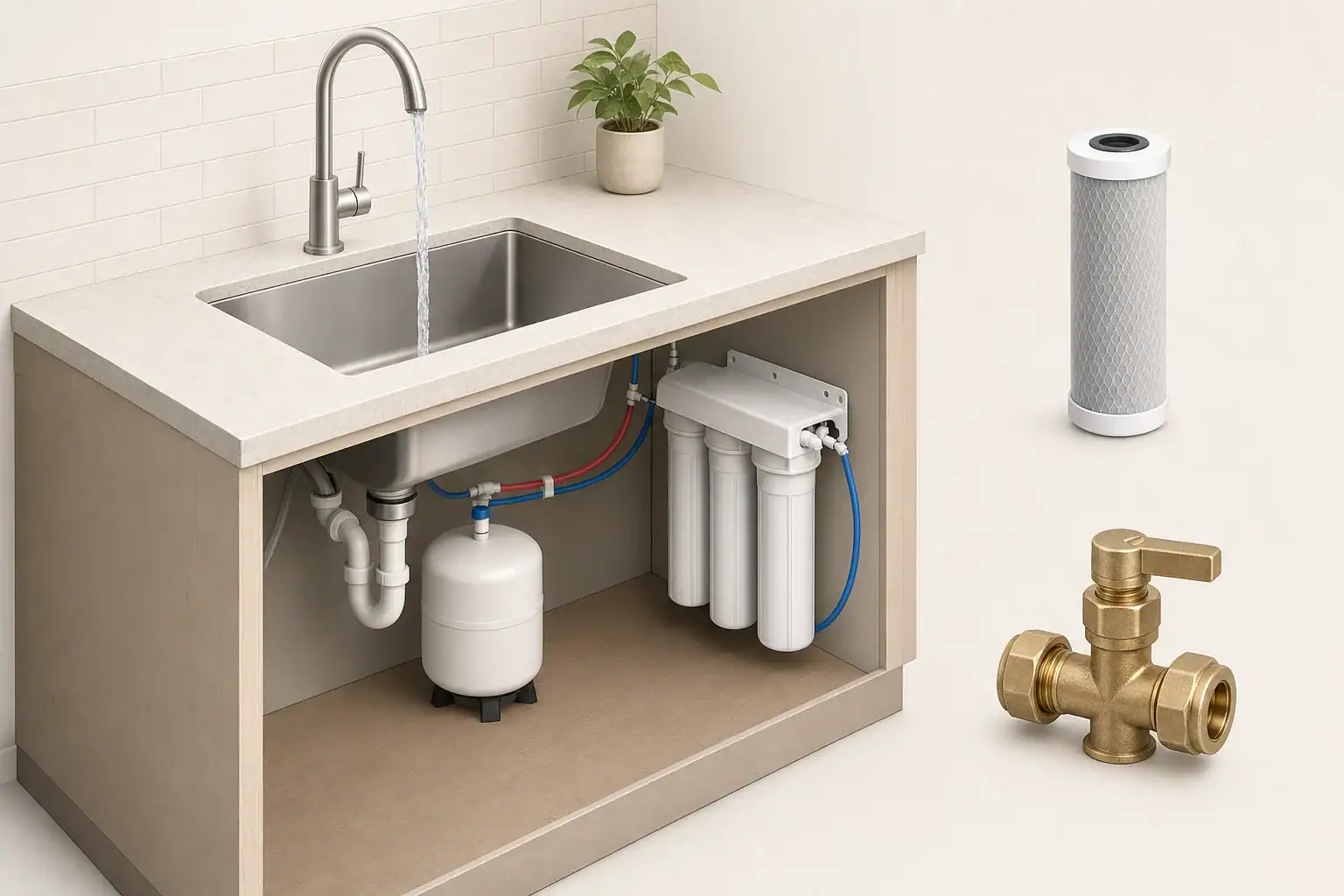
NSF/ANSI/CAN 372 certification does not mean a filter reduces lead in drinking water. It addresses how much lead is present in the wetted materials of a plumbing product. A lead reduction certification evaluates whether a water treatment system reduces lead under the conditions specified by a separate performance standard.
The distinction matters when comparing faucets, valves, filter housings, replacement cartridges, and complete filtration systems. A product can comply with NSF/ANSI/CAN 372 without treating lead, while a certified lead-reduction system may also carry a 372 claim for its materials.
NSF/ANSI/CAN 372 and lead reduction at a glance
| Claim | What it evaluates | What it does not establish |
|---|---|---|
| NSF/ANSI/CAN 372 | Lead content of materials that contact drinking water | Removal of lead already present in the water |
| NSF/ANSI 53 lead reduction | Lead reduction by a drinking water treatment system | Reduction of every contaminant covered by the standard |
| NSF/ANSI 58 lead reduction | Lead reduction by a reverse osmosis system | Performance claims not named in the product’s certification listing |
What NSF/ANSI/CAN 372 actually covers
NSF/ANSI/CAN 372 is a material-content standard for products that convey or dispense drinking water. It provides a method for determining compliance with lead-content requirements for wetted surfaces—the parts that normally contact water.
Under the standard, the lead content of individual materials is considered in a weighted calculation for the product’s wetted components. Compliant products generally meet a maximum weighted average lead content of 0.25% across those surfaces. This supports the regulatory meaning of “lead free,” which does not mean that every material contains zero lead.
Products evaluated to NSF/ANSI/CAN 372 can include:
- Faucets and drinking water fixtures
- Valves, fittings, and connectors
- Filter housings and system components
- Water meters and pumps
- Other products with surfaces that contact drinking water
The standard concerns the product’s construction. It does not challenge a filter with lead-contaminated water, measure removal performance, or establish a treatment capacity.
What a lead reduction certification means
A lead reduction certification is a treatment-performance claim. It indicates that a specific water treatment system was evaluated for reducing lead according to the applicable standard and certification program.
NSF/ANSI 53 is commonly associated with health-related contaminant reduction claims for drinking water filters. NSF/ANSI 58 covers reverse osmosis systems. Both standards encompass multiple possible claims, so seeing “certified to NSF/ANSI 53” or “certified to NSF/ANSI 58” is not enough by itself. The product’s certification listing must specifically name lead reduction.
The claim normally applies to a defined system configuration, including the specified replacement cartridge or membrane. It also comes with operating conditions and limitations such as rated capacity, flow, pressure, and replacement schedule. Certification should not be extended to a different cartridge simply because it fits the same housing.
Why the two claims are easy to confuse
Both claims may appear on the same package or certification record, and both contain the word “lead.” Their purposes are nevertheless different:
- NSF/ANSI/CAN 372 asks: How much lead is in the product’s water-contact materials?
- A certified lead reduction claim asks: Does this treatment system reduce lead in the water under the standard’s test conditions?
A 372-compliant faucet, for example, is intended to meet lead-content requirements for its materials. It is not a lead filter. Likewise, a filter housing may comply with 372 while the cartridge inside has no certified lead-reduction claim.
An integrated filtered-water fixture may carry both types of certification. In that case, 372 relates to the materials, while the lead reduction claim relates to treatment performance. One does not substitute for the other.
How to verify the right certification claim
Start with the product’s job
For a faucet, valve, fitting, or other plumbing component, NSF/ANSI/CAN 372 may be the relevant material-content claim. For a filter intended to treat lead, look for a certification listing that specifically includes lead reduction under an applicable treatment standard.
Check the exact model and cartridge
Certification applies to identified products rather than every item in a manufacturer’s product line. Match the full system model and, where applicable, the replacement element number to the certification record.
A cartridge labeled for taste, odor, chlorine, sediment, or particulate reduction should not be assumed to reduce lead. Those are separate performance claims.
Read the claim rather than relying on the standard number
Standards such as NSF/ANSI 53 and NSF/ANSI 58 cover more than one contaminant or performance characteristic. Confirm that the listing explicitly names lead reduction. A general reference to the standard is not equivalent to certification for all claims within it.
Identify the certifying organization
NSF standards can be used by multiple accredited certification organizations. The certifier’s name or mark should correspond to a searchable certification record for the exact model. The important point is not that one particular organization issued the certification, but that the specific lead claim can be verified through the named certifier.
Review operating limits
Certified performance depends on using the system as specified. Check the rated service life, flow rate, pressure range, water-temperature range, and replacement instructions. If a filter reaches its rated capacity or remains in service beyond the prescribed interval, the certification does not guarantee continued performance.
Related standards do not automatically mean lead removal
NSF/ANSI/CAN 61 evaluates health effects associated with substances that may transfer from drinking water system components into water. Like 372, it is not a certification that a product removes lead from incoming water.
Other certifications may address structural integrity, material safety, chlorine reduction, taste and odor, cyst reduction, or different contaminants. Each claim has its own scope. A long list of standard numbers should not replace verification of the particular performance claim needed.
Certification does not identify the source of lead
A product label cannot determine whether a home’s water contains lead or where it originates. Lead levels can be influenced by service lines, premise plumbing, fixtures, solder, water chemistry, and how long water has remained in the pipes.
When lead is a concern, testing can help define the problem before selecting treatment. A local water utility or state drinking water program may provide sampling guidance, and an appropriately certified laboratory can analyze a sample. Treatment selection should reflect the results and the intended treatment point, such as a kitchen drinking water tap.
Even a properly certified filter requires timely cartridge replacement and correct installation. A treatment device also does not repair a lead service line or remove the underlying plumbing source.
Common purchasing mistakes
- Treating “lead free” as “removes lead.” The regulatory material term and the filtration claim are not interchangeable.
- Assuming any NSF certification covers lead. The certification record must state the exact lead reduction claim.
- Checking the housing but not the cartridge. Treatment performance usually depends on the complete certified configuration.
- Using a compatible but uncertified replacement. Physical fit does not establish equivalent contaminant-reduction performance.
- Ignoring capacity and replacement intervals. Certified performance is tied to the system’s rated conditions and service life.
- Assuming certification guarantees results in every home. Standards use controlled test conditions; actual performance also depends on water quality, installation, use, and maintenance.
Related guides: NSF/ANSI 42 vs 53 • Choosing a filter for lead • Under-sink filters for lead reduction
The practical distinction
Use NSF/ANSI/CAN 372 when evaluating the lead content of a faucet, fitting, housing, or other water-contact product. Use a verified NSF/ANSI 53 or NSF/ANSI 58 lead reduction claim when the goal is to reduce lead already in drinking water.
For a filtration system, the strongest check is the certifier’s listing for the exact model and replacement element. It should explicitly state lead reduction and identify the conditions, capacity, and components to which that claim applies.
Frequently asked questions
Does NSF/ANSI/CAN 372 mean a filter removes lead?
No. NSF/ANSI/CAN 372 addresses lead content in a product’s water-contact materials, not lead reduction from incoming water.
What certification should a lead filter have?
Look for a certification listing for the exact system that explicitly states lead reduction, commonly under NSF/ANSI 53 or NSF/ANSI 58 for reverse osmosis systems.
Is a product labeled “lead free” the same as a lead filter?
No. “Lead free” refers to material-content requirements and does not establish that the product treats lead-contaminated water.
Does NSF/ANSI 53 always include lead reduction?
No. NSF/ANSI 53 covers multiple possible treatment claims. The product’s certification record must specifically name lead reduction.
Can I use any replacement cartridge that fits my filter housing?
No. Lead-reduction certification generally applies to a specified system and cartridge configuration. A compatible cartridge may not have the same certified claim.
- NSF/ANSI standards explained (42/53/401/58)
- Clear trade-offs: pitcher vs faucet vs under-sink vs RO
- Maintenance planning: cost per gallon and replacement cadence