
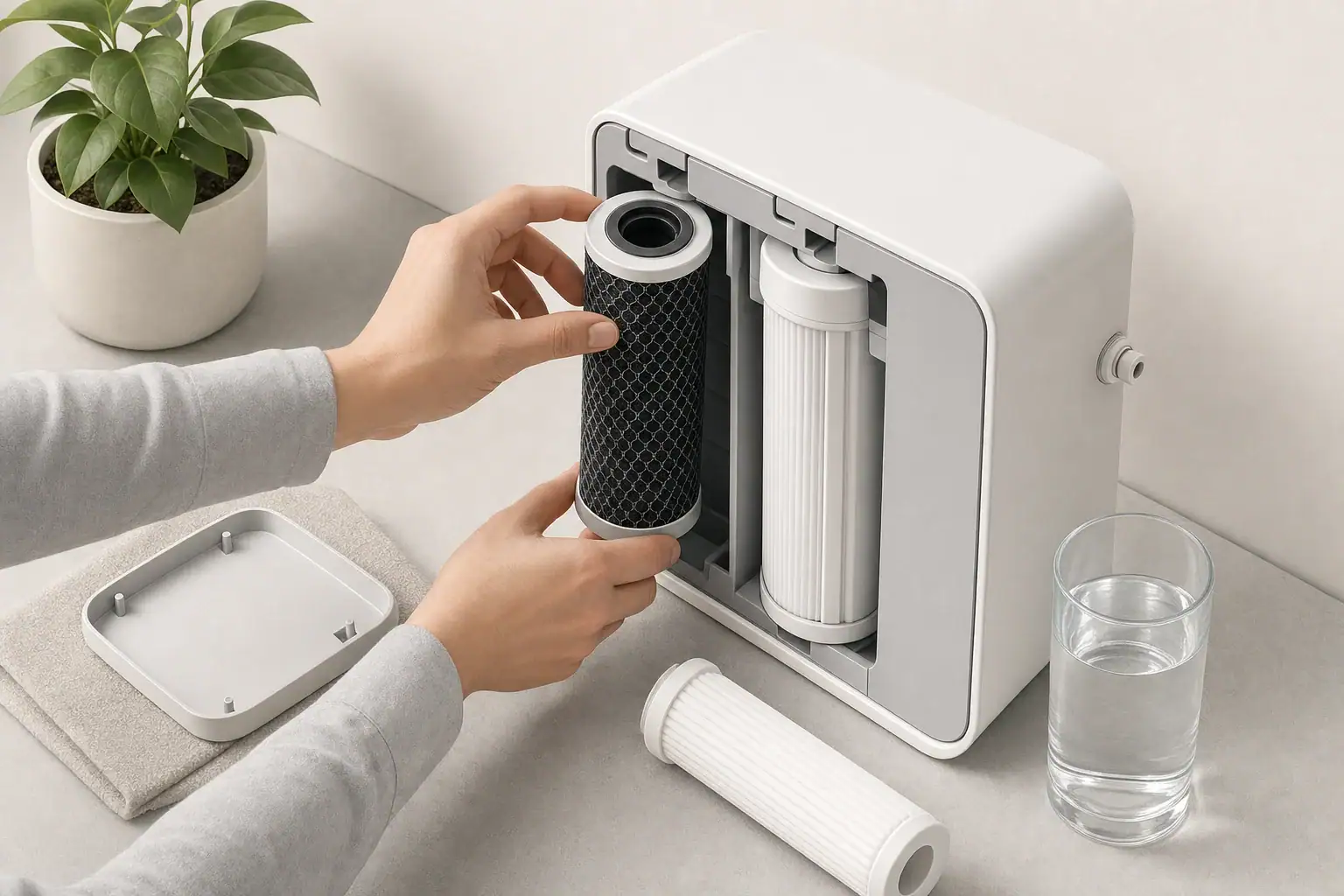
Activated carbon is the most common home treatment for trihalomethanes, while HAA5 reduction is more variable and requires closer attention to a filter’s specific performance claims. Reverse osmosis systems may also reduce some of these compounds, usually with help from their carbon stages.
A basic chlorine claim does not establish that a filter reduces trihalomethanes or HAA5. Before choosing a system, check the exact contaminant claim, rated capacity, flow conditions, and replacement schedule. The right treatment location also matters: a point-of-use filter is often practical for drinking water, while whole-house treatment has broader effects and more demanding maintenance.
What trihalomethanes and HAA5 are
Trihalomethanes and haloacetic acids are groups of disinfection byproducts. They can form when chlorine or another disinfectant reacts with naturally occurring organic matter in source water. Their concentrations may change with water temperature, source-water conditions, treatment practices, and the amount of time water remains in the distribution system.
Total trihalomethanes, commonly abbreviated TTHM, include four regulated compounds: chloroform, bromodichloromethane, dibromochloromethane, and bromoform. These compounds are relatively volatile, although their volatility differs.
HAA5 refers to five regulated haloacetic acids. Compared with trihalomethanes, these acids are generally less volatile, so aeration is not an equivalent treatment option for them.
EPA regulates TTHM and HAA5 in public water systems based on long-term compliance measurements. The federal maximum contaminant levels are 0.080 milligrams per liter, or 80 parts per billion, for TTHM and 0.060 milligrams per liter, or 60 parts per billion, for HAA5. Utility compliance is generally based on locational running annual averages rather than one household sample.
How common home treatment options compare
| Treatment option | Potential role | Main limitation |
|---|---|---|
| Activated carbon | Commonly used for TTHM; may reduce HAA5 depending on media, design, and operating conditions | Performance declines as the media becomes exhausted |
| Reverse osmosis | May reduce some haloacetic acids and other dissolved contaminants; carbon stages can address TTHM | Performance is system-specific and requires membrane and cartridge maintenance |
| Aeration | Can remove volatile trihalomethanes | Does not provide comparable HAA5 reduction and can transfer contaminants into indoor or exhaust air |
| Sediment filtration | Protects downstream equipment from particles | Does not meaningfully remove dissolved TTHM or HAA5 by itself |
| Water softener | Addresses hardness minerals | Is not designed for broad disinfection-byproduct reduction |
| Ultraviolet treatment | Inactivates susceptible microorganisms | Does not physically remove TTHM or HAA5 |
Activated carbon is usually the starting point
Activated carbon captures many organic compounds through adsorption. Carbon block cartridges and granular activated carbon tanks can both be used, but their effectiveness depends on more than the presence of carbon.
Important variables include:
- The type and quantity of carbon
- Water flow and contact time
- The specific trihalomethane or haloacetic acid present
- Water pH, temperature, and competing organic matter
- How much water has passed through the filter
- Whether the cartridge or media is replaced on schedule
A small filter operating at a high flow rate may provide less contact time than a larger, properly sized unit. Whole-house carbon tanks can hold more media, but they must be sized for the home’s peak flow rather than selected only by household size or tank diameter.
Carbon performance also changes over time. A cartridge can continue to pass water after its useful adsorption capacity has declined. Taste and odor are therefore unreliable indicators of continued TTHM or HAA5 reduction.
Chlorine reduction is not the same claim
Many carbon filters are marketed primarily for chlorine taste and odor. That does not automatically demonstrate reduction of disinfection byproducts already present in the water. Chlorine, TTHM, and HAA5 are chemically different targets.
NSF/ANSI 42 vs 53 commonly applies to aesthetic claims such as chlorine taste and odor and health-related contaminant claims, respectively, while NSF/ANSI 58 applies to reverse osmosis systems. A standard number by itself is not enough: confirm that the exact model has a specific, current reduction claim relevant to the contaminant of concern.
Where reverse osmosis can fit
A point-of-use reverse osmosis system combines a semipermeable membrane with prefilters and, in many designs, a carbon postfilter. The carbon stages may be particularly important for volatile organic compounds such as trihalomethanes. The membrane may help with certain haloacetic acids and other dissolved substances, but removal varies by compound and system design.
Do not assume every reverse osmosis system addresses both contaminant groups. Review the performance data for an explicit TTHM, HAA5, individual compound, or applicable surrogate claim. Also check the tested capacity, incoming concentration, pressure, recovery conditions, and required replacement intervals.
Reverse osmosis is usually installed at one faucet and treats water used for drinking and cooking. It also produces a reject-water stream and requires periodic filter, membrane, and sanitation service. These trade-offs make it less suitable as a whole-house treatment method in most homes.
Point-of-use or whole-house treatment
Point-of-use filtration
An under-sink, countertop, faucet-mounted, or pitcher-style filter treats a limited volume of water. When supported by an appropriate contaminant claim, this can be an efficient approach for drinking and cooking water.
Point-of-use treatment also leaves the utility’s disinfectant residual in the rest of the plumbing. That can be beneficial because the residual helps limit microbial growth within the distribution system and household pipes.
Whole-house filtration
A point-of-entry carbon system treats water before it reaches fixtures throughout the home. This may be considered when verified TTHM levels are a concern beyond drinking water, because volatile trihalomethanes can be released into air during showers and other hot-water uses.
Whole-house treatment is not automatically necessary when a utility report lists detectable disinfection byproducts. It costs more, must handle high flow rates, and removes some or all of the disinfectant residual entering the home’s plumbing. Poorly maintained media, housings, or downstream plumbing may support microbial growth.
A whole-house carbon system therefore requires appropriate sizing, scheduled media replacement, monitoring of pressure loss, and hygienic servicing. HAA5 performance should be confirmed separately rather than inferred from a TTHM or chlorine claim.
How to verify the water problem first
For a home served by a public system, start with the utility’s annual Consumer Confidence Report. Look for TTHM and HAA5 results, including averages and reported ranges. Because concentrations can vary by location and season, the utility may also be able to explain which monitoring location best represents a particular neighborhood.
A single result above or below a regulatory level does not by itself determine whether the utility is in compliance. The regulatory calculation uses results collected under a defined monitoring program.
If household-specific information is needed, use a qualified environmental laboratory and request the relevant TTHM and HAA5 analyses. Trihalomethane samples require careful collection and handling because the compounds are volatile. A handheld total dissolved solids meter, chlorine strip, or general water-quality meter cannot measure these contaminant groups.
Testing before and after a filter can help assess performance under household conditions. For a useful comparison, record the cartridge age, amount of water treated, flow rate, and sampling location. Results from a new cartridge alone do not show whether the system will maintain reduction through its full service interval.
What to check on a filter’s performance information
Look beyond broad phrases such as “carbon filtration,” “VOC reduction,” or “improved water quality.” Useful documentation should identify the exact model and provide enough information to understand what was tested.
- Specific contaminant claim: Look for TTHM, HAA5, named compounds, or a clearly explained test surrogate rather than relying on a chlorine claim.
- Independent certification: Verify the exact model and claim in the certifying organization’s current listing when certification is stated.
- Rated capacity: Note the gallons or months associated with the contaminant claim. Use whichever limit is reached first.
- Rated flow: Operating above the tested flow can reduce carbon contact time.
- Replacement requirements: Include cartridges, membranes, whole-house media, prefilters, and any sanitation steps.
- Water-condition limits: Pressure, temperature, pH, and incoming contaminant concentration may affect performance.
Certification for one contaminant does not establish performance for every contaminant named in marketing materials. Similarly, a certified component does not necessarily mean the complete assembled system carries the same claim.
Common approaches that do not solve the problem
Boiling is not a dependable all-purpose strategy. It may drive off some volatile trihalomethanes, but it is not a practical or validated way to manage both TTHM and HAA5, and boiling can concentrate less-volatile dissolved substances as water evaporates.
Allowing water to stand may reduce some volatile compounds, but the result depends on time, temperature, container shape, and the individual compound. It provides no reliable HAA5 treatment and should not replace a verified filtration method.
Replacing a carbon cartridge only when flow slows or taste changes is another common mistake. Reduced flow can indicate clogging, but adsorption capacity may be exhausted without a noticeable change in flow, taste, or odor.
Related guides: Whole-house vs point-of-use filters • How to verify a filter’s certification claim • Filter capacity calculator
A practical decision path
Begin with the utility report or qualified laboratory results. If the main goal is reducing TTHM and HAA5 in drinking and cooking water, compare point-of-use carbon and reverse osmosis systems with specific claims for the compounds reported locally. Match the rated capacity to actual water use and choose a replacement schedule the household can maintain.
Consider whole-house carbon only when broader treatment is justified by verified results and the system can be properly sized and serviced. Regardless of treatment type, contaminant-specific performance information and timely maintenance are more meaningful than filter type alone.
Frequently asked questions
Do carbon filters remove trihalomethanes and HAA5?
Activated carbon is commonly used for trihalomethanes, but HAA5 reduction varies by filter design and operating conditions. Check the exact model’s contaminant-specific performance claim rather than relying on a general chlorine claim.
Will a chlorine filter also remove TTHM and HAA5?
Not necessarily. Chlorine, TTHM, and HAA5 are different contaminants, so a chlorine taste-and-odor claim does not prove reduction of disinfection byproducts.
Does reverse osmosis remove trihalomethanes and HAA5?
Some reverse osmosis systems may reduce certain haloacetic acids, while their carbon stages may help reduce trihalomethanes. Performance is system-specific, so review the product’s documented claims and rated capacity.
Is a whole-house filter necessary for trihalomethanes?
Not always. A point-of-use filter can be practical when the goal is treating drinking and cooking water. Whole-house treatment may be considered when verified TTHM levels are a concern during showers or other household uses.
Can boiling water remove TTHM and HAA5?
Boiling is not a reliable method for treating both groups. It may reduce some volatile trihalomethanes, but it does not provide dependable HAA5 reduction and can concentrate less-volatile dissolved substances.
How can I tell whether my filter is still working?
Follow the manufacturer’s replacement schedule and rated capacity, using whichever limit comes first. Taste, odor, and water flow do not reliably show whether TTHM or HAA5 reduction capacity has been exhausted.
- NSF/ANSI standards explained (42/53/401/58)
- Clear trade-offs: pitcher vs faucet vs under-sink vs RO
- Maintenance planning: cost per gallon and replacement cadence