
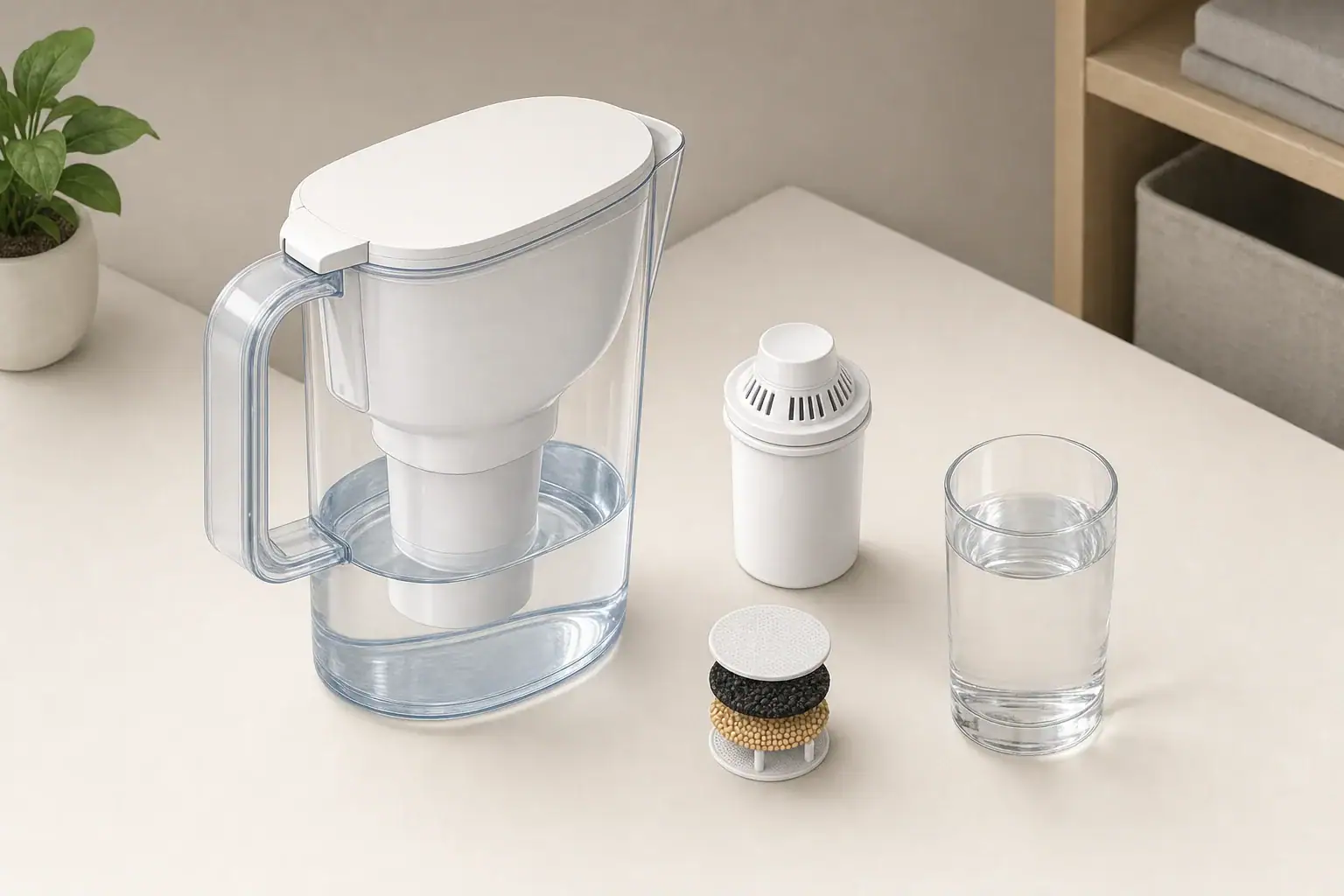
The most practical pitcher filter for a dorm room or shared apartment is one that fits the available refrigerator or counter space, addresses specific local water concerns, filters quickly enough for the household, and has replacement cartridges everyone can afford and manage.
Capacity alone should not drive the decision. A large pitcher may reduce refills but take up too much refrigerator space, while a compact model may become frustrating when several people use it. Certified contaminant-reduction claims, usable capacity, cleaning access, and cartridge availability usually matter more than extra features.
Start With the Water, Not the Pitcher
Before comparing pitcher designs, identify what you want filtration to accomplish. Common goals include improving chlorine-related taste and odor or reducing a particular contaminant identified in a utility water quality report.
Pitcher filters do not all provide the same protection. Many rely primarily on activated carbon for taste and odor improvement. Some use additional media intended to reduce substances such as lead or certain other contaminants, but performance varies by model and cartridge.
Look for independent certification that applies to the exact model and the specific reduction claim. Commonly encountered standards include:
- NSF/ANSI 42: Covers aesthetic effects such as chlorine taste and odor reduction.
- NSF/ANSI 53: Covers specified contaminants with health effects, which may include lead depending on the certified product claim.
- NSF/ANSI 401: Covers reduction claims for certain emerging or incidental compounds.
A reference to a standard does not mean a filter reduces every substance covered by that standard. Check the certification listing or performance data sheet for the exact contaminant, cartridge, capacity, and operating conditions.
A conventional pitcher filter also should not be treated as a disinfectant or as a substitute for official instructions during a boil-water advisory. Follow guidance from the local water utility or public health authority in those situations.
Measure the Space Before Comparing Capacity
Dorm refrigerators and shared refrigerator shelves often have limited height and depth. Measure the intended storage area, including the clearance needed to remove the lid or refill the upper reservoir. If the pitcher will sit in a refrigerator door, confirm that the shelf can support it when full and that the pitcher will not interfere with the door closing.
Pay attention to usable filtered capacity, not just the total size of the container. Some of the advertised volume may be occupied by the upper reservoir or filter assembly. A pitcher that appears large may hold less ready-to-drink water than expected.
| Design priority | Main advantage | Likely trade-off |
|---|---|---|
| Compact footprint | Fits small refrigerators and crowded counters | Requires more frequent refilling |
| Larger filtered reservoir | Provides more water between refills | Uses more shelf space and is heavier when full |
| Slim shape | May fit a refrigerator door or narrow shelf | Can be less stable or harder to clean by hand |
| Large top reservoir | Accepts more water per refill | May make the pitcher tall or temporarily top-heavy |
Match Capacity and Filtration Speed to the Household
Estimate how much filtered water the users expect each day and who will refill the pitcher. For example, if two roommates each drink six cups of filtered water daily, the household needs 12 cups before accounting for cooking, coffee, or guests. A compact pitcher could meet that demand, but it may need several refills.
Filtration speed matters because the upper reservoir may block access to the filtered water while a new batch is running. Slow filtration can be acceptable for one organized user but inconvenient in a household where everyone reaches for water at the same time.
Published flow rates may not represent every home. Water chemistry, cartridge age, trapped air, fine particles, and incorrect installation can affect how quickly water passes through the media. Faster flow is convenient, but it is not proof of better or worse contaminant reduction. Use certified performance claims rather than flow speed as a proxy for effectiveness.
Consider the Full Cartridge Commitment
The pitcher is a one-time purchase, but cartridges are an ongoing shared expense. Before choosing a design, check the recommended replacement interval, rated capacity, cartridge price, and local availability. A specialized cartridge that is difficult to find can leave the household using an overdue filter or an empty pitcher.
Rated capacity is normally based on defined test conditions. Actual replacement needs can vary with water quality and use. Reduced flow, changes in taste or odor, or the manufacturer’s stated limit may indicate that replacement is due.
Electronic and mechanical indicators can make shared maintenance easier, but understand what they measure. Some track time or estimated refills rather than directly measuring cartridge condition or water quality. They are reminders, not water-testing devices.
Set a simple cost-sharing rule
Roommates should decide in advance whether cartridges are a shared household expense or the responsibility of the primary user. A simple rotating replacement schedule can work, provided everyone uses the same approved cartridge and records when it was installed.
Choose a Pitcher That Can Be Cleaned Easily
Shared pitchers are handled frequently, making cleaning access especially important. Look for a lid and reservoir that can be removed without complicated clips or narrow spaces. A pitcher with a wide opening is generally easier to wash by hand in a small sink.
Follow the manufacturer’s cleaning instructions because not every part is dishwasher-safe. Do not wash the cartridge with soap or attempt to open and refill it unless the instructions explicitly allow that procedure. New cartridges may require rinsing, soaking, or discarding the first batches of water.
Agree on a few basic habits:
- Refill the pitcher after taking water rather than leaving it empty.
- Use clean hands when touching the lid or reservoir.
- Do not pour hot water through a cartridge designed for cold tap water.
- Clean the pitcher at the recommended interval and whenever visible residue develops.
- Keep track of the cartridge installation and replacement dates.
- Avoid letting the pour spout touch cups, bottles, or utensils.
Dorm and Apartment Details That Affect the Decision
Housing rules
Pitchers normally require no plumbing changes, but dorm policies may still regulate appliances, food preparation, or refrigerator use. Confirm what is allowed, especially if considering a separate countertop dispenser or electric filtration device instead of a basic pitcher.
Sink access
A large reservoir can be awkward to fill under a shallow bathroom or kitchenette faucet. Check whether the pitcher fits below the faucet and can be carried back to the room without spilling. A removable upper reservoir may make filling easier.
Noise and shared schedules
Standard gravity pitchers operate without electricity and are quiet, which suits bedrooms and shared kitchens. Their main inconvenience is waiting for water to filter, so refilling before the reservoir is completely empty can prevent morning conflicts.
Moving and storage
Students and renters may move frequently. A durable, uncomplicated pitcher with readily available cartridges is easier to transport and continue using in a new home. However, reconsider the filtration claim after moving because the new building may have different plumbing and water concerns.
Common Selection Mistakes
- Choosing only by total capacity: The pitcher may not fit the refrigerator or may provide less ready-to-pour water than expected.
- Assuming every carbon filter reduces lead: Taste and odor performance does not establish lead reduction. Look for a model-specific certified claim.
- Ignoring cartridge availability: An inexpensive pitcher can become impractical if compatible replacements are costly or difficult to obtain.
- Buying for the whole apartment without agreement: A large shared pitcher will not help if nobody accepts responsibility for refilling and cleaning it.
- Using overdue cartridges indefinitely: Follow the replacement instructions instead of assuming water is adequately treated because it still passes through the filter.
- Expecting a pitcher to solve every water problem: Gravity pitchers have limited media volume and contact time. Some concerns require a different treatment method or professional evaluation.
A Practical Shortlist Process
Before settling on a pitcher, narrow the options using these criteria in order:
- Identify the desired taste, odor, or contaminant-reduction goal.
- Verify a relevant independent certification for the exact model and cartridge.
- Measure the refrigerator, counter, faucet clearance, and available sink space.
- Estimate daily filtered-water demand and an acceptable refill frequency.
- Compare cartridge replacement intervals, cost, and availability.
- Check whether the pitcher can be disassembled and cleaned conveniently.
- Agree on refilling, cleaning, and cartridge expenses with other users.
Related guides: Pitcher filters for renters • How often to replace pitcher filters • Filter capacity calculator
When a Pitcher May Not Be Enough
A pitcher is well suited to renters and students who want portable filtration without plumbing changes. It may be a poor fit when the household uses large amounts of filtered water, needs rapid filling for cooking, or has a water concern outside the cartridge’s certified claims.
If a utility report, water test, or building notice identifies a specific issue, select treatment based on that evidence rather than taste alone. Contact the water utility, property manager, or an appropriate water-treatment professional when the source of a problem is unclear. For a typical dorm or shared apartment, the most workable choice is ultimately the pitcher whose verified performance, dimensions, refill demands, and maintenance routine fit the people who will actually use it.
Frequently asked questions
What size pitcher filter is best for a dorm room?
Choose a size based on refrigerator clearance and daily use. A compact pitcher suits limited space, while roommates who drink more filtered water may need a larger filtered reservoir and a clear refill routine.
How do I know whether a pitcher filter reduces lead?
Check the exact model and cartridge for an independent, model-specific lead-reduction certification or performance claim. A filter that improves chlorine taste and odor does not necessarily reduce lead.
How often should roommates replace a pitcher filter cartridge?
Follow the manufacturer’s stated replacement interval or rated capacity. Replace it sooner if the manufacturer directs it based on reduced flow, taste changes, or other specified signs.
Can a pitcher filter be used during a boil-water advisory?
No. A conventional pitcher filter should not be treated as a disinfectant or a substitute for official boil-water instructions. Follow guidance from the local water utility or public health authority.
What should roommates agree on before sharing a water filter pitcher?
Decide who refills and cleans the pitcher, how cartridge costs are shared, and where the installation and replacement dates will be recorded.
Recommended next:
- Best Pitcher Water Filters for Better-Tasting Tap Water (Chlorine Focus)
- Pitcher Filter vs Bottled Water: Cost per Gallon Breakdown
- How Often Should You Replace Pitcher Filters? (By Household Size)
- TDS in Pitcher-Filtered Water: What Changes and What Doesn’t
- Pitcher Filters for Renters: What to Look For (Capacity + Fridge Fit)
- Pitcher Filter Maintenance: Cleaning & Sanitizing Without Off-Flavors
- More in Pitcher Filters →
- NSF/ANSI standards explained (42/53/401/58)
- Clear trade-offs: pitcher vs faucet vs under-sink vs RO
- Maintenance planning: cost per gallon and replacement cadence