
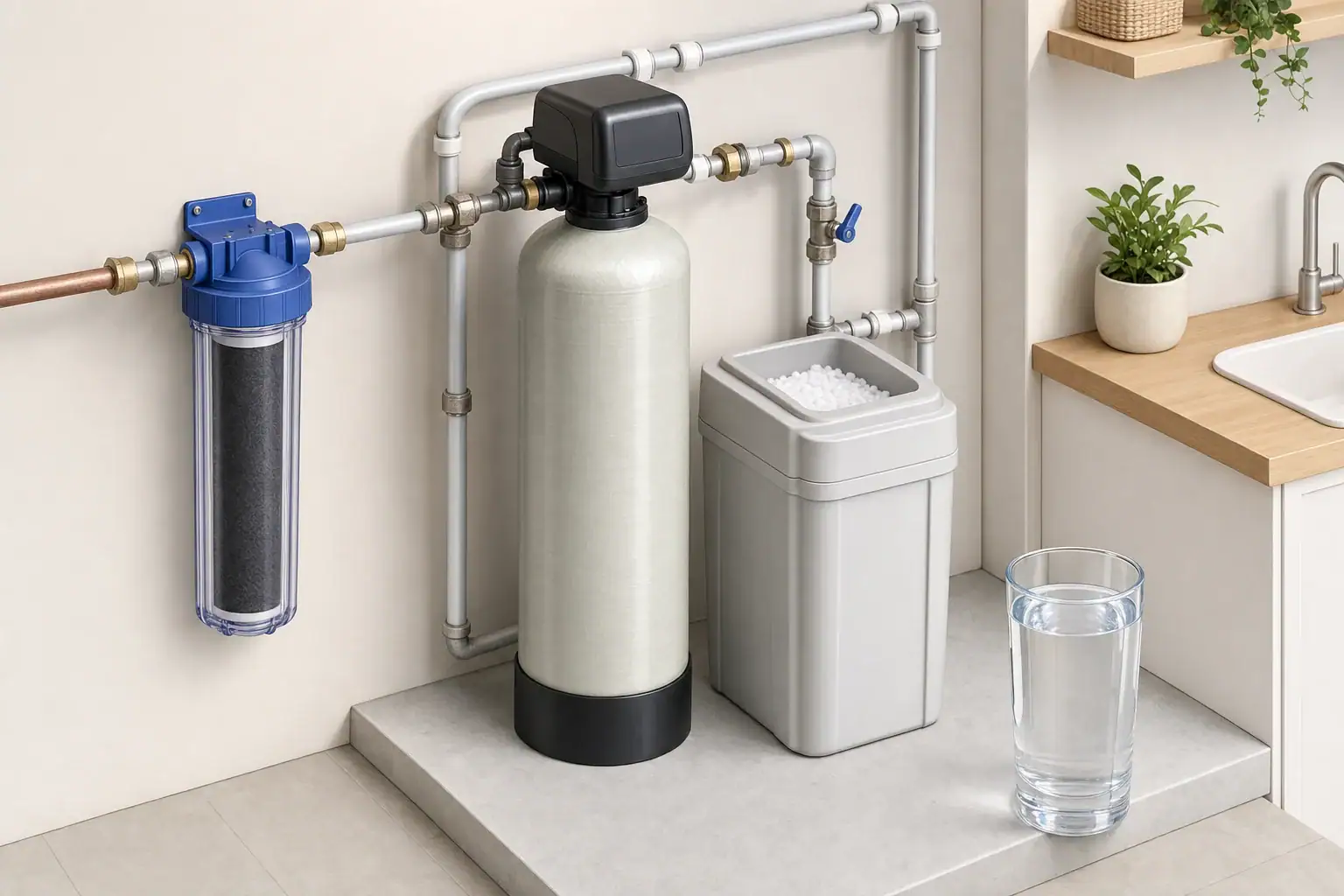
Softened water may contain more sodium than the original supply, but a properly operating water softener should not make the water taste distinctly salty. An obvious salt taste usually points to concentrated brine entering the household plumbing, incomplete rinsing after regeneration, an incorrect setting, or a valve or drain problem.
The timing and location of the taste provide useful clues. Water that tastes salty only after regeneration suggests a softener issue, while the same taste in unsoftened water may originate in the source supply.
Why a water softener changes water chemistry
Most residential water softeners use ion-exchange resin. During normal service, the resin captures hardness minerals—primarily calcium and magnesium—and releases sodium ions in their place. Systems using potassium chloride release potassium instead.
This exchange is not the same as adding spoonfuls of salt to drinking water. The added sodium is dissolved as ions, and chloride should not be carried into the service water in significant amounts after a complete regeneration and rinse cycle.
As a general estimate, sodium-based softening adds about 7.5 to 8 milligrams of sodium per liter for each grain per gallon of hardness removed. For example, softening water with 10 grains per gallon of hardness could add roughly 75 to 80 milligrams of sodium per liter. Actual results depend on the incoming water and system performance.
People vary in their sensitivity to taste, but sodium from ordinary softening may be noticeable in very hard water. A strong saltwater flavor, however, is more consistent with residual brine or elevated sodium and chloride already present in the source water.
Common causes of salty-tasting softened water
Incomplete rinsing after regeneration
During regeneration, the softener draws concentrated brine through the resin bed and then rinses it away. If the rinse ends early or does not receive enough water, some brine can remain in the tank and reach household faucets when the unit returns to service.
A power interruption, a loss of water pressure, or an interrupted manual regeneration can prevent the cycle from finishing correctly.
A restricted drain line
The softener must discharge brine and rinse water through its drain connection. A kinked, obstructed, frozen, or improperly routed drain line can limit that flow. The unit may appear to complete regeneration even though it did not remove all the brine.
The drain must also have an appropriate air gap and comply with local plumbing requirements. Do not insert or seal a softener drain line directly into a household drain.
Injector or brine-line problems
The injector creates the suction needed to draw brine from the brine tank. Sediment, iron deposits, or debris can restrict this small component. A loose, damaged, or blocked brine line can also interfere with brine draw and refill.
These problems may leave an unusual amount of water in the brine tank or prevent the expected water level from changing during regeneration.
Worn valve seals or internal components
The control valve directs water through several stages of regeneration. Worn seals, spacers, pistons, or other internal parts can allow brine to leak into the service-water path. This is more likely when the salty taste persists well beyond the end of regeneration or returns without a new cycle.
Valve disassembly is generally a service task because the correct procedure and replacement parts depend on the control-valve design.
Incorrect programming
Hardness, capacity, salt dose, and cycle-time settings affect regeneration. A setting that does not match the resin volume or household water conditions may use excessive salt or provide too little rinse time.
Do not assume that increasing every setting will improve performance. Compare the programmed values with the equipment documentation and a current hardness measurement.
High sodium or chloride in the source water
A softener does not remove sodium or chloride already dissolved in the incoming water. Coastal saltwater intrusion, road salt, certain geological conditions, or contamination of a private well can raise these levels before the water reaches the softener.
If both softened and unsoftened sampling points taste salty, the source water deserves attention. A certified laboratory test can distinguish sodium, chloride, hardness, and other dissolved constituents more reliably than taste alone.
Potassium chloride use
Potassium chloride is sometimes used instead of sodium chloride as the regenerant. It can produce a salty or slightly bitter taste if residual regenerant reaches the plumbing. The same checks for incomplete rinsing, drainage, and valve operation still apply.
Diagnostic checks to narrow down the cause
| Observed pattern | Likely area | Useful check |
|---|---|---|
| Taste begins immediately after regeneration | Incomplete rinse or restricted drain | Confirm the cycle finished and inspect the visible drain-line route |
| Taste continues between cycles | Valve leakage or source-water salinity | Compare softened and unsoftened samples |
| Only one faucet is affected | Local fixture, filter, or plumbing | Sample several cold-water taps |
| Brine-tank water level looks abnormal | Injector, brine line, drain, or refill issue | Compare conditions before and after regeneration |
| Problem followed a power or water interruption | Incomplete regeneration | Check the display, clock, error indicators, and cycle status |
Check more than one cold-water tap
Sample cold water from several fixtures. If only one faucet tastes salty, the softener is less likely to be the cause. A local cartridge, aerator, rarely used pipe branch, or fixture problem may be responsible.
Hot water can retain water produced during an earlier regeneration event, so begin with cold-water samples. If only hot water is affected, the water heater and hot-water plumbing may be holding the salty water.
Note when regeneration occurred
Check the control display or recorded schedule. A salty taste that starts shortly after regeneration strongly suggests residual brine. Also look for an error code, incorrect clock setting, or evidence that the unit stopped mid-cycle.
A brief flow of cold water may clear a small amount of residual water from the plumbing. If the taste is strong, persists, or repeatedly returns after regeneration, continued flushing is not a substitute for correcting the fault.
Compare softened and unsoftened water
If the plumbing includes a designated raw-water sampling tap, compare it with a softened cold-water faucet. Do not alter plumbing or operate unfamiliar valves solely to create a test point.
- If only softened water tastes salty, focus on the softener’s regeneration, drain, brine system, and control valve.
- If both samples taste salty, test the source water for sodium and chloride.
- If neither raw nor freshly softened water tastes salty but one fixture does, investigate that fixture or branch line.
Inspect accessible components without disassembly
Look for obvious external problems: a pinched drain hose, a loose brine connection, standing water around the unit, salt crust at fittings, or an unusual brine-tank water level. Confirm that the drain outlet and air gap are unobstructed.
Salt bridging—a hardened crust with an empty space beneath it—can stop the softener from regenerating effectively, but it more often leads to hard water than salty water. It should not be treated as the default explanation for a salt taste.
Review settings and recent changes
Check whether anyone recently changed the hardness value, salt dose, regeneration time, or cycle duration. Also consider whether the unit was recently installed, serviced, or refilled with a different regenerant.
Use the manufacturer’s documentation for the specific valve and resin-tank size. Repeated manual regenerations can waste salt and water and may obscure the original problem.
When water testing is the better next step
Taste cannot show how much sodium or chloride is present. Basic hardness strips can confirm whether softening is occurring, but they generally do not measure sodium or diagnose brine carryover.
Consider laboratory testing when:
- Both softened and unsoftened water taste salty.
- A private well is near a coast, a heavily salted road, or another plausible salinity source.
- The taste appeared suddenly without a regeneration-related pattern.
- Someone in the household has been advised to limit sodium intake.
- The taste remains after a qualified technician confirms normal softener operation.
For a private well, testing sodium and chloride separately is more informative than relying on total dissolved solids alone. Local health departments or water-testing programs may provide guidance on suitable laboratory panels.
Related guides: Water hardness: grains per gallon vs ppm • What reverse osmosis removes • Private well water testing schedule
What to do while the problem is being diagnosed
Avoid using distinctly salty water for drinking or cooking until the cause is understood. If the equipment documentation provides a normal bypass procedure, placing only the softener in bypass can help isolate the problem and prevent further brine from entering the plumbing. Bypass water will be hard, and it may not be appropriate if the same equipment also performs another necessary treatment function.
Call for service if the drain flow is weak during regeneration, brine enters the plumbing repeatedly, the control valve leaks, an error remains after a completed cycle, or internal valve work is required. Provide the technician with the regeneration time, affected fixtures, brine-tank observations, settings, and whether unsoftened water has the same taste.
Households managing medically directed sodium restrictions should discuss drinking-water sodium with a health professional. Where sodium reduction is needed, treatment must be selected for that purpose; an ordinary water softener removes hardness but does not remove dissolved sodium.
Frequently asked questions
Is it normal for softened water to taste salty?
No. A properly operating softener can add sodium, but it should not produce a distinctly salty taste. A strong salt taste can indicate residual brine, a regeneration problem, or salty source water.
Why does my water taste salty after the softener regenerates?
A salty taste soon after regeneration often points to incomplete rinsing or restricted drain flow. Check whether the cycle finished normally and inspect accessible drain-line routing and connections.
How can I tell whether the softener or my water source is causing the salt taste?
Compare cold water from a softened tap with water from a designated unsoftened sampling tap. If both taste salty, test the source water for sodium and chloride; if only softened water is affected, focus on the softener.
Can I drink water that tastes strongly salty?
Avoid using distinctly salty water for drinking or cooking until the cause is identified. Taste alone cannot determine sodium or chloride concentration, so laboratory testing may be appropriate.
Will putting the water softener in bypass stop the salty taste?
Bypassing the softener may help isolate a softener-related problem and prevent additional brine from entering the plumbing. The bypassed water will be hard, and the taste may persist briefly while previously treated water clears from pipes.
- NSF/ANSI standards explained (42/53/401/58)
- Clear trade-offs: pitcher vs faucet vs under-sink vs RO
- Maintenance planning: cost per gallon and replacement cadence