
Quick answer: A water purifier is a drinking-water treatment device, but the word “purifier” alone does not establish what it reduces. Compare the exact model’s technology, named contaminant claims, independent certification, operating limits, and maintenance requirements rather than relying on whether it is labeled a purifier or a filter.
Is a water purifier a defined performance category?
Not as a general residential-product category in the United States. NSF states that no federal regulations specifically govern residential water treatment filters, purifiers, and reverse-osmosis systems as separate product classes. Instead, voluntary standards and protocols are used to evaluate particular safety and performance claims. That means the word purifier on a package is not, by itself, a specification for contaminant reduction. See NSF’s overview of residential water-treatment standards.
This does not mean a manufacturer may make misleading claims. It means a shopper should not infer that a product addresses microorganisms, dissolved chemicals, metals, salts, sediment, or another specific issue solely because it is called a purifier. A product labeled a filter may be the better match when it has a relevant, model-specific verified claim.
The narrower microbiological-purifier meaning
Microbiological water purifier has a more specific technical context. EPA’s Guide Standard and Protocol for Testing Microbiological Water Purifiers addresses challenge testing for the removal, killing, or inactivation of bacteria, viruses, and protozoan cysts under stated conditions. The protocol does not evaluate chemical-reduction claims.
NSF P231 is a certification route for microbiological water purifiers. A product name containing “purifier” is not evidence that the product is certified to P231. If that capability matters for a particular use, check the exact product in NSF’s current P231 listing and read the product instructions and limitations.
What is a water purifier compared with a water filter?
In ordinary retail use, the distinction is inconsistent. Filter may refer to a treatment medium, a replacement cartridge, or an entire system. Purifier is often an umbrella label for a device with one or more treatment stages. The labels can appear on products with similar components.
The more useful comparison is therefore not purifier versus filter. It is one exact system and replacement component versus another, evaluated for the same water concern and operating conditions. CDC notes that home treatment devices perform different functions and that many pitcher and refrigerator filters are not designed to remove germs. Its guidance recommends identifying the problem first and checking the product’s specific claims. See CDC’s guidance on choosing a home water filter.
Technologies commonly sold as water purifiers
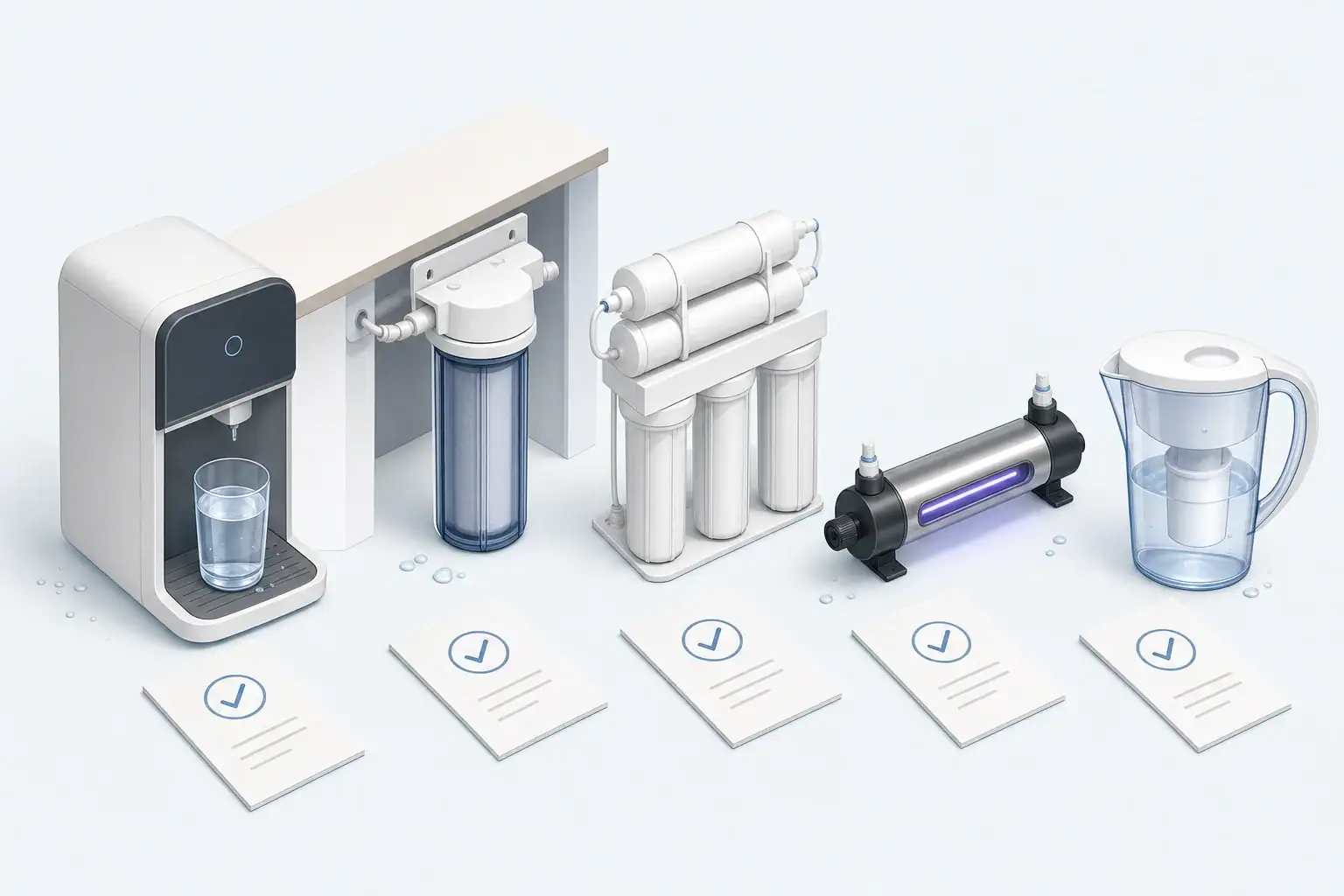
Manufacturers may use the purifier label for several kinds of treatment. The technology describes the general approach; it does not prove a particular model’s performance.
- Reverse osmosis: A membrane-based system commonly paired with prefilters and postfilters. Review the exact system’s listed claims and conditions instead of assuming every RO system addresses the same contaminants. For more context, see what reverse osmosis can and cannot address.
- Ultraviolet treatment: UV systems are designed for microbial treatment under specified water-quality, lamp, and flow conditions. A UV device does not, from the technology name alone, establish reduction of sediment, dissolved metals, salts, or chemicals.
- Distillation: These systems evaporate water and collect condensed vapor. Check the manufacturer’s documentation for operating instructions, limitations, and any independently supported claims.
- Carbon or multistage filtration: A product sold as a purifier may use carbon, ion exchange, mechanical filtration, or several stages. Capacity, flow, influent water, and the exact cartridge all affect the applicable claim.
- Portable microbial-treatment products: These may combine filtration and disinfection methods. Evidence for one organism category should not be treated as proof for all others; check whether the product evidence specifically addresses bacteria, viruses, and cysts.
NSF maintains separate standards and protocols for treatment approaches including carbon filtration, reverse osmosis, ultraviolet systems, distillation, and microbiological treatment. Certification to a standard does not mean every product certified to that standard has every possible claim associated with the standard. NSF standards and protocols provide the framework; the current product listing and performance sheet provide the model-level details.
What should a purifier label lead you to check?
| Label or wording | What to check |
|---|---|
| “Water purifier” | Exact model, treatment technology, performance data sheet, operating limits, maintenance instructions, and an independent listing where applicable. |
| “NSF certified” | The certifying organization, standard or protocol, exact model and replacement component, plus each named performance claim. |
| NSF/ANSI 42 | The particular aesthetic claim, such as chlorine taste-and-odor reduction. Do not treat the standard number alone as a general drinking-water safety claim. |
| NSF/ANSI 53 or 58 | The individual contaminant claims listed for that model. Do not infer a claim for lead, PFAS, cysts, or another contaminant unless it is specifically listed. |
| “UV purifier” | Exact model, rated flow, feed-water requirements, lamp-service instructions, alarms or indicators, and any current certification listing. |
| “Microbiological purifier” | A current NSF P231 listing or comparably specific evidence that addresses bacteria, viruses, and cysts under stated test conditions. |
| “Reduces TDS” | Separate evidence for the actual contaminant of concern. A total dissolved solids measurement does not identify which dissolved substances are present or establish microbiological safety. |
| “Tested” | The testing organization, protocol, exact model, test conditions, capacity, full results, and whether a current third-party certification supports the claim. |
Two products can cite the same standard but have different certified claims. Portland Water Bureau gives NSF/ANSI 53 as an example: one certified product may carry a lead-reduction claim while another does not. Its home water-treatment selection guidance recommends checking the contaminant and the product-specific certification details.
Start with the water problem, not the product name
For public water, review your utility’s annual water-quality report and any current notices. For a private well or another private source, testing can help identify the issue before selecting treatment. CDC recommends establishing what needs to be addressed before choosing a device.
Clearer water, improved taste, reduced odor, or a lower TDS reading should not be used as proof that water is safe. Those observations do not establish whether a particular chemical or microorganism is present. Learn more about the distinction in TDS versus hardness.
- Identify the water concern from a utility report, notice, or suitable test result.
- Choose technologies that are appropriate to investigate for that concern.
- Compare exact-model claims, not broad product labels or standard numbers alone.
- Confirm that your pressure, temperature, expected flow, and feed-water quality fit the manufacturer’s stated limits.
- Include replacement components, cleaning, servicing, and water use in the comparison.
Hypothetical comparison: two products with different labels
Suppose a household wants to address a contaminant identified in its water information. Product A is called a “water purifier” and uses multiple stages, but its documentation does not name that contaminant. Product B is called an “under-sink filter,” and its current certification listing names the same contaminant, exact model, and compatible replacement cartridge. Assuming both products fit the household’s installation and operating conditions, Product B has the more directly relevant evidence for that specific goal. The example does not establish that either product is suitable for every water source or concern.
Manual and performance-sheet checklist
Before comparing products with different labels, locate the manual, performance data sheet, and current certification listing. Record the following details for each candidate:
- Exact system model and compatible cartridge, membrane, lamp, or other replacement-part number
- Certifying organization, applicable standard or protocol, and named performance claims
- Rated capacity and flow for each relevant claim
- Allowable feed-water pressure and temperature
- Feed-water quality limits and required pretreatment
- Warnings concerning microbiologically unsafe or unknown-quality water
- Replacement, flushing, cleaning, and sanitizing instructions
- Alarms, shutoffs, indicators, or other service and failure notices
- Wastewater or recovery information for systems that discharge water
- A current listing from a certifier, where the manufacturer represents the product as certified
For a step-by-step method of matching packaging language to a listing, see how to verify a water filter certification claim.
Compare the evidence, not the label
“Purifier” and “filter” are not reliable shorthand for a fixed level of treatment. Compare the precise model, treatment technology, replacement component, named contaminant claim, certification listing, operating conditions, and maintenance requirements. Reserve the narrower microbiological-purifier meaning for products supported by evidence that addresses bacteria, viruses, and cysts under an applicable protocol.
Frequently asked questions
Does “water purifier” mean the product removes all contaminants?
No. The label alone does not establish reduction of any particular contaminant. Check the exact model’s documentation and current independent listing for named claims and operating conditions.
Is an NSF/ANSI standard number a complete list of a filter’s capabilities?
No. A standard identifies the framework used for applicable claims, but the product listing or performance sheet identifies which claims apply to the exact model and component.
Can a TDS meter tell me whether filtered water is safe?
No. A TDS meter measures the overall amount of dissolved material; it does not identify the substances present or indicate whether microorganisms are present.
- NSF/ANSI standards explained (42/53/401/58)
- Clear trade-offs: pitcher vs faucet vs under-sink vs RO
- Maintenance planning: cost per gallon and replacement cadence