
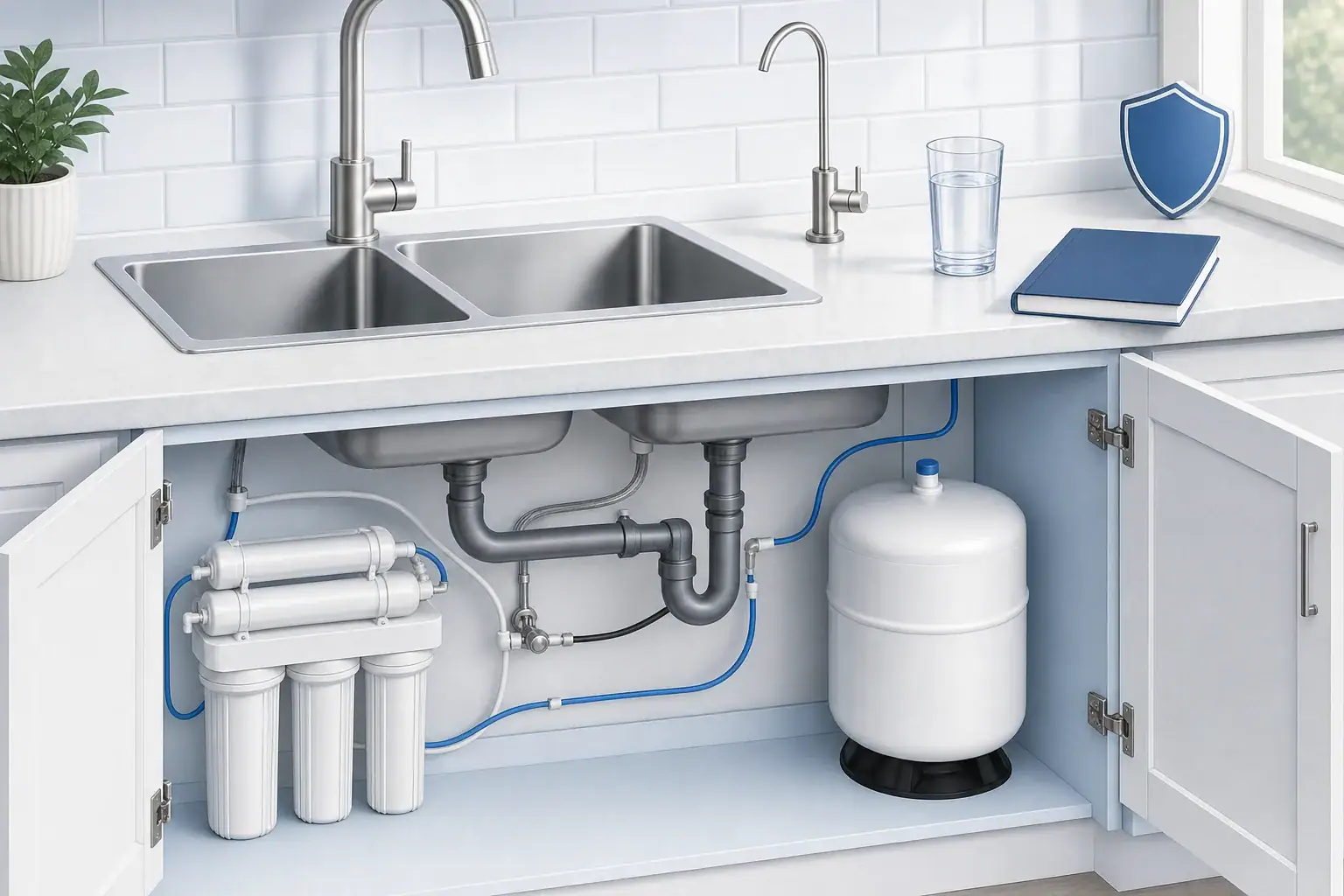
Quick answer: Reverse osmosis water is generally safe to drink when the source water is suitable for the exact system, installation is correct, and maintenance follows the manual. Mineral reduction alone is not established as a danger. The practical concerns are unsuitable feed water, neglected components, plumbing conditions, and unverified reduction claims.
Are the dangers of reverse osmosis water exaggerated?
Some warnings about reverse osmosis (RO) water begin with a real observation: RO can reduce dissolved minerals. They then make a much larger claim—that low-mineral water inherently causes dehydration, mineral deficiency, or damage to teeth and bones. The reviewed U.S. public-health guidance does not establish that mineral reduction by itself makes RO water unsafe to drink.
The useful safety question is more specific: Is this system appropriate for the water entering it, installed as its manufacturer directs, and maintained with the specified components? The CDC’s overview of home water-treatment systems notes that RO can reduce calcium, magnesium, potassium, and some contaminants, while advising consumers to check product information for the substances a particular device is designed to reduce.
Neither a low total dissolved solids (TDS) reading nor a change in taste proves that water is safe or unsafe. TDS is a broad measure of dissolved material; it does not identify individual contaminants or microorganisms. For a closer explanation of what an RO system may and may not address, see what reverse osmosis removes.
Does mineral reduction make RO water unsafe?
RO commonly reduces dissolved minerals, but that fact alone does not demonstrate a health hazard. The sources reviewed for this article do not support claims that RO water inherently dehydrates people or pulls minerals from the body.
Mineral intake is a broader dietary matter and cannot be diagnosed with a countertop TDS meter. Someone following a medically prescribed diet or with a personal nutrition concern should discuss it with a qualified clinician rather than treating a water-meter result as medical advice.
Lower-mineral water can taste different from a household’s usual water. Taste is not a safety test: water can taste pleasant and still contain a contaminant, while an unfamiliar taste does not necessarily indicate a hazard. A remineralization stage may affect taste or preference, but it is not established as a universal safety requirement; see whether a remineralization filter is needed with RO water.
What can low mineral content and pH mean for plumbing?
There is no single pH or TDS value that defines all household RO product water. Chemistry can vary with the source water, membrane, operating conditions, storage, and contact with the faucet and plumbing.
The U.S. Geological Survey explains that low-pH water can corrode or dissolve metals. But pH is only one part of corrosion potential. The USGS also identifies alkalinity, calcium-carbonate saturation, and other water characteristics as relevant in its corrosivity overview.
As a result, a generic online pH range—or one home pH-strip reading—cannot determine whether a particular RO installation will create a plumbing problem. If there is a credible concern about metallic taste, older plumbing, corrosion, or metal release, ask a certified laboratory, water utility, or local health authority which source-water and drinking-tap samples are appropriate. A sample from the RO faucet can account for contact with the system’s downstream components.
Which RO water safety checks matter most?
Confirm that the feed water fits the exact system
Feed-water pressure, temperature, hardness, dissolved solids, and other characteristics can affect RO operation. Acceptable limits are model-specific, so do not copy numbers from another brand or system manual.
Many residential RO systems are intended for potable feed water. Do not assume that a unit designed for potable water will make untreated or microbiologically unsafe water potable. For a private well, a changed water source, or water of unknown quality, begin with appropriate testing and compare the results with the exact system manual. The CDC advises identifying the water problem before choosing home treatment.
Maintain and sanitize the system as directed
RO systems have wetted filters, tubing, housings, and often a storage tank. The CDC advises maintaining filters and changing them according to the manufacturer’s instructions to help prevent germ growth and declining performance. Follow the exact replacement, flushing, sanitation, and extended-non-use directions for your model—not a universal online schedule.
Do not improvise a disinfectant, concentration, or contact time. If an RO system has been unused, consult its manual before returning it to service. Our RO system after-vacation sanitation guide explains the planning checks, but the system manual controls the approved procedure.
Use the specified installation parts and arrangement
Leaks are not the only installation concern. The faucet, drain connection, tubing, tank, air gap where required, and replacement modules may be part of the system’s specified configuration. Follow the manufacturer instructions and applicable local plumbing requirements. Use a qualified installer when instructions or local requirements are unclear.
Verify a claim, not just a standard number
A standard number is not a promise that every model reduces every contaminant. The EPA’s point-of-use RO guidance advises consumers to consider independently certified products and to check the contaminant-reduction claims relevant to their water.
When a particular contaminant matters, verify the exact model, the approved replacement component, and the named claim in an official certification directory. NSF’s drinking-water treatment-unit listings can be searched by Standard 58 and product information. A listing or a package reference to NSF/ANSI 58 does not mean that every RO product has identical claims. For a step-by-step check, see how to verify a water filter certification claim.
| Concern | What the evidence supports | Practical next step |
|---|---|---|
| Mineral reduction | RO may reduce dissolved minerals. The reviewed guidance does not establish that this alone makes water unsafe. | Do not use TDS to diagnose nutrition; discuss individual dietary concerns with a qualified clinician. |
| Corrosion or metals at the tap | Low pH can contribute to corrosion, but pH alone does not determine corrosivity. | If there is a credible concern, seek local guidance on testing relevant chemistry and metals at the drinking-water tap. |
| Germ growth or stagnation | Filters and wetted components require manufacturer-directed maintenance. | Follow the model’s replacement, flushing, sanitation, and non-use instructions. |
| Poor system performance | Pressure, temperature, and feed-water chemistry can affect operation, with limits varying by model. | Compare water-test results and site conditions with the exact manual. |
| Low TDS treated as proof of safety | TDS does not identify individual chemicals or microorganisms. | Use contaminant-specific testing and verified claims when a particular contaminant is a concern. |
| Overbroad certification claim | Certification applies to listed products, components, claims, and conditions. | Confirm the exact model, replacement component, and named contaminant in an official directory. |
Manual-reading checklist before using an RO system
- Identify the unit: Record the exact system model and approved replacement cartridge or module numbers.
- Find the source-water warning: Check whether the manual requires potable water and whether it warns against microbiologically unsafe or unknown-quality water.
- Read the operating limits: Note pressure, temperature, hardness, TDS, iron, manganese, chlorine or chloramine, turbidity, and other limits only where the manual lists them.
- Check pretreatment requirements: Confirm whether the manufacturer requires sediment control, softening, dechlorination, or another condition for the tested source water.
- Confirm the installation: Match the approved tubing, faucet, tank, drain arrangement, and any air-gap requirement to the manual and local rules.
- Complete startup: Follow the specified flushing and leak-check steps before drinking the water.
- Track each component: Record replacement triggers and intervals separately for prefilters, postfilters, and the membrane where applicable.
- Plan for downtime: Locate the manufacturer procedure for sanitation and return to service after extended non-use.
- Verify relevant claims: Check an official NSF or WQA directory for the exact model, component, and contaminant of concern.
- Choose the right test: Do not substitute taste, odor, clarity, or TDS for contaminant-specific results.
A simple decision example
Hypothetical situation: A household has a private well and wants to install an under-sink RO system because the water has an unfamiliar taste. Before treating the taste as proof of a specific problem, the household obtains an appropriate well-water test, checks the system manual’s feed-water requirements, and verifies whether the model has a relevant certified claim for any contaminant identified by the test.
If the test identifies a condition outside the manual’s feed-water limits, the next decision is not to assume the RO unit will solve it. The household should determine whether the manufacturer specifies pretreatment or whether a different treatment approach is needed. If the results fit the manual and the unit is installed and maintained as directed, the household can then follow the manufacturer schedule and reassess if source-water conditions change.
Frequently asked questions
Can you drink RO water every day?
RO water is generally suitable for routine drinking when the source water is appropriate for the specific system, the unit is correctly installed, and maintenance follows the manufacturer’s instructions. Reduced dissolved minerals alone are not established by the reviewed guidance as a reason the water is unsafe.
Does low TDS mean RO water is safe?
No. A low TDS result indicates relatively low dissolved material, but it does not identify individual contaminants or microorganisms. Use source-water information, contaminant-specific testing when appropriate, and verified model-specific claims instead.
Does RO water need remineralization to be safe?
No universal requirement is established by the sources reviewed. A remineralization stage may be chosen for taste or preference, but it should not be presented as necessary to make all RO water safe.
When should RO water be tested at the faucet?
Consider seeking local or laboratory guidance if there is a credible concern about source-water quality, a specific contaminant, older plumbing, metallic taste, or possible metal release. A drinking-faucet sample can reflect water after contact with the system and downstream components.
The practical bottom line
The most meaningful safeguards are straightforward: know the source water, stay within the exact system’s feed-water limits, use approved installation and replacement parts, follow maintenance and sanitation instructions, and verify claims by model and contaminant. Mineral reduction alone is not an established reason to reject RO water, but no RO system should be treated as a universal safety guarantee.
- NSF/ANSI standards explained (42/53/401/58)
- Clear trade-offs: pitcher vs faucet vs under-sink vs RO
- Maintenance planning: cost per gallon and replacement cadence