
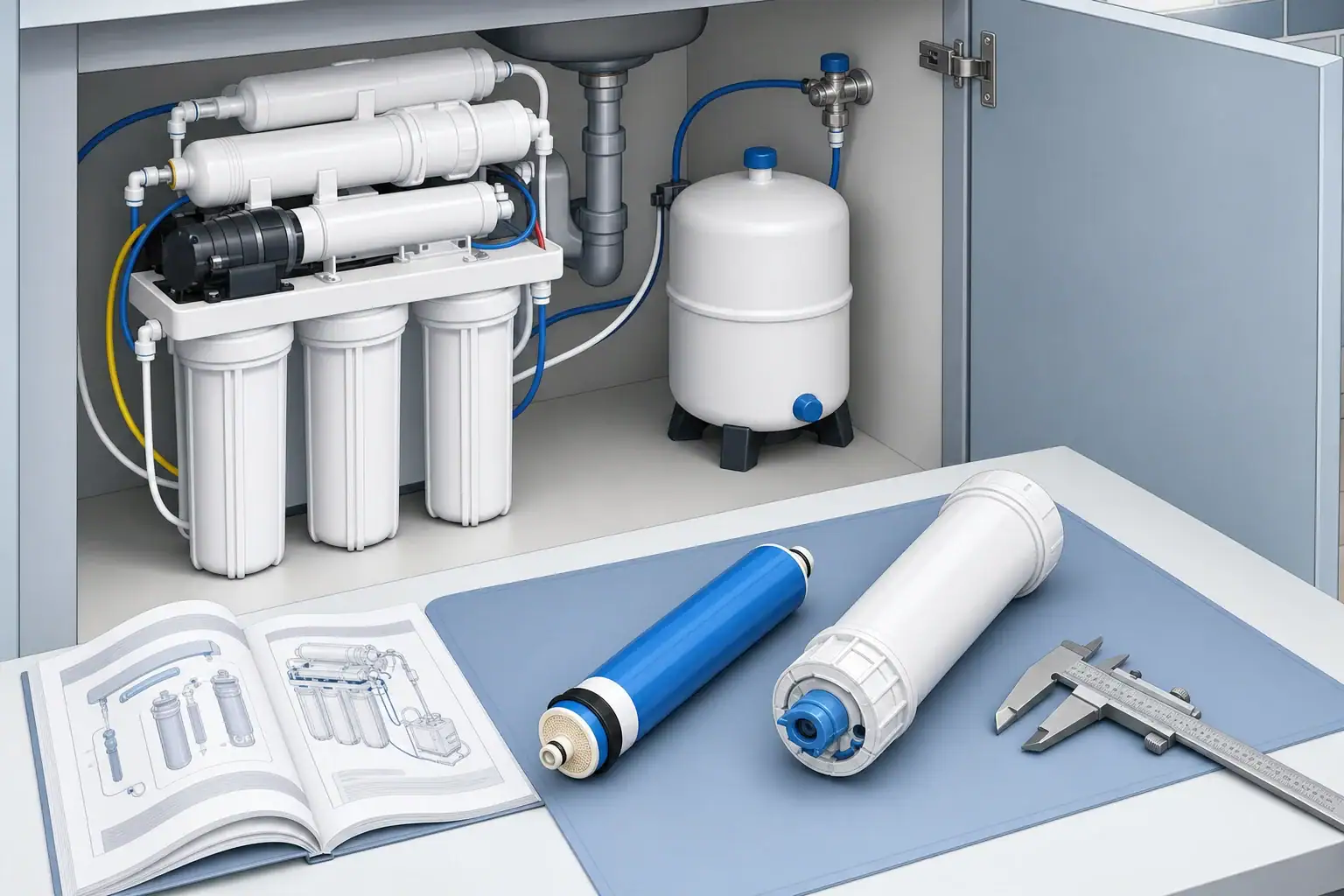
Quick answer: For RO membrane replacement compatibility, start with the system’s exact model and specified membrane part number. Before buying an alternative, confirm the cartridge format, dimensions, seal and connection layout, rated conditions, system pressure range, flow restrictor, fittings, and any certification implications.
RO membrane replacement compatibility: use a manual-first sequence
Start with the label on the installed RO system, not an online listing with a similar gallons-per-day (GPD) rating. Record the brand, complete model number, and any revision or serial information. Then find the manufacturer manual that covers that exact model or revision and locate its replacement-parts list.
The lowest-risk choice is the membrane part number specified for the system. If that part is unavailable, treat an alternative as unconfirmed until the system manufacturer documents a cross-reference for the complete model. A membrane that looks similar or has the same advertised GPD may still have a different housing interface, seal arrangement, or drain-flow requirement.
- Identify the complete system model. Compare the unit label with the manual cover and parts list.
- Record the original membrane part number. Check the parts table and the label on the old cartridge. A documented revision may explain a difference.
- Identify the membrane format. Determine whether the system uses a loose element in a reusable pressure vessel, an encapsulated cartridge, or a proprietary twist-lock or manifold connection.
- Match the physical interface. Confirm length, diameter, permeate-tube arrangement, brine-seal layout, end caps, locking features, and connection locations.
- Compare the rating conditions, not GPD alone. Read the stated pressure, temperature, feedwater composition, and recovery used for the rated output.
- Use the system’s pressure limits. The complete system manual—not only an element data sheet—governs the allowable feed-pressure range and any pump requirements.
- Confirm the drain-flow control. Identify the specified flow restrictor or drain-control kit for the membrane and system configuration.
- Check associated parts. Determine whether a check valve, O-rings, fittings, adapters, or housing cap are required or included.
- Verify certification claims separately. If a contaminant-reduction claim matters, look up the exact system or replacement module and the specific claim in an official certification listing.
RO membrane compatibility decision table
| Specification | Where to find it | What must match |
|---|---|---|
| System model and revision | Unit label and manual cover | The manual and parts family must cover the installed unit. |
| Original membrane part number | Parts table, performance sheet, or old cartridge label | The exact part, or a manufacturer-documented cross-reference. |
| Housing or cartridge type | Manual diagram and visual inspection | Loose element, encapsulated cartridge, or proprietary manifold interface. |
| Dimensions and seals | Original membrane data sheet or manual | Length, diameter, permeate tube, brine seal, end caps, and connection layout. |
| Rated output | Membrane performance sheet | Capacity plus the pressure, temperature, feedwater, and recovery used for the rating. |
| Feed-pressure range | System installation manual | Household feed pressure must fall within the system’s stated range. |
| Flow restrictor | Parts list, drain-control diagram, or replacement kit | The manufacturer-specified part or flow control for that configuration. |
| Check valve and fittings | System diagram and package contents | Correct connection type, size, location, and whether each part is included. |
| Certification | Official certification-body database and performance data sheet | The exact system or module and the particular contaminant-reduction claim. |
Is matching GPD alone sufficient?
No. GPD is a rated production figure under stated test conditions; it is not a universal size, seal, or connection standard. Two membranes labeled 50 GPD can use different form factors and have ratings based on different pressure and recovery conditions.
For example, DuPont lists its conventional TW30-1812-50HR element at approximately 11.74 inches long by 1.75 inches in diameter. Its nominal 50-GPD rating is based on 50 psi and 77°F, along with specified feedwater and recovery conditions. DuPont’s product data sheet provides those element-specific details.
In contrast, Pentair lists its GRO-50EN encapsulated element at 15.14 by 2.50 inches, with nominal performance based on 65 psi and 77°F and different stated operating conditions. Pentair’s GRO specification sheet also assigns model-specific drain-control kits. Equal GPD therefore does not establish physical or hydraulic interchangeability.
Worked comparison: Suppose a system manual specifies an encapsulated 50-GPD cartridge and its matching drain-control kit. A loose 50-GPD element may share the capacity label, but if it is shorter, narrower, or lacks the cartridge’s locking manifold connection, it fails the fit check before output rating is even considered. The documented cartridge remains the appropriate choice unless the manufacturer supplies a retrofit or cross-reference.
Can a standard membrane fit a proprietary housing?
Do not assume so. A loose cylindrical element made for a reusable pressure vessel is not automatically compatible with a sealed cartridge that locks into a proprietary manifold. Similar GPD ratings do not make these interfaces interchangeable.
Use only a manufacturer-documented retrofit or cross-reference for the exact system model. Do not force a cartridge, alter a housing, or improvise adapters. An incorrect connection can leak or create an unintended water path. For a broader explanation of RO components and water paths, see how reverse osmosis works.
When must the flow restrictor match the membrane?
Check the specified flow restrictor whenever the membrane is replaced, especially when changing membrane capacity, element family, or cartridge design. The restrictor controls concentrate flow, and the manufacturer may specify a different part for a different membrane configuration.
Pentair’s GRO specification sheet identifies different drain-control kits for its listed 36-, 50-, and 75-GPD encapsulated elements. Those values are specific to the listed products and should not be converted into a universal GPD-to-restrictor chart. If the replacement listing does not identify the required restrictor, or the installed part cannot be identified, ask the system manufacturer before ordering.
Drain-flow hardware may be a separate part, integrated into a fitting, or included in a replacement kit. Confirm the manual’s diagram and package contents before disconnecting tubing. For context on the drain stream, see RO waste water ratio.
Read pressure specifications in the right order
Start with the allowable feed-pressure range for the complete RO system. A membrane data sheet can state an element-level maximum operating pressure, but that does not establish the approved limit for the housing, tubing, valves, tank, or other components.
As one model-specific example, the Watts Kwik-Change Zero Waste RO manual lists a 40–85 psi feed-pressure range and identifies a specific 60-GPD replacement membrane. Those figures apply to that documented system, not to every household RO system.
If the feed pressure is unknown or falls outside the manual’s stated range, resolve that issue before selecting a higher-output membrane or adding equipment. A desired GPD label alone is not a basis for choosing a pump. See RO booster pump vs. permeate pump for the different jobs those devices can serve.
Manual-reading checklist before you order
- The manual covers the exact installed model or model family.
- The parts table identifies a membrane part number.
- The old cartridge label agrees with the manual, or a documented revision explains the difference.
- The replacement uses the same loose-element, encapsulated, or manifold format.
- Dimensions, seals, permeate tube, locking tabs, and connections agree with the documentation.
- The advertised GPD includes test conditions rather than serving as the only fit criterion.
- The system’s feed-pressure range is known and distinguished from an element-level pressure limit.
- The specified flow restrictor or drain-control kit is identified.
- Required check valves, O-rings, adapters, and fittings are included or separately identified.
- Model-specific flushing, startup, and leak-inspection instructions are available before installation.
Check certification at the system-and-claim level
A membrane component listing does not automatically certify every assembled system for every contaminant claim. NSF’s listing for the TW30-1812-50HR includes material-conformity information and conditions related to transfer of reduction data. Review the official NSF listing and the documentation for the exact system before relying on a claim.
The U.S. Environmental Protection Agency advises reviewing a performance data sheet or certification listing for the contaminant of concern and notes that no one treatment system removes every contaminant. EPA’s guide to selecting home water-treatment systems is a useful starting point. For more detail on interpreting an RO certification, read NSF/ANSI 58 explained.
When to stop and contact the manufacturer
Pause the order if the model label is missing, multiple manual revisions name different parts, the old membrane conflicts with the parts table, or the seller cannot document the dimensions and operating conditions. Manufacturer confirmation is also appropriate when changing capacity, changing cartridge styles, replacing an unidentified restrictor, or trying to preserve a certified reduction claim.
Ask for a written cross-reference tied to the full system model and revision. Confirm whether the membrane, restrictor, check valve, seals, and fittings are supplied together or must be ordered separately. Once you have the documented part, follow the system manual for installation, flushing, startup, and leak inspection; compatibility selection does not replace those model-specific steps.
Frequently asked questions
Is matching GPD alone sufficient?
No. GPD is a capacity rating measured under stated conditions, not a universal size or connection standard. Two products with the same GPD can have different physical formats, test pressures, recovery conditions, seals, and drain-control requirements.
Can a standard membrane fit a proprietary housing?
Do not assume it can. A loose element intended for a reusable pressure vessel differs from a sealed cartridge that locks into a proprietary manifold. Use only an exact specified replacement or a manufacturer-documented retrofit.
When must the flow restrictor match the membrane?
Confirm the specified flow restrictor whenever a membrane is replaced, particularly when capacity, element family, or cartridge design changes. Use the manufacturer-specified part or obtain confirmation for the exact system configuration.
- NSF/ANSI standards explained (42/53/401/58)
- Clear trade-offs: pitcher vs faucet vs under-sink vs RO
- Maintenance planning: cost per gallon and replacement cadence