
Water utilities commonly use chlorine or chloramine to control microorganisms in drinking water. That disinfection protects water as it travels through the distribution system, but the disinfectant can also produce a noticeable odor at the shower.
A shower filter may reduce free chlorine at that fixture when the exact filter and replacement cartridge are designed and tested for that purpose. It should not be assumed to remove chloramine, hardness minerals, microorganisms, or unrelated contaminants unless the exact model has a separate verified claim.
The first step is to identify the disinfectant in your water. The CDC recommends checking with your water utility because utilities may use chlorine, chloramine, or switch between them. Community water systems publish annual water-quality reports, also called Consumer Confidence Reports; the EPA provides information and a search tool for finding these reports.
Why Chlorine Shows Up in Your Shower
Chlorine and chloramine are used to continue controlling microorganisms as treated water moves through pipes. The CDC notes that both are used at levels considered safe under federal drinking-water regulations. A noticeable smell does not by itself establish that the water is unsafe or reveal its disinfectant concentration.
If you want to reduce the odor at a shower, first find out whether your utility uses free chlorine or chloramine. Look at the utility’s current water-quality report and, if the report is unclear, ask the utility whether it changes disinfectants during the year. This distinction matters because a certified free-chlorine claim is not evidence of chloramine reduction.
How Shower Filters for Chlorine Work
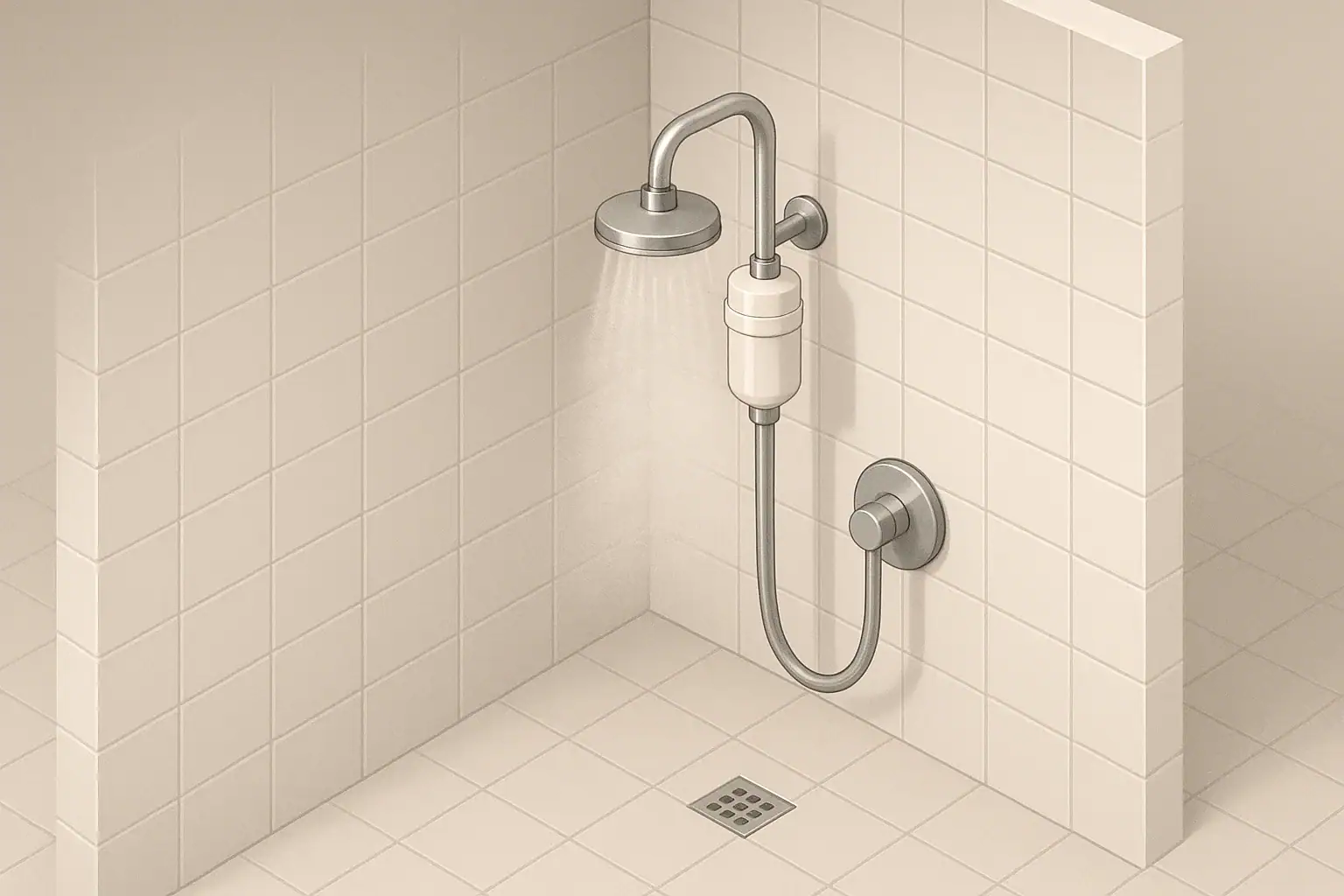
Shower filters are compact point-of-use devices installed between the shower arm and showerhead or incorporated into a filtered showerhead. Their performance depends on the media, cartridge design, water chemistry, flow, temperature, and how much water has already passed through the cartridge.
Common Filter Media Used for Chlorine
Products may use activated carbon, copper-zinc media commonly sold as KDF media, or a combination of materials. Copper-zinc media use a reduction-oxidation process; the KDF media manufacturer describes conversion of free chlorine to chloride. That description explains the media’s proposed mechanism, but it does not prove the performance of every shower cartridge containing KDF media. For more background, see how KDF media are used in shower filters.
Likewise, a list of ingredients on a product page is not a reduction test. Use the exact model’s certification listing or performance data rather than assuming what it removes from the presence of carbon, KDF, ceramic balls, vitamins, or another proprietary blend.
Chlorine vs. Chloramine in Showers
Free chlorine and chloramine are different disinfectants. A filter verified for “free available chlorine reduction” has not thereby been verified for chloramine. No model-level chloramine claim was established by the NSF/ANSI 177 shower-filter listings reviewed for this article.
If your utility uses chloramine, look for a separate chloramine-reduction claim attached to the exact system and replacement element. Check the stated flow, capacity, and test conditions. Do not treat the words “chlorine filter,” a certification logo, or the name of a filter medium as proof of chloramine reduction.
| Option | Installation location | Can affect shower water? | Important limitation |
|---|---|---|---|
| Shower filter | At one shower | Yes, at that fixture | Reduction depends on the exact verified claim and operating conditions |
| Pitcher, faucet, or under-sink filter | At a drinking-water outlet | No direct effect | Treats only the outlet connected to the device |
| Whole-house carbon system | Main water line | Potentially, if designed and sized for the relevant disinfectant | Requires model-specific design, maintenance, and performance evaluation |
| Water softener | Main water line | Changes hardness throughout the home | Its primary job is hardness treatment, not chlorine filtration |
| Point-of-use reverse osmosis | Usually under a sink | No direct effect | Not a normal full-flow shower treatment |
What Shower Filters for Chlorine Can Realistically Do
A properly selected shower filter can provide targeted free-chlorine reduction at one shower. Reduced chlorine may also make its odor less noticeable, although odor perception is subjective and is not a substitute for a water test.
Some people report changes in how their hair, skin, soap, or shampoo feel after installing a filter. Those perceptions can also be affected by hardness, water temperature, personal-care products, and skin or hair characteristics. A free-chlorine certification establishes the specified water-treatment claim; it does not establish a clinical skin or hair benefit.
Some cartridges include screens that may catch visible debris. Such a screen is not equivalent to a dedicated whole-house sediment filter when particulate matter is persistent or present throughout the home.
Because a shower filter treats one fixture, it can be useful for renters or households that do not want to modify the main water line. Other showers and taps remain untreated unless they have their own devices.
What Shower Filters Cannot Do (or Do Poorly)
They are not disinfection systems
A chlorine-reduction shower filter should not be presented as a device that disinfects water. The CDC explains that activated-carbon filters trap rather than kill microorganisms and generally are not rated for microbial removal. If there is a boil-water advisory or a known microbiological problem, follow the instructions of the water utility or public-health authority rather than relying on a shower filter. The CDC’s discussion of water treatment and activated-carbon filtration provides additional context.
They do not automatically reduce chloramine
NSF/ANSI 177 certification for free available chlorine does not demonstrate chloramine reduction. A chloramine claim requires its own model-level evidence.
They are not water softeners
A standard chlorine-focused shower filter should not be expected to remove the calcium and magnesium responsible for hardness. If scale, soap scum, or hard-water spotting is the main problem, compare the different jobs performed by whole-house filters and water softeners. You can also review shower filters versus softeners for hard-water feel.
One claim does not establish removal of other contaminants
A free-chlorine claim says nothing by itself about lead, PFAS, volatile organic compounds, total dissolved solids, or other substances. Each consequential reduction claim must be verified for the exact model. Drinking-water concerns may require a separately certified point-of-use system; reverse osmosis systems, for example, have a different purpose and are normally installed at a drinking-water tap rather than a shower.
Understanding Flow, Capacity, and Temperature
Certification and performance data apply under stated operating conditions. Three specifications are especially important:
- Rated flow: Compare the tested flow with the flow expected through your shower. Do not assume a result obtained at one flow applies at every higher flow.
- Rated capacity: Capacity is usually stated in gallons. It is a service endpoint, not a universal number of months.
- Operating range: Stay within the model’s stated pressure and temperature limits. Do not generalize one product’s range to another cartridge.
Household replacement timing depends on water use. For example, a 10,000-gallon capacity would last for different numbers of days in homes using 20, 40, or 80 shower gallons per day. Follow the lower of the stated gallon capacity, time limit, or other replacement condition in the manufacturer’s instructions.
NSF/ANSI Certification for Shower Filters
NSF describes NSF/ANSI 177 as the standard specifically covering shower filtration systems and verified reduction of aesthetic free available chlorine. That scope is narrower than “removes contaminants”: it does not create a blanket claim for chloramine, hardness, lead, PFAS, or microorganisms.
NSF/ANSI 42 is a broader standard for claim-specific aesthetic effects in drinking-water treatment units. A product’s reference to Standard 42 is not enough on its own. As NSF explains in its overview of Standards 42, 53, and 401, standards contain different contaminant-reduction claims. The exact certified claim and model listing must therefore be checked.
A Model-Level Certification Example
The official NSF shower-filter listing accessed October 31, 2026, lists the Weddell Duo WD-100 with replacement element WD-100F for free available chlorine reduction under NSF/ANSI 177. The listing specifies a 10,000-gallon service cycle and a 2.0-gallon-per-minute rated flow.
The manufacturer’s test-report page for that system states a pressure range of 28–125 psi, a temperature range of 34–120°F (1–49°C), and 93.3% average chlorine reduction at the 10,000-gallon endpoint. These figures are included only to show how specific a supported claim is: they apply to that listed system and replacement element under the stated conditions, not to shower filters generally.
How to Verify a Claim
- Find the complete system model and replacement-cartridge number.
- Search the certifier’s official database rather than relying only on packaging or a marketplace description.
- Confirm that the exact claim is listed, such as “free available chlorine reduction.”
- Check rated flow, capacity, pressure, temperature, and any replacement conditions.
- Make sure the cartridge being sold is the replacement element named in the listing.
- For chloramine or another contaminant, require a separate explicit claim. Do not infer it from a free-chlorine listing.
Choosing and Maintaining a Shower Filter
Questions to Ask Before You Buy
- Which disinfectant is in the incoming water? Check the current utility report for chlorine, chloramine, and reported levels. Ask about seasonal changes.
- What exact claim is supported? Match the system and cartridge numbers to an official certification or test record.
- Do the operating conditions fit? Compare rated flow, pressure, temperature, and capacity with the intended shower.
- Is hardness actually the problem? If scale and spotting are the main concerns, a chlorine filter is probably the wrong treatment category.
- What will replacement cartridges cost over time? Calculate from expected gallons of use and the stated service cycle rather than relying on a generic “months” estimate.
Basic Installation Considerations
An in-line unit typically attaches between the shower arm and showerhead. Follow the model’s instructions for thread sealing, orientation, flushing, and leak checks. Support the fittings while tightening them, and do not exceed the manufacturer’s temperature or pressure range. If the added device makes the assembly unstable or leaks cannot be corrected, stop using it and address the fitting or installation problem.
Maintenance and Cartridge Replacement
Record the installation date and, when practical, estimate gallons used. Replace the element according to its stated capacity, time limit, or other manufacturer condition. A return of chlorine odor may prompt an earlier check, but odor alone cannot measure cartridge performance.
If flow falls, inspect and clean only the screens or showerhead parts the instructions identify as serviceable. Reduced flow can have several causes and does not prove that a cartridge is still reducing chlorine. Use the exact approved replacement element; a similarly shaped cartridge may not carry the original system’s certified claim.
Frequently Asked Questions
Will a shower filter for chlorine remove chloramine?
Not necessarily. A free-available-chlorine claim under NSF/ANSI 177 does not verify chloramine reduction. If your utility uses chloramine, require a separate model-level chloramine claim with stated test conditions.
How often should I replace a shower-filter cartridge?
Follow the exact cartridge’s rated gallon capacity, time limit, and replacement instructions. A universal interval in months is unreliable because shower flow, shower length, household size, and daily use differ.
Can a chlorine shower filter improve skin or hair?
People may perceive a change in odor or feel after free chlorine is reduced, but a chlorine-reduction certification does not establish a clinical skin or hair outcome. Hardness, temperature, and personal-care products can also affect the experience.
Does a chlorine shower filter protect against bacteria or viruses?
No such protection should be assumed. A chlorine-reduction claim is not a microbial-removal or disinfection claim. Follow public-health or utility instructions if microbiological safety is in question.
How can I verify a shower filter’s chlorine claim?
Match the exact system and replacement element to an official certification listing. Confirm the named reduction claim, rated flow, capacity, and operating conditions. NSF/ANSI 177 is the shower-specific standard for aesthetic free-available-chlorine reduction, but certification remains claim- and model-specific.
Recommended next:
- NSF/ANSI standards explained (42/53/401/58)
- Clear trade-offs: pitcher vs faucet vs under-sink vs RO
- Maintenance planning: cost per gallon and replacement cadence