
Hard water contains dissolved calcium and magnesium. These minerals affect how soap lathers, contribute to scale, and can leave a coating on surfaces. The U.S. Geological Survey’s water-hardness guidance classifies water reported as calcium carbonate as soft at 0–60 mg/L, moderately hard at 61–120 mg/L, hard at 121–180 mg/L, and very hard above 180 mg/L.
For shower use, the three practical choices do different jobs: leaving the water untreated changes nothing, a shower filter may address a specifically certified chlorine claim, and an ion-exchange softener removes hardness minerals. The right choice therefore depends on whether the problem is hardness, disinfectant odor, or simply the amount of equipment and maintenance you want.
Why Hard Water Feels Different in the Shower
Calcium and magnesium react with soap, reducing lather and helping form residue. The EPA’s technical sheet on residential water softeners identifies reduced soap lather, sticky coatings, spotting, and scale as common effects of hard water.
In and around a shower, that may show up as:
- Reduced lather: More soap or shampoo may be needed to produce the same amount of foam.
- Soap residue: Minerals and soap can form deposits on skin and bathroom surfaces.
- Mineral spots: Evaporating water can leave visible deposits on glass, tile, and fixtures.
- Scale: Mineral accumulation can develop on showerheads and other water-contact surfaces.
People describe the resulting shower feel differently. Untreated hard water is often described as more “grippy” or squeaky, while softened water is often described as smoother or slippery. Those descriptions are subjective; lather, residue, and measured hardness provide more useful ways to compare treatment options.
Option 1: Leave the Water Untreated
Doing nothing is reasonable when the hardness level is acceptable and scale or soap residue is not causing enough inconvenience to justify treatment. It requires no equipment, cartridge replacements, salt, or plumbing changes.
What Stays the Same
Untreated water retains its incoming calcium and magnesium concentration. A home with moderately hard water may see only manageable spotting, while a home with very hard water may experience much more scale and soap residue. The hardness result—not the appearance of the water—provides the clearest starting point for comparison.
Advantages
- No equipment or installation cost.
- No cartridges, salt, regeneration cycle, or treatment-system servicing.
- No added restriction at the showerhead.
Tradeoffs
- Hardness, mineral spotting, and scale remain unchanged.
- Soap will continue to react with calcium and magnesium.
- Shower glass, fixtures, and spray nozzles may require more frequent descaling.
If deposits are the main frustration, see the practical cleaning and prevention options in Managing Hard Water Residue: Reducing Scale Buildup in the Shower.
| Question | No treatment | Shower filter | Ion-exchange softener |
|---|---|---|---|
| Removes calcium and magnesium? | No | Generally no | Yes, within the system’s rated capacity |
| Reduces free available chlorine? | No treatment | Only when the exact model has that verified claim | Not a standard softener function |
| Changes hard-water lather and soap residue? | No | Not by removing hardness | Yes |
| Reduces hardness-related scale and spotting? | No | Not unless the product has a separate substantiated scale claim | Yes, by removing hardness ions |
| Routine upkeep | Bathroom cleaning | Replace the listed cartridge at its rated service cycle | Replenish regenerant and maintain the system |
Option 2: Install a Shower Filter
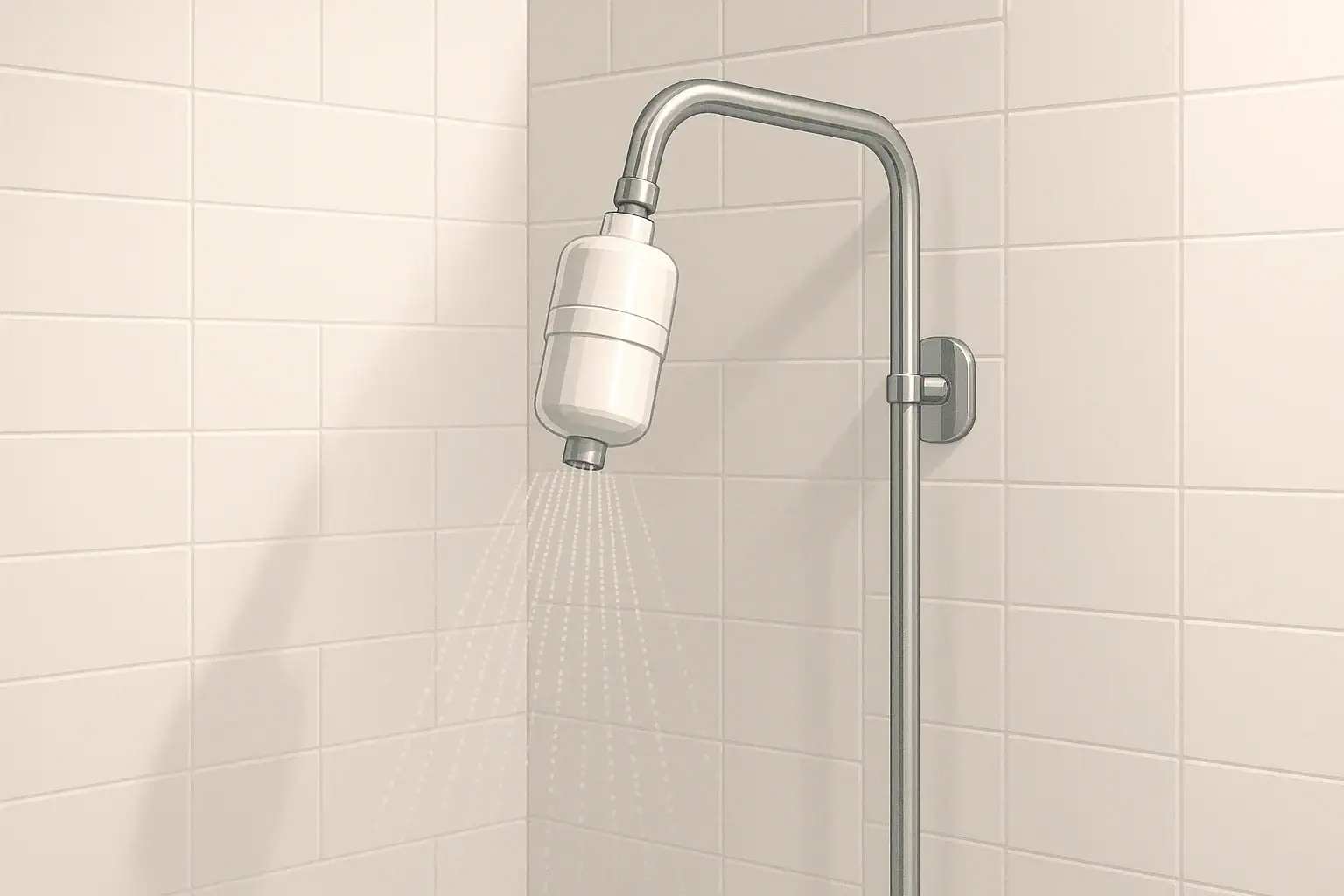
A shower filter attaches at the shower arm or is built into a showerhead. It should not be treated as a water softener unless the manufacturer supplies credible performance data showing actual calcium and magnesium removal at the stated flow and capacity.
Verify the Exact Claim
NSF identifies NSF/ANSI 177 as the standard for shower filtration systems making aesthetic-effect claims. The contaminant-reduction claim covered by that certification is free available chlorine. Certification to this standard does not by itself establish hardness removal or chloramine reduction.
Before buying, look up the exact system and replacement element in the official NSF/ANSI 177 product listings. Check:
- the exact model number and replacement cartridge;
- the listed free available chlorine claim;
- the rated service cycle or capacity;
- the rated flow; and
- any installation or incoming-water conditions in the manufacturer’s instructions.
A label that merely mentions a standard is not enough. Certification applies to the listed model and claim, not automatically to every product sold under the same brand.
What a Shower Filter May Change
A model with a verified free available chlorine claim may reduce chlorine odor at the shower. Whether that creates a noticeable change in perceived water feel varies by person and by the incoming chlorine concentration.
Because a conventional shower filter does not remove the calcium and magnesium responsible for hardness, it should not be expected to produce the same lather, residue, or scale changes as an ion-exchange softener. Claims for chloramine, sediment, scale control, or other reductions must be verified separately for the exact model rather than inferred from the filter-media name.
Advantages and Limitations
Advantages:
- Treats only the shower and usually requires less plumbing work than a whole-house system.
- Can address a listed free available chlorine claim without treating every fixture.
- May be practical for renters if fixture changes are permitted.
Limitations:
- Does not ordinarily soften water or stop hardness-related spotting.
- Requires the correct replacement cartridge at the manufacturer’s stated service interval.
- Performance and pressure depend on the exact model, flow, incoming water, and cartridge condition.
For a closer look at this product category, read Shower Filters for Chlorine: What They Can (and Can’t) Do.
Option 3: Install a Water Softener
A conventional residential water softener is normally installed on a main plumbing line. For more on how its job differs from filtration, see Whole House Filters vs Water Softeners: Different Jobs Explained.
How Ion Exchange Changes the Water
A cation-exchange softener passes water through resin that exchanges calcium and magnesium for sodium or potassium ions. The resin is periodically regenerated with brine, and the captured hardness minerals are discharged with the regeneration water. This is actual hardness removal, not merely an attempt to alter how scale forms.
The EPA’s 2026 guide to water softeners distinguishes these systems from salt-free conditioners. A conditioner may change scale-forming behavior, but it does not remove calcium and magnesium from the water. That distinction matters when the goal is to change soap lather or measured hardness.
Why Softened Water Feels Different
With less calcium and magnesium available to react with soap, lather forms more readily and less insoluble soap residue is produced. Many users describe the resulting rinse as smoother or more slippery. That sensation is not, by itself, proof that soap remains on the skin; a before-and-after hardness test is a better way to confirm what the equipment changed.
Effects Beyond the Shower
When installed to treat most of the home, a softener can also reduce hardness-related scale and spotting at sinks, dishwashers, water heaters, and other connected fixtures. A standard softener should not be assumed to reduce chlorine, chloramine, or unrelated contaminants unless the system includes additional treatment with separately verified claims.
Advantages and Tradeoffs
Advantages:
- Removes the calcium and magnesium responsible for hardness.
- Changes soap performance throughout the treated plumbing.
- Reduces hardness-related scale and spotting.
Tradeoffs:
- Requires more space, plumbing work, and upfront expense than a shower filter.
- Uses regenerant and water during regeneration.
- Must be sized and programmed for incoming hardness and household water use.
- Adds sodium or potassium to treated water as part of the exchange process.
How to Choose Between a Filter, Softener, or Nothing
1. Measure the Incoming Hardness
Hardness is commonly reported in milligrams per liter as calcium carbonate (mg/L as CaCO₃) or grains per gallon (gpg). An official USGS conversion is 1 gpg = 17.12 mg/L as CaCO₃.
Customers of a community water system can begin with the utility’s annual Consumer Confidence Report or ask the utility directly. Hardness is not guaranteed to be included, so obtain a suitable water test if the report omits it. Private-well users need a test representative of their own water.
2. Match the Equipment to the Problem
- Hardness, poor lather, mineral scale, or spotting: Consider an appropriately sized ion-exchange softener.
- Free chlorine odor only at the shower: Consider a shower filter whose exact model and cartridge have a verified free available chlorine claim.
- Minor inconvenience: Leaving the water untreated may be the most economical choice.
- Chloramine or another specific substance: Do not assume a chlorine-certified shower filter addresses it. Seek an exact, independently verified claim under the stated operating conditions.
3. Compare Maintenance
- No treatment: No water-treatment maintenance, although scale may increase bathroom cleaning.
- Shower filter: Replace the exact cartridge according to its documented service cycle, flow, and water conditions.
- Water softener: Monitor regenerant, verify programming, and service the unit as its manufacturer specifies.
A universal cartridge interval or number of salt bags per month would be misleading. Actual consumption depends on water hardness, household use, system capacity, regeneration settings, and equipment design.
Testing, Certification, and Operating Costs
Confirm What Changed
- For a softener: Measure hardness before and after treatment using an appropriate test method.
- For a shower filter: Confirm that the exact model and cartridge appear in the certification listing for the claimed reduction.
- For scale: Photograph the same clean glass or fixture at regular intervals under similar conditions.
- For maintenance: Record cartridge changes, regenerant additions, and system settings.
Relevant NSF/ANSI Standards
The standard number identifies a category of evaluation, but the certification listing identifies what a particular model has actually demonstrated.
| Standard | Relevant equipment | What to verify |
|---|---|---|
| NSF/ANSI 177 | Shower filtration systems | Exact model, replacement element, free available chlorine claim, service cycle, and rated flow |
| NSF/ANSI 44 | Residential cation-exchange water softeners | Certified model, hardness-reduction capacity, efficiency, pressure drop, and related listed performance |
NSF’s technical overview of NSF/ANSI 44 explains that the standard evaluates residential cation-exchange softeners for matters including hardness-reduction capacity, pressure drop, rinse effectiveness, and brine-system accuracy.
Build an Operating Estimate From Actual Specifications
Do not estimate softener upkeep from a universal number of bags or months. Use the measured hardness, expected softened-water use, and data for the specific unit:
- Daily hardness load: hardness in gpg × softened gallons used per day.
- Estimated days between regenerations: usable capacity in grains ÷ daily hardness load.
- Monthly regeneration water: estimated cycles per month × the manufacturer’s listed gallons per cycle.
- Monthly regenerant: estimated cycles per month × the programmed pounds per cycle.
- Estimated cost: local water and sewer charges for regeneration water, plus the actual local price of regenerant.
The EPA reports a broad typical range of 20–70 gallons of water per regeneration cycle, but the actual amount depends on hardness, use, system capacity, settings, and design. Use the selected model’s documentation for a household estimate rather than treating that range as a product rating.
Bottom Line
If calcium and magnesium are causing reduced lather, scale, and mineral spotting, a conventional shower filter is not a substitute for an ion-exchange softener. If the problem is free chlorine odor at one shower, a filter with an exact verified claim may be the more targeted option. If neither issue is significant, leaving the water untreated avoids equipment and maintenance.
Start with an incoming hardness measurement, identify the specific problem, and then check the exact model’s certified claim, flow, capacity, and service requirements. That approach is more reliable than choosing by a media name or by how a product is marketed.
Frequently Asked Questions
Will a shower filter remove the hard-water feel?
Generally not. A conventional shower filter does not remove the calcium and magnesium that cause hardness. It may reduce free available chlorine if the exact model is certified for that claim, but hardness-related lather, scale, and spotting can remain.
Does NSF/ANSI 177 certification prove chloramine reduction?
No. NSF identifies free available chlorine as the reduction claim under its shower-filter certification program. Chloramine reduction must be supported by a separate, exact claim for the specific product.
What is the difference between a softener and a salt-free conditioner?
An ion-exchange softener removes calcium and magnesium by exchanging them for sodium or potassium ions. A salt-free conditioner may alter scale-forming behavior, but it does not remove the hardness ions and should not be expected to produce the same measured hardness or soap-performance change.
How can I tell whether hardness is the problem?
Check the utility’s water report or obtain a hardness test reported in mg/L as CaCO₃ or gpg. Compare that result with the amount of scale, spotting, and soap residue you observe. If a softener is installed, test untreated and treated water to confirm the change.
How often will a shower-filter cartridge need replacement?
Use the service cycle listed for the exact model and replacement element. There is no reliable universal interval because capacity depends on the product, flow, water conditions, and usage.
Recommended next:
- NSF/ANSI standards explained (42/53/401/58)
- Clear trade-offs: pitcher vs faucet vs under-sink vs RO
- Maintenance planning: cost per gallon and replacement cadence