
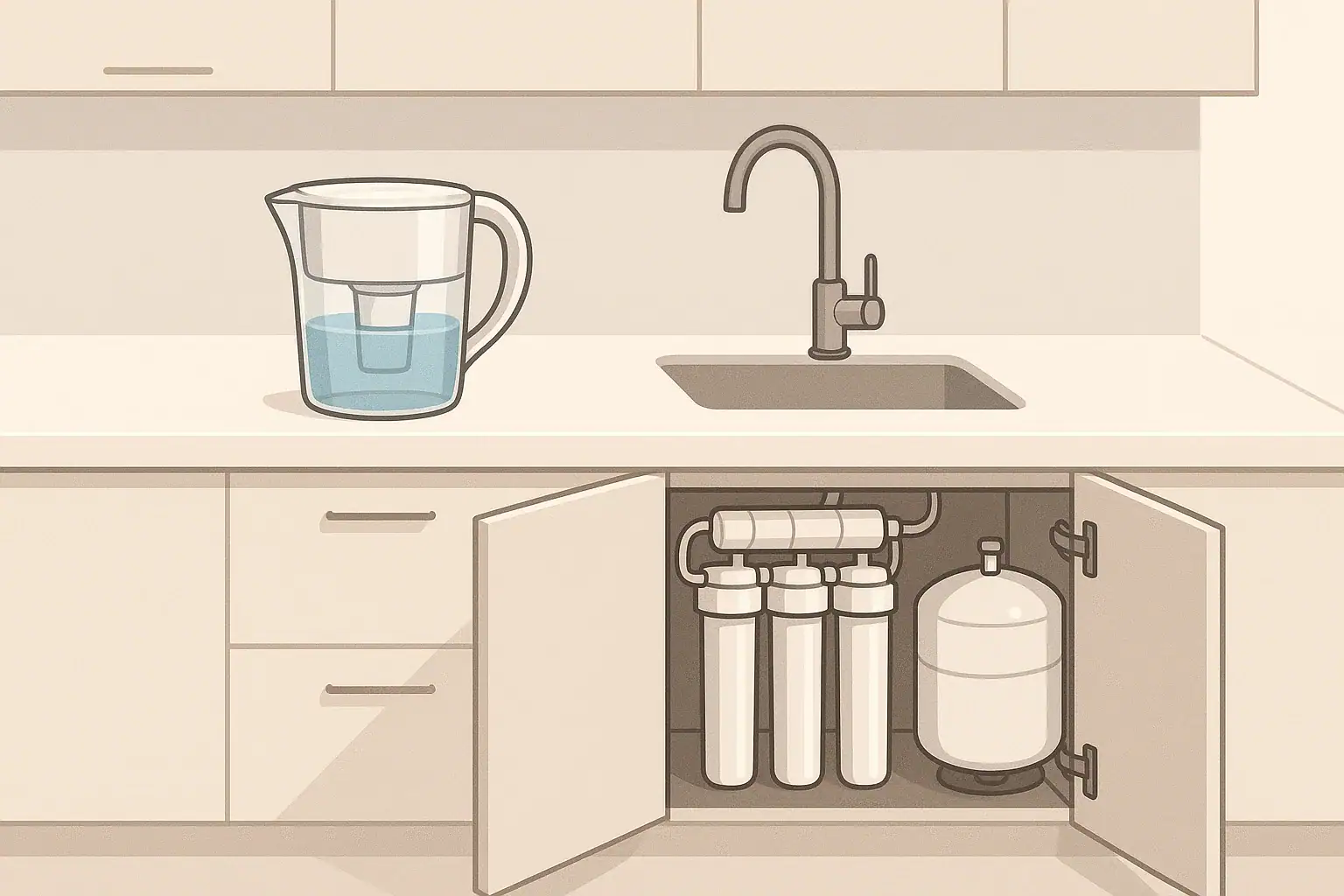
How to Compare Pitcher, Under-Sink, and RO Filters
Pitcher, under-sink, and reverse osmosis (RO) filters treat water in different ways and involve different installation, capacity, maintenance, and operating costs. The right format depends on:
- The contaminants or water-quality problems you need to address
- How much filtered water your household uses
- The certified claims, capacity, flow rate, and operating limits of the specific model
- How much installation and maintenance you are willing to handle
Start with evidence about your water rather than choosing solely by filter format. Customers of community water systems can review their annual Consumer Confidence Report, which identifies the water source and regulated contaminants detected. The U.S. Environmental Protection Agency explains what these reports contain and how to find one in its Consumer Confidence Report guidance. A report describes the public supply, but it may not identify every problem introduced by a building’s service line or interior plumbing.
Private-well owners need a different approach because private wells are not routinely monitored like public systems. The Centers for Disease Control and Prevention recommends annual testing for total coliform bacteria, nitrates, total dissolved solids (TDS), and pH, plus locally relevant contaminants, using a state-certified laboratory. See the CDC’s private-well testing guidance.
This comparison covers three common point-of-use options:
- Pitcher filters: portable containers filled manually
- Under-sink filters: cartridges plumbed into a cold-water line, with either the main faucet or a dedicated faucet dispensing the water
- RO systems: multi-stage units that use a membrane and commonly include prefilters, a postfilter, and a storage tank
Quick Comparison
| Factor | Pitcher | Under-sink, non-RO | RO system |
|---|---|---|---|
| Installation | No plumbing | Connects to cold-water plumbing; some models require a dedicated faucet | Requires feed and drain connections; many models also use a dedicated faucet and tank |
| Daily use | Manual filling and waiting | Dispenses from a faucet | Dispenses stored treated water; production and recovery rate vary by model |
| Treatment method | Depends on cartridge media | Depends on cartridge media and number of stages | RO membrane plus the system’s other treatment stages |
| Dissolved-solids reduction | Only if the exact cartridge has a relevant verified claim | Only if the exact system has a relevant verified claim | TDS reduction is a required performance claim under NSF/ANSI 58 certification |
| Water sent to drain | None during treatment | Normally none during treatment | Yes; efficiency varies by model and operating conditions |
| Cost comparison | Calculate from purchase price, installation, replacement parts, rated capacity, water use, and—where applicable—RO feed-water use. Format alone does not establish the lowest cost per gallon. | ||
These are format-level differences, not contaminant-removal promises. Two filters in the same category may have different certified claims, capacities, flow rates, and replacement requirements.
Pitcher Filters: Portable and Simple to Install
Pitcher filters use a small replaceable cartridge. Media vary by model and may include activated carbon, ion exchange material, or particulate filtration.
When a pitcher can make sense
- You rent or cannot alter plumbing.
- You need a portable option for a limited amount of drinking water.
- You are comfortable filling the pitcher and waiting for it to process water.
- A specific pitcher cartridge has a certified claim matching your water concern.
Do not infer contaminant reduction from the word “carbon,” the shape of the product, or a standard number on its own. For example, a pitcher certified for chlorine taste and odor does not automatically have a lead, PFAS, or VOC reduction claim. Check the certifier’s listing for the exact pitcher and replacement cartridge.
Capacity and upkeep
Pitcher capacity and cartridge life are model-specific. Compare the manufacturer’s rated gallons, time limit, replacement-cartridge price, and applicable water-quality conditions. Actual life can be affected by use and incoming water, so follow the product instructions rather than applying a universal replacement interval to every pitcher.
Clean the pitcher as directed by its manufacturer and avoid extending cartridge use beyond its specified time or capacity limit.
Under-Sink Filters: Plumbed Convenience Without an RO Membrane
Under-sink filters connect to the cold-water line and use one or more cartridges. Some serve a dedicated faucet, while others filter water delivered through the existing kitchen faucet.
When an under-sink filter can make sense
- You want filtered water for routine drinking and cooking without refilling a pitcher.
- You have enough cabinet space and can make the required plumbing connection.
- A non-RO system has certified reduction claims matching the contaminants found in your water.
- The model’s rated flow and capacity fit your expected use.
Under-sink placement does not guarantee stronger contaminant reduction than a pitcher. The relevant differences are the exact media, certified claims, capacity, flow, and operating conditions. A larger cartridge may offer more rated capacity than a small pitcher cartridge, but this must be confirmed from the individual model’s documentation.
Installation and flow
Installation may involve shutting off the cold-water supply, adding a valve or tee, mounting the filter, connecting tubing, checking for leaks, and possibly drilling a faucet opening. Requirements differ, so review the installation manual before buying. If the work is outside your plumbing experience or local rules require it, include professional installation in the budget.
Do not assume every under-sink unit provides normal faucet flow. Compare the model’s rated service flow with your needs, and check its permitted pressure and temperature ranges.
RO Systems: Dissolved-Solids Reduction With More Components
Reverse osmosis systems push water through a membrane while a separate stream carries concentrated material to the drain. Point-of-use systems commonly include sediment or carbon prefilters, a postfilter, a storage tank, and a dedicated faucet, although configurations vary.
When RO is worth considering
- Your test results identify dissolved contaminants for which a particular RO system has an independently certified reduction claim.
- You specifically want TDS reduction at a drinking-water tap.
- You accept a drain-water stream and more components to maintain.
- The model’s production rate, storage capacity, pressure requirements, and recovery time suit your household.
NSF explains that NSF/ANSI 58 requires a TDS-reduction claim for certified RO systems, but claims for contaminants such as lead, arsenic, nitrate/nitrite, VOCs, and fluoride are optional. An NSF/ANSI 58 mark therefore does not mean that every listed contaminant is reduced by every certified RO system.
Production rate and drain water
RO output depends on the complete system and its operating conditions. Compare the certified production rate, storage volume, feed-water pressure and temperature limits, and any inlet-water restrictions. A gallons-per-day rating is not the same as the amount immediately available from the storage tank.
EPA reports that a typical point-of-use RO system can send five gallons or more to the drain for every gallon treated. To earn the WaterSense label, a point-of-use RO system must send no more than 2.3 gallons to drain per gallon of treated water. See EPA’s point-of-use RO guidance and WaterSense criteria. Check the exact model’s efficiency information rather than assuming one ratio applies to all systems.
RO is not a universal substitute for other treatment
An RO system should not automatically be treated as a complete solution for microbial contamination, sediment loading, iron, manganese, or whole-home hardness. These conditions may require source-specific pretreatment or separate treatment. A drinking-water RO unit also does not protect showers, laundry, water heaters, or other taps.
Budget Planning: Compare Total Cost, Not Just Purchase Price
There is no reliable category-wide rule that pitchers always cost more per gallon or that under-sink filters always cost less. Use the prices and ratings for the models being compared.
A practical cost calculation
- Estimate how many gallons of filtered water your household uses each day.
- Multiply by 365 for estimated annual use.
- List the purchase price, installation cost, and replacement components required during the comparison period.
- For RO, include the effect of the model’s drain-water ratio and any additional maintenance components.
- Divide the total cost by the estimated gallons of treated water used during that period.
For example, two gallons per day equals about 730 gallons per year. That is only a usage example—not a recommended allowance. Apply each product’s rated capacity and replacement rules when estimating how many cartridges or other parts you will need.
Also compare non-price constraints: cabinet space, pitcher storage, refill effort, faucet flow, RO production rate, available water pressure, and access for cartridge changes.
Matching Treatment to Your Water
Municipal water
Read the current Consumer Confidence Report first, then consider whether your concern could arise after water leaves the utility, such as from a service line, building plumbing, or fixture. If lead or another household-specific contaminant is a concern, use appropriate sampling rather than assuming the utility-wide report describes water at your tap.
For a taste or odor concern, look for the exact relevant certified claim. For a health-related contaminant, match the contaminant by name in the certification listing. Do not select RO solely because it appears more comprehensive; select it when its verified claims and operating requirements fit the test result.
Private-well water
A pitcher or under-sink unit should not replace appropriate well testing. Use laboratory results to determine whether the water needs microbial treatment, sediment control, iron or manganese treatment, hardness treatment, or point-of-use contaminant reduction.
If excessive hardness is causing scale throughout the plumbing and appliances, a point-of-use RO system treats only the water it serves. Whole-home softening or conditioning is a separate treatment decision. RO may reduce dissolved minerals in drinking water, but that does not make it a whole-house scale-control system.
PFAS concerns
Filter format alone does not establish PFAS performance. Granular activated carbon, ion exchange, and RO technologies may be used in products with PFAS reduction claims, but readers should verify the exact product and compound covered. EPA also cautions that certifications based on earlier protocols may not demonstrate reduction to EPA’s newer drinking-water limits. See EPA’s guidance on identifying filters certified to reduce PFAS.
Using Certifications Without Overreading Them
NSF explains that standards contain individual performance claims and that the claims certified vary by product. Its overview of NSF/ANSI 42, 53, and 401 distinguishes aesthetic, health-related, and emerging-contaminant claims. Certification to one of these standards is not proof that a product reduces every contaminant associated with that standard.
| Standard | General scope | What to verify for a product |
|---|---|---|
| NSF/ANSI 42 | Aesthetic effects | The exact claims, such as chlorine taste and odor or a particulate class |
| NSF/ANSI 53 | Health-related effects | Each named contaminant claimed for the exact model and cartridge |
| NSF/ANSI 401 | Specified emerging compounds or incidental contaminants | Which individual compounds are included in the product’s listing |
| NSF/ANSI 58 | Reverse osmosis systems | The complete system, TDS claim, optional contaminant claims, production rate, efficiency information, replacement module, and listing footnotes |
A five-part certification check
- Complete model: Match the model number, not merely the brand or product family.
- Replacement element: Confirm the certified cartridge or membrane module.
- Specific claim: Find the contaminant by name in the listing.
- Capacity or production rate: Check the certified or manufacturer-stated limit relevant to the claim.
- Conditions and footnotes: Review pressure, temperature, inlet concentration, pH, or other restrictions.
Certification listings can change. Check the certifier’s live database shortly before purchase and retain the performance data sheet for the exact model.
Maintenance and Replacement Conditions
There is no universal replacement interval for all pitchers, under-sink filters, or RO systems. Use the exact manufacturer’s time and capacity limits and any instructions tied to local water conditions. EPA’s home water-treatment guide advises replacing filters according to the manufacturer’s schedule and notes that maintenance can include cartridge or membrane replacement, disinfection, mineral removal, or backwashing, depending on the equipment.
- Record installation and replacement dates.
- Track approximate gallons where the product uses a capacity limit.
- Use the earlier applicable limit when instructions specify both time and gallons.
- Inspect plumbing connections for leaks after installation and cartridge changes.
- Clean pitchers, housings, tanks, and faucets only as directed.
- Investigate unexpected changes in flow, taste, odor, or appearance rather than assuming the filter remains effective.
The best choice is the least complicated system that has verified claims for your actual water concerns, provides enough capacity and flow, and can be maintained on schedule.
Frequently Asked Questions
How should I use a water test or municipal report to choose a filter?
Identify the contaminants actually detected, then look for those exact names in an independent certification listing for the complete system and replacement element. A municipal report is a useful starting point but may not identify contaminants introduced by household plumbing. For a private well, use a state-certified laboratory and add locally relevant tests to the CDC’s annual testing recommendations.
How often should pitcher, under-sink, and RO filters be replaced?
There is no reliable format-wide interval. Replace each cartridge or membrane according to the exact model’s time, capacity, water-quality, and operating instructions. Include every required RO prefilter, postfilter, and membrane when estimating annual maintenance.
Can reverse osmosis reduce lead or PFAS?
Some RO systems have independently certified claims for lead or specified PFAS, but RO technology or NSF/ANSI 58 certification alone does not prove either claim for every system. Verify the complete model, replacement module, named contaminant, conditions, and current certification listing.
How much water does an RO system send to the drain?
It varies by model and operating conditions. EPA says a typical point-of-use RO system can send five gallons or more to drain per gallon treated, while WaterSense-labeled systems must send no more than 2.3 gallons to drain per gallon treated. Use the exact model’s certified efficiency information for comparisons.
Are under-sink filters suitable for well water?
They can be used when the exact system has claims suited to the tested water and the incoming conditions meet its limits. They do not automatically address bacteria, heavy sediment, hardness, iron, or manganese. Those problems may require separate or upstream treatment.
Recommended next:
- NSF/ANSI standards explained (42/53/401/58)
- Clear trade-offs: pitcher vs faucet vs under-sink vs RO
- Maintenance planning: cost per gallon and replacement cadence