
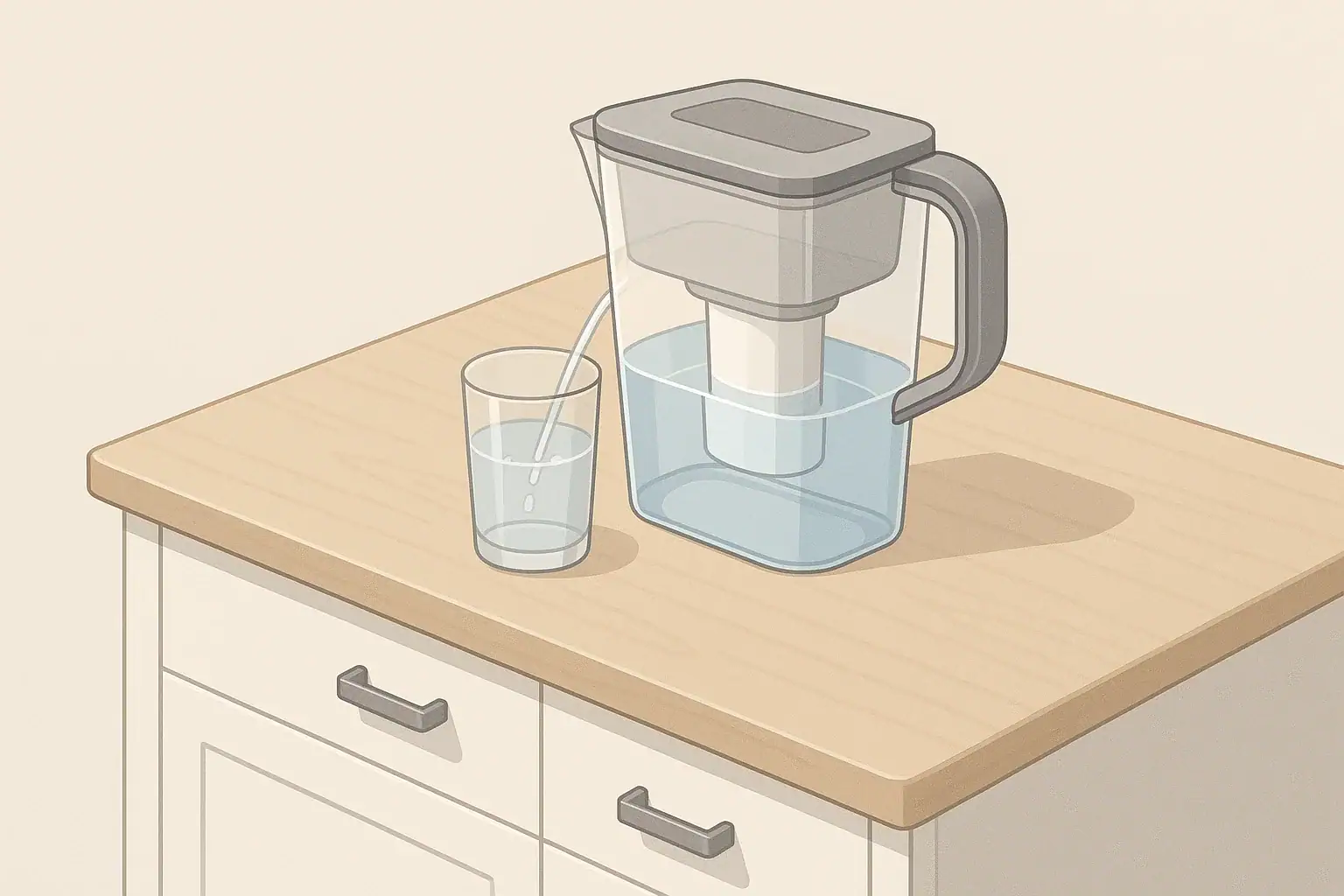
Understanding TDS in Home Tap Water
Total dissolved solids (TDS) describes dissolved material in water. It is commonly reported in milligrams per liter (mg/L), a value approximately equivalent to parts per million (ppm) in dilute water. Dissolved calcium, magnesium, sodium, bicarbonate, chloride and sulfate can all contribute to TDS.
Most handheld TDS meters do not directly weigh all dissolved material. They measure electrical conductivity and apply a conversion factor to estimate TDS. The US Environmental Protection Agency explains that conductivity responds mainly to dissolved inorganic ions, while many organic compounds conduct poorly; the conductivity-to-TDS conversion factor also varies with the water being measured. See the EPA’s conductivity and TDS monitoring guidance.
That distinction matters: a meter can indicate a change in conductivity, but it cannot tell you which ions are present or identify the concentration of a particular contaminant.
TDS is also not, by itself, a federal health-based drinking-water standard. EPA lists 500 mg/L as a non-enforceable secondary guideline associated with aesthetic effects, rather than a primary health limit. The distinction appears in EPA’s drinking-water regulations and contaminant tables.
What Pitcher Filters Actually Do
Pitcher filters are gravity-fed point-of-use devices. Their performance depends on the exact pitcher, cartridge, treatment media, source water, flow conditions and cartridge age. Many use activated carbon for taste and odor improvement. Some also contain ion-exchange or specialty media intended for specified reduction claims.
CDC notes that common pitcher and refrigerator carbon filters mainly improve taste and smell and that most are not designed to remove germs. CDC recommends choosing a filter certified for the specific chemical or germ of concern rather than assuming that every filter bearing a particular standard removes the same substances. See CDC’s guide to choosing home water filters.
A pitcher may therefore produce water that tastes different while its TDS reading remains close to the tap-water reading. That result alone neither proves that the cartridge is ineffective nor verifies that it reduced a specific contaminant.
| Treatment or change | Possible TDS-meter response | What the reading does not establish |
|---|---|---|
| Activated-carbon pitcher filtration | May show little change when the water’s conductivity is dominated by dissolved mineral ions | Whether a named chemical was reduced to a particular concentration |
| Ion-exchange media | Can alter conductivity by changing the mixture of ions | Which ions were exchanged or the reduction achieved without model-specific data |
| Removal of suspended sediment | May have little effect because suspended particles are not the same as dissolved ions | Microbiological safety or removal of all particles |
| Reverse osmosis | A certified system is expected to reduce TDS under its specified test and operating conditions | Every optional contaminant claim; those must be checked separately |
Why TDS May Change Little
Activated carbon and dissolved ions behave differently
Activated carbon can be used for aesthetic effects such as chlorine-related taste and odor reduction, but the ions that dominate conductivity may remain in the water. Removing a substance that contributes little to conductivity may therefore produce little visible change on a TDS meter.
Do not generalize this into a claim that every carbon pitcher reduces volatile organic compounds, disinfection byproducts or any other named contaminant. Those claims require documentation for the exact system and replacement cartridge.
Ion exchange can change composition without providing a simple TDS result
Ion-exchange media replace selected ions with other ions. Because different ions do not contribute identically to conductivity, a reading may rise, fall or remain similar after treatment. A TDS meter cannot show which exchange occurred.
If a new cartridge produces an unexpected result, prepare it exactly as its manual directs and compare readings under similar conditions. There is no universal number of batches to discard, and no universal post-installation TDS pattern applies to all cartridges.
Clearer water does not necessarily have lower TDS
Mechanical filtration may retain suspended material, while TDS concerns dissolved material. Water can look clearer without a substantial change in conductivity. Conversely, visually clear water can still contain dissolved chemicals or microorganisms that a TDS meter cannot identify.
Why a TDS Reading Cannot Confirm Safety
Low TDS, good taste and a clear appearance are not proof that water is safe. CDC specifically advises consumers not to rely on taste, smell or appearance when evaluating drinking water. A conductivity meter also cannot identify bacteria, viruses, lead, nitrate or another individual hazard.
Base treatment decisions on evidence about the incoming water:
- Public water: Review the utility’s Consumer Confidence Report and any current notices. EPA’s Home Water Treatment Guide recommends using the report or appropriate testing to identify the treatment goal.
- Private well: CDC recommends annual testing for total coliforms, nitrate, TDS and pH, along with testing for locally relevant hazards, through a state-certified laboratory. See CDC’s well-water testing guidelines.
- Household-specific concern: Testing may be appropriate when plumbing, a spill, flooding or another local condition creates a concern not represented by a system-wide report.
If local officials issue a drinking-water advisory, follow that advisory rather than a TDS reading or an ordinary pitcher filter. CDC explains that boiling kills disease-causing germs but does not make water with chemical or radioactive contamination safe; the correct response depends on the hazard. See CDC’s household water-treatment guidance.
Why Readings May Not Match Expectations
A conductivity estimate is not a contaminant test
A pitcher can change taste without causing a large TDS shift because many taste-related compounds contribute little to conductivity. Likewise, a lower reading does not establish that a health-related contaminant was removed.
Conversion and instrument limits matter
EPA notes that conductivity-based TDS uses an empirically determined conversion factor rather than one universal relationship. Handheld meters can also differ in calibration, temperature compensation, resolution and stated accuracy. Check the specifications and calibration instructions for the meter you own instead of treating a fixed difference in ppm as universally meaningful.
Testing technique can add variation
For a more useful before-and-after comparison:
- Use clean containers that do not contain detergent or mineral residue.
- Rinse the probe as directed by its manufacturer.
- Compare tap and filtered samples at similar temperatures.
- Allow the displayed value to stabilize according to the meter instructions.
- Repeat the comparison rather than relying on one measurement.
These steps improve consistency, but they do not turn a TDS meter into a test for individual contaminants.
Choosing and Maintaining a Pitcher Filter
Match the certified claim to the actual concern
Certification applies to named products and claims, not automatically to every filter from a brand or every contaminant associated with a standard. NSF describes NSF/ANSI 42 as addressing aesthetic effects, NSF/ANSI 53 as addressing health-effect reduction claims and NSF/ANSI 401 as covering specified emerging compounds. Its consumer explanation of water-treatment standards emphasizes checking the specific claims.
When reviewing a pitcher, verify all of the following:
- The exact pitcher or housing model
- The exact replacement-cartridge model
- The specific contaminant or aesthetic reduction claim
- The rated capacity and conditions attached to that claim
- The certifying organization’s current official listing
For example, a product listed under NSF/ANSI 53 is not necessarily certified for every health-related contaminant covered by that standard. The official listing must name the applicable claim for that model-and-cartridge combination.
| Standard | General scope | What to verify |
|---|---|---|
| NSF/ANSI 42 | Aesthetic effects | The named claim, such as chlorine taste and odor, and the exact product combination |
| NSF/ANSI 53 | Health-effect contaminant reduction | The individual contaminant claim; certification does not imply every possible claim |
| NSF/ANSI 401 | Reduction of specified emerging or incidental compounds | Which individual compounds appear in the product listing |
| NSF/ANSI 58 | Reverse-osmosis drinking-water systems | TDS reduction and any separately listed optional chemical claims |
Follow model-specific capacity and replacement instructions
Replace and prepare the cartridge according to its manual. Capacity can be stated by time, treated volume or both, and actual operating limits are product-specific. Do not use a generic TDS change as a substitute for the manufacturer’s replacement instructions.
A slower flow can indicate clogging, while returning taste or odor can indicate that performance has changed, but neither observation verifies reduction of a health-related contaminant. See the site’s guide to pitcher-filter replacement timing for practical scheduling considerations.
Using a TDS Meter at Home
A home TDS meter is most useful for limited, clearly defined tasks:
- Establishing a conductivity-based baseline for the same tap
- Observing broad changes in source water over time
- Comparing untreated and treated water under repeatable conditions
- Checking whether an RO system produces the expected broad reduction, while recognizing that model specifications and proper diagnostic testing still control
It is not a reliable stand-alone tool for:
- Confirming that drinking water is safe
- Detecting microorganisms
- Measuring lead, nitrate or another named contaminant
- Proving that a pitcher cartridge is exhausted
- Validating a manufacturer’s certified reduction claim
If your goal is specifically to compare pitcher, under-sink and reverse-osmosis treatment, see Pitcher vs Under-Sink vs RO. For the distinction between mineral concentration and hardness, see TDS vs Hardness.
Putting TDS in Context
A pitcher filter can improve taste and odor while leaving the conductivity-based TDS estimate relatively close to its starting value. That can be consistent with the device’s intended function. A small change, however, does not prove contaminant reduction, and a large change does not identify what was removed.
Use a Consumer Confidence Report or suitable laboratory testing to understand the incoming water. Then select a device whose exact model and cartridge are certified for the relevant claim, operate it within its stated conditions and replace it on the manufacturer’s schedule. For a chlorine-focused overview of pitcher options, see pitcher filters for better-tasting tap water.
Frequently asked questions
Will a pitcher filter significantly lower TDS in my tap water?
Not necessarily. Many pitcher filters focus on taste, odor or specified contaminant claims rather than bulk removal of the dissolved ions that dominate conductivity. Check the exact cartridge documentation instead of assuming a universal TDS outcome.
Why is my TDS reading higher after installing a new cartridge?
Ion-exchange media, sample temperature, preparation technique, the meter’s conversion factor or ordinary measurement variation can affect the result. Follow the exact cartridge and meter instructions, then repeat the comparison under similar conditions. A higher result alone does not identify the cause.
Can TDS show whether a pitcher removes lead or other harmful contaminants?
No. A conductivity-based TDS meter cannot identify lead or verify its concentration. Consult your water report or laboratory results and confirm that the exact pitcher-and-cartridge combination has a current certification for the named contaminant.
Can I use TDS to decide when to replace a pitcher cartridge?
Do not use it as the sole replacement trigger. TDS may remain stable even after the media’s performance for a particular claim changes. Follow the model-specific time, volume and maintenance instructions.
Do pitcher filters remove bacteria and viruses?
Most common pitcher and refrigerator filters are not designed to remove germs, according to CDC. TDS readings cannot measure microbiological safety. Use treatment appropriate to the identified hazard and follow any instructions from the responsible local authority.
Recommended next:
- NSF/ANSI standards explained (42/53/401/58)
- Clear trade-offs: pitcher vs faucet vs under-sink vs RO
- Maintenance planning: cost per gallon and replacement cadence