
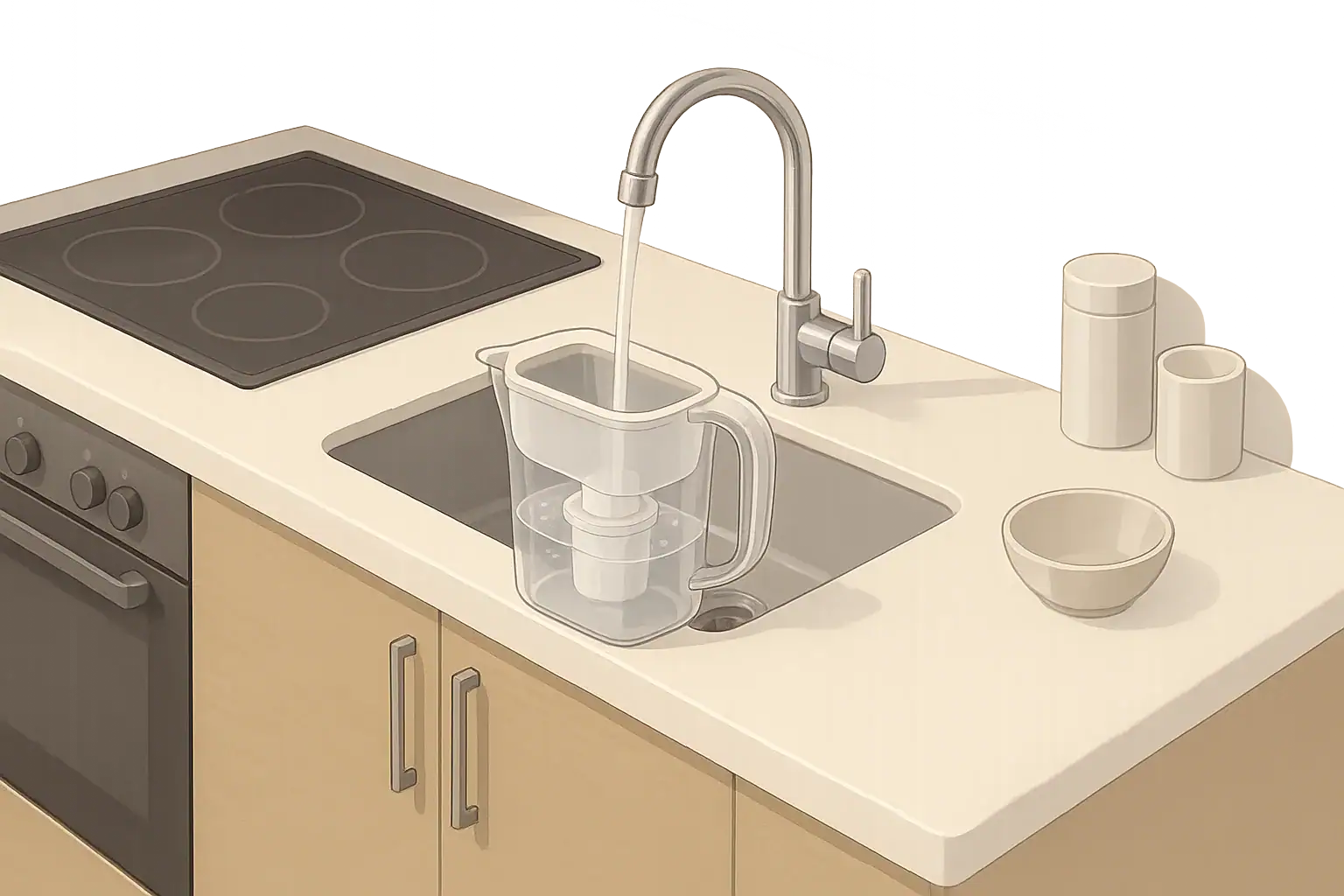
Why Pitcher Filters Work Well for Renters
Pitcher filters are useful for renters because they do not require tools or plumbing changes. They sit on a counter or in the refrigerator and can be packed when you move.
People commonly choose pitchers to address taste or odor without permanent installation. If you want to address a specific contaminant instead, start with your water information rather than assuming that any pitcher will work. For a community water system, the utility’s annual Consumer Confidence Report summarizes detected contaminants at the system level. The U.S. Environmental Protection Agency explains how to find and interpret that report in its guide to understanding your annual water-quality report.
Compared with faucet-mount, under-sink, or whole-house systems, pitchers offer several practical advantages:
- Low commitment: no drilling or pipe changes
- Portable: easy to take to a new rental
- Simple operation: fill the reservoir and allow water to pass through the cartridge
- Visible recurring cost: replacement-cartridge prices and rated service life can be compared before purchase
For renters, two practical questions often dominate: how much filtered water will be available and will the pitcher fit in the refrigerator?
How Much Capacity Do You Really Need?
Capacity affects how often you refill the pitcher and how much filtered water is available for drinking, coffee, and cooking. Product specifications do not always describe capacity in the same way. Check whether the stated figure represents the whole vessel, the lower filtered-water chamber, or another measurement defined by the manufacturer.
The useful figure is how much filtered water you can pour before another refill is needed. If that is unclear from the product page, consult the manual or ask the manufacturer before buying.
Match Capacity to Household Size
Estimate how much filtered water your household actually uses in a day. Include:
- Drinking water for each person
- Coffee, tea, and other beverages made with water
- Cooking needs such as rice, soups, or other recipes
A practical way to think about sizing is:
- Single renter: a compact pitcher may be sufficient if frequent refilling is acceptable.
- Two people: more usable capacity can reduce refilling during mornings or meals.
- Three or more people or frequent guests: a larger pitcher, dispenser, or second pitcher may be more convenient if space permits.
For a better estimate, measure your household’s filtered-water use for a day and compare it with the pitcher’s usable filtered capacity. Also check the cartridge’s operating instructions; a large vessel does not override any daily-use condition specified for the cartridge.
Consider Refill Frequency and Flow
Capacity and refill time both affect convenience. Flow can vary by cartridge design, condition, preparation, and input-water conditions, so consult the model’s instructions rather than assuming that all pitchers refill at the same speed.
Ask yourself:
- How often are you willing to refill the pitcher?
- Can the lower chamber supply enough water while a new batch filters?
- Will guests or cooking quickly empty the available filtered water?
If you regularly run out at busy times, a larger vessel or second pitcher may be more practical than a compact model, provided it fits your refrigerator and stays within the cartridge manufacturer’s usage conditions.
Use these as planning scenarios, not fixed capacity rules.
| Situation | Capacity focus | Fridge-fit priority | Likely tradeoff |
|---|---|---|---|
| Small studio, single renter, narrow shelves | Compact to medium | High: slim footprint and suitable height | More refills in exchange for easier storage |
| Two adults with a standard refrigerator | Medium | Check the intended shelf or door bin | Balance between refills and occupied space |
| Household of three or more | Large pitcher or dispenser | May require a dedicated shelf area | Fewer refills but more bulk |
| Frequent cooking with filtered water | Enough usable water for recipes and drinks | Plan a dedicated, accessible location | Greater capacity occupies more space |
| Very limited space with roommates | Compact vessel or agreed refill routine | Very high: shared shelf space matters | Less storage but more frequent refilling |
| Renter who moves often | Portable size | Dimensions likely to suit varied layouts | Flexibility may take priority over maximum capacity |
Measuring for Fridge Fit in a Rental
Fridge fit is especially important for renters because the refrigerator often comes with the property. Dimensions, shelf layouts, door bins, and interior protrusions vary between models.
Measure the exact storage location before choosing a pitcher. Also consider whether you can lift the lid or remove the pitcher without moving other food.
Key Fridge Measurements to Take
Use a tape measure and compare the available space with the manufacturer’s complete product dimensions:
- Height: Measure from the shelf surface to the shelf or compartment above. Account for lights, controls, and other protrusions.
- Depth: Measure from the back of the usable shelf to the point where the closed door or its contents would interfere.
- Width: Measure the clear left-to-right space, including shelf supports and nearby items.
- Door-bin opening: If using a door bin, measure its opening, usable base, retaining rail, and clearance when the door closes.
- Handling clearance: Allow room for the handle, spout, lid removal, and safe lifting when full.
Do not rely only on the vessel’s nominal capacity. Compare width, depth, and height, and leave enough clearance to insert and remove it without tilting or catching the lid.
Common Fridge Layout Challenges for Renters
- Fixed shelves: These can prevent a tall pitcher from fitting upright.
- Crisper covers: They can leave limited height beneath the next shelf.
- Tapered door bins: The opening may be wider than the usable base.
- Door interference: A pitcher may fit on the shelf but prevent the door from closing because of door-bin contents.
- Shared space: Roommates’ food may leave only a narrow or irregular storage area.
If vertical space is limited, compare shorter designs. If shelf width is the constraint, a narrow model may work better. Do not assume that a pitcher is door-compatible unless its filled weight, base dimensions, and the refrigerator manufacturer’s guidance make that location suitable.
What Pitcher Filters Can and Cannot Do
Pitcher filters are commonly gravity-fed and may use activated carbon, ion-exchange material, or other media. Their reduction capabilities are model- and cartridge-specific. The presence of a particular type of media does not by itself prove a contaminant-reduction claim.
Typical Uses in Rental Settings
Many pitcher products make aesthetic claims such as reducing chlorine taste or odor. Others have certified claims for specified health-related contaminants. Check the exact cartridge and system combination rather than transferring a claim from another model in the same brand.
A pitcher may be appropriate when:
- The exact system is certified for the aesthetic or contaminant claim you need.
- The incoming water meets the system’s stated operating conditions.
- You can follow its preparation, cleaning, service-capacity, and replacement instructions.
Limitations to Keep in Mind
Pitcher filters are not universal treatment systems. In particular:
- A chlorine taste-and-odor claim does not establish lead, microbial, hardness, or every other type of reduction.
- Most pitcher and refrigerator filters are not designed to remove germs, according to the Centers for Disease Control and Prevention’s guidance on choosing home water filters.
- A typical pitcher is not equivalent to a reverse-osmosis system or water softener.
- Certification applies only to the listed system, replacement element, claims, and test conditions.
During a boil-water advisory, the CDC says water must still be boiled as directed even if it has passed through a home pitcher filter. Follow the issuing authority’s instructions rather than relying on an ordinary pitcher for microbial safety.
Understanding Certifications: NSF/ANSI Standards for Pitcher Filters
Third-party certification can help renters determine what a particular system has been evaluated to do. NSF’s primary-source overview of standards for water-treatment systems explains that certification to a standard does not mean a product reduces every contaminant covered by that standard. The exact product listing and individual reduction claims matter.
- NSF/ANSI 42: Covers specified aesthetic or non-health-related claims, which may include chlorine taste and odor. Claims vary by product.
- NSF/ANSI 53: Covers specified health-related contaminant-reduction claims. A product must be checked for the individual substance of concern.
- NSF/ANSI 401: Covers individual claims for certain emerging compounds. It is not a blanket claim for all such compounds.
- NSF/ANSI 58: Applies to reverse-osmosis systems and should not be treated as a general pitcher standard.
For more background on how these standards differ, see our guide to NSF/ANSI 42 versus NSF/ANSI 53.
A concrete example shows why exact identifiers matter. NSF’s official listing for the Brita Tidal OB63/OB06 and Pacifica OB41/OB06 identifies the OB06 replacement element and a lead-reduction claim under NSF/ANSI 53, with a listed 120-gallon service cycle. That record supports those named system-and-element combinations; it does not prove that every Brita pitcher or every pitcher using a similarly named filter has the same claims. Check the current NSF certified-product listing for OB06 before relying on it because listings can change.
How Renters Can Check Claims
- Identify the input-water concern. Start with the community water system’s Consumer Confidence Report where applicable.
- Use tap-specific testing when necessary. A utility report does not reveal every condition inside a particular rental building. EPA notes that lead can enter water through a building’s plumbing and that testing is the only sure way to determine whether lead is present at a particular tap; see EPA’s frequent questions about lead in drinking water.
- Match the result to an exact claim. Search a certifier’s database for the system model, replacement cartridge, contaminant, and rated service capacity.
- Read the performance-data sheet. Confirm input-water limits, preparation steps, daily-use conditions, rated capacity, and replacement instructions.
- Recheck identifiers when buying replacements. A physically compatible cartridge is not necessarily certified for the same claims as the original element.
| Reference | General focus | What to verify | Important limit |
|---|---|---|---|
| NSF/ANSI 42 | Aesthetic effects | Exact model and individual claim, such as chlorine taste and odor | The standard number alone does not establish every possible claim |
| NSF/ANSI 53 | Health-related effects | Exact contaminant, system, cartridge, and service capacity | One certified reduction does not imply reduction of all listed contaminants |
| NSF/ANSI 401 | Emerging compounds | Each individually listed compound | It is not a universal pharmaceuticals or chemicals claim |
| NSF/ANSI 58 | Reverse-osmosis systems | Whether the product is actually an RO system | Do not apply an RO-system claim to an ordinary pitcher |
| Performance-data sheet | Product-specific conditions | Rated life, water conditions, preparation, and usage limits | Marketing summaries may omit relevant operating conditions |
| Certification database | Current certified listing | System model, replacement element, and exact claim | Listings can change, so check the live record |
Maintenance, Filter Life, and Cost Planning for Renters
Follow the cartridge’s stated replacement conditions to maintain the claims associated with that system. Replacement intervals are model-specific, so use the instructions for the exact element rather than a universal month-based rule. Our guide on how often to replace pitcher filters explains how rated volume and household use interact.
Understanding Filter Capacity and Life
A cartridge may have a rated volume, elapsed-time limit, or both. The controlling condition and operating limits should appear in the manual or performance-data sheet.
Intervals differ substantially between products. PUR states that its pitcher filters last for up to 40 gallons or two months on its pitcher and dispenser support page. Brita’s OB06 performance-data page states 120 gallons/454 liters, approximately six months for an average family, and instructs users to process no more than 2 gallons/7.5 liters daily for maximum efficiency. Brita also notes that actual performance can vary with local water conditions. These examples are not interchangeable replacement schedules.
Reduced flow or an unexpected taste change can justify checking the cartridge, assembly, and instructions, but the absence of a sensory change does not prove that certified reduction performance continues beyond the rated service life.
Simple Replacement Habits for Renters
- Record installation: Note the cartridge model and installation date.
- Follow both limits: If the instructions specify time and volume conditions, replace according to whichever applicable limit the manufacturer directs.
- Estimate volume carefully: Multiply the vessel’s actual refill volume by the number of refills, while recognizing that this is only an estimate.
- Use reminders: Set a reminder before the expected replacement point.
- Keep the instructions: Preparation and replacement steps can differ even between cartridges from the same brand.
- Inspect after moving: If a cartridge’s age, storage history, or remaining capacity is unknown, check the manufacturer’s storage and replacement guidance before using it.
Estimating Cost Per Gallon in a Rental Budget
For a rough cartridge-only estimate, divide the replacement-cartridge price by its rated gallon capacity. This figure is useful only if the cartridge reaches that volume before any applicable time limit and is used within all stated conditions.
Also account for:
- The initial pitcher or dispenser price
- How many cartridges your actual use requires per year
- Shipping or availability of the exact certified replacement element
- Whether a time limit causes replacement before the rated gallon capacity is reached
For a more detailed comparison, see our pitcher filter versus bottled water cost-per-gallon breakdown.
Everyday Practical Tips for Renters
- Assign a stable refrigerator or counter location where the pitcher can be lifted safely.
- Agree on a refill routine with roommates.
- Clean the vessel and lid at the frequency and by the method specified by the manufacturer.
- Use only the specified replacement cartridge and complete any required flushing or preparation.
- Keep the pitcher refrigerated if you prefer chilled water, but do not treat refrigeration as sterilization or as a substitute for cleaning and timely cartridge replacement.
- During a water advisory, follow instructions from the water utility or public-health authority.
By checking usable capacity, exact dimensions, input-water information, certified reduction claims, and model-specific maintenance requirements, renters can choose a pitcher that suits both their water concern and their available space.
Frequently asked questions
Can pitcher filters reduce lead from water in older rental plumbing?
Some exact pitcher-and-cartridge combinations have certified lead-reduction claims, but many do not. Because EPA says lead can come from a particular building’s plumbing, use tap-specific testing when lead is a concern and match the result to a current certification listing for the exact system and replacement element. A reference to NSF/ANSI 53 by itself is not enough.
What measurements should I take to make sure a pitcher fits?
Measure the clear height, usable shelf depth, and width at the intended location. Include lights, controls, shelf supports, door bins, the handle, and the space needed to remove the lid. If using a door bin, measure its usable base as well as its opening and confirm that the filled vessel is suitable for that location.
How often should renters replace a pitcher cartridge?
Use the instructions for the exact cartridge. Intervals vary: one verified PUR example is up to 40 gallons or two months, while the Brita OB06 documentation states 120 gallons/454 liters and approximately six months for an average family under its stated conditions. Do not apply either schedule to another model.
Is storing a pitcher in the refrigerator safer than keeping it on the counter?
Refrigeration keeps the water cold, but it does not sterilize the water, vessel, or cartridge. Follow the manufacturer’s storage and cleaning instructions and do not use refrigeration as a substitute for cartridge replacement or boil-water-advisory guidance.
Will a pitcher filter fix hard water or remove a known amount of chlorine?
Do not infer either result from the word “filter.” Check the exact certified claims and performance-data sheet. A product with a chlorine taste-and-odor claim may improve that aesthetic issue under its test conditions, but that does not mean it softens water or removes the dissolved minerals responsible for hardness. See our guide to pitcher filters and chlorine taste for more context.
Recommended next:
- Best Pitcher Water Filters for Better-Tasting Tap Water (Chlorine Focus)
- Pitcher Filter vs Bottled Water: Cost per Gallon Breakdown
- How Often Should You Replace Pitcher Filters? (By Household Size)
- TDS in Pitcher-Filtered Water: What Changes and What Doesn’t
- Pitcher Filter Maintenance: Cleaning & Sanitizing Without Off-Flavors
- Do Pitcher Filters Reduce Lead? How to Check Certified Claims
- More in Pitcher Filters →
- NSF/ANSI standards explained (42/53/401/58)
- Clear trade-offs: pitcher vs faucet vs under-sink vs RO
- Maintenance planning: cost per gallon and replacement cadence