
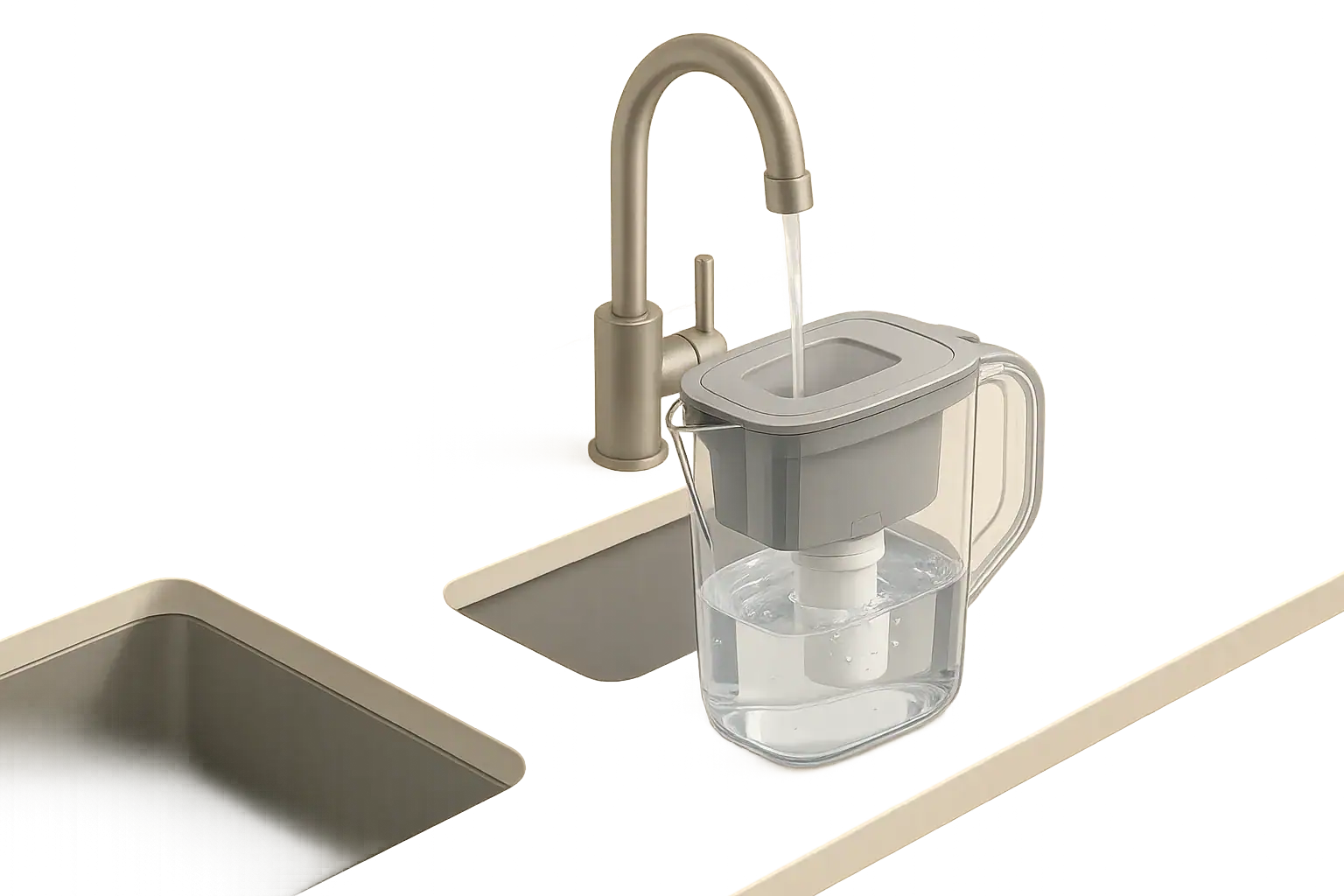
A pitcher filter that reduces ordinary chlorine taste may not provide the same result with chloramine. Chlorine and chloramine are separate reduction claims, so a product’s documentation must specifically identify chloramine reduction before you rely on it for that purpose.
Start by confirming which disinfectant your utility uses. Then check the certification listing or performance data for the exact pitcher model and replacement cartridge—not merely the filter brand or the standard printed on its packaging.
Why Chloramine Is Harder for a Pitcher to Reduce
Both free chlorine and chloramine are used as drinking-water disinfectants, but they do not behave identically. Chloramines are most commonly formed when ammonia is added to chlorine. According to the U.S. Environmental Protection Agency, chloramines provide longer-lasting disinfection as water moves through distribution pipes, and more than one in five Americans receives drinking water treated with chloramines. See the EPA’s chloramines in drinking water overview.
That persistence matters when choosing a filter. An EPA chloramine question-and-answer document states that monochloramine can be harder to remove than chlorine. It also notes that merely letting water stand at room temperature or boiling it does not remove monochloramine. The EPA advises consumers seeking treatment to look for a system carrying a chloramine-specific certification. See the EPA’s monochloramine treatment guidance.
Pitcher cartridges are compact and operate under gravity. Their construction and performance vary by model. A pitcher may have a verified free-chlorine claim without having a verified chloramine claim, so improvements in ordinary chlorine taste do not establish how that pitcher will perform on chloraminated water.
How to Check Whether Your Water Contains Chloramine
Do not choose treatment from taste or smell alone. A disinfectant-like odor cannot identify the particular chlorine species present, and other water conditions can also affect taste.
Check the utility’s information
If you receive water from a U.S. community water system, consult its latest Consumer Confidence Report and the utility’s treatment information. Consumer Confidence Reports provide annual water-quality information and may show chloramine under the disinfectant-residual results. The EPA’s guide to understanding a Consumer Confidence Report illustrates how a chloramine result can appear.
A report may list a measured residual without fully explaining every treatment step. If the disinfectant is unclear, ask the utility whether it currently uses free chlorine, monochloramine, or a seasonal combination. Treatment can change, so use the latest available information rather than an old report.
Private-well users do not receive a municipal Consumer Confidence Report. Their treatment choice should instead be based on the well’s treatment equipment and appropriate water testing.
Understand the limits of home chlorine tests
Some test kits report both free chlorine and total chlorine. Total chlorine includes free chlorine plus combined chlorine. Therefore, subtracting free chlorine from total chlorine estimates combined chlorine; it does not identify monochloramine by itself. Hach’s chlorine measurement explanation describes this relationship.
A difference between total and free chlorine can justify checking with the utility or obtaining more specific testing, but it is not proof that the utility intentionally uses monochloramine.
How to Evaluate a Pitcher Filter Claim
The most important question is not whether a product says “certified,” “carbon,” or “improves taste.” It is whether the exact model and cartridge have a documented chloramine reduction claim.
Do not treat chlorine and chloramine claims as interchangeable
NSF’s contaminant reduction claims guide lists chlorine and chloramine as separate claims. A general NSF/ANSI 42 reference or a chlorine taste-and-odor claim does not, by itself, demonstrate chloramine reduction.
When reviewing a pitcher, verify all of the following:
- The exact pitcher or dispenser model
- The exact replacement-cartridge number
- A claim explicitly labeled chloramine reduction
- The rated capacity or service cycle for that claim
- Any operating conditions and replacement instructions attached to the result
- A current listing from the certifier or an official performance data sheet
Certification to a standard only covers the claims shown in the listing. It should not be interpreted as proof that the product reduces every substance addressed somewhere within that standard.
Be cautious with material and design language
Terms such as “activated carbon,” “catalytic carbon,” “multi-stage,” or “slow flow” may describe a product, but those words alone do not quantify chloramine reduction. Likewise, a larger advertised capacity is not automatically evidence of better chloramine performance. Use these details only alongside a model-specific chloramine claim and its stated service life.
No exact pitcher-and-cartridge combination with a currently verified official chloramine-reduction listing was established for this article. That does not prove that no qualifying pitcher exists; it means shoppers should verify the current listing for any product they are considering rather than relying on a generic recommendation.
What adequate documentation looks like
A useful performance sheet identifies the system, replacement cartridge, reduction result, rated capacity, flow, temperature, and pressure conditions. For example, Aquasana’s official AQ-5300 performance data sheet reports a chloramine result and lists the AQ-5300R replacement cartridge, a 600-gallon capacity, a 0.5-gallon-per-minute flow rate, and operating conditions. This is an under-counter system, not a pitcher recommendation; it is included only to show the level of model-specific detail that should accompany a consequential reduction claim.
Capacity, Flow, and Cartridge Replacement
A verified claim applies under the test conditions and service cycle stated for that model. Follow the manufacturer’s instructions for setup, flushing, water temperature, storage, and cartridge replacement.
- Use the specified cartridge. A compatible-looking third-party replacement does not inherit the original cartridge’s certification.
- Track treated volume. Estimate pitcher refills or gallons used rather than relying only on elapsed time.
- Observe both replacement limits. If the instructions provide time and volume limits, replace the cartridge when the applicable limit is reached.
- Respect operating conditions. Do not assume that altering the cartridge, forcing water through it, or using it outside the stated conditions preserves the documented performance.
- Keep the pitcher clean. Wash and store it according to its instructions. Film, residue, particles, or cloudiness are cleaning or storage concerns, not proof of chloramine breakthrough.
For help estimating a practical schedule, see how often to replace pitcher filters. The exact product instructions and certified capacity still take precedence.
How to Check Whether the Pitcher Is Working
Taste and odor can tell you whether the water is acceptable to you, but they cannot measure chloramine reduction. A returning off-taste might coincide with cartridge use, changes in source water, storage conditions, or pitcher cleanliness. It does not by itself prove breakthrough or an elevated disinfectant concentration.
Use this sequence if a fresh cartridge does not provide the expected result:
- Confirm the utility currently uses chloramine.
- Check that the installed cartridge is the exact model covered by the claim.
- Confirm that the listing explicitly says “chloramine reduction,” not merely “chlorine reduction” or “taste and odor.”
- Review the rated capacity and installation, flushing, and replacement instructions.
- Clean the pitcher according to its manual and prepare a fresh batch.
- If measured reduction matters, use an appropriate analytical test rather than taste or a basic free-versus-total chlorine comparison alone.
If the pitcher has no chloramine-specific documentation, replacing cartridges more frequently cannot create a verified claim that the product never had.
When to Consider Another Filter Format
A pitcher remains convenient for small quantities of drinking water, including in rentals where plumbing changes are impractical. See these pitcher considerations for renters. If no documented pitcher meets your needs, another format may offer a verifiable chloramine claim.
Faucet, countertop, and under-sink systems
NSF’s current claims guide shows chloramine claims in categories including faucet, connected countertop, manual-fill countertop, under-sink, and reverse-osmosis systems. Category eligibility is not proof for a particular product: verify the exact system and cartridge in the certifier’s listing.
Compare the documented flow rate and capacity with your household’s expected use. A higher-capacity system may be more practical for cooking and drinking water, but only its stated chloramine claim establishes relevant performance.
Reverse osmosis systems
Do not credit the reverse-osmosis membrane alone with chloramine treatment. The EPA guidance cited above states that reverse osmosis itself does not remove monochloramine. If considering an RO system for chloraminated water, verify that the complete system includes a documented chloramine-rated pretreatment stage, typically before the membrane, and follow its replacement schedule.
Whole-house treatment
Point-of-entry treatment is a different project from filtering a pitcher of drinking water. It must accommodate household peak flow and the incoming water conditions. Before purchasing, obtain the relevant water information and require model-specific documentation for chloramine reduction, rated flow, capacity, installation, and media replacement. Avoid selecting a whole-house unit solely from the words “carbon filter.”
Key Takeaways
- Chloramine is longer-lasting in distribution systems and can be harder to remove than free chlorine.
- Confirm the disinfectant through the latest utility information; taste and odor cannot identify it reliably.
- A free-chlorine or general taste-and-odor claim does not establish chloramine reduction.
- Verify the exact filter model, replacement cartridge, chloramine claim, capacity, and operating conditions.
- Free-versus-total chlorine tests indicate combined chlorine, not monochloramine specifically.
- If choosing RO, look for a complete system with documented chloramine-rated pretreatment rather than relying on the membrane alone.
Frequently asked questions
Can a pitcher filter reduce chloramine?
Only rely on that claim when the exact pitcher and replacement cartridge have current documentation explicitly stating chloramine reduction. A chlorine taste-and-odor claim is not equivalent.
Does NSF/ANSI 42 certification mean a filter reduces chloramine?
Not automatically. Certification applies to the particular claims in the model’s listing. NSF treats chlorine and chloramine as separate reduction claims, so the listing must name chloramine.
Can I remove chloramine by leaving water on the counter or boiling it?
The cited EPA guidance says monochloramine is not removed merely by standing at room temperature or boiling. Use a treatment system with a documented chloramine-specific claim when reduction is required.
Does a total-chlorine result higher than free chlorine prove chloramine is present?
No. The difference estimates combined chlorine and can support further investigation, but it does not identify monochloramine by itself. Check with the utility or use an appropriate specific test.
How often should a chloramine-rated cartridge be replaced?
Use the service cycle stated for the exact cartridge and claim, including applicable time and volume limits. Taste alone is not a reliable measure of remaining chloramine-reduction capacity.
Recommended next:
- NSF/ANSI standards explained (42/53/401/58)
- Clear trade-offs: pitcher vs faucet vs under-sink vs RO
- Maintenance planning: cost per gallon and replacement cadence