
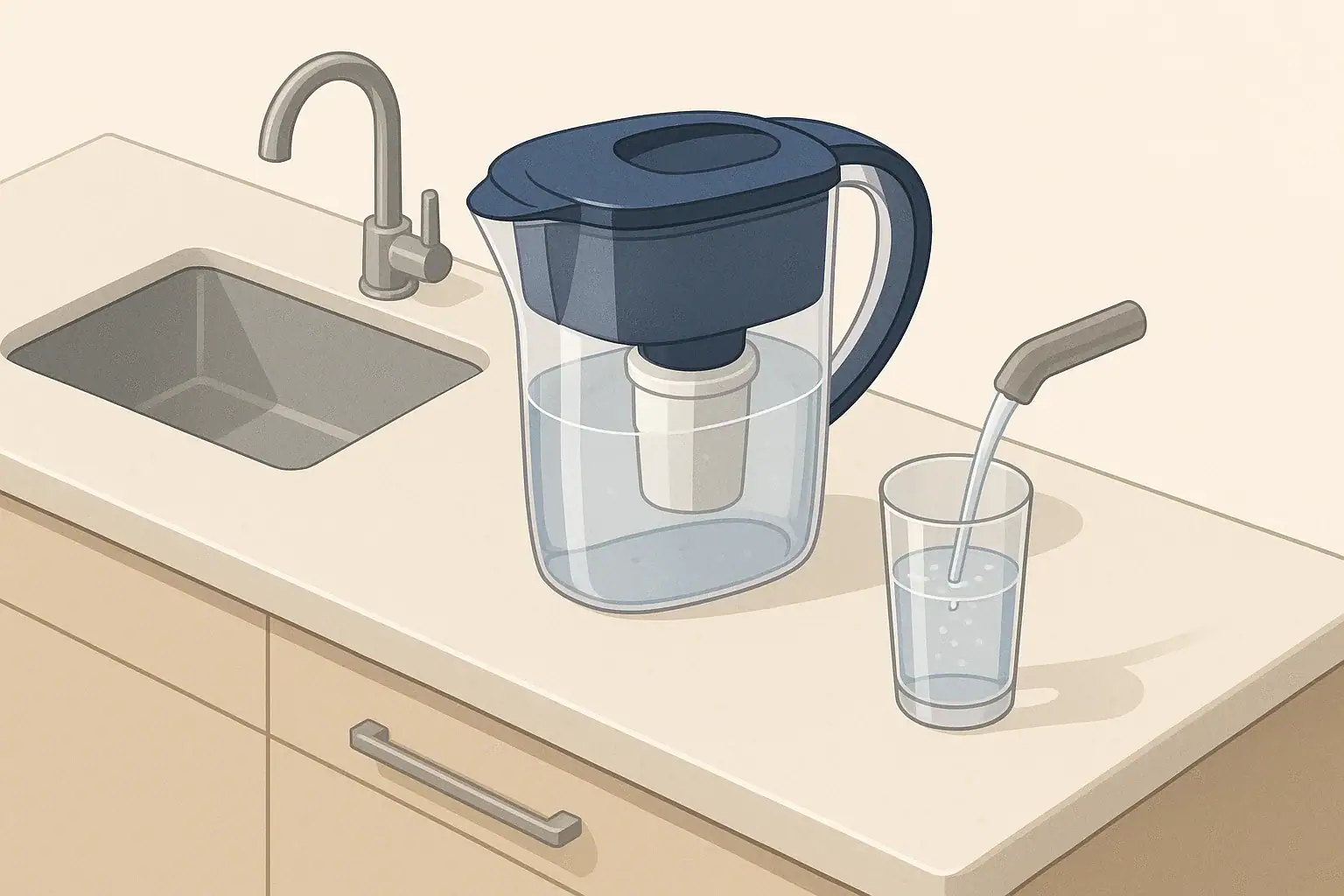
Pitcher filters are portable and require no plumbing changes, but ordinary pitchers can be inconvenient when several people use filtered water for drinking, coffee, tea, and cooking. A high-consumption household should compare more than the cup count on the package: ready-to-use filtered volume, filtration time, cartridge limits, handling, and model-specific contaminant claims all matter.
There is no independently tested winner established here. Instead, this guide explains how to identify the best fit and compares two large dispensers using their manufacturers’ published specifications. A convenient spigot or the ability to dispense while filtering should not be interpreted as proof of fast filtration.
What to Prioritize for Heavy Daily Use
Usable filtered capacity, not just the headline cup count
A container’s advertised capacity may include both water that has already passed through the cartridge and water waiting in the upper tray. That distinction affects how much water is immediately available.
For example, PUR describes its 30-cup PDS1820 dispenser as holding 18 cups of filtered water plus 12 cups in the upper holding tray. The headline 30-cup figure therefore does not mean that 30 filtered cups are ready to dispense at once. Check the manual or product page for an upper- and lower-reservoir breakdown whenever one is published.
Filtration time versus dispensing convenience
Gravity-fed systems filter without a pump. A spigot can make stored water easy to dispense, but it does not establish how quickly new water passes through the cartridge. PUR states that its 30-cup dispenser tray can take more than 20 minutes to filter, depending on the cartridge type and age. Its DS1811 design can dispense water while filtration continues, which helps access but is not a comparative fast-flow test.
When manufacturers publish a refill time, treat it as a product-specific estimate under stated conditions. Incoming water, cartridge age, installation, and use can affect actual filtration time.
Cartridge capacity and daily-use limits
Do not select a system from its gallon rating alone. Read the performance sheet for:
- rated gallon capacity;
- any replacement time limit;
- maximum or rated gallons processed per day;
- required priming, flushing, and installation steps; and
- conditions that call for earlier replacement.
This is particularly important for families using more than two gallons per day. The reviewed Brita Elite OB06 documentation says to process no more than two gallons daily for maximum efficiency, while PUR’s reviewed pitcher-filter sheet specifies rated service use of two gallons per day. Those limits mean that a cartridge’s total gallon rating, by itself, does not demonstrate suitability for a household filtering three or more gallons every day.
Exact contaminant claims
Filters certified under the same general standard can have different reduction claims. NSF explains that NSF/ANSI 42, 53, and 401 encompass specific claims rather than giving every certified product identical capabilities. Check the exact combination of container and cartridge, not merely the brand or standard number. See the NSF overview of Standards 42, 53, and 401 for the scope of these standards.
Two Documented High-Capacity Options
The following are specification-based examples, not hands-on rankings. Specifications and reduction percentages apply only to the identified system, cartridge, test conditions, and replacement schedule.
| System and cartridge | Published capacity details | Important trade-offs |
|---|---|---|
| Brita Ultramax OB24 with Elite OB06 | 27-cup advertised vessel; 120-gallon cartridge rating | Brita specifies no more than two gallons per day for maximum efficiency. The reviewed documentation does not establish how much of the 27-cup total is immediately available in the lower reservoir. |
| PUR 30-cup dispenser, including PDS1820, with PPF951K PUR PLUS or PPF900Z PUR | 40-gallon cartridge rating; PDS1820 is described as 18 filtered cups plus 12 cups in the holding tray | Rated service use is two gallons per day. PUR says tray filtration can take more than 20 minutes, depending on cartridge type and age. |
Brita Ultramax OB24 with Elite OB06
Brita advertises the Ultramax OB24 as a 27-cup dispenser and rates the Elite OB06 cartridge for 120 gallons. Its official performance data sheet reports 97.4% chlorine reduction and 99.5% or 99.6% lead reduction under the listed test conditions. Those figures are not universal results for every Brita cartridge or every household’s water.
Brita also says actual performance can vary with local water conditions, recommends testing the incoming water, and instructs users to process no more than two gallons per day for maximum efficiency. At exactly two gallons per day, the 120-gallon volume would be reached after about 60 days; this arithmetic is only a planning estimate and does not override any time limit or earlier replacement instruction.
PUR 30-cup dispensers
PUR’s performance sheet covers systems including DS1811X and PDS1820X with the PPF951K PUR PLUS and PPF900Z PUR cartridges. Both reviewed cartridges are rated for 40 gallons and two gallons of service use per day. At exactly two gallons per day, that volume would be reached after about 20 days.
The cartridges do not have identical claims. PUR’s official pitcher-filter performance sheet lists certified chlorine taste-and-odor reduction for both, but lists lead reduction for PPF951K while marking PPF900Z as not certified for lead. This illustrates why a brand-level claim is not enough: the exact cartridge designation changes what is certified.
The PUR 30-cup dispenser product page provides the reservoir breakdown and the manufacturer’s filtration-time qualification. These models may suit a household that values a large stationary container, but their published information does not establish comparative superiority or rapid real-world filtration.
Size a Filter for Your Household’s Demand
Measure actual use
Track pitcher refills for a typical week instead of guessing from household size. Include water used for:
- drinking and reusable bottles;
- coffee and tea;
- pet bowls, if permitted by the product instructions; and
- cooking tasks for which the household chooses filtered water.
Convert the weekly total into an average daily figure. Then compare that number with both the cartridge’s total gallon capacity and any daily processing limit. If normal demand exceeds the stated daily limit, a larger vessel does not solve the cartridge limitation.
Estimate replacement frequency correctly
Use the earliest applicable limit. In general, replace a cartridge when it reaches the manufacturer’s gallon limit or time limit, whichever comes first. Replace it earlier if the manufacturer instructs you to do so because of a marked flow change, taste or odor change, damage, improper storage, or another stated condition.
For more help tracking household use, see how often to replace pitcher filters by household size.
Know when a pitcher is the wrong format
A family filtering more water per day than a cartridge permits may need two independently compliant systems or another point-of-use format with a higher documented service capacity. Repeatedly filling a large cooking pot can also be awkward with a gravity dispenser even when enough water is eventually available.
Two medium pitchers can be easier to lift than one large pitcher, while a stationary dispenser avoids lifting a full vessel each time water is served. Renters and shared households can also compare the space and responsibility issues discussed in the guides to pitcher filters for renters and choosing a pitcher filter for a dorm or shared apartment.
Start With the Incoming Water
Capacity and convenience do not determine which contaminants need treatment. The CDC advises choosing a filter based on germs or chemicals identified in the water. Customers of a public water system can review the utility’s annual water-quality report; private-well users need appropriate testing. The CDC also recommends checking specific products in certification databases and maintaining them according to manufacturer instructions. See the CDC guidance on choosing home water filters.
Sediment and visible cloudiness
Visible particles or persistent cloudiness warrant investigation rather than an assumption that a pitcher will correct the source. Particles can obstruct some cartridges and reduce flow. Follow local public-health guidance if the appearance of the water changes suddenly, and do not use a pitcher as a substitute for an official boil-water or do-not-use notice.
Where testing identifies a recurring sediment problem, compare the pitcher’s instructions with an appropriate upstream treatment. A separate guide covers whole-house sediment filters for cloudy water. A dry ring or film on a container is not, by itself, proof of sediment because dissolved minerals can also leave deposits.
Hardness
Hardness is associated mainly with dissolved calcium and magnesium. Do not assume that a pitcher softens water unless the exact system has a documented hardness-reduction claim. A taste-and-odor or lead claim does not establish softening performance.
Chlorine and chloramine
Chlorine taste-and-odor reduction is a common product-specific claim, but it should still be verified for the exact cartridge. See the guide to pitcher filters for chlorine taste and odor.
Chloramine is a separate concern. EPA guidance says monochloramine can be more difficult to remove than chlorine and recommends looking for a system certified specifically for chloramine reduction. Do not infer a chloramine claim from a chlorine claim. The reviewed Brita and PUR sheets cited above did not establish a chloramine-reduction claim. For more context, see why many pitcher filters struggle with chloramine and the EPA monochloramine guidance.
Verify Certifications and Reduction Claims
Certification is useful only when read at the claim and model level. Common standards include:
- NSF/ANSI 42: aesthetic claims such as specified chlorine taste-and-odor or particulate reductions.
- NSF/ANSI 53: specified health-effects claims, which can include individual contaminants such as lead when explicitly listed.
- NSF/ANSI 401: claims for individual emerging compounds included in the product’s listing.
A reference to NSF/ANSI 53 does not mean that every contaminant addressed somewhere within that standard is reduced by every certified cartridge. Before buying, confirm:
- the exact dispenser or pitcher model;
- the exact replacement-cartridge model;
- the individual reduction claim relevant to the water report or test;
- rated capacity and service conditions; and
- the certification organization’s current listing or the manufacturer’s official performance sheet.
“Tested to” language is not necessarily the same as an active third-party certification. Also check whether a claim applies only when a particular cartridge is installed; the PUR example above shows that two compatible cartridges can differ on certified lead reduction.
Pitcher and Dispenser Design Choices
Traditional pitcher
A handled pitcher is easier to move to the sink, table, or coffee station. Its disadvantages are lower stored volume and greater filled weight as capacity increases. Check refrigerator dimensions and the product’s filled weight before relying on door storage.
Stationary dispenser
A rectangular dispenser can store more water and serve it through a spigot without lifting the full container. Check whether the dispenser must be removed from the refrigerator for refilling and cleaning, whether a glass fits below the spigot, and how much filtered water is ready below the upper tray.
Lid, refill opening, and indicator
A refill door can reduce handling, while a secure lid helps prevent the upper tray from shifting during movement. Mechanical and electronic indicators differ: some track time, while others estimate use. Read the manual to learn what the indicator actually measures, and do not let it override an earlier gallon or time limit.
Cleaning access
Large containers need enough sink clearance for cleaning. Check whether the lid, reservoir, and dispenser body are hand-wash only and whether the electronic indicator can be submerged. Follow the product’s instructions rather than assuming that all components are dishwasher safe.
Maintenance and Cartridge Replacement
Heavy use makes a clear maintenance routine important. The CDC advises maintaining filters according to manufacturer recommendations, and manufacturer performance claims depend on using the identified cartridge within its stated conditions.
- Install and prime the cartridge exactly as directed. Soaking, flushing, or discarding initial batches varies by model.
- Track both time and volume. Record the installation date and estimate gallons from the number and size of refills.
- Use the earliest replacement limit. Replace at the gallon limit or time limit, whichever comes first, or earlier when the instructions require it.
- Clean the vessel as directed. Use only cleaning methods allowed in the manual and keep non-submersible indicators dry.
- Investigate an abrupt change. Check cartridge seating and installation instructions. If the incoming water suddenly changes in appearance, odor, or official safety status, contact the water provider or relevant local authority rather than assuming a new cartridge resolves it.
Keeping one compatible spare cartridge can prevent downtime, but verify its model number and storage instructions before purchase.
Frequently Asked Questions
What is the best high-capacity pitcher filter for a large family?
There is no universal winner. Select a system whose ready-to-use filtered volume, daily-use limit, gallon and time limits, refrigerator fit, and exact certified reduction claims match the household. Brita Ultramax OB24 with Elite OB06 and PUR 30-cup dispensers are documented large options, but their cartridges have different capacities and claims.
Does a 30-cup dispenser provide 30 cups of filtered water immediately?
Not necessarily. PUR describes the PDS1820 total as 18 cups of filtered water plus 12 cups in the upper holding tray. Look for a reservoir breakdown rather than treating the advertised total as ready-to-dispense capacity.
Is a dispenser with a spigot faster than a pitcher?
A spigot can make already-filtered water quicker to serve, but it does not prove faster filtration. PUR says its 30-cup tray can take more than 20 minutes to filter depending on cartridge type and age. Compare published filtration times separately from dispensing features.
How often should a high-capacity pitcher cartridge be replaced?
Use the manufacturer’s gallon limit or time limit, whichever comes first, and follow any instruction requiring earlier replacement. Tracking refills is useful, but taste or flow alone should not be used to extend a cartridge beyond its stated limits.
Can a family filter more than two gallons per day?
Only if the exact system documentation permits that use. The reviewed Brita Elite OB06 instructions specify no more than two gallons daily for maximum efficiency, and the reviewed PUR cartridges list rated service use of two gallons per day. A household exceeding a cartridge’s limit should compare another documented system or filtration format rather than relying on total gallon capacity alone.
Does certification to NSF/ANSI 53 prove that a cartridge reduces lead?
No. Verify lead as a specific claim for the exact system and cartridge. PUR’s reviewed sheet, for example, lists lead reduction for PPF951K but marks PPF900Z as not certified for lead even though both are compatible pitcher-filter products.
Recommended next:
- NSF/ANSI standards explained (42/53/401/58)
- Clear trade-offs: pitcher vs faucet vs under-sink vs RO
- Maintenance planning: cost per gallon and replacement cadence