
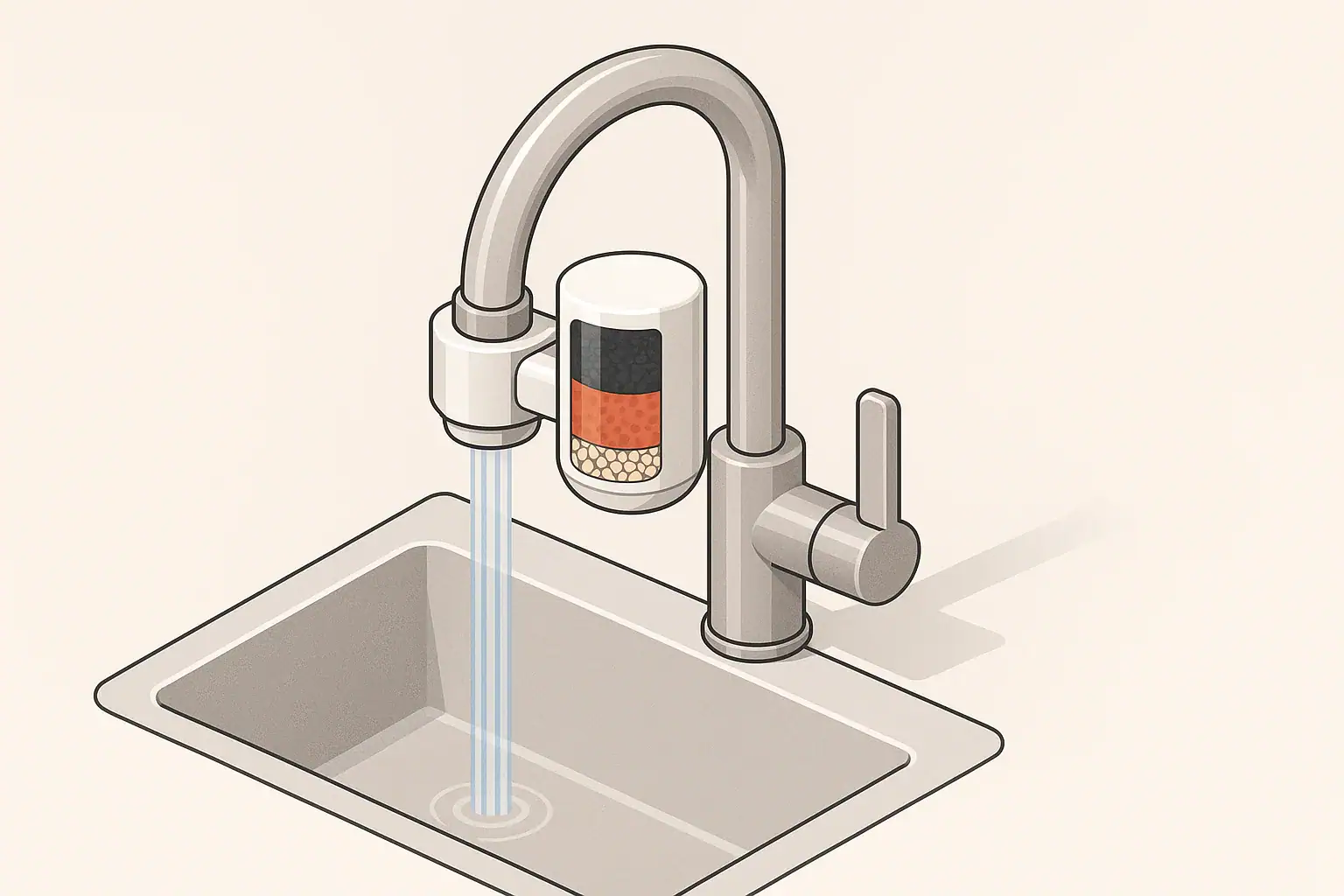
Faucet-mount filters may contain granular activated carbon (GAC), a formed carbon block, or a combination of carbon and other filtration materials. The carbon form affects how a cartridge can be constructed, but the label alone does not tell you its contaminant reduction, flow rate or useful capacity.
The practical answer is to compare the complete faucet unit and its exact replacement cartridge. Look for product-specific contaminant claims, particulate ratings, rated flow and capacity, operating-pressure limits and replacement instructions. No current controlled test was identified that compares otherwise identical faucet cartridges differing only in GAC versus carbon block, so broad claims that one form is always better are not justified.
What Carbon Block and GAC Mean
Activated carbon adsorbs certain substances onto its internal surface. In a GAC cartridge, the carbon is present as loose granules held inside a housing. Carbon block is made by forming fine carbon particles into a porous solid, typically with a binder.
Those descriptions identify the physical form, not the complete filter design. A cartridge can also include screens, nonwoven layers, sediment filters or specialized treatment media. Even two products both described as GAC can be built differently. For example, a Pentair GAC cartridge specification describes an expansion pad intended to reduce channeling and a separate post-filter; it also states that the listed cartridges do not have a micron rating. This is not a faucet-filter comparison, but it illustrates why performance cannot be inferred from the word “GAC” alone.
The same caution applies to carbon block. A block may have a stated particulate rating, but that rating and the associated test method must be checked for the particular cartridge. The CDC’s filter-selection guidance notes that a nominal micron rating does not mean every pore is at or below that size; an absolute rating is a different claim.
Which Carbon Type Filters Better?
Neither form is automatically the better faucet filter. Carbon form is one design variable among several:
- The amount and formulation of carbon
- Other treatment media included in the cartridge
- The route water takes through the cartridge
- Rated flow and the pressure used for testing
- Contaminant concentration in the incoming water
- Particulate layers or screens
- Rated capacity and replacement conditions
A manufacturer may use either form as part of a successful design. Conversely, neither “carbon block” nor “GAC” by itself proves reduction of chlorine, lead, PFAS, volatile organic compounds or fine particles. Product-level certification and performance data are more useful than the media label.
| Information | Can the media label establish it? | What to check instead |
|---|---|---|
| Physical carbon form | Yes | GAC granules or a formed carbon block |
| Lead reduction | No | Exact model and cartridge claim, commonly under NSF/ANSI 53 |
| PFAS reduction | No | Product-specific PFAS claim under NSF/ANSI 53 or 58, as applicable |
| Particle performance | No | Certified particulate class or documented nominal/absolute micron rating |
| Flow and pressure loss | No | Rated flow and operating-pressure range for the complete unit |
| Cartridge life | No | Rated gallons or time limit and the conditions in the instructions |
How to Compare Contaminant Reduction
Certification to a standard does not mean a filter reduces every substance covered by that standard. Verify the named contaminant claim for the exact faucet model and replacement element in the certifier’s directory or the product’s performance data sheet.
Chlorine, Taste and Odor
NSF/ANSI 42 covers aesthetic effects, including specific chlorine taste-and-odor and particulate claims. If chlorine is your main concern, look for a chlorine reduction claim and its rated capacity rather than assuming that any activated-carbon cartridge will provide the same performance throughout its life.
A filter certified for chlorine taste and odor is not necessarily certified for lead or another health-related contaminant. For product suggestions intended around this narrower task, see our guide to faucet-mount filters for chlorine taste.
Particles, Rust and Cloudiness
Do not choose carbon block solely because water contains visible particles. First identify the issue and then look for a documented particulate class, micron rating or separate sediment stage. A carbon block can have a particulate claim, but not every block has the same rating. A GAC cartridge can also contain a post-filter or other particulate layer.
Persistent cloudiness can have causes other than sediment. If it does not clear after a glass of water stands, or if it appears suddenly, investigate the water supply instead of treating the media label as a diagnosis.
Lead
Lead reduction depends on the complete filter and cartridge, including any specialized media—not merely whether the carbon is granular or formed into a block. Look for a lead reduction claim for the exact model, commonly certified under NSF/ANSI 53. Our guide to reading faucet-filter lead claims explains where to find the relevant model and replacement-cartridge details.
A certification record for one cartridge cannot be transferred to a different cartridge that happens to fit the same general product category. Confirm both the faucet unit and replacement-element numbers.
PFAS and Emerging Contaminants
PFAS should not be evaluated through NSF/ANSI 401. The NSF overview of Standards 42, 53 and 401 describes Standard 401 as addressing a set of named emerging compounds, including specified pharmaceuticals, over-the-counter medications, pesticides, herbicides and other chemicals.
For PFAS, the EPA advises consumers to look for a product certified under NSF/ANSI 53 or 58 specifically for PFAS reduction. Not every product certified to either standard has a PFAS claim, so verify the exact substance and model in the certifier’s directory. Standard 58 generally applies to reverse-osmosis systems rather than ordinary faucet-mount carbon filters.
For the scope and limitations of Standard 401, see our guide to NSF/ANSI 401 and emerging contaminants.
Flow, Pressure and Capacity
It is tempting to assume that every GAC faucet filter flows faster and every carbon block causes more pressure loss. Available evidence does not support that as a universal rule. Screens, media quantity, cartridge dimensions, flow controls and incoming pressure can all affect the result.
Compare these specifications for the complete system:
- Rated filtered flow: The volume delivered per minute under stated test conditions.
- Operating-pressure range: Whether the unit is suitable for the pressure available at your faucet.
- Rated capacity: The gallons and any calendar limit associated with the reduction claims.
- Temperature range: Faucet filters are generally intended for cold water, but use the exact limits in the instructions.
- End-of-life direction: Whether replacement is based on gallons, elapsed time, an indicator or another manufacturer instruction.
A slowing faucet can indicate a clogged cartridge, a blocked screen, low supply pressure or an installation problem. It does not prove that the carbon’s adsorption capacity is exhausted. Likewise, unchanged flow does not establish that the cartridge continues to meet its contaminant claims. See the faucet-filter slow-flow troubleshooting guide before replacing parts at random.
Start With Your Inlet Water
Choose a filter based on the water entering your home. The EPA’s WaterSense guide to home water treatment recommends that public-water customers review their utility’s Consumer Confidence Report. Private-well users, and utility customers concerned about conditions at their own tap, should use an appropriate state-certified laboratory.
The CDC similarly recommends testing the water, selecting a filter for the substances identified, verifying the exact product certification and replacing the cartridge according to its instructions. A utility report is a useful starting point, but testing at the tap may be necessary for contaminants such as lead that can enter water through service lines or household plumbing.
Use the results to define the task:
- For chlorine taste or odor, verify the corresponding NSF/ANSI 42 claim.
- For lead, verify a product-specific lead reduction claim.
- For PFAS, verify the named PFAS claim rather than relying on a general standard number.
- For visible particles, compare certified particulate classes or documented micron ratings.
- For contaminants not covered by a faucet filter, consider a different treatment technology appropriate to the test results.
Maintenance and Cost per Gallon
Rated capacity is tied to the cartridge and its test conditions, not to carbon form as a category. Actual service life can be affected by water quality, usage, pressure and sediment. Replace the cartridge at the manufacturer’s stated gallon or time limit, whichever the instructions require, even if flow and taste appear unchanged.
Follow the specified flushing procedure after installation. For practical steps, see the faucet-mount cartridge replacement guide.
To make a basic cost comparison, divide replacement-cartridge price by rated gallons. Also account for a time limit: a low-use household may reach the calendar replacement date before using the full gallon rating. There is not enough evidence to conclude that carbon block cartridges generally cost more or last less time than GAC cartridges; compare compatible cartridges individually.
A Concrete Faucet-Filter Certification Example
A model-specific record shows how much more useful certification data are than a general carbon label. In the NSF official faucet-mount listing for lead reduction, checked October 31, 2026, the PUR FM-3700B faucet unit is listed with the PUR RF-9999 replacement element. The record gives a 100-gallon service cycle, a 0.52-gallon-per-minute flow and individual claims including lead, chlorine, mercury, VOC, asbestos, chlordane and toxaphene reduction. It also lists Particulate Class I under NSF/ANSI 42 and lead reduction under NSF/ANSI 53.
The manufacturer’s June 4, 2025 RF-9999 performance data sheet reports model-specific results for lead at pH 6.5 and 8.5, chlorine taste and odor, Particulate Class I, VOCs and named NSF/ANSI 401 compounds. Its faucet-system instructions specify 100 gallons or up to three months, 0.52 gpm at 60 psi, an operating range of 20–100 psi and a water-temperature range of 34–100°F.
Those details apply only to the named unit and compatible replacement element. The documents reviewed do not clearly identify that cartridge as GAC or carbon block, so this example cannot be used to prove that either carbon form inherently produces those reductions.
Carbon Block vs GAC Decision Guide
- Identify the water concern. Use your Consumer Confidence Report and, when appropriate, tap-water testing.
- Find products with the exact claim needed. Do not stop at “NSF certified”; check the contaminant and model.
- Match the replacement cartridge. Certification for one element does not automatically cover another compatible-looking cartridge.
- Check particulate information. Distinguish certified particulate classes and absolute ratings from nominal micron descriptions.
- Compare rated flow and pressure. Use complete-system specifications rather than assumptions about GAC or carbon block.
- Compare capacity and replacement cost. Include both gallon and calendar limits.
- Use carbon form as a secondary detail. After the required claims and operating limits are confirmed, media construction can help distinguish otherwise suitable options.
In short, carbon form does matter to the manufacturer designing the cartridge, but certified model-level performance matters more to the household choosing one.
Frequently Asked Questions
Does carbon block remove lead better than GAC?
That cannot be concluded from carbon form alone. Verify a lead reduction claim for the exact faucet unit and replacement cartridge, commonly under NSF/ANSI 53. Specialized media and the complete cartridge design may be responsible for the claim.
Does GAC always provide a higher faucet flow?
No universal rule was verified. Compare the complete unit’s rated flow and operating-pressure range. Cartridge size, screens, media quantity and flow controls can matter in addition to carbon form.
Which standard should I check for PFAS?
Look for a product-specific PFAS reduction claim under NSF/ANSI 53 or 58, as applicable. NSF/ANSI 401 addresses a different list of emerging compounds and should not be treated as a PFAS certification.
Should I choose carbon block for visible sediment?
Not automatically. Identify the source of the particles and compare a certified particulate class, documented micron rating or dedicated sediment stage. Carbon form by itself does not establish particle performance.
Can reduced flow tell me when the carbon is exhausted?
Reduced flow may indicate clogging or another restriction, but it does not measure remaining adsorption capacity. Replace the cartridge at its rated gallon or calendar limit and follow any product-specific indicator or replacement instructions.
Sources
- NSF official certified drinking-water treatment unit listings: faucet-mount lead reduction
- NSF: NSF/ANSI 42, 53 and 401 filtration-system standards
- U.S. EPA: Reducing PFAS in drinking water with a home filter
- U.S. EPA WaterSense: Guide to selecting home water treatment
- CDC: About choosing home water filters
- PUR RF-9999 performance data sheet, June 4, 2025
Recommended next:
- NSF/ANSI standards explained (42/53/401/58)
- Clear trade-offs: pitcher vs faucet vs under-sink vs RO
- Maintenance planning: cost per gallon and replacement cadence