
Why RO Filter Replacement Schedules Matter
Reverse osmosis (RO) systems can significantly improve the taste and odor of tap water and reduce many dissolved impurities. But the performance of an RO system depends on regular filter maintenance. Prefilters and the RO membrane do very different jobs, so they follow different replacement schedules.
Replacing too late can lead to:
- Poor taste or odor returning to the water
- Slower flow from the RO faucet
- Higher total dissolved solids (TDS) in the filtered water
- Shortened life of the RO membrane or postfilters
Replacing too early can waste money and create unnecessary plastic and cartridge waste. Understanding how and when to replace each component helps you balance performance, cost per gallon, and convenience.
How RO Prefilters and Membranes Work
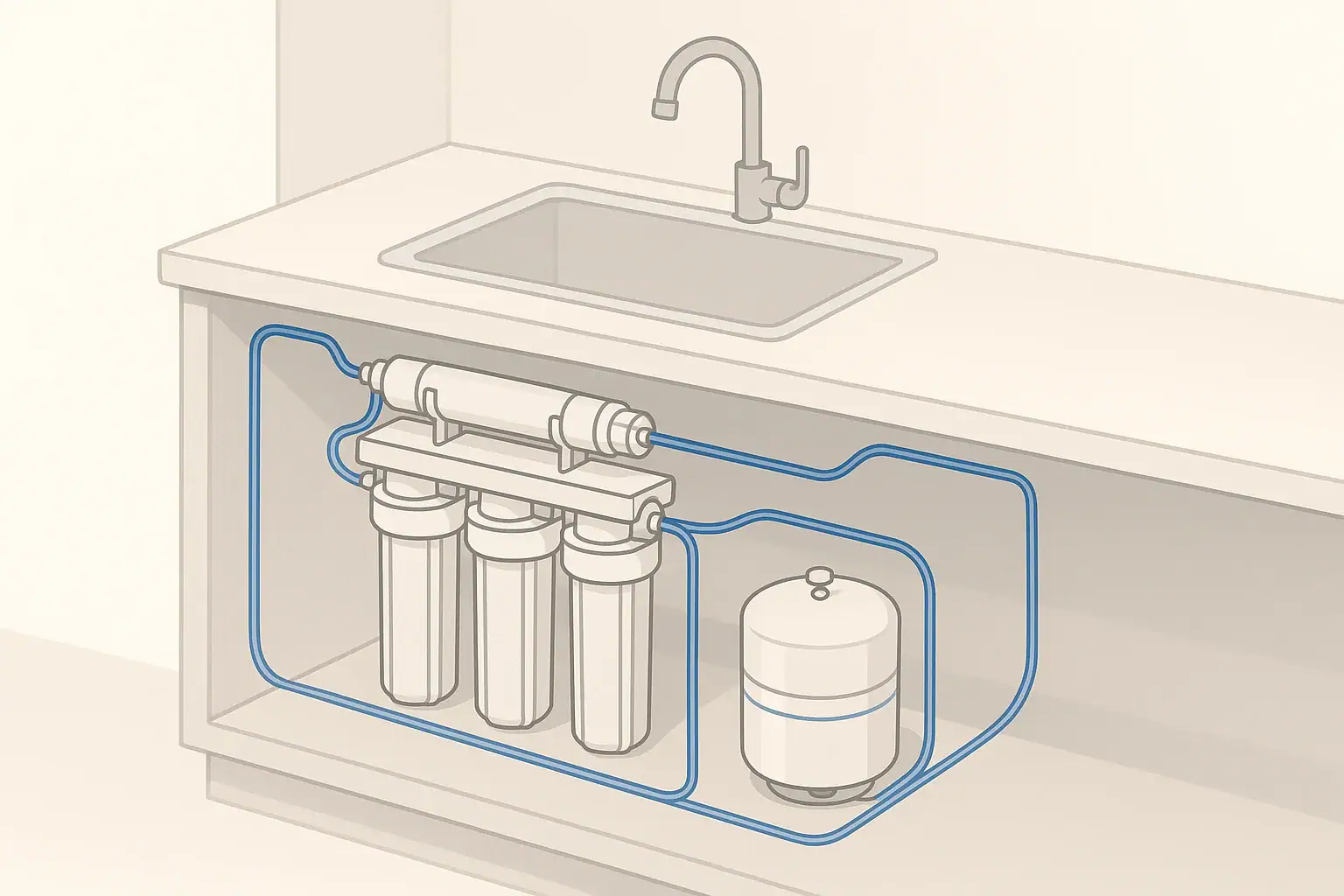
An under-sink RO system typically has several stages of filtration. While designs vary, most home systems include:
- One or more sediment prefilters
- One or more carbon prefilters (often for chlorine or chloramine)
- An RO membrane
- One or more postfilters (such as carbon polishing filters)
The RO membrane is the core of the system, but it relies on the prefilters to protect it.
Sediment Prefilters
Sediment prefilters are usually the first stage. They are designed to capture:
- Sand and silt
- Rust particles
- Other visible or fine suspended solids
If sediment reaches the RO membrane, it can plug the tiny pores and permanently reduce production. The sediment prefilter acts like a shield, sacrificing itself so the membrane lasts longer.
Carbon Prefilters
Carbon prefilters (often activated carbon blocks or granular carbon) target dissolved contaminants that affect taste and odor, such as chlorine. In municipal supplies that use chlorine or chloramine for disinfection, carbon prefilters are especially important because these disinfectants can damage certain RO membranes over time.
Carbon prefilters help with:
- Chlorine and chloramine reduction (depending on design)
- Many taste- and odor-causing compounds
- Some volatile organic compounds (VOCs), depending on media and contact time
RO Membrane
The RO membrane is a semi-permeable barrier that separates water from many dissolved ions and small molecules under pressure. It typically reduces:
- A portion of dissolved salts and minerals (contributing to TDS)
- Many metals and inorganic compounds
- Some organic compounds, depending on molecular size and charge
Unlike prefilters, which mostly trap or adsorb contaminants on the surface or within pores, the membrane continuously sends a portion of incoming water to drain as concentrate. This concentrate carries away many rejected contaminants and helps keep the membrane from rapidly clogging. Even so, it slowly fouls and loses performance, which is why it must eventually be replaced.
Example values for illustration.
| Component | Main role | Typical replacement range* | Key wear factors | If neglected |
|---|---|---|---|---|
| Sediment prefilter | Capture sand, rust, and fine particles | About 6–12 months | High sediment, low pressure, heavy use | Clogs quickly; can starve membrane of flow |
| Carbon prefilter | Reduce chlorine/chloramine, improve taste/odor | About 6–12 months | Chlorine level, organics load, usage volume | Can allow disinfectant to reach and stress membrane |
| RO membrane | Reduce many dissolved ions and small molecules | About 2–5 years | TDS level, hardness, pressure, prefilter care | Gradual TDS rise, lower rejection, slower production |
| Postfilter (carbon) | Final taste and odor polishing | About 12–24 months | Stagnant water, usage pattern, chlorine carryover | Flat or musty taste, possible flow restriction |
| Storage tank | Hold treated water between uses | Often 5+ years (as needed) | Internal bladder wear, pressure cycling | Reduced usable volume, pressure issues |
*Ranges are general examples, not product-specific guarantees.
Typical RO Filter Replacement Intervals
Manufacturers provide recommended intervals for each stage of an RO system. These recommendations are starting points; real-world schedules depend on your water quality and how much water your household uses.
Prefilter Replacement Schedule
For many home RO systems, a common example schedule is:
- Sediment prefilter: about every 6–12 months
- Carbon prefilter: about every 6–12 months
You might lean toward the shorter end of the range if:
- Your tap water has visible cloudiness from sediment
- You notice pressure drops at fixtures or on a built-in pressure gauge
- Your municipality reports high average turbidity for source water
- You have a larger household using many gallons per day
Well water and surface water sources can be more variable, with seasonal sediment spikes that may justify more frequent changes.
RO Membrane Replacement Schedule
The RO membrane usually lasts longer than prefilters because it is protected and continuously rinsed by the concentrate stream. A typical example range is:
- RO membrane: about every 2–5 years
Membrane life tends to be shorter when:
- Feed water TDS is very high
- Water hardness is high and not treated before the RO
- Chlorine or chloramine levels are high and prefilters are not replaced on time
- Household water pressure is consistently low
Conversely, membranes can sometimes last longer than typical ranges in homes with relatively low TDS, moderate hardness, and excellent prefilter maintenance.
Postfilter and Other Components
Postfilters are usually carbon-based and polish the taste of water coming from the storage tank. A typical schedule is:
- Postfilter (carbon): about every 12–24 months
Some systems also have remineralization stages that add minerals back for taste. These cartridges are often changed on a similar 12–24 month schedule, or based on taste and manufacturer guidance.
Factors That Change Your RO Replacement Schedule
Even with a suggested schedule, real intervals can vary widely from home to home. Several key factors influence how often you should replace prefilters and the RO membrane.
Incoming Water Quality
Your source water heavily affects filter workload:
- Turbidity and sediment: High sediment loads clog sediment filters faster. If your clear glasses show visible particles after filling from the tap, your sediment stage will likely need more frequent changes.
- Chlorine or chloramine: Higher disinfectant levels place more demand on carbon prefilters. Municipal water quality reports often list average chlorine levels as an indicator.
- TDS (total dissolved solids): Higher TDS generally means the membrane works harder and may reach the end of its useful life sooner.
- Hardness: Hard water can encourage scale build-up on the membrane surface and within plumbing. Pretreatment with a softener can significantly extend RO membrane life in high-hardness areas.
Household Water Use
Filter capacity is usually tied to the volume of water treated. A family using the RO faucet constantly will reach a given cartridge’s capacity faster than a single person who only draws a few glasses a day.
Consider:
- Number of people in the home
- How often you cook with RO water
- Whether the RO supplies a refrigerator or ice maker
- Additional uses, such as aquariums, humidifiers, or small appliances
Water Pressure and Temperature
RO systems are designed to operate within a certain pressure range. If pressure is low:
- Production rate drops
- Membrane may not flush itself as effectively
- Fouling can increase over time
Higher feed water temperature (within normal household ranges) can slightly improve production rates and help reduce fouling, while cold water slows production and can make problems more noticeable.
System Design and Stage Order
Some RO systems use multiple sediment or carbon stages, finer micron ratings, or specialty media. These differences change how the workload is shared:
- Additional sediment stages can protect downstream filters and the membrane more effectively.
- Larger filter housings or cartridges often have more media, which can translate to longer intervals between replacements.
- Systems with automatic flush valves or permeate pumps may help maintain membrane performance and pressure balance.
Practical Signs It Is Time to Replace Prefilters or Membrane
Calendars and manufacturer guidance are important, but observing system performance gives you additional, practical cues.
Signs of Worn Sediment or Carbon Prefilters
Common indicators include:
- Noticeable flow drop at the RO faucet compared to when filters were new
- Slow tank refill time after emptying it fully
- Cloudy water from the RO faucet if the sediment filter is overloaded
- Return of chlorine smell or taste, suggesting carbon prefilter exhaustion
Inspecting sediment cartridges (when design allows) can also help. Dark discoloration, heavy rust staining, or visible clogging of the filter media are signs of heavy loading.
Signs of a Worn RO Membrane
Membranes typically fail gradually instead of all at once. Over time, you may notice:
- Rising TDS in product water when measured with a handheld meter
- Less noticeable improvement in taste compared to tap water
- Reduced rejection rate when comparing feed and product TDS
- Persistent slow production even after installing fresh prefilters
Measuring TDS periodically gives a more objective indicator. Many homeowners track the percentage difference between tap and RO water TDS as a simple trend. When that difference shrinks substantially over time, it can be a sign that the membrane is nearing replacement.
When to Replace Sooner Than Scheduled
Regardless of the nominal schedule, you should consider changing filters or the membrane sooner if:
- There is a sudden change in taste, odor, or appearance of the water
- Local water issues, main breaks, or boil advisories are reported
- The system has been unused for a long period and water has sat stagnant in the cartridges
- You are troubleshooting unexplained pressure or flow problems and other causes have been ruled out
Using NSF/ANSI Certifications to Guide Expectations
NSF/ANSI standards help you understand what a given RO system or cartridge has been independently evaluated for. They do not guarantee a specific lifespan in your home, but they provide a baseline performance framework.
Key Standards Relevant to RO Systems
- NSF/ANSI 42: Evaluates reduction of aesthetic contaminants such as chlorine, taste, and odor.
- NSF/ANSI 53: Covers reduction of certain health-related contaminants, such as some heavy metals and specific organic compounds, when claimed by the manufacturer.
- NSF/ANSI 58: Applies specifically to residential reverse osmosis systems, including structural integrity, TDS reduction, and other performance claims.
- NSF/ANSI 401: Addresses reduction of certain emerging or incidental contaminants when claimed.
When a system or component is listed to a standard like NSF/ANSI 58, it indicates that the product has been evaluated for certain aspects of RO performance and construction. The testing is performed under specific conditions and capacity ratings that may differ from your home’s use pattern and water quality.
What Certifications Mean for Replacement Schedules
Certification documents and product literature often include example capacity ratings and conditions under which testing occurred, such as:
- Influent TDS concentration
- Operating pressure and temperature
- Rated daily production
These details help you understand how closely your home matches the tested conditions. If your water is more challenging (for example, much higher TDS or hardness), it is reasonable to expect that prefilters and membranes may reach the end of their effective life more quickly than under test conditions.
Example values for illustration.
| Standard | Primary focus | Typical relevance to RO filters | What to verify on documentation |
|---|---|---|---|
| NSF/ANSI 42 | Aesthetic effects | Chlorine taste/odor claims for carbon prefilters and postfilters | Which aesthetic contaminants were tested and rated capacity |
| NSF/ANSI 53 | Health-related contaminants | Claims for specific metals or organics reduced by carbon stages | List of contaminants claimed and test conditions |
| NSF/ANSI 58 | Reverse osmosis systems | Overall system design, TDS reduction, structural integrity | System model, rated TDS reduction, and operating parameters |
| NSF/ANSI 401 | Emerging/incidental contaminants | Additional claimed reductions by specific stages | Which compounds were tested and at what levels |
| Component listings | Individual cartridges or housings | Safe materials and construction for filter parts | Component identity and compatible system types |
| System ratings | Capacity and performance under test | General guidance for replacement frequency | Example gallons or days used during certification tests |
Planning a Simple RO Maintenance Routine
Keeping up with RO prefilters and membrane changes is easier when you turn recommendations into a routine. A few basic practices can help you stay on track without over- or under-replacing components.
Combine Time-Based and Performance-Based Checks
Many households find it practical to:
- Replace sediment and carbon prefilters on a calendar schedule (for example, every 6 or 12 months)
- Check TDS readings and flow rate every few months
- Decide on membrane replacement when TDS reduction or production rate declines noticeably, even if a calendar estimate suggests it could last longer
Track Changes and System Behavior
A simple log helps you make better decisions over time. Note:
- Dates of each filter and membrane replacement
- Any measured TDS readings before and after changes
- Visible issues, such as cloudy water or sudden flow changes
- Municipal notices about water main work or quality changes
Over a few years, this record shows how your actual filter life compares to generic recommendations and helps you refine your personal RO filter replacement schedule.
Consider Upstream Pretreatment if Needed
If your raw water is especially challenging, adding pretreatment upstream of the RO can ease the burden on prefilters and the membrane. Examples include:
- A whole-house sediment filter on very sandy or rusty supplies
- A water softener in high-hardness areas
- Dedicated treatments for specific concerns such as iron or manganese, when present at elevated levels
With the right combination of pretreatment, timely prefilter changes, and occasional membrane replacement, an RO system can remain a stable part of your home water setup for many years.
Frequently asked questions
How often should I replace sediment or carbon prefilters if my feed water has high sediment or chlorine?
In supplies with elevated sediment or disinfectant levels, sediment and carbon prefilters often require changes closer to the short end of the typical range (around 3–6 months in heavy-loading situations, or commonly 6–12 months). Watch for pressure drops, visible cartridge discoloration, or the return of chlorine taste or odor as signals to replace sooner.
What are the clearest signs that the RO membrane needs replacement?
The clearest indicators are a sustained rise in TDS on the product water, a lower rejection percentage compared with feed water, and continued slow production even after installing fresh prefilters. Regular TDS checks and comparing feed vs. product readings provide objective evidence that the membrane is nearing end of life.
Can changing prefilters more frequently extend the RO membrane replacement interval?
Yes. Timely replacement of sediment and carbon prefilters reduces physical fouling and chemical exposure that can shorten membrane life, so good prefilter maintenance commonly extends membrane lifespan. Combining frequent prefilter changes with appropriate pretreatment (for example, softening in very hard water) gives the best protection.
How should I balance calendar-based replacement with performance-based checks in my RO filter replacement schedule?
A hybrid approach works well: replace prefilters on a calendar schedule (for example every 6–12 months) while using periodic TDS and flow checks to assess membrane health and overall system performance. Keeping a simple log of replacement dates and performance metrics helps you tailor the schedule to your water quality and usage.
Are postfilters and remineralization cartridges on the same replacement schedule as prefilters?
Postfilters and remineralization cartridges typically last longer than prefilters, often about 12–24 months, because they polish stored water rather than protect the membrane. Replace them based on taste changes, stagnation concerns, or manufacturer guidance rather than solely following prefilter intervals.
Recommended next:
- Reverse Osmosis 101: What RO Removes (and What It Doesn’t)
- NSF/ANSI 58 Explained: What It Means for RO Systems
- RO vs Carbon Under-Sink: Taste, TDS, and Maintenance Compared
- RO System Installation Guide: Space-Saving Layout Under the Sink
- RO Waste Water Ratio: What’s Normal and How to Reduce It
- More in Reverse Osmosis (RO) →
- NSF/ANSI standards explained (42/53/401/58)
- Clear trade-offs: pitcher vs faucet vs under-sink vs RO
- Maintenance planning: cost per gallon and replacement cadence