
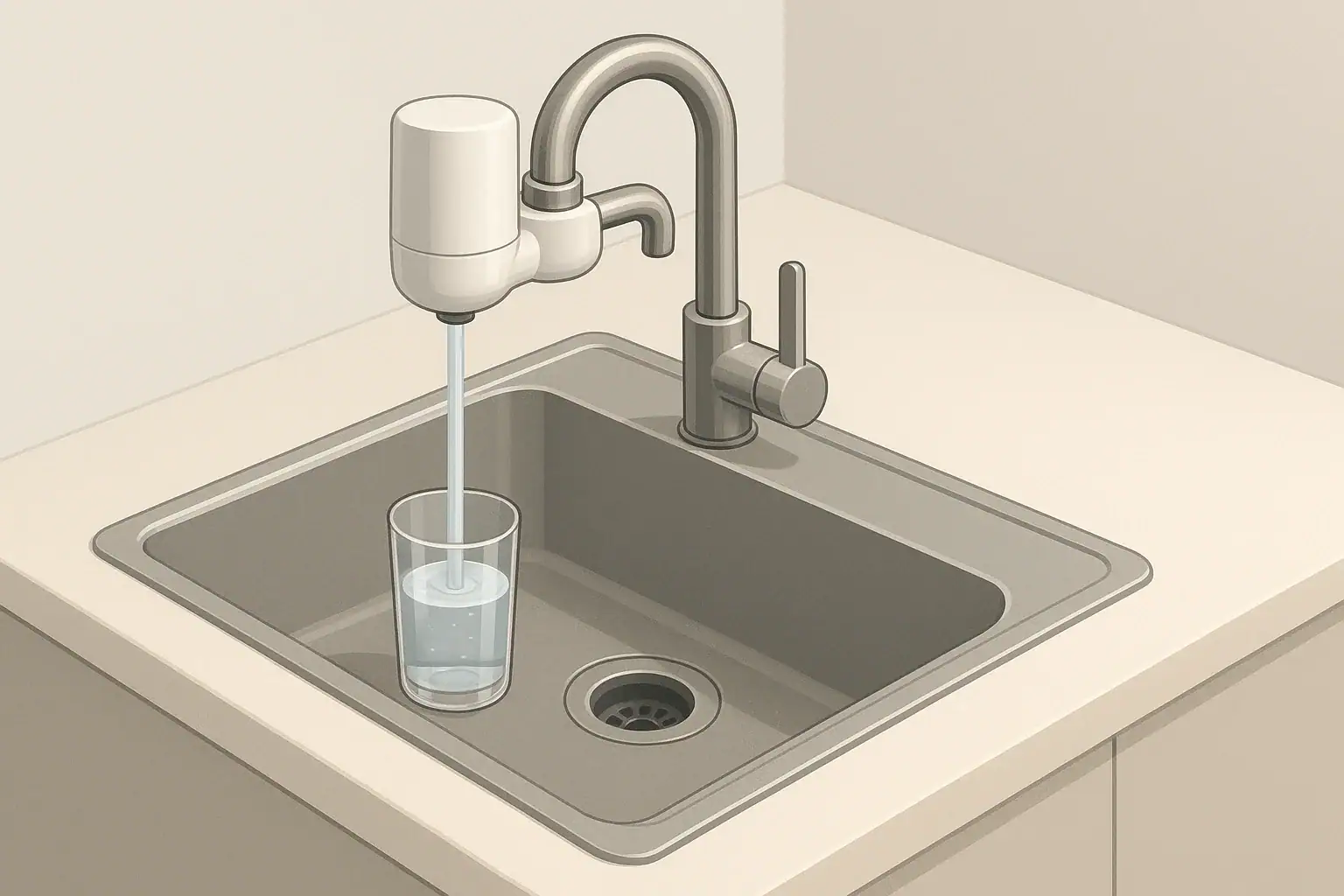
Faucet-mount filters treat water at the kitchen tap without requiring under-sink plumbing or a pitcher that must be refilled. For chlorine taste, the most useful comparison is not a broad claim that a filter is “high flow.” It is the combination of an exact chlorine-reduction claim, the rated service flow, cartridge capacity, operating limits, and compatibility with your faucet.
This guide compares two documented faucet-filter configurations. The published specifications are useful for narrowing a shortlist, but they are not results from independent household testing. Actual flow can vary with water pressure, sediment, cartridge condition, and plumbing.
Check Your Water Before Choosing a Filter
Do not select a filter from taste or odor alone. The CDC advises determining what is in the water before choosing a home treatment device and notes that water that tastes or smells unusual is not necessarily unsafe—and unsafe water may have no unusual taste or smell. Community-water customers can start with their utility’s annual Consumer Confidence Report, which identifies the source of the water and detected regulated contaminants. The EPA says these reports must be provided annually by July 1. See the CDC’s guidance on choosing a home water filter and the EPA’s Consumer Confidence Report information.
Also determine which disinfectant your utility uses. Some systems use chloramine instead of free chlorine. A product claim for chlorine reduction should not be assumed to cover chloramine unless the exact model’s certified listing or performance sheet specifically says so. The EPA provides background on chloramines in drinking water.
If your report or a suitable water test identifies concerns beyond taste and odor, search for certified claims covering those particular substances. A chlorine-focused faucet filter is not automatically suitable for lead, microorganisms, nitrate, arsenic, or every other potential contaminant.
Documented Faucet-Filter Configurations for Chlorine Taste
The following examples pair the faucet unit with the cartridge named in its supporting documentation. Do not extend the figures to a different housing, replacement element, or generic compatible cartridge.
| Configuration | Chlorine evidence | Rated service flow | Rated capacity | Evidence type |
|---|---|---|---|---|
| PUR FM-2000B with RF-3375 or RF-9999 | Listed for chlorine reduction and taste-and-odor reduction; PUR reports greater than 97.4% chlorine taste-and-odor reduction under its stated test conditions | 0.52 gpm | 100 gallons | Official NSF listing plus manufacturer performance data sheet |
| Brita FF-100 or SAFF-100 with FR-200 | Brita reports 99.0% chlorine reduction under the conditions in its performance data | 0.58 gpm | 100 gallons | Manufacturer performance data; an independent live listing was not confirmed for this review |
PUR FM-2000B: independently listed model-and-cartridge pairing
NSF’s official drinking-water treatment-unit listing identifies the PUR FM-2000B faucet model with RF-3375 or RF-9999 replacement elements for chlorine reduction and taste-and-odor reduction. The listing gives a 100-gallon service cycle and a 0.52 gpm flow rate. Readers should verify the model and element in the current NSF certified product listing for PUR under NSF/ANSI 42 before purchasing because claims apply to specified configurations.
PUR’s September 4, 2025 performance data sheet reports greater than 97.4% chlorine taste-and-odor reduction with a 2.0 mg/L challenge, a rated service flow of 0.52 gpm, a 100-gallon capacity, operating pressure of 20–100 psig, and usable water temperature of 34–82°F. That percentage describes the stated test conditions; it is not a promise that every household will receive identical results.
Brita FF-100 or SAFF-100: higher published flow for the compared configurations
Brita’s current faucet-filter performance page identifies FF-100 and SAFF-100 systems using the FR-200 cartridge. It reports 99.0% chlorine reduction, a 0.58 gpm service flow, a 100-gallon capacity, pressure limits of 20–100 psig, and a filtered-water temperature range of 34–100°F.
Brita’s 0.58 gpm specification is higher than PUR’s published 0.52 gpm figure for the configurations compared here, but the difference does not establish which unit fills containers faster in a particular kitchen or which product is best overall. The figures come from published performance documents, not side-by-side household testing. An independent certifier’s current listing for this exact Brita configuration was not confirmed during this review, so its figures are presented as manufacturer data rather than an independently verified ranking.
How to Read Certification and Reduction Claims
NSF/ANSI 42 addresses aesthetic effects such as taste and odor, but a reference to the standard does not mean every product certified under it reduces every substance within the standard’s scope. NSF explains the roles of the principal standards for water-treatment systems.
Use this verification sequence when shopping:
- Record the complete faucet-unit model. Similar-looking units may have different listings.
- Record the replacement-cartridge model. A claim may apply only to a named unit-and-cartridge combination.
- Open the certifier’s current database. Match the model numbers and read the individual reduction claims rather than relying on a certification logo alone.
- Check the rated flow, capacity, pressure, and temperature. These are operating conditions, not optional details.
- Distinguish certification from manufacturer testing. “Tested to” a standard or made with certified media is not necessarily the same as certification of the complete system for a specific claim.
If you also need reduction claims for a substance such as lead, look for that substance in the exact model’s listing. Do not infer it from a chlorine claim or from the standard number by itself.
Flow, Capacity, and Operating Limits
Compare rated service flow rather than “full stream” language
A numerical flow specification gives you a more useful starting point than an undefined “fast” or “high-flow” label. The two documented examples above are rated at 0.52 and 0.58 gpm. Those figures were obtained under specified test conditions with the appropriate cartridges; your faucet may deliver a different result.
Incoming pressure, sediment, a partly used cartridge, plumbing restrictions, and installation details can all affect the stream at the sink. If your unfiltered faucet already has weak flow, a faucet-mounted cartridge may feel noticeably slower.
Capacity belongs to an exact cartridge
Both configurations compared here publish a 100-gallon capacity. That does not establish a universal lifespan for faucet filters, and it should not be converted into a fixed number of months without checking the instructions for the exact system and considering household use.
Brita’s official FF-100 faucet-filter user guide describes replacement at approximately 100 gallons or four months, whichever comes first, and notes that high sediment can reduce flow and lead to premature replacement. Follow the replacement indicator and instructions for the exact unit rather than applying Brita’s interval to another product.
Use only the permitted temperature range
Operating limits differ by product. PUR’s cited sheet gives a usable-water range of 34–82°F, while Brita publishes 34–100°F for the compared system. Brita’s user guide directs users to filter cold water. Follow the instructions for your exact model rather than relying on a generic rule or sending hot water through the cartridge.
Faucet Compatibility and Installation
Faucet-mount units commonly require a removable aerator and compatible outlet threads. Supplied adapters may accommodate multiple thread patterns, but they do not make every faucet compatible.
Check these points before buying:
- Confirm that the aerator at the faucet outlet can be removed.
- Compare the exposed thread type with the adapters supplied for the chosen unit.
- Measure clearance below and beside the spout so the filter does not obstruct tall bottles, the backsplash, or faucet movement.
- Check the manufacturer’s restrictions for pull-down, pull-out, spray, or nonstandard designer faucets.
- Make sure the added housing will not interfere with normal sink use.
Brita’s cited FF-100 guide says its unit cannot be attached to faucets with a built-in spray feature at the outlet. Other brands can have different exclusions, so this rule should not be generalized without checking their instructions. For a fuller pre-purchase check, see how to check faucet-mount filter compatibility.
Faucet-mount systems can be convenient for tenants because they avoid drilling, provided the lease permits the attachment and the faucet is compatible. Our no-drill setup guide for renters covers that use case.
Maintenance and Cartridge Replacement
Complete the specified initial flush
Flush requirements are model-specific. Brita’s official FF-100 guide calls for a five-minute initial flush. Do not substitute that duration for another product’s instructions; use the procedure supplied with the exact system and cartridge.
Use the bypass for non-filtered tasks
If the unit has filtered and unfiltered settings, reserve filtered mode for water you intend to drink or use in food and beverages. Using unfiltered mode for tasks that do not require filtered water can conserve the cartridge’s rated capacity. Follow the manual’s directions for operating the selector.
Replace according to the product instructions
Replace the cartridge according to the manufacturer’s stated capacity, time limit, indicator, and other instructions. The two compared configurations publish a 100-gallon capacity, while Brita’s FF-100 guide specifies approximately 100 gallons or four months, whichever comes first. Reduced flow or a return of objectionable taste may also warrant checking the cartridge and instructions, but taste alone is not a water-safety test.
Clean only as directed
Follow the housing manufacturer’s cleaning directions. Brita’s FF-100 guide supports cleaning the exterior with a damp sponge or soft cloth and, if needed, mild dishwashing liquid; it warns against abrasive cleaners. Do not open or clean internal areas unless the product manual specifically directs you to do so.
Estimate operating cost with current cartridge prices
To estimate cartridge cost per rated gallon, divide the current replacement-cartridge price by the cartridge’s stated capacity. For example, use 100 gallons as the denominator only for a cartridge that actually carries that rating. The result does not account for time-based replacement or early replacement caused by sediment or reduced flow. For a broader comparison method, see this cost-per-gallon breakdown.
When to Choose Another Filter Format
A faucet-mount filter may suit a household that needs treatment at one compatible kitchen faucet, wants a removable installation, and can accept the unit’s rated filtered flow. Another format may be more practical when:
- Your faucet has an incompatible pull-down, spray, or nonstandard outlet.
- You need more filtered water at once than a faucet cartridge conveniently supplies.
- Your water analysis identifies a contaminant without a matching claim for the faucet-filter model.
- You want the filter hardware hidden below the sink.
- You have very low faucet pressure or sediment that causes frequent clogging.
For a more permanent setup focused on taste and odor, compare under-sink filters for chlorine taste and odor. Families weighing formats can also review under-sink systems versus pitchers. If installation is the main constraint, a pitcher filter focused on chlorine taste avoids faucet compatibility issues.
Frequently Asked Questions
Which compared faucet filter has the higher published flow specification?
For the exact configurations compared here, Brita publishes 0.58 gpm for FF-100 and SAFF-100 systems with the FR-200 cartridge, while PUR publishes 0.52 gpm for the FM-2000B with RF-3375 or RF-9999. These are rated specifications, not results from independent side-by-side use, so they do not establish which will be faster in your home or which is best overall.
Does NSF/ANSI 42 certification automatically mean chloramine reduction?
No. Check the exact model-and-cartridge listing for the named reduction claim. Do not infer chloramine reduction from a free-chlorine claim or from the standard number alone.
Can I run hot water through a faucet-mount filter?
Use only the temperature range and water mode specified for your exact system. PUR’s cited sheet lists 34–82°F, while Brita lists 34–100°F and directs FF-100 users to filter cold water. Product limits differ.
How often should a faucet-filter cartridge be replaced?
Follow the exact system’s gallon limit, time limit, indicator, and replacement instructions. Both configurations reviewed here publish a 100-gallon capacity. Brita’s FF-100 guide specifies approximately 100 gallons or four months, whichever comes first, and notes that high sediment can cause premature replacement. There is no single interval that applies to every faucet filter or household.
Will a faucet-mount filter fit a pull-down faucet?
Compatibility varies, and many faucet-mount filters are not designed for pull-down, pull-out, or integrated-spray outlets. Check the manufacturer’s instructions for the exact unit before purchasing rather than assuming an included adapter will solve the problem.
Recommended next:
- NSF/ANSI standards explained (42/53/401/58)
- Clear trade-offs: pitcher vs faucet vs under-sink vs RO
- Maintenance planning: cost per gallon and replacement cadence