
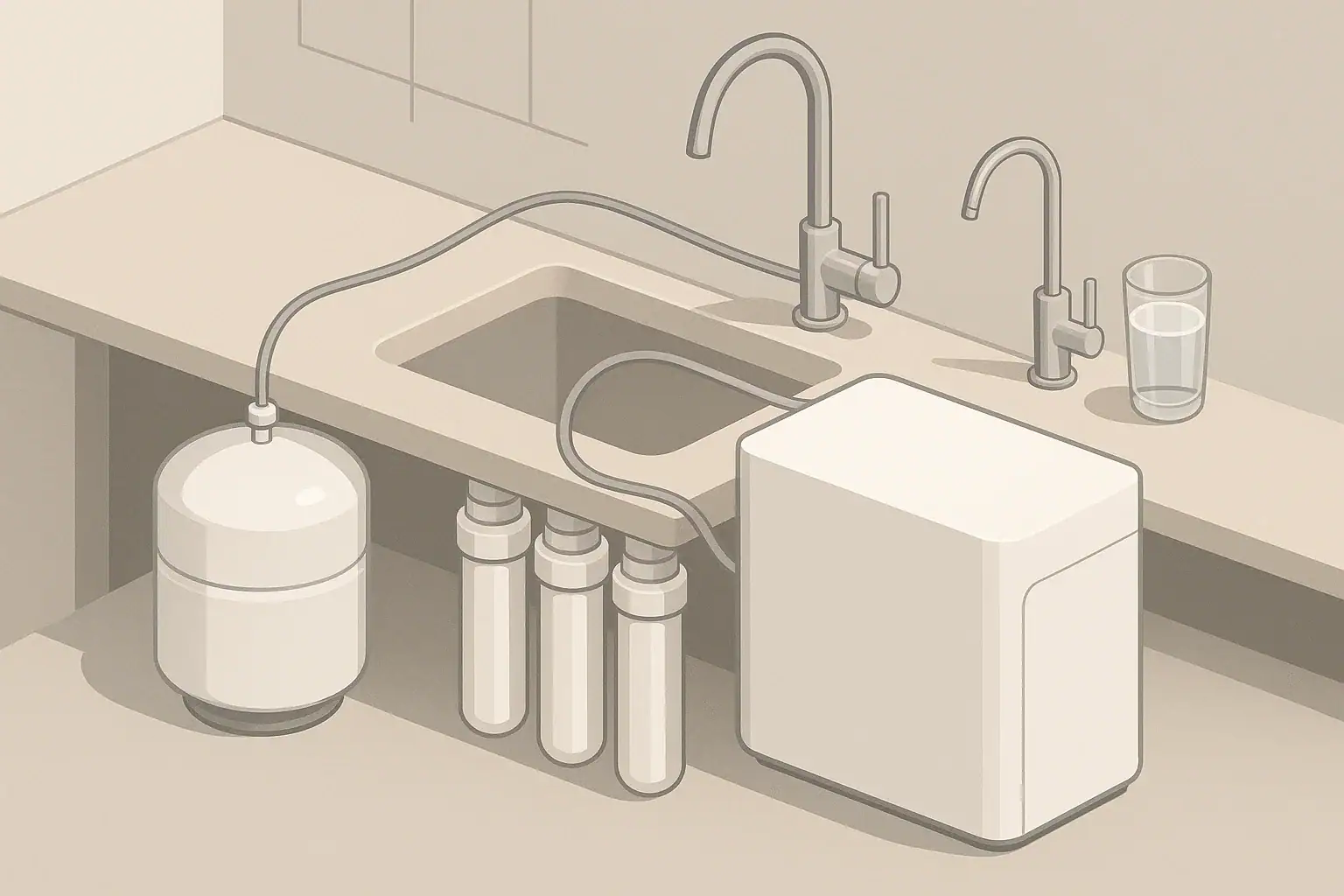
Under-sink water filters usually deliver filtered water in one of two ways: through a small dedicated drinking water faucet or through the main kitchen faucet. Both setups can work well, but they are not equal for every home, filter type, sink layout, or renter situation.
The better choice depends on how much filtered water you use, whether you want one faucet or two, how comfortable you are with sink modifications, and whether the filter needs separate plumbing for flow, pressure, or drainage. This is especially important for reverse osmosis systems, which often have specific faucet and drain requirements.
This article compares a dedicated filter faucet vs main faucet connection in practical terms, without assuming that one is always best.
How the two setups work
A dedicated filter faucet is a separate small faucet installed at the sink. It is typically used only for filtered drinking and cooking water. The main kitchen faucet continues to supply unfiltered hot and cold water for washing dishes, rinsing produce, and general sink use.
A main faucet connection routes filtered water to the faucet you already use, or to a compatible replacement faucet designed to handle filtered water. In some cases, only the cold side is filtered. In others, a special faucet has separate internal water paths so filtered and unfiltered water do not mix before reaching the outlet.
Dedicated filter faucet basics
Dedicated faucets are common with under-sink carbon systems, multi-stage filters, and reverse osmosis systems. Many RO systems use a separate faucet because filtered water is produced more slowly and may be stored in a small pressure tank. A dedicated faucet also keeps treated water separate from the main hot and cold supply.
The main tradeoff is that the sink or countertop needs an available hole. Some sinks already have one for a soap dispenser, sprayer, or accessory. If not, installation may require drilling, which is not appropriate for every material or rental agreement.
Main faucet connection basics
Main faucet connections appeal to people who want a cleaner-looking sink deck and do not want a second faucet. These setups may use a diverter, a three-way faucet, or an under-sink connection that feeds filtered water to the cold side.
The details matter. A simple carbon or sediment filter may be easier to pair with a main faucet than an RO system. RO water should only be routed through materials and faucet designs intended for that use, and many systems still require a dedicated faucet for proper function.
The main differences that affect daily use
The biggest everyday difference is whether filtered water is always separate from general sink water. With a dedicated faucet, filtered water is clearly reserved for drinking, coffee, tea, cooking, and filling bottles. With a main faucet connection, the setup may feel more convenient, but it can also increase the volume of water passing through the filter.
That extra use is not automatically bad. It may be exactly what a household wants. However, filtering all cold water used at the main faucet can shorten cartridge life compared with using filtered water only when needed.
Flow rate and waiting time
Main faucets are expected to handle rinsing, filling pots, and other higher-flow tasks. Some under-sink filters can support that well. Others, especially very fine filtration systems, may reduce flow noticeably. If the filter is restrictive, connecting it to the main faucet can make the whole cold-water side feel slow.
A dedicated filter faucet can have a lower flow rate without affecting normal sink use. For many households, that is acceptable because drinking water is drawn in smaller amounts.
Sink space and appearance
A dedicated faucet adds one visible fixture. Some people like having a clear drinking water tap, while others prefer a simpler sink area. Main faucet connections reduce countertop clutter, but they may require a compatible faucet and careful plumbing layout under the sink.
Example values for illustration.
| Factor | Dedicated filter faucet | Main faucet connection |
|---|---|---|
| Filtered water use | Usually drinking and cooking only | May include most cold-water sink use |
| Sink appearance | Adds a separate small faucet | Keeps one main faucet or uses a multi-path faucet |
| Flow impact | Main faucet flow is unchanged | Main cold-water flow may be reduced |
| Filter life | Often more controlled because use is limited | May shorten if all cold water is filtered |
| RO compatibility | Common and often preferred | Possible only with compatible components |
| Rental fit | May be an issue if drilling is required | May avoid extra sink holes but still changes plumbing |
| Maintenance access | Separate faucet makes troubleshooting clearer | Integrated setup can be less obvious to diagnose |
| Best use case | Targeted drinking water filtration | Minimalist sink layout and compatible filter flow |
When a dedicated filter faucet is usually better
A dedicated faucet is often the more flexible and predictable under-sink setup. It separates filtered water from general-use water, which helps manage cartridge capacity and reduces confusion about what is being filtered.
You are installing reverse osmosis
Many reverse osmosis systems are designed around a separate drinking water faucet. RO systems typically use a membrane, prefilters, postfilters, and sometimes a storage tank or pump. They may also require a drain connection for concentrate water. Because of these needs, a dedicated faucet is often the simplest way to keep the system operating as intended.
Some RO systems can be used with specialty faucets, but compatibility should be confirmed before purchase. The faucet materials, tubing, pressure rating, air gap requirements, and internal water path all matter.
You want to preserve filter capacity
If the household mainly wants better-tasting water for drinking, ice, coffee, tea, and cooking, a dedicated faucet keeps the filter from treating water used for handwashing or rinsing dishes. That can extend replacement intervals compared with filtering all cold water at the sink.
Actual cartridge life depends on water quality, household use, filter size, and manufacturer guidance. A dedicated faucet does not make filters last forever, but it can make usage more intentional.
You want simple troubleshooting
When filtered water comes from its own faucet, it is easier to tell whether a pressure drop, taste change, or slow flow issue is related to the filter system. The main faucet remains separate, so normal kitchen function is less likely to be interrupted during filter maintenance.
When a main faucet connection is usually better
A main faucet connection can be a good fit when simplicity at the sink is a priority and the filter can handle the expected flow. It may also be appealing in kitchens with limited sink deck space or in homes where drilling is not practical. For shoppers comparing layouts, a broader faucet-mount vs under-sink filters overview can also help frame the tradeoffs.
You want filtered water from the faucet you already use
Some people prefer not to think about which faucet to use. If the main cold-water line is filtered, filling a glass or pot can feel seamless. This can also make sense when the filter is intended for taste and odor improvement rather than a slower, specialized process.
However, convenience should be balanced against cartridge capacity. If a lot of water is used for rinsing, soaking, or general cleanup, the filter may need replacement more often.
You have a compatible three-way faucet
A three-way faucet can deliver hot, cold, and filtered water through one fixture while keeping filtered water in a separate internal path. This can offer the clean appearance of one faucet without blending treated and untreated water inside the faucet body. If you are evaluating fixtures, it may also help to review faucet mount filter compatibility before choosing an adapter or replacement.
Compatibility is important. The faucet should be intended for filtered water service and made with suitable wetted materials. It should also match the pressure and flow requirements of the filter system.
You are avoiding a new sink hole
If the sink or countertop has no available accessory hole, a main faucet connection may avoid drilling. This is especially relevant for stone countertops, undermount sinks, and rental homes. Still, it is not a no-impact choice. Under-sink plumbing changes should be reversible when possible, leak-tested, and allowed under the lease or local requirements. For renters, no-drill under-sink filters are worth comparing first.
Filtration type matters more than the faucet choice
The faucet setup determines how filtered water is delivered, but the filter technology determines what the system is designed to reduce. A dedicated faucet does not automatically mean better filtration, and a main faucet connection does not automatically mean weaker filtration.
Carbon filters
Activated carbon is widely used for chlorine taste and odor, some organic compounds, and general taste improvement. Carbon block filters can be more restrictive than loose media designs, so flow rate should be checked before connecting one to the main faucet. If taste is your main issue, under-sink filters for chlorine taste and odor are a good place to start.
For city water treated with chloramine, a filter specifically designed for that disinfectant may be needed for noticeable taste improvement. Performance varies by media type, contact time, and cartridge size.
Sediment filters
Sediment filters reduce particles such as sand, silt, and rust flakes. They are often used as prefilters rather than as complete drinking water systems. A sediment-only filter will not address dissolved substances, taste issues, or disinfectants by itself.
Reverse osmosis systems
Reverse osmosis uses pressure to move water through a membrane. RO systems are commonly used when a broader reduction approach is desired for dissolved solids and certain other substances, depending on system design and testing. They usually produce water more slowly than simple carbon filters and may use a storage tank or tankless pump system.
RO faucet choice should be treated as part of the system design, not as a cosmetic decision only. Drain connection, air gap needs, tank pressure, and postfilter placement can all affect performance. The details behind NSF/ANSI 58 are especially relevant when comparing RO setups.
Certifications and claims
For any under-sink system, look for performance information tied to recognized testing standards such as NSF/ANSI standards. The exact standard matters because different standards address different reductions or structural requirements. Avoid assuming that one certification covers every contaminant or situation.
Installation, maintenance, and safety considerations
Under-sink installations involve pressurized water lines, shutoff valves, tubing, fittings, and sometimes drain connections. A good setup should be accessible, supported, and easy to inspect. It should not rely on improvised parts, unsupported tubing, or bypassed safety features.
Drilling and sink compatibility
A dedicated faucet may require a hole through stainless steel, composite, porcelain-coated cast iron, stone, or another surface. Some materials are easier to work with than others. Drilling can damage a sink or countertop if done incorrectly, and it may void warranties or violate rental terms.
If there is no existing hole, it is reasonable to compare the cost and risk of adding one against using a compatible main faucet connection.
Leaks and pressure checks
Both setups should be checked after installation and after filter changes. Look for moisture around fittings, tubing, faucet bases, shutoff valves, and filter housings. A small drip under a sink can cause cabinet damage if it is unnoticed for days. If flow suddenly changes, filtered water flow dropped troubleshooting may help pinpoint the cause.
Water pressure should also be considered. Very high pressure can stress housings and fittings, while low pressure can reduce flow or RO production. Use components within their rated range and follow the system documentation.
Replacement intervals
Dedicated faucets often make it easier to estimate filter use because the filtered water is limited to drinking and cooking. Main faucet connections can make use less visible. If the filter serves all cold-water tasks, replacement may be based on gallons used, time in service, taste changes, flow reduction, or a combination of these factors. A practical under-sink filter replacement schedule can help you plan ahead.
Example values for illustration.
| Priority | Setup to consider first | Reason |
|---|---|---|
| Reverse osmosis installation | Dedicated filter faucet | Commonly matches RO design and flow needs |
| No extra visible faucet | Main faucet connection | Keeps the sink deck simpler |
| Longer cartridge life | Dedicated filter faucet | Limits filtration to selected uses |
| High-volume cold-water use | Depends on filter capacity | Flow and cartridge rating are key |
| Rental or temporary setup | Reversible option | Avoid permanent changes when possible |
| Coffee and tea focus | Either setup | Choose based on convenience and taste goals |
| Limited under-sink space | Compact compatible system | Faucet style does not solve space constraints alone |
| Easy troubleshooting | Dedicated filter faucet | Separates filter issues from the main faucet |
A practical way to choose
Start with the water problem you are trying to solve, then choose the filter, and then choose the faucet connection. This order prevents the faucet style from driving the whole decision.
If your goal is basic taste and odor improvement from city water, either setup may work if the filter has enough flow. If your goal is reverse osmosis, a dedicated faucet is often the more straightforward option unless the system clearly supports another arrangement.
Next, look at the sink. An existing accessory hole makes a dedicated faucet easier. No available hole, a stone countertop, or a rental restriction may push the decision toward a main faucet solution or a non-permanent alternative.
Finally, think about maintenance. If you want the least confusion and more predictable filter use, a dedicated faucet has advantages. If you value a clean sink layout and accept potentially higher filter use, a main faucet connection can make sense.
Neither setup is universally better. The best under-sink arrangement is the one that matches the filter technology, household water habits, installation limits, and maintenance expectations without creating avoidable plumbing risks.
Frequently asked questions
Is a dedicated filter faucet better than using the main faucet?
It depends on the filter and your goals. A dedicated faucet is often better for reverse osmosis and for limiting filter use, while a main faucet connection can be better if you want one visible tap and the filter has enough flow.
Can I connect a reverse osmosis system to my main faucet?
Sometimes, but only if the system and faucet are designed for that setup. Many RO systems still need a dedicated faucet and a drain connection to work properly.
Will filtering water through the main faucet use cartridges faster?
It can, especially if all cold-water use goes through the filter. More water passing through the system usually means earlier cartridge replacement.
Do I need to drill a new hole for a dedicated filter faucet?
Often, yes, unless your sink already has an unused hole. If drilling is not practical, a main faucet connection or another compatible option may be easier.
Which setup is best for a rental home?
The best choice is usually the one that is reversible and allowed by the lease. A main faucet connection may avoid drilling, but any under-sink changes should still be checked for fit and leak risk.
Related guides: Faucet-Mount vs Under-Sink Filters: Convenience vs Performance • Under-Sink Filter Installation: Tools, Parts, and Common Mistakes • RO System Installation Guide: Space-Saving Layout Under the Sink • Under-Sink Filter Flow Rate Explained: Why GPM Matters
- NSF/ANSI standards explained (42/53/401/58)
- Clear trade-offs: pitcher vs faucet vs under-sink vs RO
- Maintenance planning: cost per gallon and replacement cadence