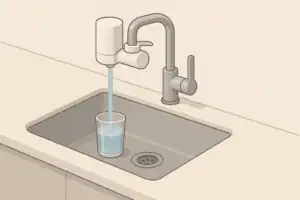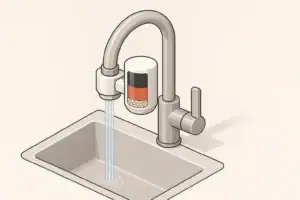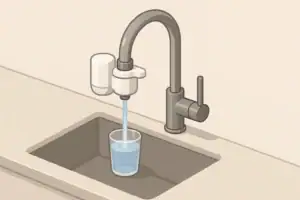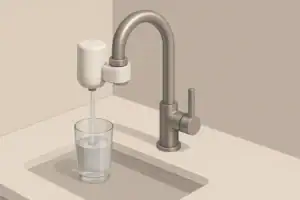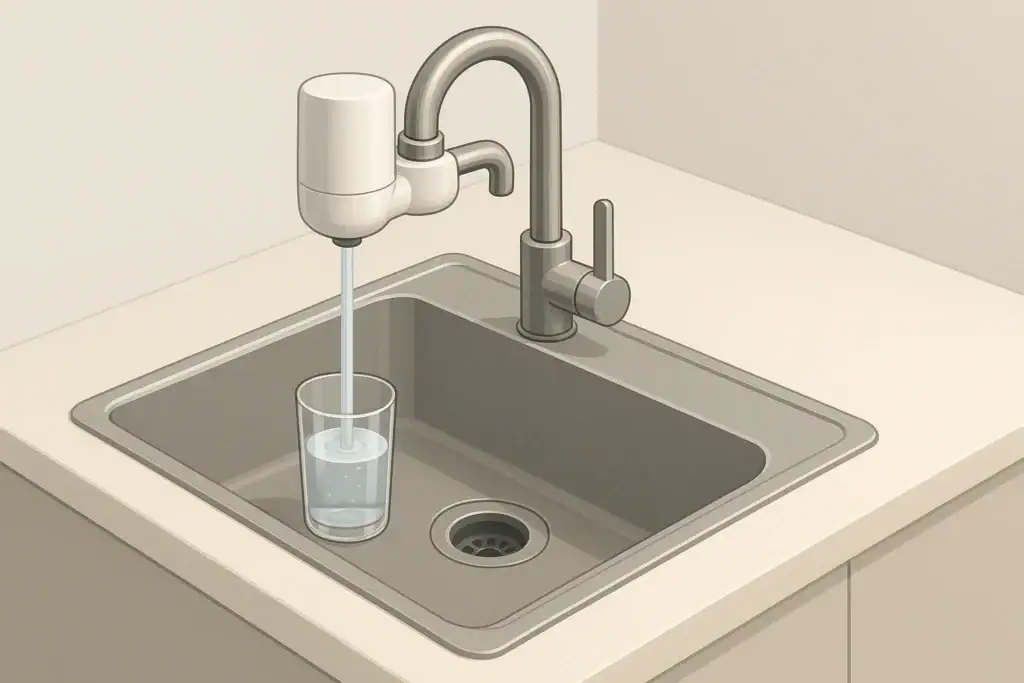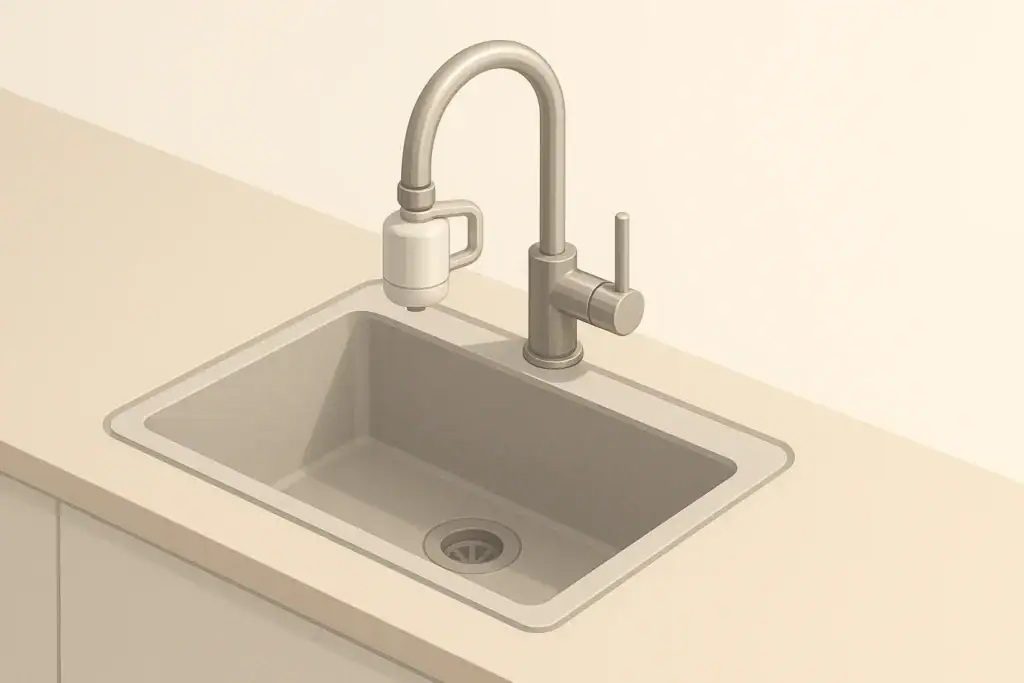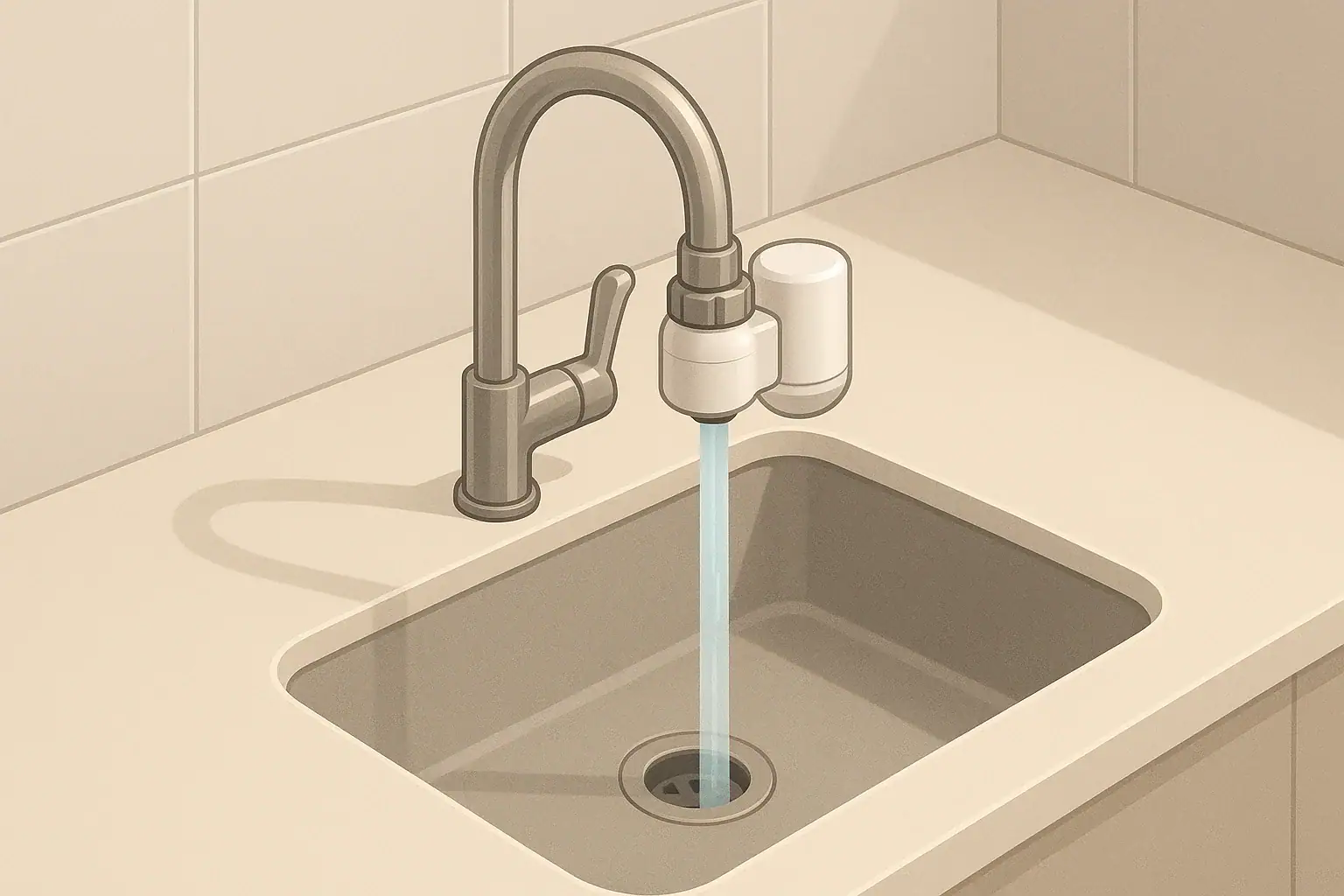
Faucet-mount water filters are designed to screw directly onto the end of a kitchen faucet. They can be a convenient way to improve tap water taste and reduce common contaminants like chlorine and sediment. However, they only work when the faucet body and threads match the filter’s connector or a compatible adapter.
If the faucet and filter do not physically match, you may experience:
- Leaks around the connection point
- Poor water flow or spray patterns
- Filters that will not tighten or keep spinning
- Adapters that pop off under pressure
Understanding your faucet type before buying a filter prevents trial-and-error installs and unnecessary returns. It also helps you plan for adapters and verify that your faucet can support the added weight and flow resistance of a faucet-mount filter.
Why Faucet Type Matters for Faucet-Mount Filters
Faucet-mount water filters are designed to screw directly onto the end of a kitchen faucet. They can be a convenient way to improve tap water taste and reduce common contaminants like chlorine and sediment. However, they only work when the faucet body and threads match the filter’s connector or a compatible adapter.
If the faucet and filter do not physically match, you may experience:
- Leaks around the connection point
- Poor water flow or spray patterns
- Filters that will not tighten or keep spinning
- Adapters that pop off under pressure
Understanding your faucet type before buying a filter prevents trial-and-error installs and unnecessary returns. It also helps you plan for adapters and verify that your faucet can support the added weight and flow resistance of a faucet-mount filter.
Step-by-Step: How to Check Your Faucet for Compatibility
You do not need special tools to check basic faucet compatibility. A few minutes of inspection and measurement can tell you whether a typical faucet-mount filter is likely to fit.
Step 1: Confirm You Have a Standard Aerator Faucet
Most faucet-mount filters are designed for standard kitchen faucets with removable aerators. Look for these signs:
- Threaded tip: The end of the faucet spout has visible metal or plastic threads.
- Removable aerator: The small cap at the end of the spout can be unscrewed by hand or with a tool.
- Single fixed spout: The water comes from a single rigid tube, not a pull-out hose.
Faucets that are often not compatible include:
- Pull-out or pull-down sprayer faucets (where the head detaches as a sprayer)
- Faucets with integrated side or top spray buttons on the tip
- Designer gooseneck faucets with non-standard ends
- Very small bathroom faucets with tiny aerators
Step 2: Remove the Aerator Safely
Once you confirm the faucet has an aerator, remove it to expose the threads:
- Place a cloth over the aerator to protect the finish.
- Try unscrewing it by hand, turning counterclockwise.
- If it is tight, use a small adjustable wrench or pliers over the cloth.
- Keep any washers and screens in a small container so they are not lost.
With the aerator off, rinse any debris off the faucet tip. This will help the filter or adapter seal properly later.
Step 3: Identify Male vs. Female Threads
Faucet threads come in two basic styles:
- Male threads: Threads are on the outside of the faucet spout.
- Female threads: Threads are inside the faucet spout.
Most faucet-mount filters can connect to either style using built-in parts or included adapters, but you need to know which you have to choose the correct connection method.
Step 4: Measure Thread Size
Standard kitchen faucet aerators in the U.S. are typically one of two sizes:
- Standard (often called regular) size
- Small (often called junior) size
To estimate your thread size at home:
- Use a simple ruler to measure the outside diameter of male threads or the inside diameter of female threads.
- Compare your measurement with typical faucet aerator sizes listed in the filter’s documentation.
- Note whether your size appears close to common “standard” or “junior” ranges; many faucet filters include adapters for both.
Precise plumbing dimensions use specific thread standards, but for home users a simple diameter measurement and visual comparison with the product’s compatibility notes is usually enough.
Step 5: Check Faucet Clearance and Reach
Even if the threads match, you also need enough space for the filter housing:
- Sink basin space: Ensure the filter will not hang so low that it hits the sink or dishes.
- Backsplash clearance: Check that the filter can rotate without bumping into the wall or backsplash.
- Side clearance: Make sure nearby soap dispensers or side sprays will not interfere.
- Handle movement: Confirm that hot/cold handle motion will not be blocked.
If your faucet is very low or close to the backsplash, you may need a more compact filter style or a different filtration format, such as an under-sink or countertop system.
Example values for illustration.
| Faucet feature | What you see | Compatibility outlook |
|---|---|---|
| Aerator type | Removable aerator with visible threads | Usually compatible with standard adapters |
| Sprayer style | Fixed spout, separate side sprayer | Often compatible, check thread size |
| Pull-out / pull-down | Faucet head detaches as a sprayer | Commonly not compatible with faucet-mount filters |
| Thread orientation | Male or female threads present | Usually adaptable with included fittings |
| Clearance | Adequate space below and behind spout | Good candidate; filter can rotate freely |
| Location | Standard kitchen sink vs. small bathroom sink | Kitchen sink is preferred for filter mounting |
Recognizing Faucet Types That Commonly Need Adapters
Many real-world faucets can still work with faucet-mount filters when adapters are used. Recognizing these faucet types helps you plan ahead and understand when additional fittings might be necessary.
Faucets With Female Threads
If your faucet has female threads, you may need a male-thread adapter to bridge between the faucet and filter. Typical steps include:
- Choosing an adapter that matches the faucet’s female thread size.
- Screwing the adapter into the faucet until hand-tight, then lightly snugging if allowed.
- Attaching the faucet-mount filter to the adapter’s male threads.
Most faucet filters include at least one adapter for common female-thread faucets, but less common sizes may require a separate purchase from a plumbing supplier.
Small or “Junior” Aerator Faucets
Some faucets, especially compact designs, use smaller aerators. These may need a “junior to standard” adapter that steps the diameter up to the filter’s connector size.
When dealing with smaller aerators:
- Confirm that the adapter does not overload the small faucet with weight.
- Check that the stepped adapter does not cause splashback from the sink.
- Be prepared for reduced flow if the internal passages are narrow.
Faucets With Unusual Finishes or Shapes
Designer faucets may use non-standard end shapes, thicker walls, or specialty finishes. Even when threads exist, the outer shape sometimes prevents filters from seating fully.
For these faucets, consider:
- Checking whether the filter’s connector can rotate enough to clear the faucet body.
- Using a low-profile adapter, if available, to extend the connection point outward.
- Switching to an under-sink or countertop filter if the geometry does not allow a secure fit.
Faucets That Are Often Incompatible With Faucet-Mount Filters
Some faucet designs rarely work well with faucet-mount filters, either because they lack standard threads or because the filter’s weight and size interfere with normal use.
Pull-Out and Pull-Down Sprayer Faucets
On pull-out and pull-down faucets, the head doubles as a sprayer connected by a hose. Adding the extra weight of a faucet-mount filter can strain the hose, affect retracting mechanisms, and create leak points.
Common issues include:
- Hose not retracting smoothly back into the faucet body
- Unbalanced spray head that hangs awkwardly
- Stress on internal connections, increasing the risk of leaks
For these faucets, an under-sink filter with a dedicated drinking water tap or a countertop system that connects via a temporary diverter hose usually works better.
Integrated Spray Button Faucets
Some fixed spout faucets have a small button or toggle at the tip to switch between stream and spray modes. Installing a faucet-mount filter on top of this control usually is not recommended because it can:
- Block or damage the spray mechanism
- Trap water where it is not intended to collect
- Lead to unstable mounting and leaks
In these cases, again, an alternative filtration style may be more practical.
Non-Threaded or Specialty Faucets
Some faucets have smooth ends with no threads or use specialty quick-connect systems for aerators. Without threads, standard faucet-mount filters simply cannot attach.
Options if you have a non-threaded faucet include:
- Installing a separate drinking water faucet connected to an under-sink filter
- Using a countertop filter that connects to a different, compatible faucet
- Using a pitcher filter for basic taste and odor improvements
Flow Rate, Pressure, and Everyday Use Considerations
Even when a filter physically fits your faucet, performance still depends on household water pressure and the faucet’s flow characteristics. Faucet-mount filters add resistance to flow and can slow water output.
Understanding Flow Changes After Installation
Many faucet filters divert water through a cartridge when you flip a lever or knob. During filtered mode:
- Flow is usually lower than unfiltered mode because water passes through filter media.
- Very low household pressure may result in a thin stream, especially when the cartridge is nearing replacement.
- High pressure can cause splashback if the filter outlet is very close to the sink surface.
Before installation, consider how often you will use filtered vs. unfiltered water. Some households use filtered water mainly for drinking and cooking, which keeps total filtered flow relatively low and can extend cartridge life.
Planning for Cartridge Capacity and Replacement
Faucet-mount filters are typically rated for a certain number of gallons or months, under average use. Actual life varies depending on:
- How often you use filtered mode
- Local water quality, including sediment levels
- Household size and daily cooking habits
Common practical cues that it is time to replace the cartridge include:
- Noticeably slower filtered flow compared with a new cartridge
- Return of tap water taste or odor that the filter used to reduce
- Manufacturer’s suggested time or volume interval reached
Tracking approximate filtered water use helps you choose between faucet-mount filters and other types such as under-sink or whole-house systems that may have higher capacities.
NSF/ANSI Certifications and What They Mean for Faucet-Mount Filters
Beyond physical compatibility, it is useful to understand what performance standards apply to faucet-mount filters. Many are tested against NSF/ANSI standards to verify that they reduce specific contaminants or improve aesthetic qualities like taste and odor.
Common Standards Relevant to Faucet-Mount Filters
Several widely used standards apply across different filter types, including faucet-mount units:
- NSF/ANSI 42: Covers reduction of aesthetic impurities such as chlorine taste and odor and some particulates.
- NSF/ANSI 53: Focuses on health-related contaminants such as certain heavy metals, particulates, and some organic compounds.
- NSF/ANSI 401: Addresses emerging compounds like select pharmaceuticals and other trace-level contaminants.
- NSF/ANSI 58: Applies primarily to reverse osmosis systems rather than typical faucet-mount filters.
Not every faucet-mount filter is certified to every standard. Many focus on taste, odor, and basic contaminant reduction. When evaluating a filter, look for which specific standard and contaminant claims have been independently tested.
Verifying Claims and Matching Them to Your Water
To make certifications meaningful, it helps to understand your local water conditions. You can use sources like municipal water quality reports or private lab testing to see which contaminants are most relevant.
Steps for aligning certifications with your needs:
- Identify key concerns (for example, chlorine taste, potential lead from older plumbing, or certain organic compounds).
- Check whether the filter’s documentation lists testing to the relevant NSF/ANSI standards.
- Confirm that the specific contaminant or category appears in the performance data, not just the standard number.
This approach helps you avoid over- or under-specifying your filtration system and can guide whether a faucet-mount filter is sufficient or whether more advanced systems, such as reverse osmosis, might be needed.
Example values for illustration.
| Standard | General focus | How it relates to faucet-mount filters |
|---|---|---|
| NSF/ANSI 42 | Aesthetic effects (taste, odor, chlorine, particulates) | Common for faucet filters aimed at improving taste and clarity |
| NSF/ANSI 53 | Selected health-related contaminants (e.g., some metals, organics) | Some faucet filters are tested to this for additional reductions |
| NSF/ANSI 401 | Emerging compounds (e.g., some pharmaceuticals and trace chemicals) | Less common, but some advanced cartridges may be evaluated |
| NSF/ANSI 58 | Reverse osmosis system performance | Generally applies to RO systems, not standard faucet-mount filters |
| Label verification | Checking for clear claims and testing details | Helps ensure filter performance statements are supported |
| Local water data | Comparing reports or tests with filter claims | Guides whether a faucet filter alone is appropriate |
When a Faucet-Mount Filter Is Not the Best Fit
After checking thread type, size, clearance, and performance expectations, you may find that a faucet-mount filter is not ideal for your situation. Common reasons include:
- A pull-down or pull-out faucet where added weight is a concern
- A non-threaded or specialty faucet body
- Limited clearance between faucet, sink, and backsplash
- High household demand for filtered water beyond typical faucet-filter capacity
In these cases, alternative filtration formats can offer more flexibility:
- Under-sink filters: Hidden under the cabinet, connect to either the main cold line or a dedicated drinking water faucet.
- Countertop systems: Sit beside the sink and usually connect via a temporary diverter fitting.
- Pitcher filters: Provide a portable, non-plumbed option for taste and odor improvements.
- Whole-house filters: Treat water at the entry point, addressing issues like sediment and chlorine for the entire home.
Taking the time to evaluate faucet type, installation constraints, and water quality priorities helps you select a filtration approach that works smoothly with your plumbing and daily routines.
Frequently asked questions
How do I tell whether my faucet has male or female threads?
Remove the aerator if possible and inspect the exposed end: male threads are visible on the outside of the spout, while female threads are recessed inside the opening. If you cannot remove the aerator, look for visible threads on the outside or a recessed socket that would accept a threaded part.
What measurements should I take to check faucet-mount filter compatibility?
Measure the outside diameter for male threads or the inside diameter for female threads with a ruler or caliper and compare that to the filter’s compatibility notes. Also check vertical and backsplash clearance so the filter housing can fit and rotate without hitting the sink or wall.
Can I install a faucet-mount filter on a pull-out or pull-down sprayer?
It is generally not recommended because the added weight and bulk can strain the retractable hose and mechanisms, causing retraction problems or leaks. For those faucets, under-sink systems with a dedicated tap or a countertop diverter are usually better options.
What adapter do I need for a small (“junior”) aerator?
Look for a junior-to-standard step-up adapter that matches your faucet’s thread size and converts it to the filter’s connector diameter. Ensure the adapter does not add excessive leverage or weight to the small spout and watch for increased splashback if the outlet changes position.
Why does my water flow drop after installing a faucet-mount filter and is that normal?
A drop in flow is normal because water is being routed through filter media, which adds resistance. Very low household pressure or an aged/clogged cartridge will further reduce flow, so check supply pressure and replace cartridges per the manufacturer’s guidance if flow becomes too restricted.
Recommended next:
- NSF/ANSI standards explained (42/53/401/58)
- Clear trade-offs: pitcher vs faucet vs under-sink vs RO
- Maintenance planning: cost per gallon and replacement cadence