
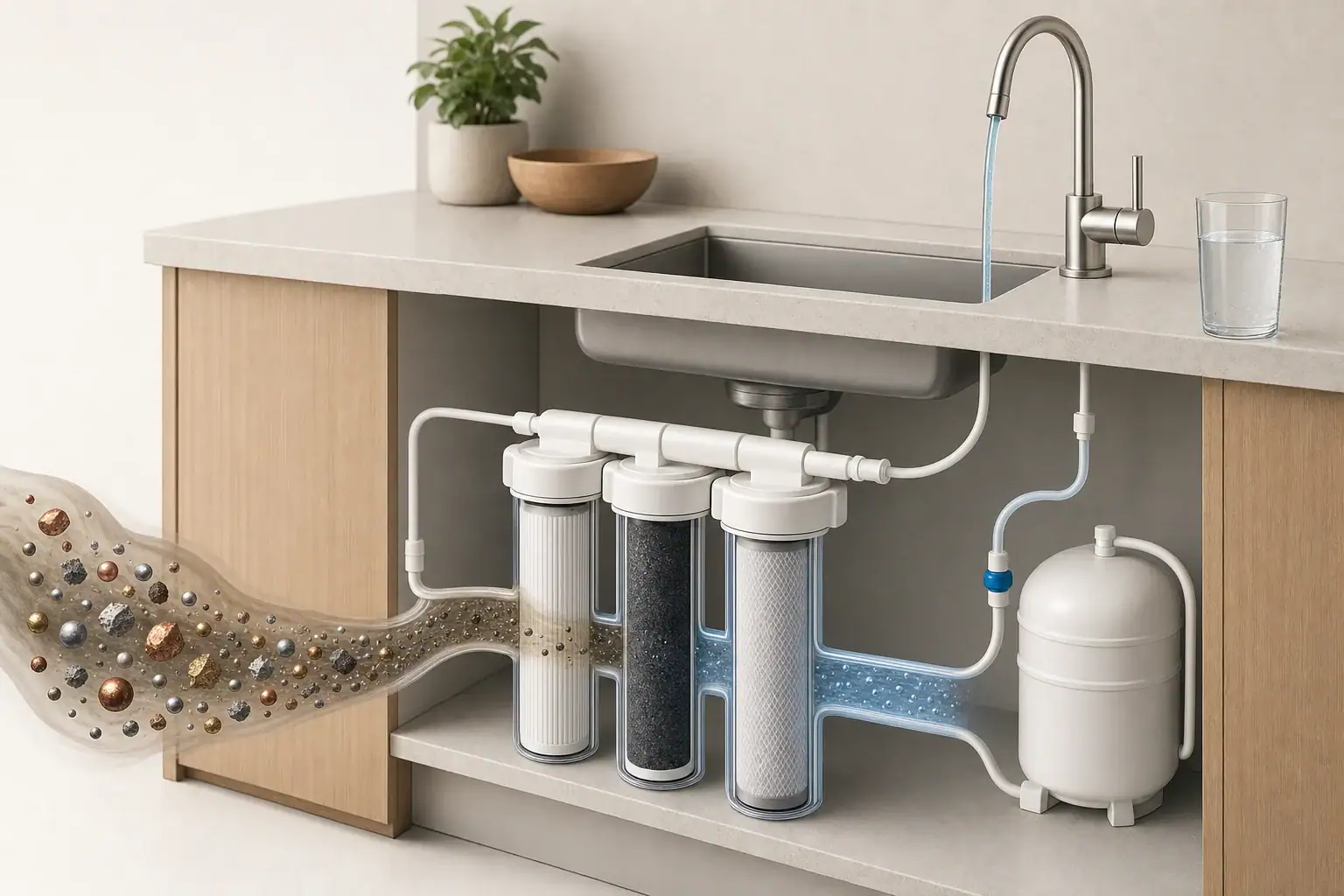
A metallic taste in filtered water does not automatically mean the filter has failed. The source may be a new or exhausted cartridge, but it can also be the faucet, household plumbing, water heater, pressure tank, or incoming water supply.
The timing and location of the taste provide useful clues. Water that tastes metallic only after sitting overnight suggests a different problem than water that develops the taste immediately after a cartridge replacement. Comparing filtered and unfiltered water can help narrow the possibilities without making unsafe plumbing changes.
Why Filtered Water Can Taste Metallic
People commonly describe water as metallic when it contains certain dissolved minerals or when its chemistry changes how it interacts with metal surfaces. Iron in water, copper, manganese, and zinc can contribute metallic, bitter, or astringent notes. Taste alone cannot identify a specific substance or determine its concentration.
Some metallic sensations are not caused by unusually high metal levels. Reverse osmosis and other high-reduction systems can produce low-mineral water that tastes flat, sharp, or unfamiliar. A person may interpret that change as metallic, particularly when the water passes through a metal faucet or sits in a metal container.
Chlorine, chloramine, sulfur compounds, high total dissolved solids, and changes in pH can also alter taste. More than one factor may be present at the same time. For example, a spent carbon stage may allow disinfectant taste through while older plumbing adds a separate metallic note.
Why taste is only a screening clue
Taste and odor observations are useful for troubleshooting, but they are not substitutes for water testing. Some substances have a noticeable taste at relatively low concentrations, while others may not be detectable by taste. If the change is persistent, widespread, or accompanied by discoloration, testing is more informative than repeated cartridge changes.
Cartridge-Related Causes of a Metallic Taste
A cartridge is a likely suspect when the taste begins directly after installation, appears only at the filtered faucet, or changes as the filter ages. The exact cause depends on the filtration stages and how the system was serviced.
A new cartridge was not fully flushed
New carbon cartridges can release harmless-looking carbon fines that make water gray or cloudy during initial flushing. New membranes and specialty media may also contain manufacturing residues or storage solution that must be rinsed according to the system instructions. These conditions are not always described as metallic, but they can create an unfamiliar bitter, mineral, or chemical taste.
Use the manufacturer-specified flushing procedure. Do not exceed pressure limits, remove required flow controls, or bypass safety components in an attempt to flush the system faster.
The cartridge is exhausted or overdue
An exhausted carbon filter may stop reducing chlorine, chloramine, or taste-producing organic compounds effectively. Sediment loading can reduce flow and change how water moves through later stages. A spent cartridge does not necessarily add metal, but it may no longer reduce the condition that was masking or contributing to the taste.
Replacement timing should account for water use, incoming water quality, pressure, and the cartridge’s rated capacity. Calendar intervals alone are approximate.
The replacement cartridge is incompatible or installed incorrectly
A cartridge with the wrong media, dimensions, seals, or flow direction may allow bypass around the treatment media. Misaligned O-rings can also cause leakage or internal bypass. Only compatible components should be used, and housings should be assembled according to their instructions rather than force-tightened.
Specialty media changed the mineral profile
Ion-exchange, scale-control, alkaline, and remineralization cartridges intentionally change water chemistry. A new stage may create a mineral taste that was not present before. Excessive contact time after overnight stagnation can make that taste more noticeable. This does not prove the media is unsafe, but it is a reason to verify compatibility, flushing requirements, and replacement condition.
Example values for illustration.
| Observation | More consistent with cartridge | More consistent with plumbing or supply |
|---|---|---|
| Taste began immediately after filter service | Yes; check flushing, installation, and cartridge type | Possible if plumbing was disturbed |
| Only filtered water tastes metallic | Likely | Possible at a dedicated filtered faucet |
| Filtered and unfiltered cold water taste alike | Less likely | More likely |
| Taste is strongest after water sits overnight | Possible in the filter or storage tank | Likely in stagnant plumbing |
| Hot water is affected more than cold water | Unlikely for a cold-water filter | Check the water heater and hot-water plumbing |
| Multiple faucets changed at the same time | Unlikely for a point-of-use filter | Likely supply or whole-house issue |
| Taste returns as cartridge flow declines | Possible cartridge loading or exhaustion | Also check pressure and sediment conditions |
Plumbing and Water-Supply Causes
If a fresh, correctly installed cartridge does not resolve the problem, the water may be picking up taste before or after filtration. This is especially plausible when the taste occurs at more than one fixture.
Stagnation in household pipes
Water that remains in plumbing for several hours has more contact time with pipe, fittings, valves, and soldered joints. Copper, galvanized steel, brass, and some plated fixtures can affect taste depending on their condition and the water chemistry. The first glass drawn in the morning may therefore taste different from water collected after normal use.
Low-pH or otherwise corrosive water can increase metal release from plumbing. This is more common as a concern for private wells, but municipal water chemistry can also change temporarily because of source changes or utility treatment adjustments.
The filtered-water faucet or connector
A metallic taste confined to a dedicated drinking-water faucet may originate downstream of the cartridge. Possible sources include an aging faucet, a deteriorating internal component, an unsuitable connector, or water standing in the short outlet tube.
Visible corrosion, flaking finish, persistent discoloration, or leakage warrants evaluation. Components in contact with drinking water should be intended for that purpose and compatible with the system.
Water heater effects
If metallic taste is more noticeable in hot water, the point-of-use cold-water filter is unlikely to be the primary cause. Sediment, corrosion, or components inside the water heater may affect hot-water taste. A qualified plumber can assess the heater safely. Homeowners should not disable protective devices or open a pressurized or energized heater.
Changes in the incoming supply
Main repairs, hydrant use, seasonal source changes, or work on private-well equipment can temporarily disturb sediment and alter taste. In well systems, iron and manganese may vary with groundwater conditions, pumping patterns, or treatment performance. Municipal customers can ask the utility whether recent work or a source change occurred.
How to Isolate the Source Safely
A controlled comparison is more useful than replacing several parts at once. Use clean glass containers and compare samples at approximately the same temperature, since temperature can affect taste perception.
Compare filtered and unfiltered cold water
- Collect cold water from the filtered outlet.
- Collect cold water from a nearby unfiltered faucet, if one is normally available.
- Compare samples immediately and again after the faucet has run during ordinary use.
- Check another fixture to determine whether the issue is local or house-wide.
Do not create a makeshift bypass, disconnect pressurized tubing, or defeat backflow-prevention components merely to obtain a comparison sample.
Record when the taste occurs
Note whether the taste is strongest after overnight stagnation, only during low flow, or immediately after maintenance. Also record discoloration, particles, odor, pressure changes, and the cartridge installation date. A short log can reveal patterns that are easy to miss.
Review recent changes
Consider cartridge replacement, plumbing repairs, a new faucet, water-heater service, utility work, well maintenance, or long periods of low occupancy. If the metallic taste appeared immediately after one event, investigate that event first.
Inspect without disassembling unsafe components
Look for external leaks, kinked tubing, corrosion around accessible fittings, an incorrectly seated housing, or a cartridge installed against its marked flow direction. Shutoff and depressurization procedures should follow the equipment instructions. Work involving fixed plumbing, electrical equipment, hot-water systems, or uncertain connections is best handled by a qualified professional.
Practical Corrective Actions
If the taste began after a cartridge change, confirm that the correct cartridge was installed and complete the required flushing procedure. If the cartridge is overdue, replace it and sanitize reusable housings only as directed by the system documentation. Avoid mixing cleaning chemicals or using unapproved disinfectants.
If the issue occurs only after stagnation, compare first-draw water with water collected after normal faucet use. A persistent result may justify testing for metals and basic water chemistry. Repeatedly flushing large volumes is not a substitute for identifying a corrosion or treatment problem.
For reverse osmosis systems, check whether the taste comes from the membrane output, storage tank, post-carbon stage, remineralization stage, or faucet. A service professional can isolate stages using proper procedures. Low pressure, an aging storage tank, or a depleted post-filter can affect taste even when the membrane is still producing water.
On private wells, treatment should be selected from test results rather than taste alone. Sediment filtration, oxidation and filtration, pH correction, or other methods may be appropriate in different circumstances. No single cartridge is suitable for every combination of iron, manganese, acidity, hardness, and organic matter.
When Water Testing or Professional Help Makes Sense
Consider laboratory testing when the taste persists across multiple fixtures, appears with blue-green, reddish, brown, or black staining, or returns soon after filter replacement. Testing is also useful for private wells, homes with older plumbing, and situations involving a significant change in source-water conditions.
A suitable test panel depends on the setting. Common diagnostic parameters may include pH, alkalinity, hardness, iron, manganese, copper, zinc, and total dissolved solids. Well owners may need additional routine microbiological and source-specific testing. Use a qualified laboratory and follow its sampling instructions because first-draw and flushed samples answer different questions.
Contact a plumber or water-treatment professional if there is visible corrosion, a leaking pressure vessel, recurring sediment, a damaged faucet, or uncertainty about safe depressurization. Municipal customers can contact their water utility when the change affects several fixtures or nearby homes.
Example values for illustration.
| Finding | Reasonable next step |
|---|---|
| Taste started after installing a new cartridge | Verify compatibility and complete the specified flush |
| Taste appears near the expected replacement time | Review use, flow decline, and replacement status |
| Only the dedicated filter faucet is affected | Check the cartridge, outlet tubing, and faucet condition |
| All cold-water faucets are affected | Ask about supply changes and consider water testing |
| First-draw water tastes stronger | Investigate stagnation and plumbing interaction |
| Only hot water is affected | Arrange a safe water-heater and hot-plumbing assessment |
| Taste occurs with staining or visible corrosion | Use appropriate testing and seek professional evaluation |
Related guides:
Bad Taste After Installing a New Filter: Quick Fixes •
Fixing Metallic or Plastic Taste from a New Faucet Filter •
Iron in Water: Staining, Taste, and Filtration Options •
Private Well Water Testing Schedule: What to Check and When
Preventing Metallic Taste From Returning
Maintain a record of cartridge type, installation date, estimated water use, and any taste or flow changes. Replace cartridges based on their instructions and actual operating conditions rather than waiting for severe taste or pressure problems.
Flush new components as directed, keep filter housings sanitary during service, and use drinking-water-compatible replacement parts. Address leaks and corrosion promptly rather than relying on a filter to compensate for deteriorating plumbing.
For private wells, periodic testing provides a baseline that makes later changes easier to interpret. For municipal water, utility water-quality information can help distinguish a temporary supply event from a condition within the home. These steps make it easier to decide whether the next response should be cartridge maintenance, targeted testing, or a plumbing inspection.
Frequently asked questions
Why does my filtered water taste metallic after changing the cartridge?
A new cartridge may need additional flushing, may be incompatible with the system, or may have changed the water’s mineral profile. Confirm the cartridge type, installation direction, seals, and manufacturer flushing instructions.
Can old plumbing cause filtered water to taste metallic?
Yes. Water can pick up taste from a dedicated filter faucet, outlet tubing, fittings, or household pipes after filtration. A taste that is strongest in first-draw water after sitting often points to stagnation in plumbing.
Should filtered and unfiltered water taste the same?
Not necessarily. A filter can reduce some taste-causing compounds and alter mineral content. If both filtered and unfiltered cold water develop the same metallic taste, the source is more likely the plumbing or incoming water than the cartridge alone.
When should I test water with a metallic taste?
Consider testing if the taste persists after proper cartridge service, affects several fixtures, occurs with staining or discoloration, or is associated with older plumbing, a private well, or a recent supply change.
Why does only hot water have a metallic taste?
A cold-water filter is unlikely to cause a hot-water-only taste. The water heater or hot-water plumbing may need assessment, especially if the change is persistent or accompanied by sediment, discoloration, or corrosion.
- NSF/ANSI standards explained (42/53/401/58)
- Clear trade-offs: pitcher vs faucet vs under-sink vs RO
- Maintenance planning: cost per gallon and replacement cadence