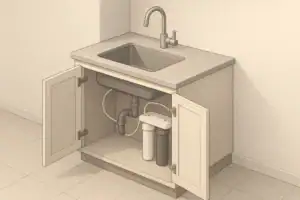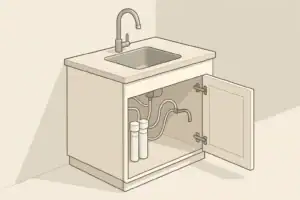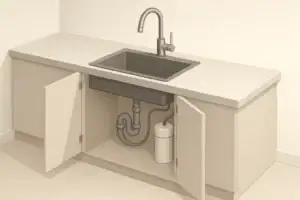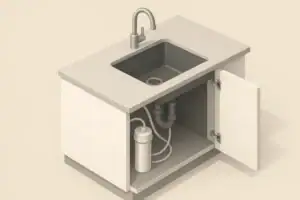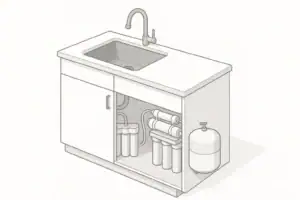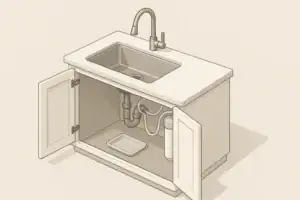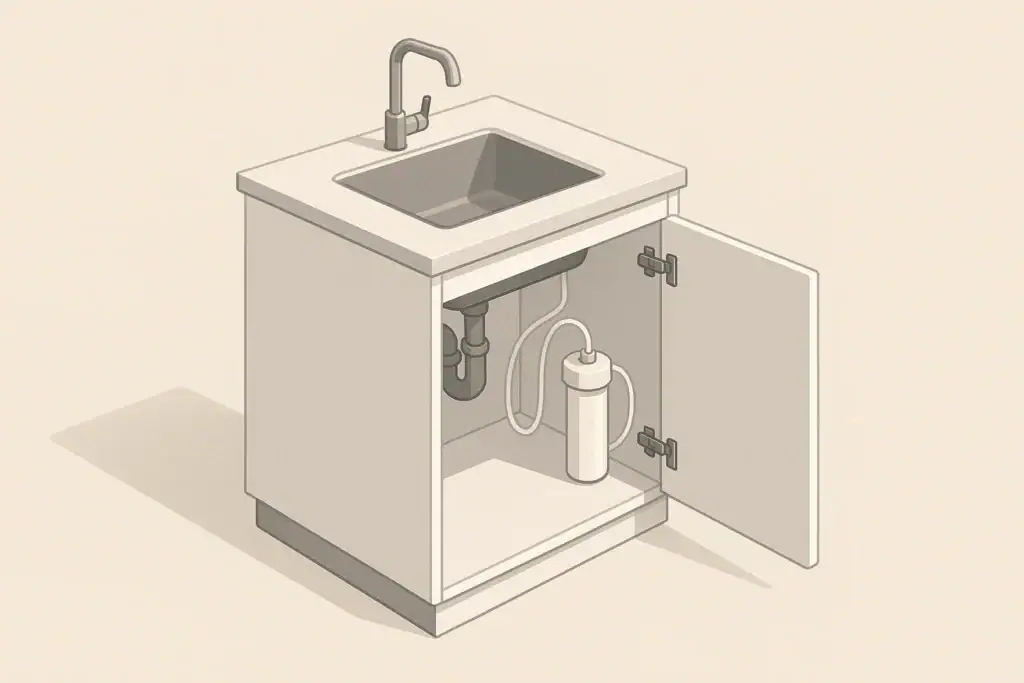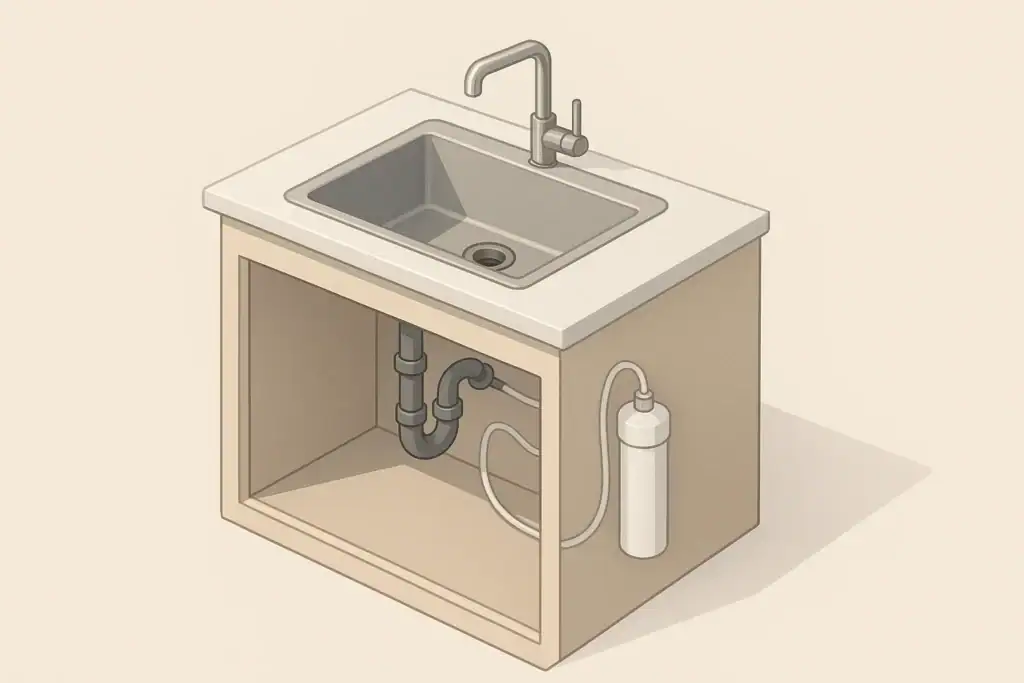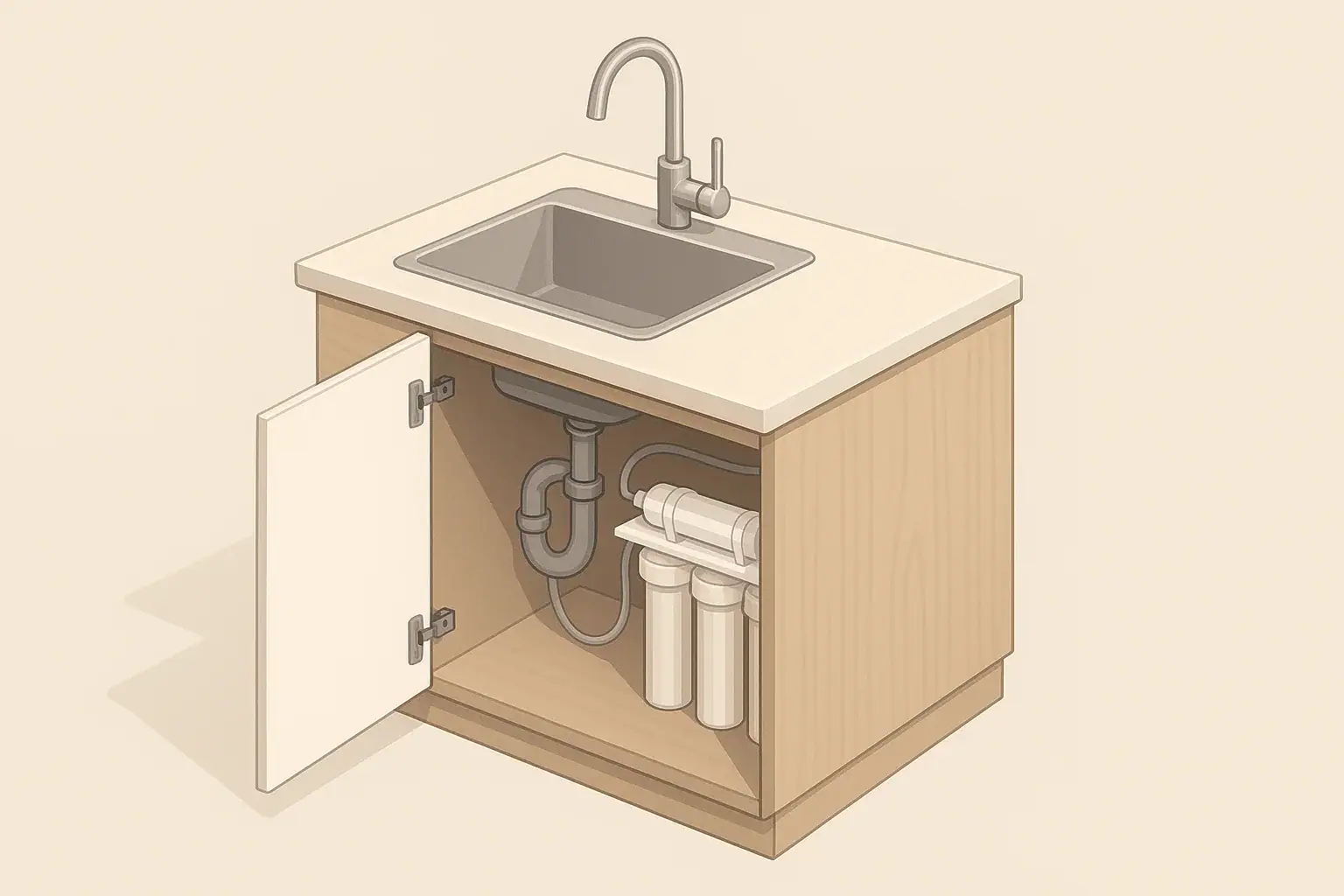
Multi-stage under-sink filters that combine carbon and ion exchange are compact systems installed in the cabinet beneath your kitchen sink. They use more than one type of filter media to treat tap water, typically pairing activated carbon with an ion exchange resin, and often adding sediment pre-filters or polishing stages.
Instead of relying on a single cartridge, these systems send water through a sequence of stages. Each stage is designed to target specific types of contaminants or issues such as taste, odor, or hardness-related minerals.
These systems connect directly to your cold water line and usually feed either a dedicated filtered-water faucet or, in some designs, the main kitchen faucet. Once installed, they provide continuous filtration without needing to refill a pitcher or attach a device to the spout.
What Are Multi-Stage Under-Sink Carbon + Ion Exchange Filters?
Multi-stage under-sink filters that combine carbon and ion exchange are compact systems installed in the cabinet beneath your kitchen sink. They use more than one type of filter media to treat tap water, typically pairing activated carbon with an ion exchange resin, and often adding sediment pre-filters or polishing stages.
Instead of relying on a single cartridge, these systems send water through a sequence of stages. Each stage is designed to target specific types of contaminants or issues such as taste, odor, or hardness-related minerals.
These systems connect directly to your cold water line and usually feed either a dedicated filtered-water faucet or, in some designs, the main kitchen faucet. Once installed, they provide continuous filtration without needing to refill a pitcher or attach a device to the spout.
How Carbon and Ion Exchange Work Together
The strength of these under-sink systems comes from combining two well-established technologies: activated carbon and ion exchange. Each tackles different groups of substances found in municipal and well water supplies in the United States.
Activated Carbon Stages
Activated carbon is processed to have a large internal surface area. As water passes through, many unwanted substances are trapped or adsorbed on that surface. Common roles for carbon stages include:
- Reducing chlorine taste and odor
- Improving overall flavor and smell of tap water
- Reducing some disinfection byproducts and organic compounds
- Capturing some types of industrial chemicals and volatile organic compounds (VOCs)
Systems may use different carbon formats:
- Granular activated carbon (GAC) – loose granules that allow higher flow but can channel if poorly packed.
- Carbon block – compressed carbon that forces water through a denser matrix, often improving contact time and fine particulate capture.
Ion Exchange Stages
Ion exchange resins are small beads that swap certain ions in the water for others attached to the resin surface. In multi-stage under-sink systems, ion exchange cartridges typically aim to:
- Reduce hardness minerals such as calcium and magnesium (to help with scale and taste)
- Target specific dissolved metals like lead, copper, or others, depending on resin type
- Modify overall mineral content to improve mouthfeel
Unlike carbon, which primarily adsorbs substances, ion exchange is a chemical swapping process. Once the resin becomes loaded with target ions, its performance declines and the cartridge must be replaced.
Why Use Both in a Multi-Stage Layout?
Carbon and ion exchange each have limitations. Carbon is effective for many organic compounds and chlorine but is not ideal for dissolved minerals. Ion exchange works well on charged particles but does not address uncharged organics or many taste-and-odor issues by itself.
By arranging stages in sequence, designers can:
- Use a sediment pre-filter to protect downstream stages from clogging
- Run water through carbon to address chlorine, taste, and odor
- Pass water through ion exchange resin to reduce selected metals or hardness minerals
- Add a final polishing carbon stage to improve clarity and taste
This combination allows the system to address a broader spectrum of common household water concerns than a single-technology filter.
Example values for illustration.
| Household situation | If this sounds like you… | Under-sink carbon + ion exchange fit |
|---|---|---|
| Priority on taste and odor | You dislike chlorine flavor or musty smells in tap water. | Often a strong fit due to carbon stages focused on taste and odor. |
| Concern about some metals | You have testing showing elevated levels of certain dissolved metals. | Can be a good fit if cartridges use resins designed for those metals. |
| Mild scale or spotting | You see some scale on fixtures but not major hardness issues. | Partial hardness reduction from ion exchange may help at point of use. |
| Very hard water overall | Hardness is high throughout the home with frequent scale buildup. | May help at the kitchen sink, but often supplemented by whole-house treatment. |
| Limited under-sink space | Your cabinet already contains garbage disposals or storage bins. | Check compact models; multi-stage units require some vertical and horizontal space. |
| Need highest contaminant reduction | Your testing shows a complex mix of contaminants of concern. | Consider comparing with reverse osmosis and whole-house solutions. |
How These Filters Compare to Other Home Systems
Multi-stage under-sink carbon + ion exchange systems sit in the middle of the home filtration landscape. They are more capable than basic pitchers or single-stage faucet filters but generally simpler and less comprehensive than full reverse osmosis (RO) or whole-house systems.
Versus Pitcher Filters
Pitcher filters also rely heavily on activated carbon, and some include small ion exchange components. Key differences include:
- Convenience: Under-sink systems provide filtered water on demand, while pitchers require refilling and waiting for gravity flow.
- Flow rate: Under-sink filters typically deliver higher, more consistent flow than gravity-fed pitchers.
- Capacity: Under-sink cartridges usually handle more water between changes than pitcher cartridges, though specifics vary by design.
- Installation: Pitchers need no plumbing changes; under-sink units require basic installation and possibly a dedicated faucet.
Versus Faucet-Mount Filters
Faucet-mount filters attach directly to the spout and often use a single carbon-based cartridge. Compared to these, multi-stage under-sink systems often offer:
- More advanced media combinations (multiple carbon stages plus ion exchange)
- Better aesthetics, as equipment is hidden under the sink
- Less clutter and weight on the faucet itself
- Potentially higher flow and capacity
However, faucet-mount filters are simpler to install and remove and are often easier for renters.
Versus Reverse Osmosis (RO) Systems
RO systems force water through a semi-permeable membrane and typically include pre- and post-filters, sometimes including carbon and ion exchange. Compared to RO, multi-stage carbon + ion exchange under-sink systems usually:
- Do not remove as broad a range of dissolved substances as RO membranes
- Do not require a storage tank or a drain connection
- Produce no separate wastewater stream from the membrane process
- Maintain higher flow rates directly from line pressure
- Leave more minerals in the water, which some users prefer for taste
Households with complex water quality concerns sometimes compare these multi-stage systems with RO units and choose based on local water testing results and installation constraints.
Versus Whole-House and Other Point-of-Use Filters
Whole-house filters treat all incoming water and are usually focused on sediment, chlorine, and sometimes hardness. In contrast, under-sink carbon + ion exchange filters are point-of-use systems designed for one or a few outlets, typically used for drinking and cooking water.
They can complement whole-house systems by adding more targeted contaminant reduction at the kitchen sink, especially for dissolved metals or additional taste and odor improvement.
Key Water Metrics and What They Mean for These Systems
Understanding basic water quality metrics can help you decide whether a carbon + ion exchange under-sink filter is appropriate and what cartridge types to look for.
Total Dissolved Solids (TDS)
TDS is a general measure of dissolved substances in water. Multi-stage carbon + ion exchange filters can influence TDS slightly, especially if ion exchange resins target certain minerals. However:
- A change in TDS alone does not indicate safety or quality.
- These systems do not usually aim to minimize TDS the way RO systems do.
- Some TDS readings may remain similar even after effective contaminant reduction.
Hardness
Hardness refers mainly to calcium and magnesium levels. Ion exchange stages designed for hardness can:
- Reduce scale formation in kettles, coffee makers, and around the kitchen faucet
- Alter taste and mouthfeel of water
The amount of hardness reduction depends on the resin type, cartridge size, and incoming hardness. For very hard water, a point-of-use under-sink system may provide local improvement while a dedicated softening solution handles whole-house supply.
pH and Corrosivity
Most household systems do not dramatically change pH, though some media can shift it slightly. Corrosivity affects how water interacts with plumbing and fixtures. If tests show elevated corrosivity, it is useful to discuss options with a local water professional, since changes in plumbing materials and broader treatment may be more effective than point-of-use filtration alone.
Turbidity and Sediment
Turbidity describes how clear or cloudy water appears. Sediment pre-filters in multi-stage systems capture sand, rust particles, and other visible material. This:
- Protects carbon and ion exchange stages from clogging
- Improves clarity and appearance of water
For homes with visible particles, selecting a system that includes a dedicated sediment cartridge is especially important.
Common Contaminants Targeted by Carbon + Ion Exchange Stages
No single filter handles every possible contaminant. Multi-stage carbon + ion exchange under-sink systems are typically designed for a practical subset of common issues in U.S. tap water. Always check system documentation and independent certifications to understand what a specific model has been tested to reduce.
Chlorine and Chloramine
Municipal systems commonly use chlorine or chloramine for disinfection. Activated carbon stages are frequently used to reduce chlorine taste and odor, and some specialized carbons are designed for chloramine as well. This often results in water that tastes and smells closer to neutral.
Lead and Other Metals
Ion exchange resins and some advanced carbon blocks can be designed to reduce dissolved metals such as lead or copper. Whether a particular under-sink system does this depends on its cartridge media and how it is certified.
Because metals can originate from local plumbing, testing at the tap is useful before selecting a system.
PFAS, VOCs, and Other Organic Compounds
Activated carbon can reduce some organic chemicals, including certain volatile organic compounds (VOCs) and some per- and polyfluoroalkyl substances (PFAS), depending on carbon type and contact time. Performance varies widely by compound, so independent testing and certifications are important for understanding what a specific system can address.
Sediment, Rust, and Microplastics
Sediment pre-filters and dense carbon blocks can capture:
- Sand and silt particles
- Rust flakes from aging pipes
- Some larger microplastic particles
Particle size ratings (for example, nominal micron ratings) give a sense of what the filter is designed to capture, though these numbers are general guidelines rather than guarantees for every particle type.
Understanding NSF/ANSI Certifications for Multi-Stage Under-Sink Systems
NSF/ANSI standards provide a framework for testing and verifying specific performance claims. While not mandatory for all products, certifications make it easier to compare different multi-stage under-sink systems.
NSF/ANSI 42: Aesthetic Effects
NSF/ANSI 42 focuses on taste, odor, and appearance. For multi-stage systems, this often applies to:
- Chlorine reduction claims
- Particulate reduction (improved clarity)
- General taste and odor improvement
If a system carries 42 certification, it has been tested under defined conditions for those specific aesthetic claims.
NSF/ANSI 53: Health-Related Contaminants
NSF/ANSI 53 covers reduction of a range of contaminants that are associated with potential health-related concerns, such as certain metals and organic compounds. For multi-stage carbon + ion exchange filters, this standard may apply to claims for:
- Lead and other specified metals
- Some industrial chemicals and VOCs
- Other contaminants listed in the product documentation
Always check exactly which substances the system is certified to reduce; 53 certification is not a blanket claim for every possible contaminant.
NSF/ANSI 401: Emerging Compounds
NSF/ANSI 401 addresses certain “emerging” compounds, such as some pharmaceutical residues and personal care products. Some advanced multi-stage systems that use specialized carbon or resins may be tested to this standard for specific substances. This standard is useful for households concerned about these newer categories of contaminants, but coverage varies widely.
NSF/ANSI 58 and Reverse Osmosis Context
NSF/ANSI 58 applies to RO systems. While multi-stage carbon + ion exchange under-sink filters are not themselves RO systems, households often compare 53 and 401-certified filters with 58-certified RO units when deciding between technologies. Understanding the difference in standards helps set realistic expectations for each approach.
Example values for illustration.
| Standard | General focus | What to verify |
|---|---|---|
| NSF/ANSI 42 | Aesthetic effects like chlorine, taste, odor, and particulates. | Check which aesthetic claims (e.g., chlorine reduction) are specifically listed. |
| NSF/ANSI 53 | Selected contaminants with potential health-related concerns. | Look for named contaminants (such as particular metals) and their test conditions. |
| NSF/ANSI 401 | Certain emerging compounds such as some pharmaceuticals. | Confirm which compounds were tested and whether they match your concerns. |
| NSF/ANSI 58 | Reverse osmosis system performance and structural integrity. | Relevant mainly if comparing with RO; verify membrane and system claims. |
| Material safety | Ensures system materials are appropriate for contact with drinking water. | Look for statements that wetted components meet applicable safety requirements. |
| Structural integrity | Addresses pressure-related performance of housings and components. | Verify pressure ratings and suitability for your household water pressure. |
Maintenance, Cost per Gallon, and Practical Tips
Owning a multi-stage under-sink carbon + ion exchange system means planning for routine maintenance. Cartridges gradually load with contaminants and lose effectiveness over time. Consistent upkeep helps maintain taste, flow, and performance.
Typical Replacement Intervals
Manufacturers usually specify replacement intervals based on time (for example, several months) and volume (for example, a certain number of gallons). Actual intervals depend on:
- Number of people using the system
- Daily water usage for drinking and cooking
- Incoming water quality (more contaminants can shorten cartridge life)
Some households track approximate usage by noting the installation date and estimating gallons per day based on routine kitchen habits.
Recognizing When Filters Need Attention
Aside from scheduled changes, signs that cartridges may be nearing the end of their useful life include:
- Noticeable change in taste or odor of filtered water
- Reduced flow rate from the filtered faucet
- Visible discoloration or cloudiness if sediment is bypassing clogged stages
Many systems recommend replacing cartridges even if these signs are not yet obvious, to stay within tested performance ranges.
Estimating Cost per Gallon
To understand operating costs, households often calculate a rough cost per gallon. A simple approach is:
- Add the price of all cartridges changed at the same time.
- Divide by the approximate number of gallons used between changes (based on documentation and estimated daily use).
This provides a general cost per gallon figure, which can be compared to alternatives like bottled water, pitchers, or other treatment systems. Even approximate calculations help with budgeting and deciding which system size is most appropriate.
Installation and Plumbing Considerations
Before installing a multi-stage under-sink system, it is useful to:
- Measure available space under the sink, including height for cartridge removal
- Check the condition and material of existing plumbing lines
- Decide whether to use a dedicated filtered-water faucet or a combined faucet
- Verify household water pressure is within the system’s stated operating range
Homeowners comfortable with basic plumbing may install these systems themselves, while others prefer professional installation, especially in tight spaces or older homes with complex plumbing.
Integrating with Broader Water Treatment Plans
A multi-stage carbon + ion exchange under-sink filter is often one part of a broader water quality strategy. For example, a home might use:
- A whole-house sediment and carbon system to address chlorine and particulate at every tap
- A point-of-use under-sink system for additional metal or organic compound reduction at the kitchen sink
- Occasional laboratory or at-home testing to track changes in water quality over time
Aligning your under-sink filtration choice with actual test results and household priorities—taste, scale control, or concern about specific contaminants—helps ensure that the combination of carbon and ion exchange stages is used effectively.
Frequently asked questions
How often should I replace the carbon and ion exchange cartridges in a multi-stage under-sink system?
Replacement intervals vary by manufacturer, usage, and incoming water quality, but many carbon and ion exchange cartridges are replaced every 6 to 12 months or after a specified number of gallons. Replace sooner if you notice changes in taste, odor, or a drop in flow rate, and follow the system’s documentation for tested performance life.
Can a carbon + ion exchange under-sink filter remove lead or PFAS from my tap water?
Some models can reduce lead and certain PFAS, but performance depends on the specific media and cartridge design; look for independent certifications that name the contaminants tested. NSF/ANSI 53 covers many health-related contaminants like lead, while PFAS reduction is variable and may require systems tested specifically for those compounds.
Will a multi-stage under-sink carbon and ion exchange filter soften very hard water in my home?
These point-of-use systems can provide partial hardness reduction at the kitchen sink if the ion exchange stage is designed for hardness, but they are not a substitute for a whole-house water softener when hardness is high throughout the home. For widespread scale issues, a dedicated whole-house softening solution is typically more effective.
Do these under-sink systems need a drain line or storage tank like reverse osmosis units?
No; most multi-stage carbon + ion exchange under-sink filters connect to the cold water line and deliver filtered water directly without a storage tank or drain connection. Reverse osmosis systems differ because membranes produce a wastewater stream and often use a tank to store filtered water.
How should I verify a model’s contaminant claims before buying?
Review the product’s independent test reports and certifications, such as NSF/ANSI 42, 53, or 401, and confirm which specific contaminants and test conditions are listed. Also compare cartridge life, micron ratings, and match the system’s tested reductions to results from local water testing to ensure it meets your priorities.
Recommended next:
- Under-Sink vs Pitcher: Which Is Better for Families?
- Best Under-Sink Filters for Chlorine Taste & Odor
- Under-Sink Filter Installation: Tools, Parts, and Common Mistakes
- No-Drill Under-Sink Filters for Renters: What’s Possible?
- Under-Sink Filters for Lead Reduction: What Certifications to Look For
- Under-Sink Filter Flow Rate Explained: Why GPM Matters
- More in Under-Sink Filters →
- NSF/ANSI standards explained (42/53/401/58)
- Clear trade-offs: pitcher vs faucet vs under-sink vs RO
- Maintenance planning: cost per gallon and replacement cadence