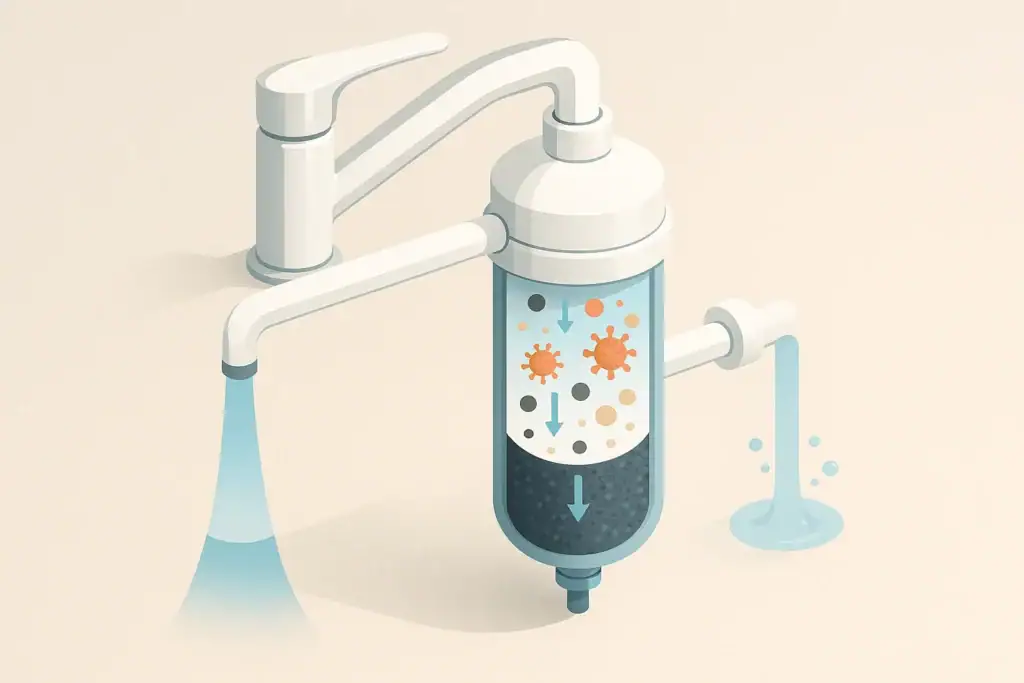
This article explains NSF/ANSI 401 in plain English so homeowners can understand what the standard covers and how it compares with other NSF/ANSI standards. It covers what is meant by “emerging contaminants”, what the standard actually tests, examples of products that may carry the certification, and practical steps to use the information when choosing and maintaining a filter. The goal is to make the technical standard understandable without altering the original regulatory language, so you can compare labels and certification claims with confidence. Read through the sections and use the table of contents to jump to topics such as testing, common misunderstandings, and maintenance.
The content below includes detailed headings on how NSF/ANSI 401 fits with standards like 42, 53, and 58, examples of contaminants, how to read labels, and a cheatsheet table for quick reference. It also reviews filter types and gives practical guidance for matching certified products to household needs. Use it as a practical guide to decide when a 401 certification matters and how to verify specific contaminant claims.
What Is NSF/ANSI 401?
NSF/ANSI 401 is a voluntary standard for drinking water treatment units that focuses on “emerging contaminants.” These are newer or more recently recognized substances that can show up in tap water but are not always covered by older standards.
Unlike basic safety rules that look only at how a filter is built, NSF/ANSI 401 looks at performance. It answers a simple question: if a filter claims to reduce a specific emerging contaminant, can it actually do it under controlled test conditions?
Filters certified to NSF/ANSI 401 are tested against a menu of possible contaminants, not all of them at once. Each certified model is approved only for the contaminants it was tested for, which will be listed on its certification documentation and packaging.
What Are “Emerging Contaminants” in Plain English?
In everyday terms, emerging contaminants are substances that:
- Were not widely tested for in drinking water in the past
- Come from modern products and activities
- Can be detected today because lab tests have become more sensitive
Examples of contaminant categories covered under NSF/ANSI 401 include:
- Pharmaceuticals – trace amounts of pain relievers, hormones, or other medications that can pass through wastewater systems
- Over-the-counter drugs – common household medicines that may enter waterways
- Herbicides and pesticides – chemicals used in lawns, gardens, and agriculture
- Industrial chemicals – solvents, plasticizers, and similar compounds used in manufacturing
- Household chemicals – ingredients found in cleaning products or personal care products
NSF/ANSI 401 does not say anything about whether these contaminants are safe or unsafe at certain levels. It simply provides a way to test whether a given water treatment unit can reduce their levels in water when properly installed and maintained.
Example values for illustration.
| Typical Home Goal | Common Filter Formats | Key Standards to Look For | Where NSF/ANSI 401 Fits |
|---|---|---|---|
| Improve taste and reduce chlorine odor | Pitcher, faucet-mount, fridge filter | NSF/ANSI 42 | Usually not required |
| Reduce lead and other heavy metals | Faucet-mount, under-sink, some pitchers | NSF/ANSI 53 | Useful but secondary to 53 |
| Address many dissolved substances | Under-sink reverse osmosis | NSF/ANSI 58 | May appear as an added claim |
| Target specific modern chemicals (e.g., some pharmaceuticals) | Pitcher, under-sink, faucet-mount | NSF/ANSI 401 | Primary performance indicator |
| Cover both classic and emerging contaminants | Under-sink, RO, whole-house point-of-entry + point-of-use | Combinations of 42, 53, 58, 401 | Shows extra tested reduction claims |
| General household protection and taste improvement | Whole-house plus point-of-use filters | Often 42 at whole-house; 53/401 at taps | Used at point-of-use units |
How NSF/ANSI 401 Fits With Other NSF Standards
NSF/ANSI 401 is one part of a larger family of standards for residential drinking water treatment units. Understanding how they relate helps you read labels and certifications more confidently.
NSF/ANSI 42: Aesthetics (Taste, Odor, and Chlorine)
NSF/ANSI 42 applies mainly to aesthetic effects, such as:
- Chlorine taste and odor
- Some forms of particulate matter (like visible sediment)
- General clarity and appearance
Filters certified only to 42 are often used to make water taste and smell better. They are not primarily focused on contaminants of health concern or emerging contaminants.
NSF/ANSI 53: Contaminants of Health Concern
NSF/ANSI 53 focuses on contaminants that, under some conditions, can pose health-related concerns. Typical contaminant categories tested under 53 include:
- Certain heavy metals, such as lead
- Some disinfection byproducts
- Some organic chemicals, such as certain volatile organic compounds (VOCs)
A filter with NSF/ANSI 53 certification has been tested for one or more specific contaminants on the 53 list. It does not mean it removes all contaminants in that category, only the ones actually listed in its test report.
NSF/ANSI 58: Reverse Osmosis Systems
NSF/ANSI 58 applies specifically to reverse osmosis (RO) systems. It covers:
- How well the RO membrane reduces dissolved solids during testing
- Structural integrity of the unit
- Other performance and safety aspects specific to RO designs
Some RO systems may also carry 42, 53, or 401 certifications for additional stages or cartridges in the system.
NSF/ANSI 401: The “Extra Layer” for Modern Compounds
NSF/ANSI 401 acts as an extra layer on top of the standards above. Many filters that carry 401 also carry 42 and/or 53. In practical terms:
- 42 covers taste and smell improvements
- 53 covers many traditional contaminants of concern
- 58 covers RO system performance
- 401 covers specific modern or emerging compounds beyond those earlier lists
Each of these standards focuses on what the filter is tested to do. None of them guarantee performance for contaminants that are not explicitly listed.
What NSF/ANSI 401 Actually Tests
NSF/ANSI 401 includes a defined list of potential test contaminants. A manufacturer can choose which of these to test for, depending on how the filter is designed. Common categories include:
- Some prescription medications
- Some over-the-counter drugs
- Some herbicides and pesticides
- Some plastic-related chemicals
- Some flame retardants and industrial compounds
The testing process generally involves:
- Preparing water with known concentrations of the target contaminant(s)
- Running it through the filter according to the standard’s procedure
- Measuring the contaminant level before and after filtration
- Repeating tests at different points in the filter’s rated life
Filters must meet the standard’s performance criteria for each contaminant they claim to reduce, from the start of their life through their rated capacity under test conditions.
Why NSF/ANSI 401 Matters for Homeowners
NSF/ANSI 401 is useful if you want your filter to address contaminants that go beyond basic taste improvements and traditional heavy metals. It matters most when:
- Your local utility or a water quality report mentions specific modern chemicals that concern you
- You want a filter that has been tested for a broader range of potential contaminants
- You are comparing two similar filters and one has documented 401 claims for contaminants that interest you
However, NSF/ANSI 401 is not the only factor to consider. For many homes, it works best as part of a layered approach, alongside 42, 53, or 58 certifications, depending on your water source and priorities.
How to Read NSF/ANSI 401 Labels and Claims
When you see “Certified to NSF/ANSI 401” on packaging or documentation, it is important to look beyond the headline. The details tell you what the filter has actually been tested for.
Look for the Exact Contaminant List
A proper 401 claim should be accompanied by a list of specific contaminants. When reviewing labels or product literature, check for:
- The exact compound names (for example, a specific herbicide rather than a broad category)
- Clarification that performance is based on testing to NSF/ANSI 401
- A note that the claims apply only when the filter is used and replaced as directed
If only the standard number is mentioned, look for more detailed documentation that spells out which contaminants were actually tested.
Pay Attention to Rated Capacity
Every certified filter has a rated capacity, often expressed as an approximate number of gallons or liters. This is the volume of water the unit is expected to treat under test conditions while still meeting its performance claims.
For example, a cartridge may be tested up to a capacity such as several hundred gallons. After that point, the standard does not require the filter to maintain the same level of contaminant reduction, so replacement on schedule is important.
Understand That Your Water May Be Different
NSF/ANSI test water is carefully controlled. Real household water can vary in pH, temperature, sediment, and other characteristics. As a result:
- Actual performance can differ from lab test results
- Very high levels of certain substances may challenge a filter more than the test conditions did
- Pre-filtration (such as sediment filters) can help maintain performance in some systems
Certification is still useful, because it shows that the filter has been independently evaluated under standard conditions. It just is not a guarantee for every possible real-world situation.
Common Misunderstandings About NSF/ANSI 401
Because 401 deals with emerging contaminants, it can be easy to misinterpret what it means. A few points help keep expectations realistic.
Myth: NSF/ANSI 401 Means “Removes All Pharmaceuticals”
NSF/ANSI 401 does not mean a filter removes all medications or all chemicals of a particular class. It only verifies performance for the specific substances actually listed in that filter’s certification.
If you are concerned about a certain compound, you need to check whether the filter has been tested for that exact substance or a very close chemical relative specified in the standard.
Myth: Any Filter Media Automatically Meets NSF/ANSI 401
Filters cannot claim 401 performance just because they use carbon, membranes, or another media type. They must be tested as a complete system. The design, flow rate, contact time, and other details affect performance.
For this reason, two filters using similar media can perform differently. The presence of a certain media type is not a substitute for actual certification and data.
Myth: NSF/ANSI 401 Replaces Other Standards
NSF/ANSI 401 is not a replacement for 42, 53, or 58. Instead, it adds coverage for additional contaminants. A filter with only 401 but not 53, for example, might be tested for certain pharmaceuticals but not for lead.
When comparing filters, it is better to look at the full group of standards they meet and the detailed contaminant list under each standard, rather than assuming one number is “better” than another.
Filter Types That Commonly Use NSF/ANSI 401
Several residential filter formats may carry NSF/ANSI 401 certifications, usually at the point of use (near where you drink or cook with the water):
- Pitcher filters – often focus on taste and some contaminants, with selected 401 claims on certain models
- Faucet-mount filters – attach directly to the tap, sometimes combining 42, 53, and 401 claims
- Under-sink filters – include cartridge-based systems that route cold water through one or more filter stages
- Reverse osmosis systems – may have pre- or post-filters with 401 claims in addition to the RO membrane’s 58 certification
- Refrigerator and ice filters – some include targeted claims related to 401, especially for taste and certain organic compounds
Whole-house filters are more commonly certified for aesthetic effects (42) and sometimes particulates, while detailed 53 and 401 claims are often handled at point-of-use locations like kitchen sinks.
Practical Steps to Use NSF/ANSI 401 in Your Filter Choice
NSF/ANSI 401 is most useful when you combine it with a basic understanding of your own water supply and your household priorities.
1. Check Your Water Source Information
Start with information you already have or can easily obtain:
- Annual water quality reports from your municipal supplier, if you are on city water
- Well testing results if you use a private well
- Any local reports or notices about specific contaminants
These documents may not list every emerging contaminant, but they can highlight known issues and give general context for your area.
2. Decide Which Contaminant Categories Matter Most
Different households focus on different priorities, such as:
- Improving taste and removing chlorine odors
- Reducing lead or other metals from older plumbing
- Targeting certain organic chemicals or modern compounds
If you are primarily concerned about emerging contaminants like certain household chemicals or pharmaceuticals, 401 certifications may weigh more heavily in your decision.
3. Match Filter Format to Your Daily Habits
Consider how you use water in your home:
- Pitchers work well for smaller households or for drinking water only.
- Faucet-mount filters are convenient for both drinking and light cooking use directly from the tap.
- Under-sink systems provide filtered water from a dedicated faucet, often at a higher flow than pitcher-style units.
- RO systems are often used where broader reduction of dissolved substances is desired.
Once you choose a format, you can compare the NSF/ANSI standards and contaminant lists among models within that category.
4. Read the Fine Print on Certifications
When comparing options, look for documentation that clearly states:
- Which NSF/ANSI standards the system is certified to
- The specific contaminants tested under each standard
- The rated capacity and replacement schedule for each filter element
Pay attention to notes about how many stages are included and which stage is responsible for each reduction claim.
Maintenance and NSF/ANSI 401 Performance Over Time
NSF/ANSI 401 testing assumes that filters are replaced as directed. Over time, filter media can become saturated with contaminants or clogged with sediment. When that happens, performance can change.
To keep 401-tested performance closer to lab results, it helps to:
- Follow the manufacturer’s replacement schedule based on time or estimated volume
- Watch for changes in flow rate or taste, which can indicate a spent filter
- Use pre-filters where recommended, especially in systems with multiple stages
Some homeowners set calendar reminders or track approximate daily usage to estimate when cartridges will reach their rated capacity.
Example values for illustration.
| Standard | Main Focus | Typical Use in Homes | What to Verify on Documentation |
|---|---|---|---|
| NSF/ANSI 42 | Aesthetic effects (taste, odor, chlorine, some particulates) | Pitchers, faucet-mount, fridge, whole-house | Chlorine reduction claims and rated capacity |
| NSF/ANSI 53 | Selected contaminants of health concern | Faucet-mount, under-sink, some pitchers | Which metals or chemicals are listed by name |
| NSF/ANSI 58 | Reverse osmosis system performance | Under-sink RO systems | RO recovery, total dissolved solids reduction, capacity |
| NSF/ANSI 401 | Selected emerging contaminants | Pitcher, faucet-mount, under-sink, some RO stages | Exact list of tested pharmaceuticals and chemicals |
| Structural integrity checks | Housing strength and pressure resistance | Most certified systems | Pressure rating and installation notes |
| Material safety checks | Materials suitable for contact with drinking water | Cartridges, housings, tubing | Statement that materials meet NSF/ANSI requirements |
Key Takeaways for Using NSF/ANSI 401 Wisely
NSF/ANSI 401 gives homeowners a clearer way to evaluate filters that claim to address modern, emerging contaminants. It does not guarantee that every possible substance is removed, but it does confirm tested performance for specific compounds under standard conditions.
By combining NSF/ANSI 401 with other standards like 42, 53, and 58, and by matching your filter type and maintenance habits to your household needs, you can choose a system that more closely aligns with your priorities for taste, clarity, and targeted contaminant reduction.
Frequently asked questions
Which specific contaminants are covered under NSF/ANSI 401 testing?
NSF/ANSI 401 includes a defined menu of emerging contaminants such as selected pharmaceuticals, over-the-counter drugs, certain herbicides and pesticides, plastic-related chemicals, and some industrial compounds. Manufacturers choose which compounds from that list to test, and the exact names of tested contaminants must appear in the certification documentation. The presence of a class label (like “pharmaceuticals”) does not substitute for the specific compound names on the report.
Does NSF/ANSI 401 certify just a filter cartridge or the whole system?
Certification applies to the complete unit as tested, including the cartridge and its housing, flow rate, and any specified stages; individual media types are not automatically certified by type alone. If a component is changed or used in a different configuration, the original certification may not apply. Always check the certified model number and configuration on the test report.
If a filter is certified to NSF/ANSI 401, does that mean it removes lead and other traditional contaminants?
No — NSF/ANSI 401 focuses on selected emerging contaminants and does not replace standards that target traditional contaminants like lead (NSF/ANSI 53) or aesthetic issues (NSF/ANSI 42). A filter would need separate certification to NSF/ANSI 53 or other relevant standards to claim removal of lead or similar contaminants. Check each product’s documentation for the specific standards and contaminant lists it meets.
How can homeowners verify a product’s NSF/ANSI 401 claims?
Look for the certified model number and the test report or certificate that lists the exact contaminants tested under NSF/ANSI 401, plus the rated capacity and which stage provides each claim. Independent certification bodies publish searchable lists or downloadable reports where you can confirm those details. If only the standard number is on packaging, request the detailed documentation before relying on the claim.
Will a 401-certified filter perform the same way in my home as in lab tests?
Lab tests use controlled water conditions, so real-world performance can differ based on local water chemistry, temperature, sediment, and how well the filter is maintained. Following replacement schedules, using recommended pre-filters, and monitoring flow and taste helps maintain performance closer to test results. Certification shows independent evaluation under standard conditions but is not a guarantee for every household scenario.
Recommended next:
- NSF/ANSI standards explained (42/53/401/58)
- Clear trade-offs: pitcher vs faucet vs under-sink vs RO
- Maintenance planning: cost per gallon and replacement cadence