What Is NSF/ANSI 58?
NSF/ANSI 58 is a voluntary performance standard for point-of-use reverse osmosis (RO) drinking water treatment systems. It is published by NSF in cooperation with the American National Standards Institute (ANSI). When an RO system is certified to NSF/ANSI 58, it means an independent lab has tested that specific system against detailed requirements in the standard.
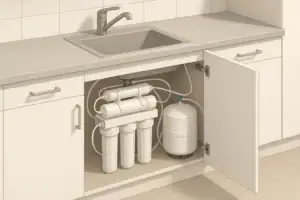
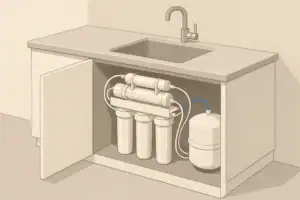
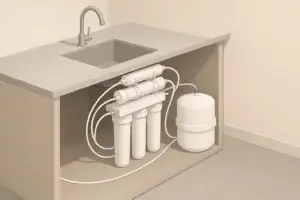
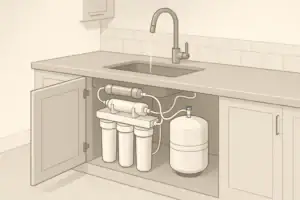
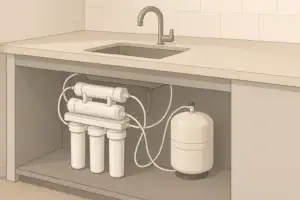
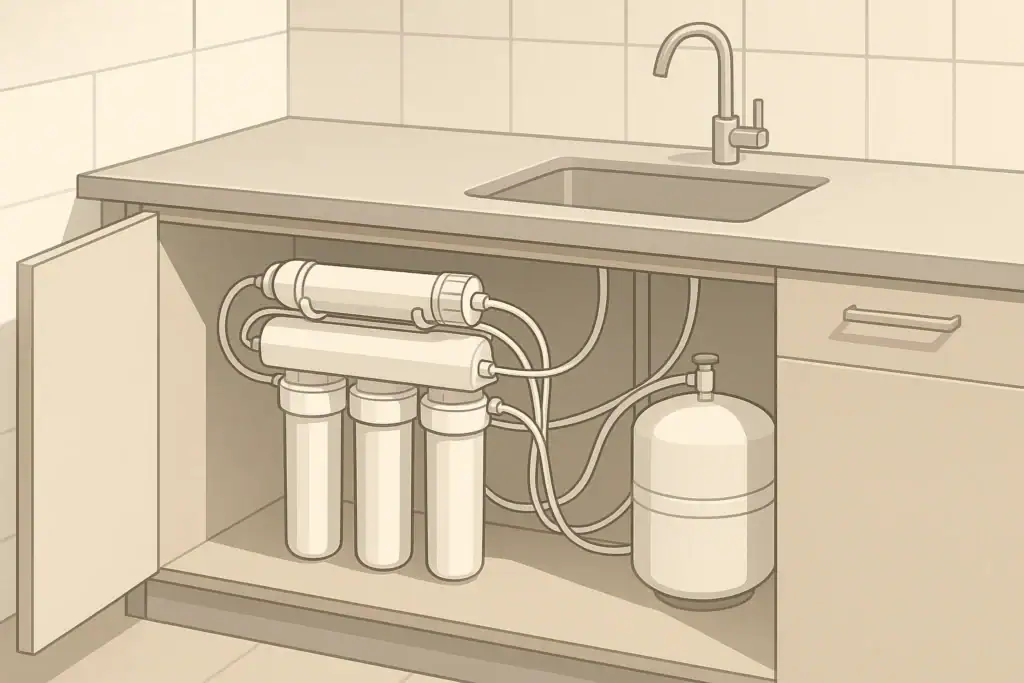
This standard focuses on complete RO systems used at the tap, usually installed under a kitchen sink. It does not cover whole-house systems or standalone carbon filters. Instead, it is designed for multi-stage RO units that include a membrane, prefilters, postfilters, and typically a storage tank.
NSF/ANSI 58 does not guarantee that a system is right for every water situation. It does, however, provide a common way to compare systems and to verify that key performance and safety claims have been evaluated under controlled test conditions.
How NSF/ANSI 58 Differs From Other NSF Standards
Home water filters can be certified to several different NSF/ANSI standards. Understanding how NSF/ANSI 58 fits in helps you see when RO is being evaluated and when other technologies are involved.
NSF/ANSI 58 vs 42, 53, and 401
Other common standards for residential drinking water treatment units include:
- NSF/ANSI 42 – for aesthetic effects such as chlorine taste and odor, and particulates.
- NSF/ANSI 53 – for health-related contaminant reduction such as lead or certain volatile organic compounds (VOCs).
- NSF/ANSI 401 – for reduction of certain emerging compounds, such as some pharmaceuticals and personal care products, when claimed.
NSF/ANSI 58 is different because it is specifically written for reverse osmosis systems. While an RO system may also be tested to standards like 42, 53, or 401 for its carbon stages, the 58 standard includes requirements that are unique to RO technology, such as recovery rating and how the membrane is evaluated.
Technology-Specific vs. Performance-Specific Standards
Another way to look at it:
- NSF/ANSI 42, 53, and 401 are mostly performance-focused (what the system reduces) and often apply to carbon filters and other technologies.
- NSF/ANSI 58 is both technology-specific (reverse osmosis) and performance-focused (what a certified RO system is tested to reduce, plus how it behaves during operation).
This is why RO products usually highlight NSF/ANSI 58 first, then list any additional standards that apply to their pre- or post-filtration stages.
Example values for illustration.
| Household situation | Main water concern | Is NSF/ANSI 58 a key standard? | Why it matters |
|---|---|---|---|
| Using an under-sink RO system | Overall dissolved solids and multiple contaminants | Yes, primary standard | Applies directly to RO membranes, storage tank, and system performance. |
| Using only a faucet-mount carbon filter | Chlorine taste and odor | No, look at 42 instead | NSF/ANSI 42 is the typical standard for this type of device. |
| Evaluating an RO system for lead reduction claims | Specific contaminant reduction | Yes, plus check 53 if listed | NSF/ANSI 58 may include certain claims; 53 may apply to carbon stages. |
| Concerned about specific emerging compounds | Some pharmaceuticals or personal care products | Sometimes, if claimed | RO systems may list additional certification to NSF/ANSI 401 for certain compounds. |
| Whole-house filtration only | Scale, sediment, basic taste | Usually no | NSF/ANSI 58 targets point-of-use RO, not whole-house equipment. |
| Apartment with mixed water quality | Unknown tap water profile | Often yes | An NSF/ANSI 58-certified RO can provide broad performance information for drinking water. |
What NSF/ANSI 58 Covers for RO Systems
NSF/ANSI 58 includes several categories of requirements. Not every certified system will have every possible contaminant claim, but the standard defines how those claims must be tested and how key system characteristics are measured.
Contaminant Reduction Claims
Under NSF/ANSI 58, manufacturers may have their systems tested for reduction of specific contaminants. The list can include, for example:
- Certain dissolved solids, often measured by total dissolved solids (TDS) as an indicator.
- Some metals and other inorganics, when claimed.
- Some organic compounds, when claimed.
- Cysts and certain microscopic particles, when claimed and when system design allows.
The exact contaminants a system is certified to reduce will appear on the certification listing and on product literature. NSF/ANSI 58 does not assume a system reduces all possible contaminants; it only verifies claims that have been tested.
Material Safety and Structural Integrity
NSF/ANSI 58 also addresses aspects that are not directly related to taste or specific contaminants:
- Material safety – Components in contact with drinking water are checked so they do not introduce unexpected substances above specified limits under test conditions.
- Structural integrity – Housings, tubing, and other pressure-bearing parts are pressure-tested to help ensure they can withstand typical residential water pressure ranges specified in the standard during testing.
- System design – Requirements cover features like automatic shutoff valves and how reject water is handled.
These elements are important because RO systems are pressurized, may sit under sinks for years, and are often out of sight. The standard is intended to reduce the chance of failures when the system is installed and maintained according to the manufacturer’s instructions.
Performance Over Time
NSF/ANSI 58 test protocols evaluate system performance over a defined period that is intended to represent how the system behaves as filters and membranes are used. Tests include multiple cycles, and water with defined characteristics is used to challenge the system.
This is different from a one-time laboratory measurement. The goal is to see how the system performs as it approaches the end of its stated service life under test conditions, rather than only when new.
Key RO Performance Concepts in NSF/ANSI 58
Because NSF/ANSI 58 is specific to RO technology, it includes concepts that do not appear in the same way in other standards. Two of the most important are rejection and recovery.
Rejection (Reduction of Dissolved Solids)
An RO membrane separates water into two streams: permeate (treated water) and concentrate (reject water). One way to describe performance is how much of the dissolved material is removed from the permeate compared to the feed water.
Under NSF/ANSI 58, total dissolved solids (TDS) are often used as an indicator in testing. A typical home RO system is expected to reduce TDS significantly under test conditions. However, actual reduction can vary based on:
- Membrane condition and age.
- Feed water temperature.
- Incoming TDS level and composition.
- Water pressure at the tap.
This is why the standard provides test conditions, but real-world performance can differ from example values.
Recovery (Use of Feed Water)
Recovery is the percentage of incoming water that becomes treated water. The remainder becomes reject water that goes to the drain. NSF/ANSI 58 includes a method for determining recovery under defined conditions.
For a typical residential under-sink system, recovery might be in a range where several gallons of water are sent to drain for each gallon of treated water produced, depending on design and conditions. Some systems are optimized for higher recovery, while others target maximum contaminant reduction or membrane life.
Production Rate and Storage
Under NSF/ANSI 58, production rate is evaluated at defined pressure and temperature. This production rate is usually given in gallons per day (GPD) as a laboratory measure.
In a home, the effective rate at the faucet also depends on:
- Size and design of the storage tank.
- How full the tank is at any given moment.
- Household demand peaks, such as cooking or filling large containers.
When comparing systems using NSF/ANSI 58 information, it is reasonable to use production rate as a relative indicator rather than a guaranteed real-world throughput.
How to Read an NSF/ANSI 58 Certification Label
The benefit of NSF/ANSI 58 is only realized if you know how to interpret the information on packaging and listings. The details can be dense, but some key items are especially useful for homeowners.
System-Level vs. Component-Level Certification
NSF/ANSI 58 is a system standard. A complete RO system might list:
- The specific model or series designation.
- NSF/ANSI 58 certification for the drinking water treatment unit.
- Any additional standards (such as 42, 53, or 401) that apply to pre- or post-filters.
Individual components, such as a loose membrane cartridge, may be tested separately, but that does not automatically mean any system using that cartridge meets the full system standard. When you want the assurance of NSF/ANSI 58, look for the entire system to be listed, not only a single replacement part.
Contaminant Performance Claims
Legitimate certification information for NSF/ANSI 58 should specify:
- Which contaminants were tested.
- Under what general conditions (for example, type of influent water used in testing).
- How the system must be installed and maintained to achieve those results under test conditions.
Statements such as “tested to NSF/ANSI 58” are not the same as “certified to NSF/ANSI 58.” Certification implies third-party verification and ongoing oversight, not just internal testing.
Operational Limits and Installation Notes
NSF/ANSI 58 certification is tied to specific operating conditions. Labels and manuals often list:
- The recommended pressure range for the system.
- Acceptable water temperature range.
- Maximum TDS level at which performance claims were tested.
Installing outside these ranges can affect how closely your system’s behavior matches any laboratory examples. For instance, lower water pressure than used in testing can mean slower production and different rejection ratios.
Practical Implications for Home RO Use
Knowing that a system is certified to NSF/ANSI 58 helps frame realistic expectations for daily use and upkeep. It does not remove the need for maintenance, but it gives you a baseline for how the system was designed to perform.
Taste, Odor, and TDS Expectations
RO systems often produce water with a noticeably different taste compared to tap water, largely because of reduced dissolved solids and, when carbon stages are present, reduced chlorine taste and odor.
With an NSF/ANSI 58-certified system installed and maintained according to the manufacturer’s schedule, you can usually expect:
- More consistent performance over the rated life of the filters and membrane, when used within specified conditions.
- Predictable decline in flow or change in taste as a cue that cartridges are nearing replacement time.
You can use a simple TDS meter, if desired, as a rough indicator of change over time. A gradual increase in TDS in the treated water, compared to the original baseline after installation, often signals that the membrane is aging.
Wastewater and Efficiency Considerations
Because RO systems send a portion of water to the drain, some homeowners are concerned about water use. NSF/ANSI 58’s recovery information helps you compare how different systems balance treated water production with reject water.
In practice, you can manage this by:
- Using RO water mainly for drinking and cooking, while using regular tap water for tasks like rinsing dishes.
- Spacing out high-demand activities (such as filling large jugs) to allow the storage tank to refill.
Planning Maintenance with Certification in Mind
NSF/ANSI 58 assumes that the system is installed and maintained using the instructions provided. Filter and membrane replacement intervals are part of how performance claims are framed. To keep your system operating closer to its tested behavior:
- Follow the recommended replacement schedule for prefilters, postfilters, and membrane.
- Record installation and replacement dates to track usage over months and years.
- Pay attention to taste, odor, and flow changes as early indicators of needed maintenance.
Skipping or stretching replacement intervals can lead to clogging, reduced flow, or performance different from any examples provided in literature.
NSF/ANSI 58 in Context with Other Certifications
RO systems often include several stages that may be covered by multiple standards at once. Putting them together can help you interpret a long list of certifications.
Common Combinations on RO Systems
A multi-stage RO unit might be certified as follows:
- NSF/ANSI 58 for the overall RO system, including contaminant reduction, structural integrity, and material safety.
- NSF/ANSI 42 for the carbon prefilter and postfilter related to chlorine taste and odor or particulates, when claimed.
- NSF/ANSI 53 for certain specific contaminants reduced primarily by carbon filtration, when claimed.
- NSF/ANSI 401 for some emerging compounds, if the carbon stages are tested for them.
When comparing options, it can be helpful to list which standards apply to which stages. For example, if chlorine reduction is a priority, you might look for NSF/ANSI 42 in addition to the core NSF/ANSI 58 listing.
Verifying Certification Status
Because standards can change over time and models can be updated, certification information may also be updated. It is reasonable to:
- Check that the exact model number is included in current certification listings.
- Confirm which contaminants are specifically listed as tested and verified.
- Note any limitations on source water quality in the certification details.
This approach helps you avoid assuming that any RO system behaves the same as another just because both use a membrane. NSF/ANSI 58 provides a way to differentiate systems on more than just marketing descriptions.
Example values for illustration.
| Standard | Typical focus | Common system types | What a homeowner should verify |
|---|---|---|---|
| NSF/ANSI 42 | Aesthetic effects such as chlorine taste, odor, and particulates | Pitcher filters, faucet-mount, refrigerator, some under-sink units | Which taste/odor or particulate claims are listed, and filter replacement intervals. |
| NSF/ANSI 53 | Specific contaminant reduction claims, often related to health-based concerns | Under-sink carbon filters, some faucet-mount and whole-house units | Exactly which contaminants are listed and the conditions under which they were tested. |
| NSF/ANSI 401 | Certain emerging compounds such as some pharmaceuticals and personal care products | Advanced carbon filters, some pitcher and under-sink systems | Which emerging compounds are included and whether they match your local water report. |
| NSF/ANSI 58 | Reverse osmosis system performance, materials, and structure | Point-of-use RO systems, usually under-sink with storage tank | That the complete RO system (not just components) is listed and which contaminant claims are certified. |
| NSF/ANSI 60/61 | Drinking water treatment chemicals (60) and system components (61) | Municipal treatment, plumbing products, and some filter components | For plumbing fixtures or parts, that wetted materials comply with the relevant standard. |
| NSF/ANSI/CAN standards updates | Occasional revisions to existing standards | All certified devices and systems | That the certification is current and matches the standard version used in documentation. |
Using NSF/ANSI 58 as One Part of Your Water Strategy
NSF/ANSI 58 provides a structured way to evaluate reverse osmosis systems, but it should be combined with other information when making decisions. Your local water quality report, plumbing configuration, desired maintenance workload, and water use habits all influence whether an RO system is appropriate and how it should be set up.
By understanding what NSF/ANSI 58 actually covers—system integrity, material safety, and specific contaminant claims under defined conditions—you can interpret RO marketing claims more clearly, select equipment that matches your priorities, and maintain it so that its performance stays closer to the conditions used in testing.
Frequently asked questions
Does NSF/ANSI 58 certification mean an RO system removes lead?
NSF/ANSI 58 only verifies contaminants that were specifically tested and listed in the certification. If the certification listing for that exact system includes lead reduction, then the system has been tested for lead under the standard; otherwise you should not assume lead removal without a listed claim or an additional relevant standard.
Can an NSF/ANSI 58-certified RO system be used as a whole-house solution?
No. NSF/ANSI 58 is written for point-of-use reverse osmosis systems (typically under-sink units with a storage tank) and does not cover whole-house equipment, which is designed and tested under different standards and conditions.
How does NSF/ANSI 58 address wastewater and recovery rates?
The standard includes test methods for determining recovery (the percentage of feed water converted to treated water) under defined laboratory conditions and reports expected reject water behavior. Real-world recovery can vary with water pressure, temperature, and feed water composition, so the listed recovery is best used as a comparative indicator.
If a membrane cartridge is tested, does that mean any system using it meets NSF/ANSI 58?
No. NSF/ANSI 58 is a system-level standard; component testing (for example, a membrane cartridge) does not automatically confer certification to an assembled system. For the assurance provided by NSF/ANSI 58, check that the complete system model is included on the certification listing.
How should I maintain an NSF/ANSI 58-certified RO system to keep it performing as tested?
Maintain the system according to the manufacturer’s installation and replacement schedule for prefilters, postfilters, and the membrane because certification assumes maintenance per instructions. Monitoring flow, taste, and optionally using a TDS meter can help you detect when components are due for replacement.
Recommended next:
- NSF/ANSI standards explained (42/53/401/58)
- Clear trade-offs: pitcher vs faucet vs under-sink vs RO
- Maintenance planning: cost per gallon and replacement cadence