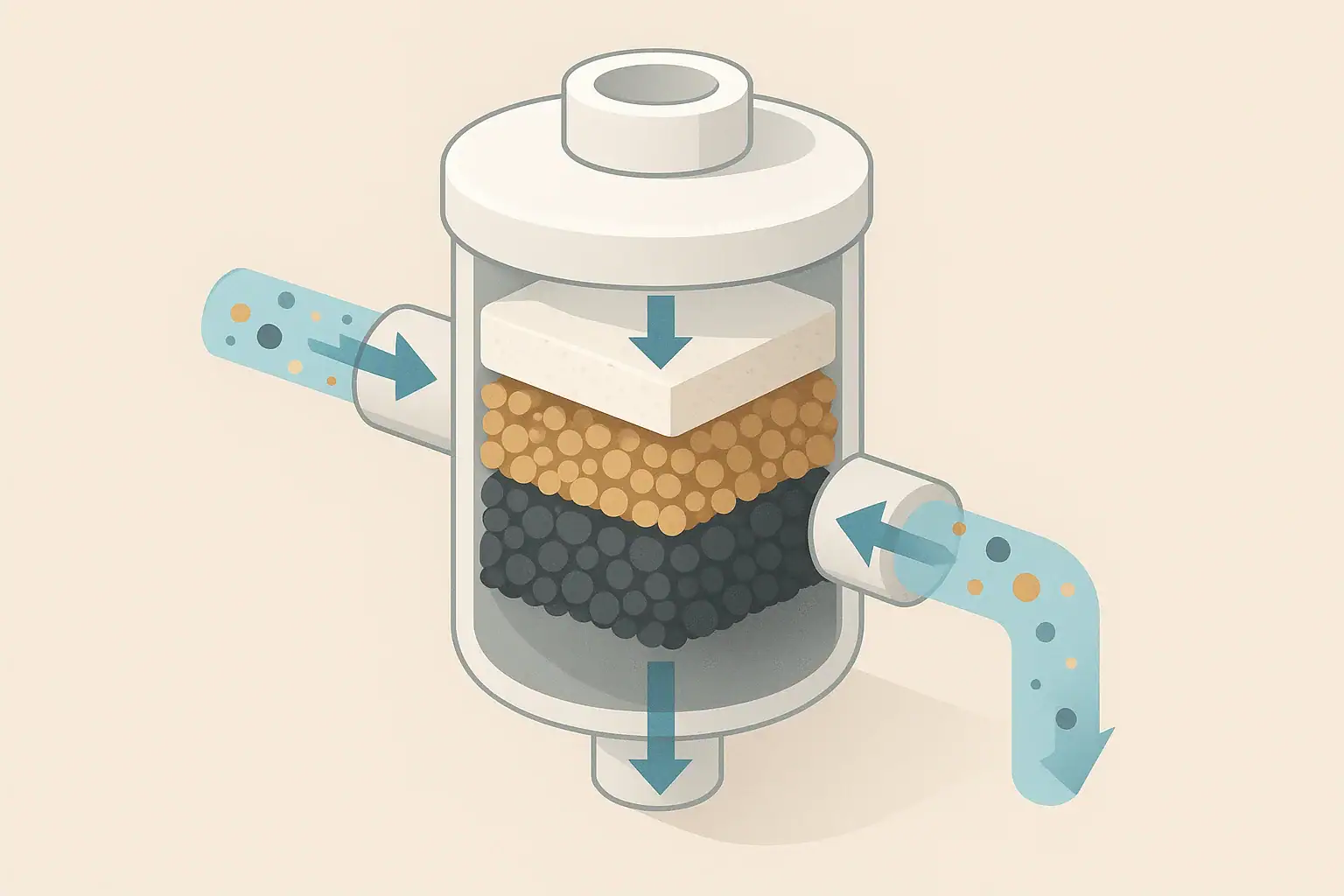
Understanding PFAS in Home Water
PFAS (per- and polyfluoroalkyl substances) are a large group of man-made chemicals used in many industrial and consumer applications. They are valued for being water- and grease-resistant, but this also means they are persistent in the environment and can be difficult to remove from drinking water.
For home water treatment, PFAS matter because:
- They do not easily break down in water systems.
- They are not removed by basic sediment filters or simple softeners.
- They often require specialized media or membranes to significantly reduce levels.
Households in the United States may encounter PFAS in both municipal and well water. Municipal utilities may or may not currently treat for PFAS, depending on local regulations, infrastructure, and testing programs. Many homeowners choose point-of-use or point-of-entry filtration as an added layer of protection and control over taste and quality.
This article focuses on three common PFAS removal options for homes:
- Reverse osmosis (RO) systems under the sink
- Activated carbon filters (pitchers, under-sink, and other formats)
- Whole-house filtration systems (point-of-entry)
Each approach has strengths and trade-offs in terms of performance, coverage, maintenance, and cost per gallon.
How PFAS Are Removed from Water
PFAS removal in residential systems relies on a few core treatment mechanisms. Understanding these helps you compare RO, carbon, and whole-house options more clearly.
Adsorption with Activated Carbon
Activated carbon is a porous material with a large internal surface area. PFAS molecules can adhere to the surface of the carbon in a process called adsorption.
Key practical points:
- Performance depends on carbon type (granular vs block), contact time, and flow rate.
- Filters eventually saturate and must be replaced to maintain PFAS reduction.
- Carbon filters are often used as point-of-use (POU) devices at a single tap.
Separation with Reverse Osmosis Membranes
Reverse osmosis uses a semi-permeable membrane to separate many dissolved substances from water. Under pressure, water passes through the membrane, while a portion of contaminants is rejected and sent to drain.
Key practical points:
- RO is typically installed under the sink and supplies a dedicated drinking water faucet.
- Systems usually include pre-filters (often carbon and sediment) that also help reduce PFAS.
- RO produces a separate waste stream and fills a small storage tank over time.
Specialized Media in Whole-House Systems
Whole-house (point-of-entry) systems treat all water entering the home. For PFAS, these often use large beds of activated carbon or other sorbent media tailored for organic chemicals.
Key practical points:
- They can improve water used for bathing, laundry, and cooking, not just drinking.
- Flow rate and plumbing size must be matched so the system does not restrict household water use.
- Media replacement is less frequent but can be more expensive when due.
In practice, many homes use a combination of technologies—for example, a whole-house carbon system for broad treatment plus an under-sink RO unit for a final polishing step at the kitchen tap.
Example values for illustration.
| Option | Typical Location | PFAS Focus | Water Coverage | Complexity | Relative Cost Per Gallon* |
|---|---|---|---|---|---|
| Pitcher/Countertop Carbon | Fridge or counter | Basic PFAS reduction if certified | Drinking water only | Low | Higher (small cartridges) |
| Faucet-Mount Carbon | Kitchen faucet | Targeted PFAS reduction if certified | Selected faucet | Low–moderate | Moderate |
| Under-Sink Carbon | Under kitchen sink | Enhanced PFAS reduction with longer contact time | Dedicated tap or main faucet | Moderate | Moderate |
| Under-Sink RO | Under kitchen sink | Membrane plus carbon pre/post filters | Dedicated drinking/ice line | Moderate–high | Lower (spread over many gallons) |
| Whole-House Carbon | Point of entry | Bulk PFAS and organic reduction | Entire home | High (plumbing work) | Low–moderate (large media volume) |
| Whole-House Specialty Media | Point of entry | Media chosen for challenging PFAS | Entire home | High | Varies by media |
*Relative cost per gallon is a general comparison based on typical media cost and capacity.
Reverse Osmosis (RO) for PFAS
Under-sink RO is one of the most common point-of-use options for homes concerned about PFAS and a broad range of other dissolved substances. RO systems combine several stages of treatment:
- A sediment pre-filter to catch rust, sand, and larger particles.
- One or more activated carbon stages to reduce chlorine, some PFAS, and other organics.
- The RO membrane itself, which rejects many dissolved ions and larger molecules.
- Often a final carbon polishing filter after the storage tank.
What RO Does Well for PFAS
In practice, homeowners choose RO for PFAS because it:
- Targets a broad spectrum of contaminants beyond PFAS, including many salts and metals.
- Provides a dedicated source of treated water for drinking, cooking, and ice.
- Often comes with clear filter change intervals and capacity ratings.
RO systems designed and tested for PFAS usually rely on both the membrane and the carbon stages. When comparing options, check independent test data or certifications rather than assuming all RO systems behave the same.
Considerations and Trade-Offs
Before choosing RO primarily for PFAS removal, keep these factors in mind:
- Water waste: RO produces a reject stream. Some systems are more efficient than others, but all send some water to drain during operation.
- Flow and storage: Water is produced slowly and stored in a small pressure tank. High-demand uses (like filling large pots) may take longer.
- Mineral content: RO reduces many dissolved minerals. Taste may change compared with your tap water, and some people notice the difference.
- Installation: Requires under-sink space, a connection to the cold water line, a drain connection, and usually a dedicated faucet.
RO Maintenance Basics
RO performance for PFAS depends on timely maintenance:
- Pre-filters (sediment and carbon) are typically changed every several months to one year, based on usage and manufacturer guidance.
- The RO membrane usually lasts longer, often a few years in typical residential use, assuming proper pre-filtration.
- Most systems specify a maximum number of gallons or a time interval. Following these limits is important to keep PFAS reduction consistent.
Monitoring basics include checking for noticeable drops in flow, off-tastes, or odors, and replacing cartridges on schedule even if water looks and tastes fine.
Activated Carbon Filters for PFAS
Activated carbon is widely used for home water treatment and is often the most accessible way to begin addressing PFAS at a single tap. It is found in pitchers, countertop dispensers, faucet-mount units, refrigerator filters, and under-sink systems.
Where Carbon Filters Fit Best
Carbon filters are useful for PFAS-focused households when:
- You want a simple, low-commitment way to improve taste and reduce certain contaminants.
- Installation of RO or a whole-house system is not feasible (for example, in rentals or tight spaces).
- You need a low-flow drinking-water solution and are comfortable with manual refilling (pitchers) or basic faucet attachments.
Under-sink carbon systems, especially larger block cartridges, can offer more contact time and capacity than small pitcher filters, which may be helpful for PFAS reduction.
Limitations and Performance Factors
PFAS reduction with carbon depends on design and usage conditions:
- Contact time: Slower flow and larger carbon beds generally allow more PFAS to adsorb.
- Filter life: Once media is saturated, PFAS reduction declines. This may happen before noticeable taste or odor changes occur.
- Water quality: High levels of competing organic matter can reduce the effective life of the carbon for PFAS.
Because performance is so design-dependent, it is important to look for systems that have been independently tested or certified for PFAS or related contaminant classes, instead of assuming any carbon filter will perform similarly.
Maintenance and Cost Considerations
Carbon filters are straightforward to maintain but require discipline:
- Replace cartridges at or before the rated gallon capacity or time limit.
- Do not rely solely on taste or flow as indicators; PFAS reduction can decline without obvious sensory cues.
- Track replacement dates using calendar reminders, labels on the system, or household logs.
Cost per gallon is often higher for small cartridges (like pitchers) and generally decreases for larger under-sink cartridges, which treat more water before replacement. When evaluating options, consider both cartridge price and rated capacity to estimate approximate cost per gallon for your household’s consumption.
Whole-House PFAS Filtration
Whole-house, or point-of-entry, systems treat all water entering your home before it reaches any faucet, shower, or appliance. For PFAS, these systems typically use large activated carbon tanks or specialized media designed to adsorb organic contaminants.
When to Consider Whole-House PFAS Treatment
Whole-house PFAS filtration may be worth considering when:
- You want PFAS-reduced water for all uses, not just for drinking and cooking.
- You own your home and can modify the main water line.
- Your household has higher water usage that would quickly exhaust small point-of-use cartridges.
Installing a point-of-entry system can also simplify maintenance by centralizing media replacement rather than managing multiple small filters on different fixtures.
System Design and Plumbing Factors
Because these systems handle the full flow of the home, design details are important:
- Flow rate and pressure: The system must be sized to maintain adequate flow during peak use, such as morning showers and appliance operation.
- Media volume: Larger tanks provide more contact time and capacity, but take up more space and cost more upfront.
- Pretreatment: In areas with high sediment or hardness, additional pre-filters or softeners may be recommended to protect the PFAS media and plumbing.
Installation is usually more involved than a point-of-use device and often requires a plumber or experienced installer. Planning for bypass valves and service access can make future maintenance and troubleshooting much easier.
Maintaining PFAS Performance in Whole-House Systems
Whole-house PFAS media typically lasts longer than small cartridges but still has a finite life. Key maintenance considerations include:
- Tracking estimated throughput (total gallons processed) based on household water use.
- Following any recommended media replacement intervals from the system documentation.
- Being aware that PFAS breakthrough (a rise in PFAS levels after media saturation) is not detectable by taste or odor.
Some households choose to periodically test water before and after the system, using certified laboratories, to check whether PFAS levels remain within their chosen target range. This can help inform when media replacement is due, especially for systems that treat high PFAS concentrations or large volumes of water.
Comparing RO, Carbon, and Whole-House for PFAS
Choosing between RO, point-of-use carbon, and whole-house PFAS treatment comes down to goals, budget, and constraints like space and plumbing access. Many homes combine methods—for example, a whole-house carbon tank plus an under-sink RO system for drinking and cooking water.
Key Questions to Ask Yourself
To narrow options, consider:
- Which taps matter most? Kitchen only, or also bathroom sinks and showers?
- Do you rent or own? Renters often favor non-permanent point-of-use devices.
- How much complexity is acceptable? Are you comfortable with RO installation and maintenance, or would you prefer a simple cartridge change?
- What’s your budget? Upfront cost is typically highest for whole-house, moderate for RO, and lower for basic carbon units, while long-term cost per gallon can reverse that order.
Typical Use Scenarios
Households often fall into a few broad patterns:
- Starter approach: Pitcher or faucet-mount carbon filters at the kitchen sink, focusing on drinking water only.
- Targeted drinking water upgrade: Under-sink RO or large under-sink carbon system, sometimes feeding the refrigerator and ice maker.
- Whole-home strategy: Point-of-entry carbon or specialty media tank plus an under-sink RO unit for the kitchen.
Any of these can be valid, depending on water test results, household priorities, and long-term plans for the home.
Example values for illustration.
| Standard | Primary Focus | Typical Relevance to PFAS | What Homeowners Commonly Verify |
|---|---|---|---|
| NSF/ANSI 42 | Aesthetic effects (taste, odor, chlorine) | Indirect; some carbon filters with this standard may not be tested for PFAS | Certification mark, claims for chlorine reduction, and rated capacity |
| NSF/ANSI 53 | Health-related contaminants (various metals and organics) | Some products under this standard are tested for certain PFAS when specified | Which contaminants were specifically tested and at what conditions |
| NSF/ANSI 58 | Reverse osmosis systems | RO systems may be evaluated for various contaminants; PFAS testing is product-specific | That the complete RO system (not only components) is certified |
| NSF/ANSI 401 | Emerging compounds and incidental contaminants | Covers certain newer contaminants; some PFAS may be included depending on product testing | Whether PFAS or similar compounds are listed among tested contaminants |
| NSF/ANSI 61 | Material safety for drinking water system components | Addresses materials contacting water, not direct PFAS removal performance | That wetted materials meet safety criteria for potable water use |
| Independent lab reports | Product-specific performance testing | Can provide PFAS data even when not tied to a specific standard | Test conditions (inlet level, flow, volume treated) and measured PFAS reduction |
Homeowners commonly look for documentation that clearly states which PFAS types were evaluated and under what operating conditions.
Practical Steps to Choose a PFAS Removal Strategy
Putting the options together, a practical approach is:
- Start with information: Review any available water quality reports for your utility, or consider testing well water through a certified lab for PFAS and other key parameters (such as hardness, pH, and total dissolved solids).
- Define your scope: Decide whether you want PFAS-reduced water only at the kitchen sink, at multiple taps, or throughout the entire home.
- Match technology to goals:
- For drinking-only coverage with flexibility, consider under-sink carbon or RO.
- For whole-home coverage, look at point-of-entry carbon or specialty media systems, potentially combined with RO at the kitchen.
- Check certifications and data: Focus on systems that provide clear, third-party test results for PFAS or similar contaminants, and read the conditions under which testing was done.
- Plan maintenance: Before buying, map out replacement intervals, approximate annual media costs, and how you will track filter changes.
With a clear understanding of RO, carbon, and whole-house options, along with realistic expectations about maintenance and cost per gallon, you can build a PFAS reduction setup that fits your home, budget, and long-term water quality goals.
Frequently asked questions
How do RO, activated carbon, and whole-house systems compare for PFAS removal?
Under-sink RO combined with carbon pre/post filters often gives the strongest point-of-use PFAS reduction because the membrane plus carbon stages address a broad range of compounds. Certified activated carbon filters can be effective for many PFAS types at a single tap if sized for adequate contact time. Whole-house carbon or specialty media treats all water but requires larger media volumes and careful design to avoid early saturation and PFAS breakthrough.
Will a whole-house carbon system remove PFAS from shower and laundry water?
Yes, a properly sized whole-house carbon or specialty media system treats incoming water for the entire home, reducing PFAS in showers, laundry, and other taps. Performance depends on media type, bed volume, flow rate, and when media becomes saturated, so periodic replacement or testing is important to maintain effectiveness.
How often should I replace carbon media or RO filters to keep removing PFAS?
Replacement intervals vary by product and use: small carbon cartridges may need replacement every few months, larger under-sink or whole-house media can last much longer based on rated gallons, and RO membranes typically last multiple years with proper pre-filtration. Follow manufacturer ratings for gallons and time, and consider periodic lab testing to detect PFAS breakthrough since taste or odor are unreliable indicators.
Are short-chain PFAS harder to remove, and which option handles them best?
Short-chain PFAS are generally more challenging for adsorption onto carbon compared with long-chain PFAS because they are more water-soluble and less strongly retained. RO membranes tend to reject a broader range of PFAS, including some short-chain types, while specialized sorbents or engineered media may be needed for reliable short-chain removal; check independent test data for specific products.
Should I test my water before choosing a PFAS removal option?
A certified laboratory test will identify which PFAS compounds and concentrations are present and reveal other water parameters (such as organics and TDS) that affect system selection and sizing. Use that data to compare product test reports, size whole-house media appropriately, and verify performance after installation with follow-up testing if needed.
Recommended next:
- NSF/ANSI standards explained (42/53/401/58)
- Clear trade-offs: pitcher vs faucet vs under-sink vs RO
- Maintenance planning: cost per gallon and replacement cadence