
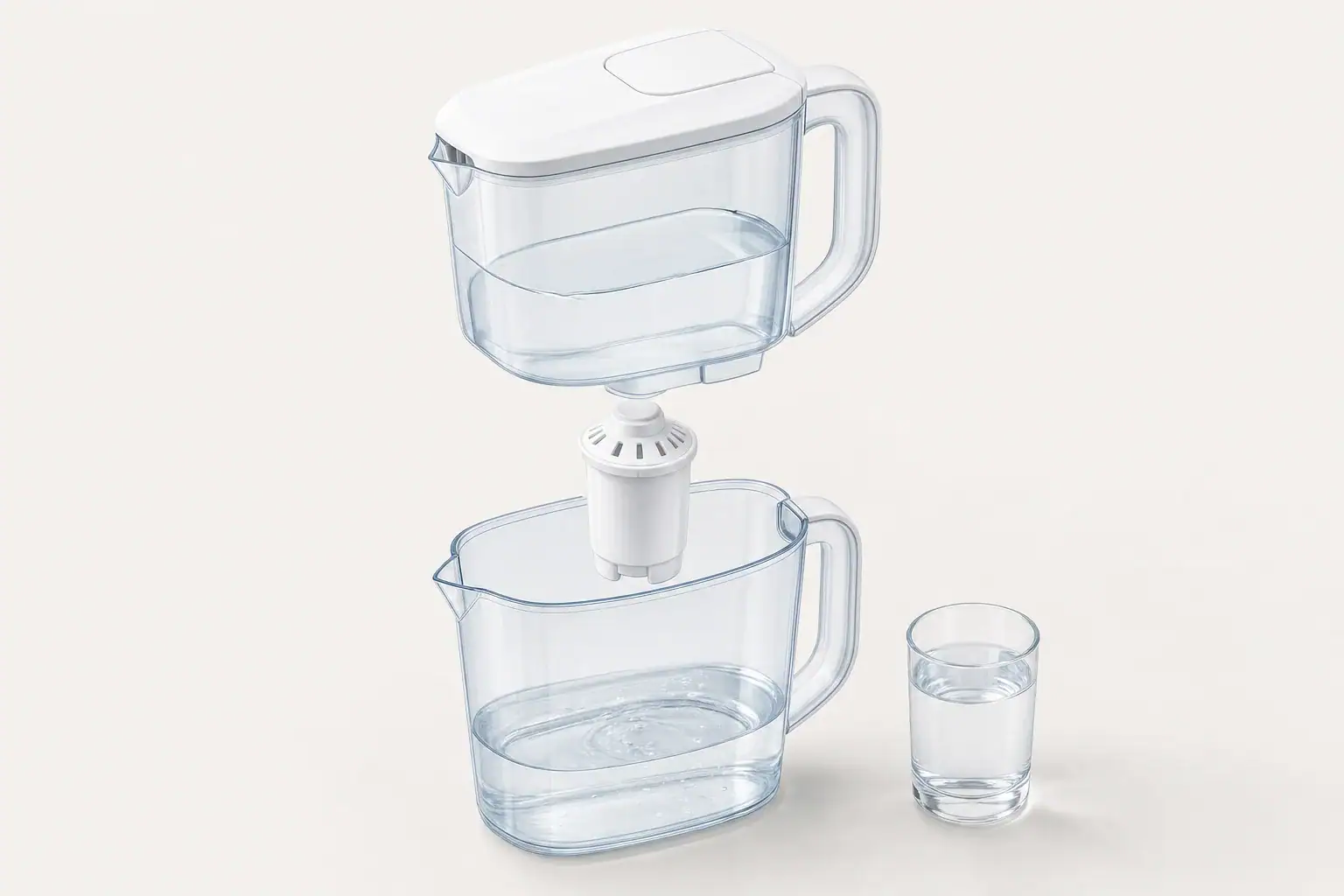
Filling a water filter pitcher above its maximum fill line can allow tap water to overflow the upper reservoir, travel around the cartridge, or mix with water that has already been filtered. The exact pathway depends on the pitcher’s design, but the practical response is the same: stay at or below the marked line and let each batch drain completely.
Overfilling does not always mean that every drop in the pitcher is unfiltered. However, once untreated water has spilled into the lower chamber or entered the pouring path, there is no reliable way to tell how much bypass occurred by looking at or tasting the water.
How pitcher overfilling can bypass the filter
Most filter pitchers have two main water chambers. Tap water enters an upper reservoir, passes through a cartridge, and collects in a lower storage chamber. The cartridge is intended to be the only route between the two.
A maximum fill line helps keep the water within that intended route. If the upper reservoir is filled too high, water may reach openings, seams, or edges that are not part of the filtration path.
Water can spill over the reservoir edge
In some pitchers, the upper reservoir sits inside the main body with a small gap around it. Water above the reservoir’s capacity may spill over its side and fall directly into the lower chamber. That water has not passed through the cartridge.
This can be difficult to notice when the pitcher is opaque, the reservoir is covered by a lid, or the overflow is small.
Water can move around a poorly seated cartridge
A cartridge usually fits into an opening at the bottom of the reservoir. If the filter is loose, tilted, incorrectly prepared, or missing a required gasket, a high water level may increase leakage around the connection.
The fill line cannot compensate for incorrect installation. Even when the reservoir is filled properly, the cartridge should be seated according to the manufacturer’s instructions.
Filtered and unfiltered water can meet
Some pitchers require more than one reservoir load to fill the lower chamber. Adding another batch before checking the lower water level can cause filtered water to rise toward the upper reservoir or other internal openings.
That contact does not necessarily create a large bypass, but it defeats the intended separation between incoming tap water and stored filtered water. It can also lead to leaking when the lid is installed or when the pitcher is moved.
Pouring before the reservoir drains can release tap water
Even when the pitcher is not filled above its line, pouring while tap water remains in the upper reservoir can cause untreated water to leave through the lid or spout on certain designs. This is especially likely if the pitcher is tilted sharply.
Unless the instructions specifically say that the pitcher can be poured while filtering, wait until the upper reservoir has drained.
Which max fill line matters?
A pitcher may have a line in the upper reservoir, a capacity mark on the main body, or both. These markings can serve different purposes, so use the instructions supplied for the specific pitcher when available.
| Marker location | What it usually controls | Possible result of overfilling |
|---|---|---|
| Upper reservoir | Amount of tap water added per batch | Water may spill around the filter or reservoir edge |
| Lower pitcher body | Stored filtered-water capacity | Water may rise into upper components or leak while pouring |
| Both locations | Batch size and total capacity | Ignoring either line may disrupt chamber separation |
Do not assume that a line on the outside shows how much tap water can be poured into the upper reservoir at once. If the markings are unclear, add a smaller amount, allow it to filter completely, and check the lower chamber before adding another batch.
What to do after overfilling a filter pitcher
If water clearly overflowed the upper reservoir or may have bypassed the cartridge, the simplest correction is to empty the pitcher and refill it correctly.
- Stop adding or pouring water. Keep the pitcher upright so additional tap water does not move into the spout or lower chamber.
- Discard the remaining water. If bypass is suspected, empty both the upper reservoir and lower chamber rather than trying to separate them.
- Check the cartridge position. Confirm that it is fully seated, straight, and installed with any required gasket or adapter. Follow the preparation directions for that filter type.
- Wipe up overflow. Dry the lid, pitcher exterior, counter, and refrigerator shelf as needed.
- Refill only to the applicable line. Allow the upper reservoir to drain before adding another batch or pouring from the pitcher.
Replacing the cartridge is not usually necessary after a one-time overfill if it remains correctly installed and undamaged. Replacement may be appropriate if the cartridge has become dislodged, cracked, overdue for replacement, or cannot be seated securely.
Why slow filtration often leads to overfilling
Pitcher cartridges commonly drain gradually because water has to move through compact filtration media. Users may add more water when the level appears to fall, even though the lower chamber is already approaching capacity.
If flow has become unusually slow, do not solve the problem by filling above the line, pressing on the cartridge, enlarging openings, or otherwise modifying the pitcher. Instead, check for common issues:
- The cartridge was not prepared as directed.
- Air is trapped in the filter.
- The cartridge is not seated correctly.
- Sediment has accumulated on the filter inlet.
- The cartridge has reached its recommended replacement point.
- The reservoir or vent area needs routine cleaning.
Use only troubleshooting steps allowed by the pitcher’s instructions. A filter that remains abnormally slow, leaks around its seal, or will not stay in position may need replacement.
How to prevent unfiltered water from mixing
- Fill in measured batches. Stop at the upper reservoir line rather than estimating available space in the lower chamber.
- Let each batch finish draining. This makes the lower water level easier to assess.
- Keep the pitcher level while it filters. Tilting can send reservoir water toward the lid or spout.
- Do not pour early unless the design permits it. A covered reservoir does not necessarily prevent untreated water from leaving the pitcher.
- Recheck the filter after cleaning. Cartridge seals can shift when the pitcher is disassembled and reassembled.
- Do not rely on taste or appearance. A small amount of bypass may not produce an obvious difference.
Related guides: Pitcher filter maintenance • How often to replace pitcher filters • High-capacity pitcher filters
The practical rule for pitcher fill levels
Treat each marked fill line as an operating limit, not merely a capacity estimate. Keep tap water below the upper reservoir line, avoid filling the lower chamber beyond its intended capacity, and wait for filtration to finish before pouring. These habits preserve the separation between untreated and filtered water without requiring guesswork about whether overflow caused bypass.
Frequently asked questions
What happens if I fill a water filter pitcher above the max line?
Water may overflow the upper reservoir, bypass the cartridge, or mix with filtered water in the lower chamber. Empty the pitcher and refill it to the correct line if bypass is possible.
Should I discard water after overfilling a filter pitcher?
If water overflowed the upper reservoir or may have entered the lower chamber without filtering, discard the water and refill the pitcher correctly.
Can I pour water from a pitcher while the filter is still draining?
Only if the manufacturer’s instructions specifically allow it. On some designs, tilting the pitcher before the upper reservoir drains can release unfiltered water through the lid or spout.
Which fill line should I follow on a filter pitcher?
Follow the upper reservoir line when adding tap water and any lower-body capacity line for stored filtered water. If the markings are unclear, use smaller batches and allow each one to drain fully.
Do I need to replace the filter after overfilling the pitcher?
Usually not, provided the cartridge is undamaged and securely seated. Replace it if it is cracked, dislodged, overdue for replacement, or unable to seal correctly.
Recommended next:
- Best Pitcher Water Filters for Better-Tasting Tap Water (Chlorine Focus)
- Pitcher Filter vs Bottled Water: Cost per Gallon Breakdown
- How Often Should You Replace Pitcher Filters? (By Household Size)
- TDS in Pitcher-Filtered Water: What Changes and What Doesn’t
- Pitcher Filters for Renters: What to Look For (Capacity + Fridge Fit)
- Pitcher Filter Maintenance: Cleaning & Sanitizing Without Off-Flavors
- More in Pitcher Filters →
- NSF/ANSI standards explained (42/53/401/58)
- Clear trade-offs: pitcher vs faucet vs under-sink vs RO
- Maintenance planning: cost per gallon and replacement cadence