How to Compare Pitcher, Under-Sink, and RO Filters
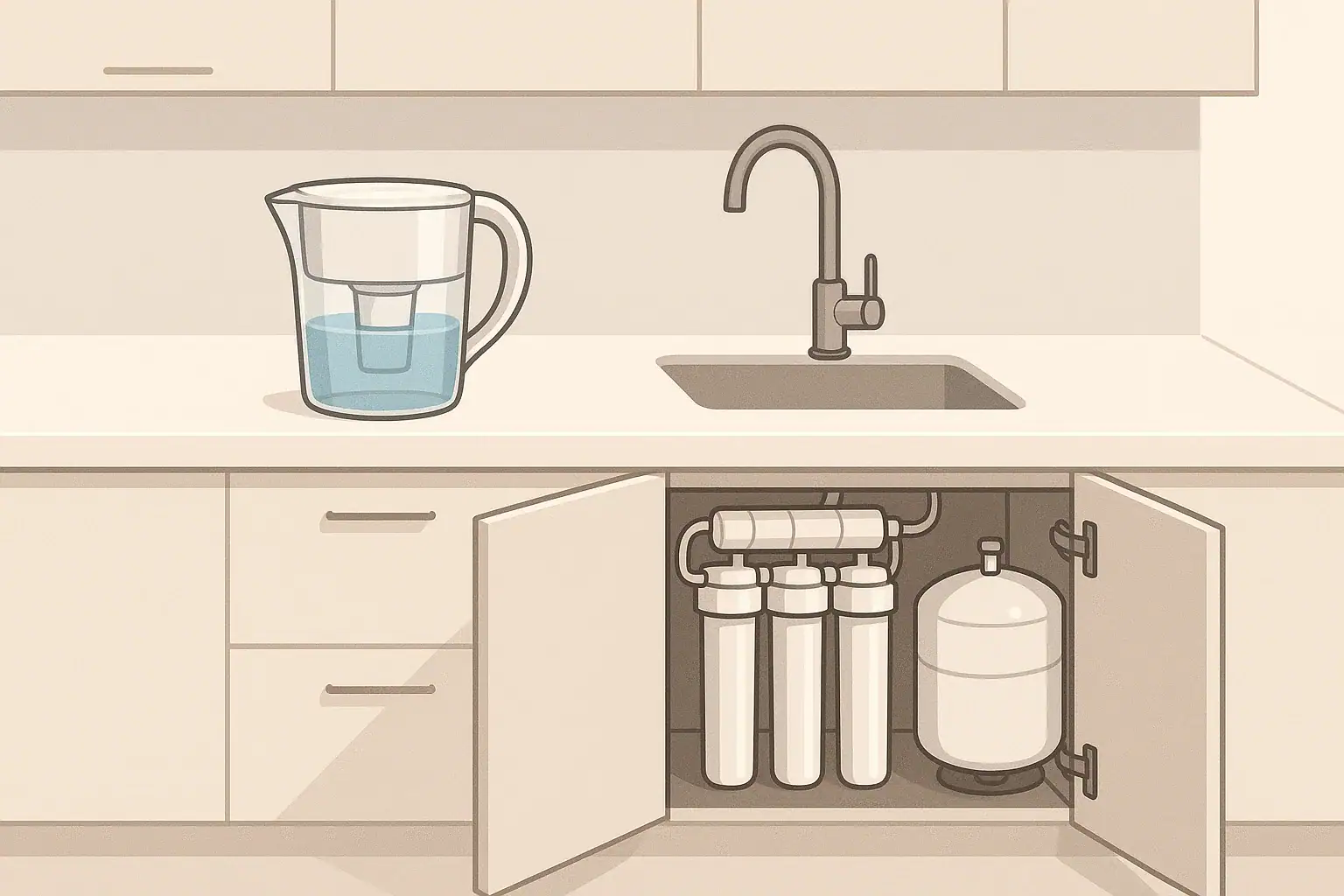
Pitcher, under-sink, and reverse osmosis (RO) filters all improve tap water, but they do it in different ways and at very different costs. The best choice for your home depends on three main factors:
- What is in your water now (municipal vs well, known issues)
- How much water you actually use every day
- How much time and money you want to spend on installation and upkeep
In most U.S. homes, a basic profile of water quality and use is enough to narrow the choice. If you know whether you are on city water or a private well, and you have a recent water quality report or test, you can map those findings to what each filter type can reasonably handle.
This article focuses on three common point-of-use options:
- Pitcher filters: countertop jugs you fill manually
- Under-sink filters: canisters or cartridges plumbed to your cold line, with or without a separate faucet
- Reverse osmosis (RO) systems: multi-stage units, usually under the sink, that include a membrane and a small storage tank
Other formats such as faucet-mount, whole-house, refrigerator, and shower filters can complement these, but they solve slightly different problems and are covered elsewhere in the content cluster.
Pitcher Filters: Low Cost, Limited Capacity
Pitcher filters are usually the easiest and lowest-cost way to start improving tap water. They rely on relatively small cartridges, often combining activated carbon with simple mechanical filtration. Some designs also include ion exchange media for targeted contaminants such as certain metals.
When a Pitcher Filter Makes Sense
A pitcher filter is usually a good fit when:
- You live in a small household or only need filtered water for drinking.
- You rent and cannot make plumbing changes.
- You mainly want to reduce chlorine taste and odor from a treated municipal supply.
- You have limited upfront budget and are comfortable with frequent manual refills.
Pitchers are especially practical in apartments, dorms, or offices where under-sink access is limited. They can sit in the refrigerator to keep water cold and are easy to move if you relocate.
What Pitchers Typically Address
Depending on the cartridge design and certifications, pitcher filters can often help with:
- Chlorine taste and odor
- Some sediment and visible particles
- Certain metals such as lead, if specifically certified
- Some organic compounds that affect taste and smell
However, they have limited capacity and flow rate. Cartridges are relatively small and can become clogged faster in water with high sediment or rust. For contaminants that require more extensive treatment, such as many dissolved salts, some PFAS, or a broad range of volatile organic compounds (VOCs), pitchers are usually not the strongest option.
Costs and Maintenance for Pitchers
Pitchers usually have the lowest upfront cost. Ongoing replacement costs are driven by how much water you drink and the recommended capacity per cartridge. Many manufacturers specify cartridge life in gallons or in months, whichever comes first.
You can estimate cost per gallon by dividing the cartridge price by its rated capacity, keeping in mind this is an example and real usage may be lower in turbid or heavily treated water. You also need to consider:
- Frequent refilling time and space in the refrigerator.
- Remembering to replace cartridges on schedule.
- Hand-washing the pitcher to prevent biofilm buildup.
Example values for illustration.
| Aspect | Pitcher | Under-sink (non-RO) | RO system |
|---|---|---|---|
| Typical upfront cost (example range) | Low | Moderate | Higher |
| Cost per gallon (example trend) | Higher | Lower | Moderate to higher |
| Installation complexity | None | Basic plumbing tools | More involved plumbing |
| Flow and convenience | Slow; must refill | On-demand at tap | On-demand, limited by tank refill |
| Common role in home | Entry-level drinking water | Main kitchen drinking/cooking tap | Higher-reduction drinking water |
| Useful for heavily mineralized water | Limited | Moderate | Stronger |
| Ideal household size | 1–2 people (light use) | Most small to medium households | Households prioritizing extensive treatment |
Under-Sink Filters: Higher Flow and Mid-Range Costs
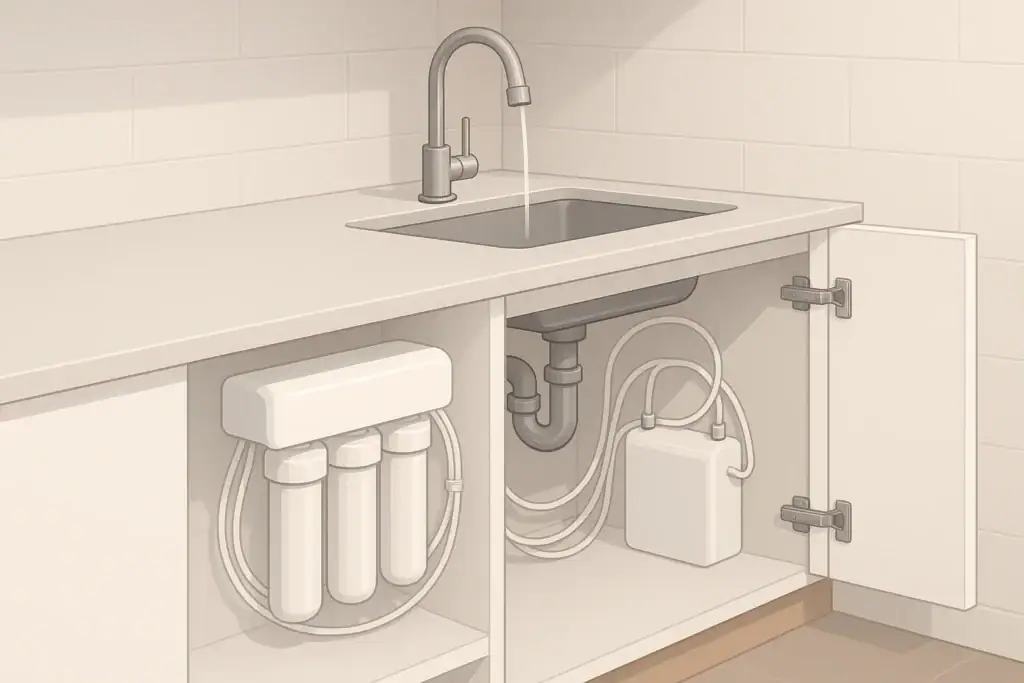
Under-sink filters plumb directly into your cold water line. Some feed a dedicated filtered faucet; others connect to your main kitchen faucet. They typically use one or more larger cartridges containing activated carbon, sediment filters, and sometimes specialty media for specific contaminants.
When an Under-Sink Filter Fits Best
An under-sink system is often a good match when:
- You want filtered water for both drinking and cooking.
- You use several gallons of water per day in the kitchen.
- You prefer not to manage refilling a pitcher.
- You want better performance than a pitcher, but do not need or want RO.
Under-sink filters are popular on municipal water supplies where the main concerns are chlorine, some metals, and a range of taste and odor issues. They can also serve as a polishing stage after a whole-house filter in homes with more complex water challenges.
Typical Contaminant Reduction
The exact performance of an under-sink filter depends on its cartridge design and certifications. In general, under-sink systems can address:
- Chlorine taste and odor (common for NSF/ANSI 42-certified units)
- Some particulates, sediment, and rust
- Certain metals such as lead, if certified under NSF/ANSI 53
- Some VOCs, depending on media and certification
- Selected emerging contaminants if listed under NSF/ANSI 401
Some under-sink systems can also include basic microbial barriers or be paired with additional stages, but this is more specialized and should be confirmed by the system’s documentation, not assumed.
Costs, Flow, and Capacity
Under-sink systems usually have a moderate upfront cost plus periodic cartridge replacements. Cartridges are larger than pitcher filters, so their capacity in gallons is typically higher. If your water is not extremely turbid and you replace cartridges on time, cost per gallon can be relatively low for everyday kitchen use.
Because they tap into the plumbing, under-sink systems can deliver water at or near normal faucet flow rates, though some designs may restrict flow slightly. For families who cook frequently, this convenience is often a deciding factor.
Installation usually requires:
- Shutting off the cold water line under the sink.
- Adding a tee or valve and connecting tubing to the filter housing.
- Mounting the unit and, if applicable, installing a small dedicated faucet.
Many homeowners can handle this with basic tools, but you can also plan for a plumber visit in your budget if preferred.
RO Systems: More Extensive Treatment and More Complexity
Reverse osmosis (RO) systems add a semi-permeable membrane to a multi-stage under-sink setup, usually along with sediment and carbon pre-filters and a post-filter. Water is pushed through the membrane, and a portion of the incoming water carries concentrated dissolved solids to the drain.
When RO Is Worth Considering
RO is generally considered when:
- You have very high total dissolved solids (TDS), such as in some well water or mineral-rich municipal supplies.
- You want broader reduction of many dissolved substances beyond chlorine and basic metals.
- You are willing to accept slower tank refill and some water sent to drain in exchange for more extensive treatment.
- You primarily need treated water for drinking, cooking, and possibly feeding appliances such as countertop coffee makers or kettles.
RO systems are most often installed at the kitchen sink and serve one or two faucets or appliances. They are less suited to high-flow uses like showers or outdoor taps without additional equipment.
What RO Systems Typically Address
The RO membrane is designed to reduce a wide range of dissolved substances. Performance depends on inlet water quality, pressure, temperature, and the specific membrane, but RO is commonly used for:
- Reducing many dissolved salts that contribute to TDS and hardness.
- Reducing certain metals and inorganic contaminants, within the system’s rated capabilities.
- Working alongside carbon stages to address chlorine, chloramine (if designed for it), and organic compounds that affect taste and odor.
RO alone is not a disinfection system in the same way as chlorination or ultraviolet treatment. Microbial risks should be evaluated separately, especially on private wells or after interruptions in municipal service.
Costs, Wastewater, and Maintenance
RO systems typically have higher upfront cost than basic under-sink filters and more components to maintain:
- Pre-filters (sediment and carbon) replaced on a regular schedule.
- RO membrane replaced less frequently, based on water quality and usage.
- Post-filter (often carbon) replaced periodically.
RO systems produce a stream of water to the drain that carries away concentrated dissolved solids. The ratio of treated water to drain water varies by design and by operating conditions; it is often a focus area when comparing systems, but values can only be treated as examples unless specified by actual test data.
The storage tank provides treated water on demand up to its capacity. After the tank is emptied, it takes time to refill, so very large households or heavy peak usage may notice slower recovery.
Budget Planning: Upfront vs Long-Term Cost per Gallon
Choosing between pitcher, under-sink, and RO often comes down to how you balance short-term and long-term costs against the level of treatment you want.
Estimating Cost per Gallon
For an approximate comparison, you can use a simple example method:
- Step 1: Estimate your daily filtered water use (glasses, cooking, coffee, etc.).
- Step 2: Multiply by 365 to get an annual total.
- Step 3: Divide your estimated annual replacement cost by that gallon total.
For instance, if a household uses about 2 gallons of filtered water per day (an example only), that is roughly 730 gallons per year. If replacement cartridges across the year cost a certain amount, dividing that number by 730 gives an estimated cost per gallon. You can repeat this for a pitcher, under-sink system, and RO system to see which aligns better with your budget and expectations.
Typical Cost and Effort Patterns
While each specific product differs, some common patterns are:
- Pitchers: Low initial price, higher cartridge cost per gallon, higher daily effort (refilling and waiting).
- Under-sink: Moderate initial price, relatively low cost per gallon, low daily effort once installed.
- RO: Higher initial price, moderate cost per gallon, low daily effort but periodic multi-stage maintenance.
Remember to consider plumber time if you do not plan to install under-sink or RO systems yourself, and to factor in any special pre-filtration needs if your water contains high sediment.
Matching Filter Type to Your Water and Household
To choose effectively, start with a basic profile of your water and how you use it. The source of your water and common issues in your area can help steer you toward or away from each type.
Municipal Water: Chlorine, Taste, and Aging Pipes
If you are on a municipal supply, you can usually access an annual water quality report. Common concerns include:
- Chlorine or chloramine taste and odor
- Sediment or rust from aging distribution pipes or in-home plumbing
- Metals such as lead from older service lines or fixtures
- Certain organic compounds and byproducts within regulatory limits but still of interest to some homeowners
On this kind of water, many households find that a well-chosen under-sink carbon-based filter, possibly with additional media for metals, provides a practical balance of performance and cost. A pitcher can be adequate if usage is low and budget is tight. RO is usually considered when TDS is high, taste remains objectionable after basic filtration, or a more extensive barrier to many dissolved substances is desired.
Well Water: Sediment, Hardness, and Variability
Private well water is more variable and typically lacks centralized treatment. Common issues include:
- High levels of sediment, sand, or rust
- Hardness (mineral content) contributing to scale
- Iron or manganese staining fixtures and dishes
- Potential microbial contamination, especially shallower wells
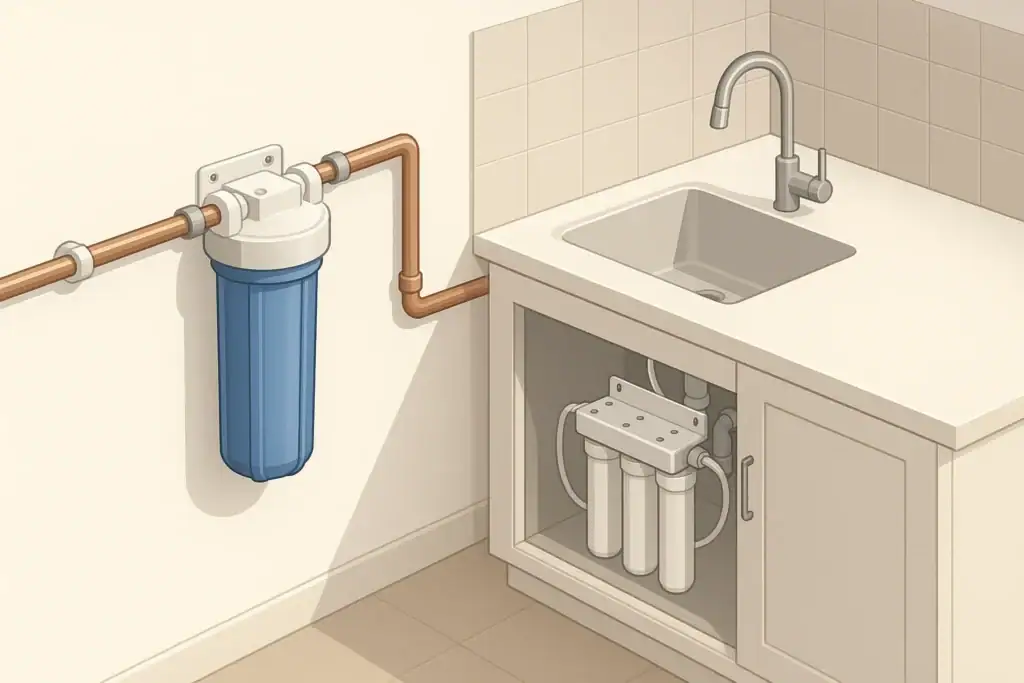
Pitcher filters alone are rarely sufficient as a primary strategy on challenging well water. Under-sink filters can still be valuable but often need to be combined with whole-house treatment (such as sediment filtration, softening, or disinfection) to prevent rapid clogging and to address concerns throughout the home.
RO can help reduce many dissolved minerals and improve taste, but it is usually deployed after upstream treatment for sediment and microbial control. Without that, membranes and pre-filters may foul quickly, increasing costs and maintenance.
Household Size and Use Patterns
Water demand patterns also affect the best choice:
- One or two people, light cooking: A pitcher or small under-sink filter may cover most needs.
- Families cooking daily: A full-flow under-sink filter or RO system is more convenient than repeated pitcher refills.
- Very high use (frequent guests, large pots, multiple appliances): Larger-capacity under-sink systems or RO with a larger tank may be worth the extra cost.
Think about peak times such as mornings and evenings. If emptying and refilling a pitcher repeatedly during these periods sounds frustrating, a plumbed solution will likely feel more sustainable.
Using Certifications and Water Metrics to Compare Options
Water filter claims are only meaningful when backed by standardized testing. In the U.S., NSF/ANSI standards are commonly used benchmarks. For pitcher, under-sink, and RO systems, the most relevant standards are:
- NSF/ANSI 42: Aesthetic effects such as chlorine taste and odor, and particulate reduction.
- NSF/ANSI 53: Health-related contaminants such as certain metals and organic compounds.
- NSF/ANSI 401: Selected emerging contaminants, such as some pharmaceuticals and chemicals.
- NSF/ANSI 58: Performance of reverse osmosis systems, including various inorganic and organic substances.
Third-party certifications can help you compare a pitcher, under-sink filter, and RO system in an apples-to-apples way, provided you look at the detailed contaminant reduction claims and not only the standard number.
Key Water Metrics to Keep in Mind
While you do not need laboratory-level testing to choose a home filter, a few basic measurements can guide your decision:
- Total dissolved solids (TDS): A general indicator of dissolved minerals and salts.
- Hardness: Related to calcium and magnesium content; affects scale and soap performance.
- Turbidity: Cloudiness from suspended particles; affects clarity and can clog filters.
- Water pressure and flow: Important for under-sink and RO performance; low pressure can reduce RO output.
Municipal reports may list many of these, and simple at-home tests can supplement them. In all cases, tie your metrics back to certified performance data for the specific system you are considering.
Example values for illustration.
| Standard | Focus area | Typical use in pitcher / under-sink / RO | What to verify |
|---|---|---|---|
| NSF/ANSI 42 | Aesthetic (taste, odor, chlorine, particulates) | Common for pitchers and under-sink; often a pre-filter stage in RO | Which aesthetic contaminants were tested and at what inlet conditions |
| NSF/ANSI 53 | Selected health-related contaminants (e.g., some metals, VOCs) | More advanced pitchers and under-sink units; can accompany RO | Specific contaminants listed, test conditions, and replacement interval used in testing |
| NSF/ANSI 401 | Selected emerging contaminants | Certain pitcher and under-sink systems; some multi-stage setups | Which emerging contaminants are claimed and whether they match your local concerns |
| NSF/ANSI 58 | Reverse osmosis system performance | RO units for under-sink use | That the complete RO system (not just a single stage) is certified and under what water pressure |
| Independent lab reports | Supplemental performance data | All formats, especially newer technologies | Lab accreditation, test protocols, and whether full reports (not just summaries) are available |
| Manufacturer documentation | Capacity, replacement intervals, operating limits | All formats | Maximum and minimum pressure, temperature, and any pre-treatment requirements |
Maintenance Habits That Keep Any System Working
Regardless of whether you choose a pitcher, under-sink filter, or RO system, consistent maintenance is what keeps your water tasting and looking as expected.
General Maintenance Principles
For all three formats, it helps to:
- Track cartridge changes by date and approximate gallons used.
- Follow the shortest of the recommended time or capacity intervals.
- Watch for changes in taste, odor, or flow as early indicators of exhausted media or clogging.
- Clean housings, pitchers, and faucet aerators according to instructions to limit buildup.
Pitchers need more frequent attention but are simple to handle. Under-sink and RO systems require less frequent work but involve more components. Keeping a simple log on paper or a digital reminder can help you avoid overextending filters, which may reduce effectiveness and increase pressure drop.
By aligning your choice of pitcher, under-sink, or RO system with your water quality, household size, and realistic maintenance habits, you can arrive at a configuration that fits both your budget and your expectations for everyday use.
Frequently asked questions
How should I use a water test or municipal report to choose between a pitcher, under-sink, and RO?
Start by identifying key issues in the test or report: high TDS or hardness points toward RO, chlorine or taste issues can often be solved with carbon-based pitchers or under-sink units, and sediment suggests pre-filtration or whole-house treatment. Match the reported contaminants to systems that have third-party certifications for those specific reductions and factor in household water use and maintenance capacity.
What are typical maintenance intervals and costs for each system type?
Pitcher cartridges commonly need replacement every 1–3 months depending on use; under-sink cartridges often last 6–12 months; RO pre- and post-filters are usually changed every 6–12 months while membranes are replaced every 2–5 years. Exact costs vary widely by model and local prices, so check manufacturer capacity ratings and estimate annual replacement expense to compare cost per gallon.
Can reverse osmosis reliably remove lead and PFAS?
RO membranes reduce many dissolved metals, including lead, and can significantly lower concentrations of some PFAS compounds, but removal depends on the membrane, pre-/post-filtration, and operating conditions. Verify performance with NSF/ANSI 58 certification or independent lab data for the specific contaminants of concern before assuming complete removal.
How much water does an RO system waste, and can I reduce that waste?
Waste ratios vary by design and conditions; older or basic RO units commonly produce 3–4 gallons of drain water per gallon of product water, while more efficient systems or units with recovery boosters can approach 1:1 or better. You can reduce net waste by choosing higher-efficiency systems, adding a permeate pump, or repurposing drain water for non-potable uses where appropriate.
Are under-sink filters suitable for well water?
Under-sink filters can treat some taste, odor, and particulate issues from well water, but untreated well water often requires upstream solutions for sediment, hardness, iron, and microbial risks to prevent rapid clogging and protect downstream equipment. For wells, combine whole-house pretreatment and disinfection as needed and use under-sink or RO units as polishing stages after those measures.
Recommended next:
- NSF/ANSI standards explained (42/53/401/58)
- Clear trade-offs: pitcher vs faucet vs under-sink vs RO
- Maintenance planning: cost per gallon and replacement cadence