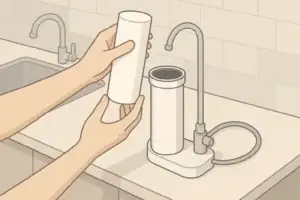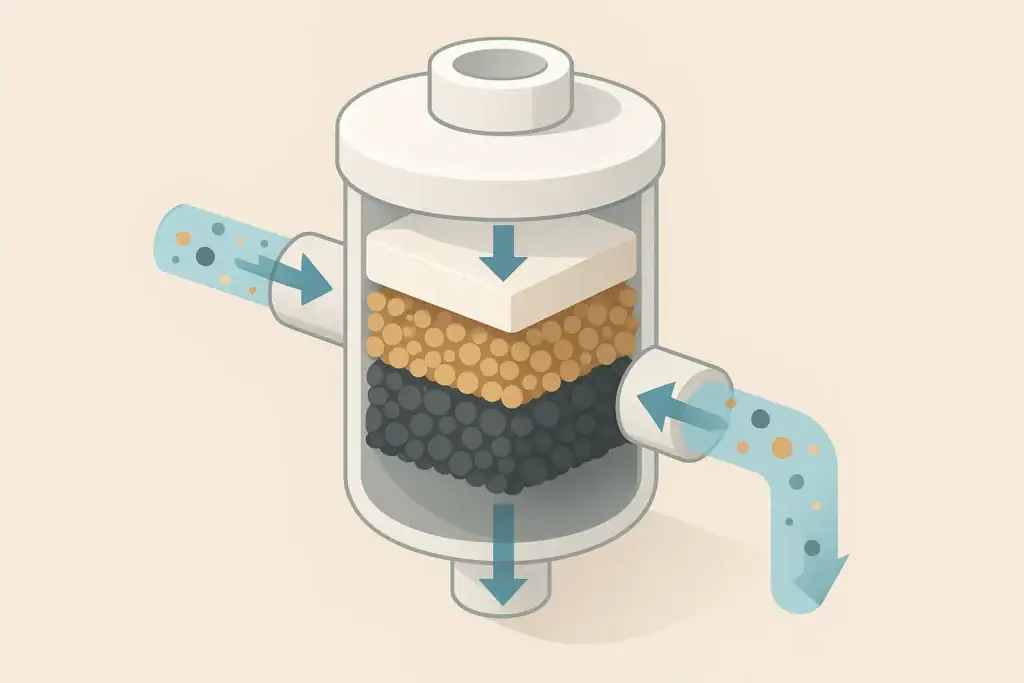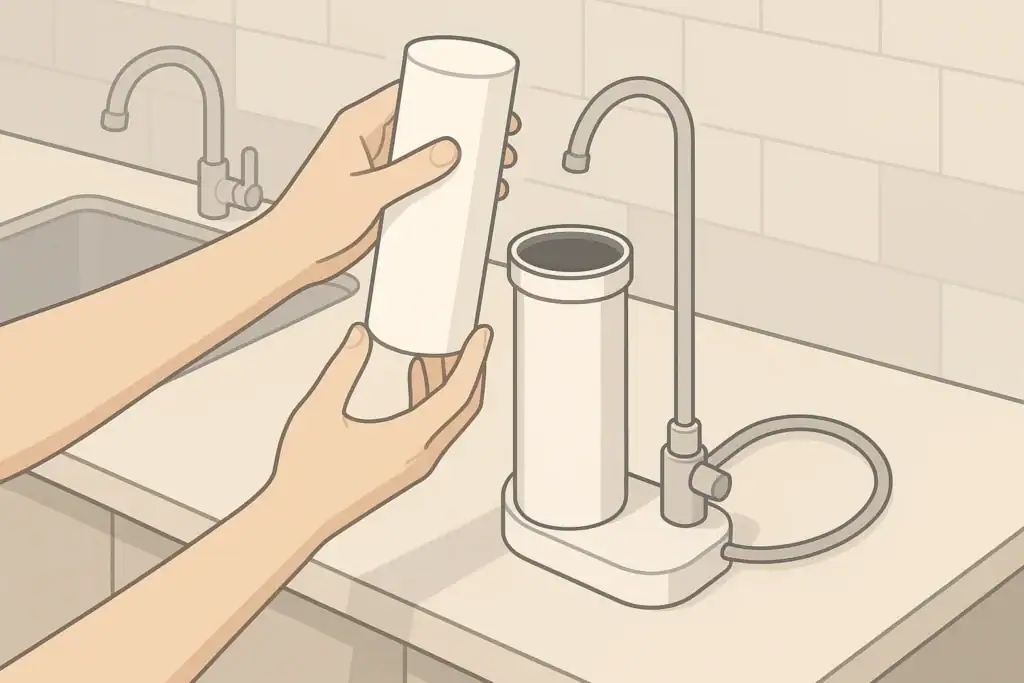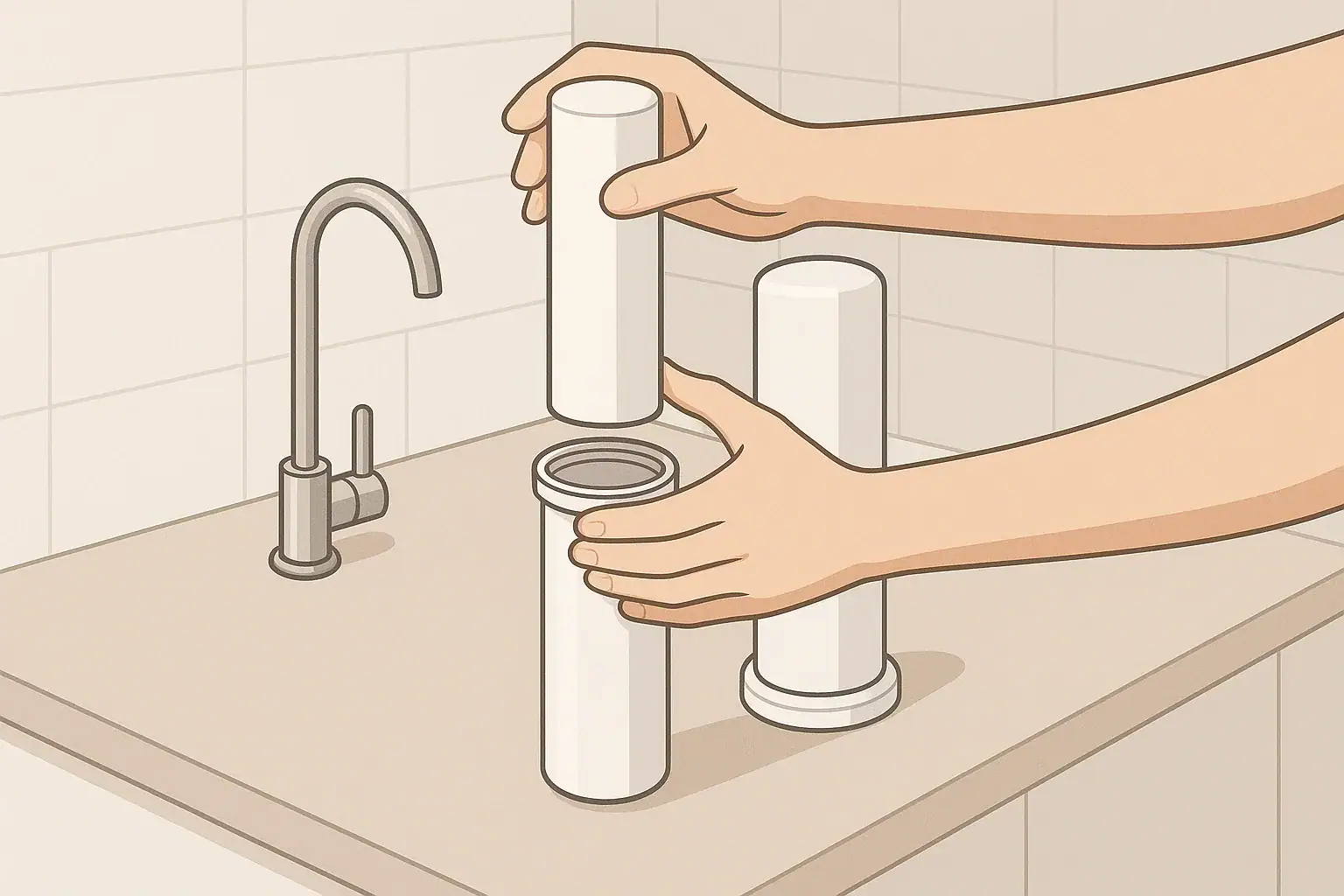
Water filters work best when they are replaced on time. Waiting until water tastes noticeably different or flow nearly stops can mean you have been using an exhausted filter for weeks or months. A simple replacement planner helps you estimate your next filter change date instead of guessing.
Most home water filtration systems in the United States are rated either by time (months) or by capacity (gallons or liters). Those ratings are based on typical households, typical municipal water, and controlled test conditions. Real homes are more variable. Your actual replacement timing depends on how much water you run through the filter and what is in that water.
Building a basic planner can help you:
- Track different filters in your home (kitchen, fridge, shower, whole-house)
- Estimate change dates using your own water use, not just the box estimate
- Spot patterns, such as filters clogging early due to sediment
- Budget for replacement cartridges over the year
Why Planning Filter Changes Matters
Most home water filtration systems in the United States are rated either by time (months) or by capacity (gallons or liters). Those ratings are based on typical households, typical municipal water, and controlled test conditions. Real homes are more variable. Your actual replacement timing depends on how much water you run through the filter and what is in that water.
Building a basic planner can help you:
- Track different filters in your home (kitchen, fridge, shower, whole-house)
- Estimate change dates using your own water use, not just the box estimate
- Spot patterns, such as filters clogging early due to sediment
- Budget for replacement cartridges over the year
Step 1: Gather the Key Specs for Each Filter
Start by collecting the fundamental information for every water filter you maintain. This includes pitcher filters, faucet-mount units, under-sink systems, reverse osmosis systems, whole-house cartridges, refrigerator filters, and shower filters. Having this information in one place makes planning much easier.
Information to record
Use a simple spreadsheet, notebook, or note-taking app to capture:
- Filter location – for example: kitchen sink, fridge, whole-house, shower
- Filter type – pitcher, faucet-mount, under-sink, RO, whole-house, refrigerator, shower
- Filter role – sediment, carbon taste/odor, lead reduction, scale control, RO membrane, post-filter, etc.
- Rated capacity – usually in gallons or liters (for example, “up to 200 gallons” as an illustrative figure)
- Rated time – typical maximum time in service (for example, “3 months” or “12 months” as examples)
- Install date – when you last installed the cartridge
- Water source – municipal supply or private well
- NSF/ANSI claims – such as 42, 53, 401, or 58 if listed on the product materials
When possible, keep the original packaging or a photo of the label so you can refer back to the stated capacity and any maintenance notes. If you cannot find a capacity number, you can still plan using the time-based recommendation paired with your observations of flow and taste.
| Filter format | Main rating to track | Common use pattern | Primary planner focus |
|---|---|---|---|
| Pitcher | Gallons and months | Intermittent pours | Refills per day and taste |
| Faucet-mount | Gallons | On-demand at sink | Estimated drinking and cooking volume |
| Under-sink (carbon) | Gallons and months | Daily cooking and drinking | Household size and meal prep habits |
| Reverse osmosis | Individual stage intervals | Drinking, ice, some cooking | Stage-specific schedules and taste |
| Whole-house | Gallons or months | All taps and appliances | Flow changes and visible sediment |
| Refrigerator/ice | Months or gallons | Cold water and ice | Time in service and ice quality |
| Shower | Months | Daily showers | Time plus odor at hot water |
Step 2: Estimate Your Household Water Use
Next, estimate how much water each filter actually processes. Manufacturer ratings are calculated from assumed daily use. Your real use may be higher or lower, which affects the true change date.
Simple way to approximate gallons per day
For most households, a quick approximation is enough. Consider:
- How many people live in the home (full-time and frequent visitors)
- Where each person gets drinking water – pitcher, fridge, sink, or bottled
- How often you cook with filtered water – boiling pasta, making coffee, rinsing produce
- Whether pets use filtered water
You can assign rough example values like:
- Per person drinking water: 0.5–1.0 gallons per day (example range)
- Cooking with filtered water: 1–3 gallons per day for the household (example range)
- Coffee/tea makers, countertop dispensers: 0.5–1.0 gallons per day (example values)
These are illustrative estimates. Your actual use may be different. The goal is not to be perfectly precise, but to be consistent so your future comparisons are meaningful.
Matching usage to specific filters
Different filters may share the household’s total water use. For example, a home might use a whole-house filter for all incoming water plus an under-sink system for drinking and cooking. In that case:
- The whole-house filter handles showers, toilets, laundry, and sinks.
- The under-sink filter covers only drinking and cooking at one tap.
Try to assign water uses to specific devices. For example:
- Pitcher: most drinking water at home
- Fridge filter: drinking and ice for quick access
- Shower filter: only showers in one bathroom
Once you have this breakdown, you can estimate a daily volume for each filter based on your household routines.
Step 3: Convert Capacity Into a Target Change Date
With capacity and estimated daily use in hand, you can calculate an approximate service life in days. This gives you a target date for your planner, instead of relying only on the maximum months listed on packaging.
Basic calculation method
The simplest approach is:
- Service days (estimate) = Rated capacity (gallons) ÷ Estimated gallons per day
Then you can convert service days into calendar months, or directly count forward from the installation date on a calendar.
For example values only:
- If a filter is rated for 200 gallons (example) and you use about 2 gallons per day (example), the estimated life is around 100 days.
- If a filter is rated for 1,000 gallons (example) and you use about 10 gallons per day (example), the estimated life is also about 100 days.
These numbers are for illustration only and will not match any specific product. The idea is to use your own estimates for capacity and daily use.
Factor in maximum time in service
Many filters specify both a maximum capacity and a maximum time in use, whichever comes first. Even if you use very little water, you are generally expected to change the cartridge after the stated months due to gradual changes in media performance and potential buildup inside the housing over time.
In your planner, note both:
- Calculated capacity-based date – when the estimated gallons will be reached
- Time-based limit date – installation date plus the stated months
Use the earlier of the two as your target change date. This is a practical compromise between usage-based planning and the manufacturer’s time guidance.
Adjust for water quality conditions
Water quality can make filters clog faster or work harder. Important factors include:
- Sediment and turbidity – visible particles or cloudiness often shorten the life of sediment and carbon filters.
- Hardness and scale – high calcium and magnesium can affect some media and appliances.
- Chlorine or chloramine levels – carbon filters designed for taste and odor may reach their practical lifespan sooner with higher disinfectant levels.
If you know your municipal water quality report values (such as hardness or typical turbidity) or have general information from a private well test, you can note this in your planner. Households with higher sediment or hardness often find they need shorter intervals than capacity alone would suggest.
Step 4: Use Visual and Performance Cues
Real-world performance often tells you as much as any calculation. Your replacement planner should include a place to record observations about water taste, odor, and flow, along with your actual change date. Over a few cycles, these notes help fine-tune your estimates.
Common cues that it is time to replace a filter
Watch for these practical signs:
- Noticeable drop in flow rate at the tap, shower, or entire home.
- Change in taste – for example, water begins to taste or smell closer to unfiltered tap water.
- Reappearance of chlorine-like odor in hot showers or at the kitchen sink.
- More sediment or discoloration visible in tubs, sinks, or toilets with a whole-house filter.
- Appliance behavior – such as ice cubes looking different or ice production slowing down for fridge filters.
While you should not rely solely on these cues, they help confirm whether your estimated change date is realistic. If you consistently notice these signs weeks before your planned date, your household usage or water quality may be shortening the effective life of the filter.
Tracking your actual change history
Each time you replace a filter, log:
- Date removed and date installed for the new cartridge.
- Estimated gallons used based on your planner.
- Reason for change – scheduled, poor taste/odor, low flow, visible sediment, etc.
- Notes on water quality – such as clear, slightly cloudy, or unusual odors.
Over time, this becomes a personalized baseline, more specific than general packaging guidance. For example, you might discover that your whole-house filter consistently reaches your flow comfort limit about one month earlier than the stated interval, while your shower filter can comfortably reach its stated time limit without issue.
Step 5: Integrate Certifications and Performance Claims
Many home water filters reference NSF/ANSI standards, especially 42, 53, 401, and 58. Your replacement planner should include a column for which standards each filter claims to meet. This can help you match filter stages to their roles and understand which performance aspects depend on timely replacement.
How certifications relate to replacement planning
NSF/ANSI certifications typically specify that performance claims, such as reduction of certain contaminants or improvement in taste and odor, are valid up to the product’s rated capacity and service conditions. If you continue using a filter well beyond that point, you can no longer assume it meets the tested performance claims.
For household planning:
- Note which filters are certified for taste and odor improvement.
- Note which filters are certified for particulate or turbidity reduction.
- Note which filters are certified for specific chemical or particulate contaminants.
- For RO systems, note stage-specific recommendations related to NSF/ANSI 58.
When a filter is associated with a particular certification, it is especially important to respect the recommended capacity and time-in-service so you stay within the performance envelope that was evaluated in testing.
| Standard | Primary focus area | What to log in your planner | Planning reminder |
|---|---|---|---|
| NSF/ANSI 42 | Aesthetic effects (taste, odor, chlorine) | Which filters improve taste or reduce chlorine-like odors | Track taste and odor notes near end of rated life |
| NSF/ANSI 53 | Health-related contaminant reduction | Filters with claims for contaminants like lead or certain metals | Emphasize capacity-based change dates for these filters |
| NSF/ANSI 401 | Emerging compounds and incidental contaminants | Filters designed for additional specified compounds | Make note of any water quality changes you observe near interval end |
| NSF/ANSI 58 | Reverse osmosis systems | RO systems and which stages follow this standard | Plan separate intervals for prefilters, membrane, and postfilters |
| Other relevant standards | System-specific performance | Any additional standards listed on documentation | Record along with notes on capacity and replacement interval |
Example values for illustration.
Putting Your Replacement Planner Into Daily Use
Once you have capacity, estimated use, visual cues, and certification notes in one place, the last step is to make your planner easy to use. Many households find it helpful to set calendar reminders for upcoming change dates based on calculations, then adjust those reminders using real-world observations.
You can:
- Assign each filter a color or label in your notes so you can quickly see what is due next.
- Mark estimated change windows rather than a single exact date, allowing for variations in guests, travel, and seasonal water use.
- Review your log every few months to see which filters tend to be replaced early or late compared with your initial estimate.
Over time, your replacement planner becomes a customized schedule built around your specific home, usage patterns, and local water characteristics. That makes it easier to maintain consistent taste and odor, keep filters performing as intended within their rated capacity, and plan ahead for the cost and timing of new cartridges.
Frequently asked questions
How do I use a filter’s rated capacity to estimate next filter change date?
Divide the filter’s rated capacity (in gallons) by your estimated gallons per day for that device to get an approximate service life in days, then count forward from the install date. Also compare that calculated date with the manufacturer’s maximum time-in-service and use the earlier date as your planned change date. This approach gives a usage-based estimate rather than relying solely on the package months.
What should I do if a cartridge lists only a time recommendation and no capacity?
If no capacity is provided, follow the time-based recommendation as a starting point and track real-world observations such as flow, taste, and any visible sediment. Log each replacement and the conditions that prompted it to build a household-specific pattern; over a few cycles you can decide whether to shorten the interval based on observed performance. For critical contaminant-reduction claims, err on the side of replacing on schedule.
How does poor water quality change how I estimate next filter change date?
High sediment, turbidity, hardness, or elevated disinfectant levels can shorten a filter’s useful life by clogging media or consuming capacity faster. If you know your water has higher sediment or hardness, reduce the estimated service days or schedule more frequent checks. Recording local water quality values in your planner helps you adjust estimates consistently.
Can I rely only on taste or flow changes to decide when to replace a filter?
Taste and flow cues are useful confirmations but can appear after the filter has already passed its effective capacity, especially for health-related contaminants. Use sensory cues alongside capacity- and time-based estimates in your planner, and treat sudden changes in taste or flow as a reason to replace the cartridge promptly. Combining methods gives the safest and most reliable schedule.
How often should I log replacements and review my planner to improve estimates?
Log each replacement with install/remove dates, estimated gallons used, and the reason for change every time a cartridge is replaced. Review logs after two to three replacement cycles or every few months to spot patterns and adjust your estimated change dates. Regular logging turns uncertain guesses into a personalized, data-backed schedule.
- NSF/ANSI standards explained (42/53/401/58)
- Clear trade-offs: pitcher vs faucet vs under-sink vs RO
- Maintenance planning: cost per gallon and replacement cadence