
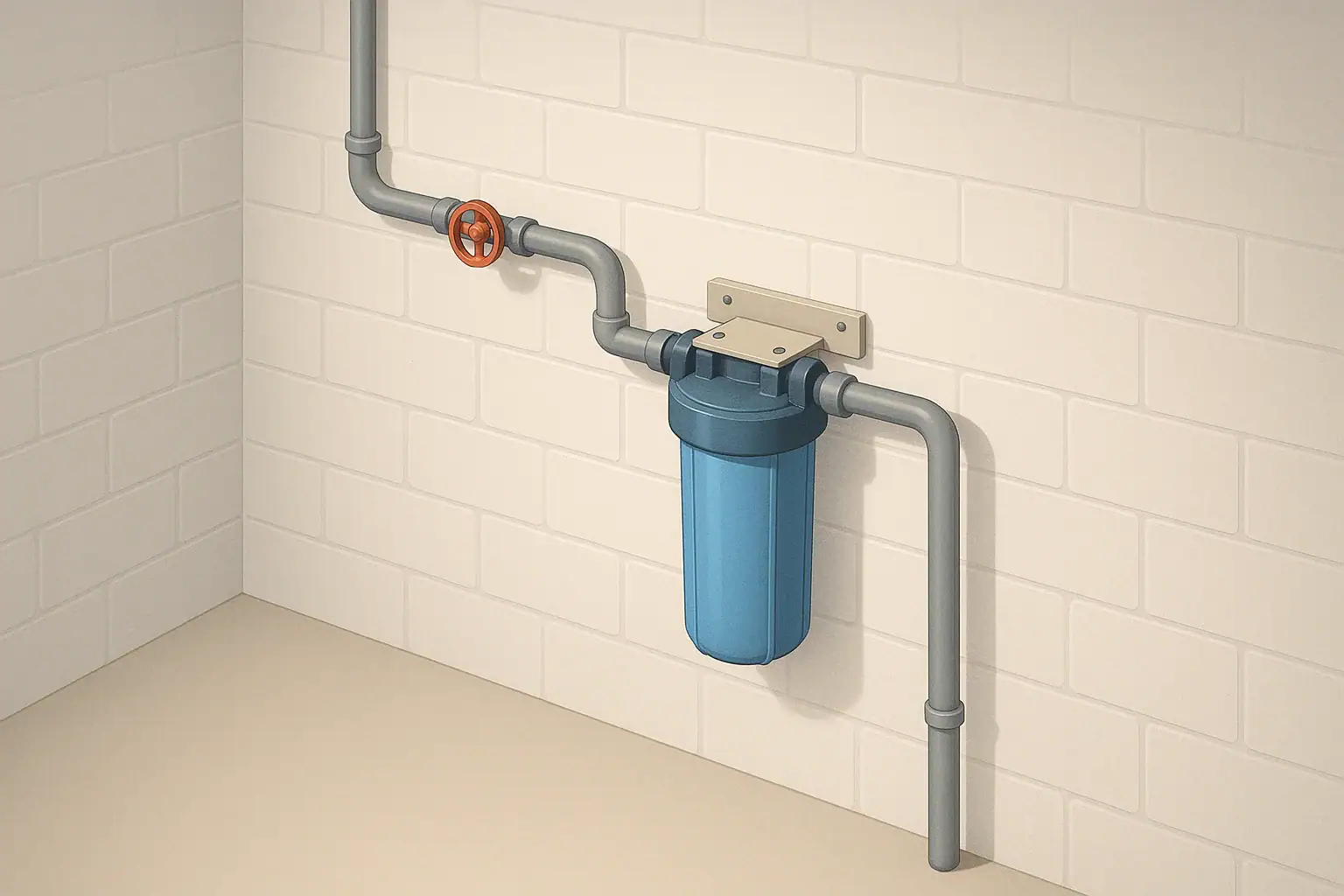
Why Whole House Sediment Filters Matter for Cloudy Water
Cloudy, murky or gritty tap water can be caused by suspended dirt, clay, silt, sand or rust. Cloudiness is not always sediment, however. Water that looks milky when drawn but clears while standing may contain entrained air rather than filterable particles. Diagnose the cause before buying treatment; the EPA’s drinking-water guidance discusses both sediment-related turbidity and air in water (EPA).
A whole house sediment filter, also called a point-of-entry sediment filter, is installed on the main water line so water is filtered before reaching most fixtures and appliances. It is intended to capture suspended solids rather than dissolved substances.
Filterable sediment can include:
- Sand and fine soil
- Silt and clay particles
- Rust flakes and pipe scale
- Other visible debris carried by the source water or plumbing
Sediment can affect water clarity and accumulate in aerators and other narrow passages. A correctly selected filter can reduce the particulate load reaching downstream equipment, but it does not establish that the water is microbiologically or chemically safe. The CDC recommends testing water first, selecting treatment for the substance identified and checking the exact product in an appropriate certification database (CDC, Choosing Home Water Filters).
How Whole House Sediment Filters Work
Most whole house sediment filters use a screen or porous cartridge to retain particles as water passes through. They are generally installed near the point where the service line enters the building and before equipment that the filter is meant to protect. The exact order depends on the plumbing, water source and other treatment equipment.
Common formats include:
- Spin-down or flushable screens: A screen retains relatively coarse material, and a valve allows accumulated debris to be purged. These are commonly used as a first stage where visible sand or grit is present.
- Pleated cartridges: A replaceable pleated surface provides filtration area. Only cartridges identified by their manufacturer as cleanable should be rinsed and reused.
- Depth cartridges: Spun, string-wound or molded media retain particles within the thickness of the cartridge.
- Staged systems: A coarse screen or cartridge precedes a finer cartridge, reducing the load placed on the later stage.
These are mechanical filters. A sediment rating alone does not demonstrate reduction of dissolved lead, chlorine, PFAS, hardness minerals or other dissolved substances. It also does not prove removal of microorganisms or microplastics. Any such claim should be verified for the exact system and cartridge in the certifier’s listing.
| Format | Useful starting situation | Maintenance | Main limitation |
|---|---|---|---|
| Spin-down screen | Visible sand or coarse grit | Purge the collection chamber and clean the screen as directed | May not resolve fine haze |
| Pleated cartridge | Visible particles where additional surface area is useful | Replace, or clean only if the cartridge instructions permit it | Flow can decline as the cartridge loads |
| Depth cartridge | Mixed or finer suspended particles | Replace according to condition and manufacturer instructions | Heavy sediment can shorten service life |
| Coarse and fine stages | A broad range of particle sizes | Monitor and service each stage separately | Requires more space and components |
Understanding Micron Ratings, Flow and Capacity
Micron rating, rated flow and pressure drop must be considered together. Choosing the smallest advertised number without checking the rest of the product data can result in disappointing flow or unnecessarily frequent replacement.
Micron rating and water clarity
A micron rating describes particle size, but it does not by itself state what percentage of particles will be retained or under what test conditions. A finer cartridge may capture smaller particles, yet it can also load faster when the incoming water carries a large amount of sediment. A staged arrangement can place a coarse screen or cartridge before a finer element.
Use the observed particle type and a water analysis to establish the treatment goal. Then compare cartridges using their complete data sheets rather than treating a micron number as a universal performance guarantee. For more detail, see the water filter micron rating chart and the comparison of 1-, 5- and 20-micron sediment filters.
Nominal vs. absolute micron ratings
Nominal and absolute ratings are not interchangeable. The CDC explains that an absolute pore-size rating represents the largest pore and is intended to provide a defined maximum, while nominal or mean ratings allow variation in pore size. Consequently, a nominal rating should not be presented as a guaranteed cutoff (CDC).
Manufacturers may also use different test methods or retention percentages. Check the product literature for the rating type, test method, stated efficiency and the exact cartridge to which the claim applies.
Flow rate and pressure drop
A point-of-entry filter must accommodate the household’s simultaneous demand. Review:
- Service or rated flow: The flow associated with the manufacturer’s performance data or certification listing.
- Initial pressure drop: The pressure loss through a clean housing and cartridge at a stated flow.
- Loaded pressure drop: The increasing restriction as captured sediment accumulates.
- Port and pipe size: Connections and valves can become bottlenecks even when the cartridge is described as high flow.
Estimate peak demand from the fixtures and appliances likely to run together, then compare that estimate with product-specific flow and pressure-drop information. Do not assume that a certification recorded at one flow establishes acceptable pressure at every household demand.
Capacity and replacement intervals
Mechanical filter life depends on the cartridge, incoming sediment load, water use and acceptable pressure loss. A calendar interval can be a useful reminder, but it should not override the product instructions or signs that the filter is obstructed.
Inspect or replace a cartridge when indicated by its instructions or when you observe:
- A sustained pressure or flow decline at multiple fixtures
- A growing pressure difference across the filter, if gauges are installed
- The return of particles that the system previously controlled
- Damage, contamination or another condition identified in the manual
The CDC advises replacing filters according to manufacturer instructions. Capacity or service-cycle claims should be checked for the exact filter; they cannot be inferred from the micron rating alone.
Matching a Sediment Filter to Your Water Source
Start with the source water and the actual problem rather than a generic list of filter sizes. Fill a clear glass from a cold tap and observe whether particles settle or the cloudiness clears. Also note whether the issue affects hot and cold water, one fixture or the entire home. These observations help identify where further inspection or testing is needed, but they are not a substitute for a laboratory analysis.
Municipal water with occasional cloudiness
If a sudden color or clarity change affects municipal water, contact the utility before assuming that permanent filtration is the answer. Utility work, distribution-system sediment or a problem within the building’s plumbing can require different responses. If the issue is confirmed as particulate matter entering the home, a point-of-entry sediment filter may be useful.
A separate treatment stage is needed for a dissolved contaminant or for a taste-and-odor claim not covered by the sediment cartridge. For example, some systems use carbon, but its performance must be verified for the intended claim. The site’s guide to under-sink filters for chlorine taste and odor discusses point-of-use treatment for that different task.
Private well water with visible particles
Visible sand or silt in well water can support using a coarse first stage followed by a finer cartridge, but it can also indicate a well, pump or plumbing problem that filtration alone will not correct. Investigate a new or worsening sediment problem rather than continually installing finer cartridges.
The EPA recommends testing private wells annually for total coliform bacteria, nitrate, total dissolved solids and pH, and testing for additional contaminants when local conditions suggest them. It also recommends testing when water changes in appearance and using a state-certified laboratory (EPA, Protect Your Home’s Water).
A sediment filter does not disinfect well water. If testing identifies bacteria or another health-related contaminant, select treatment specifically validated for that finding and address possible defects in the well system.
Considering other water quality factors
Sediment filtration is not a general substitute for contaminant-specific treatment. Depending on test results, a home may require a different or additional process for:
- Disinfectant taste and odor
- Dissolved lead or other metals
- PFAS or volatile organic compounds
- Hardness, dissolved iron or manganese
- Bacteria, viruses or protozoa
Verify the exact reduction claim for the complete product configuration. A housing, brand name or general reference to an NSF/ANSI standard is not evidence that every cartridge from that manufacturer reduces every substance.
Installation Basics and Sizing Considerations
Installation requires shutting down and opening the main water line, supporting the housing and making watertight connections. Follow the system manual and applicable plumbing requirements. A plumber can assess pipe sizing, pressure, backflow considerations and placement when the installation is outside the homeowner’s experience.
Where the filter is installed
A typical sediment filter is placed after the main shutoff and before equipment it is intended to protect, often before the water heater. The correct location depends on the water source and treatment train. Leave the clearance specified by the manufacturer for removing the sump or cartridge, and account for the weight of a water-filled housing.
Bypass and shutoff valves
Service valves can isolate the filter, while a properly arranged bypass can maintain water service during maintenance. Water sent through the bypass is unfiltered. Include a safe way to relieve pressure before opening a housing and follow the manual’s startup procedure when repressurizing it.
Pipe size and flow requirements
Match the installation to the existing main, expected peak demand and the housing’s listed limits. Port size alone does not prove that a filter will deliver a particular flow with an acceptable pressure drop. Compare the complete system data, including the intended cartridge.
System pressure and temperature range
Confirm that operating pressure and water temperature remain within the housing’s listed limits. Consider pressure surges and the well pressure-switch range, not only a single static reading. Install pressure control or other protection only where appropriate for the plumbing system and product instructions.
NSF/ANSI Standards and Verified Claims
Certification is claim- and configuration-specific. NSF explains that NSF/ANSI 42 addresses aesthetic effects, while NSF/ANSI 53 covers specified health-effects claims and NSF/ANSI 401 covers specified emerging-compound or incidental-contaminant claims. Systems under these standards may be point-of-use or point-of-entry; the listing for the exact product identifies its certified claims (NSF).
Other standards may apply to different products. NSF/ANSI 58 applies to reverse-osmosis systems, as discussed in this guide to NSF/ANSI 58. NSF/ANSI 61 and NSF/ANSI/CAN 372 concern material or lead-content requirements in relevant applications; they do not by themselves establish sediment or contaminant reduction.
| Standard | General scope | What to verify |
|---|---|---|
| NSF/ANSI 42 | Aesthetic effects, including specified particulate or taste-and-odor claims | The exact particulate class or other claim, model, element and rated conditions |
| NSF/ANSI 53 | Specified health-effects reduction claims | The individual contaminant named in the listing |
| NSF/ANSI 401 | Specified emerging-compound or incidental-contaminant claims | The listed compounds and exact system configuration |
| NSF/ANSI 58 | Reverse-osmosis systems | The claims made for the complete RO system |
| NSF/ANSI 61 or NSF/ANSI/CAN 372 | Relevant material-safety or lead-content requirements | Do not interpret component compliance as a contaminant-reduction claim |
A certification-checking example
As one certification example—not a product ranking—the official NSF database lists the A. O. Smith AO-WH-PREV point-of-entry system with the AO-WH-PREV-R2 replacement element under NSF/ANSI 42 for nominal particulate reduction, Class V, at a listed flow of 6 gallons per minute (NSF certified-product listing).
The manufacturer separately describes AO-WH-PREV-R2 as a nominal 5-micron cartridge and recommends replacement every six months, while noting that filter life varies with local water conditions and water use (A. O. Smith product page). The replacement label distinguishes the evidence: the particulate Class V claim is NSF certified, while the nominal 5-micron statement was tested and verified by Kemflo rather than NSF (official replacement label).
This example shows why the model, replacement element, claim and test conditions must be read together. The NSF listing does not establish lead, PFAS, chlorine, microorganism or microplastics reduction for that configuration, and it states that capacity or service-cycle claims do not apply to the mechanical-filtration claim.
Maintenance Tips to Keep Sediment Filters Working Well
Maintenance should follow the manual for the installed housing and cartridge. Keep the model number and replacement-element number with the maintenance record so that a physically compatible but differently rated cartridge is not substituted accidentally.
Monitoring water clarity and pressure
Watch for a sustained reduction in flow throughout the home and the return of visible particles. Gauges installed before and after the filter can provide a more useful indication than appearance alone: an increasing pressure difference at the same approximate flow suggests growing restriction. Use the manufacturer’s service threshold if one is specified.
Replacing or cleaning cartridges
For a typical cartridge housing, the manual may direct the user to:
- Isolate or bypass the housing and relieve pressure
- Remove the sump with the specified tool
- Discard or clean the cartridge only as its instructions allow
- Clean the housing and inspect the seal
- Use only a lubricant approved by the manufacturer if the O-ring requires it
- Reassemble, repressurize slowly, check for leaks and flush as directed
These are general steps, not a replacement for the product manual. Do not open a pressurized housing or reuse a disposable cartridge.
Flushing spin-down and screen filters
Flush a spin-down filter at the interval and in the manner specified by its manufacturer. Direct discharge to a safe location and inspect the screen if flushing no longer restores performance. A damaged screen should be replaced rather than treated as a finer filtration stage.
Coordinating with other filtration stages
Record service dates and pressure observations for each stage separately. A clogged sediment cartridge can reduce flow to carbon filters, softeners, ultraviolet equipment and point-of-use systems, while a problem in a downstream component can be mistaken for a clogged prefilter. If only one sink needs particulate protection, compare whole-house treatment with a sediment prefilter under the sink.
Frequently asked questions
How often should I replace a whole house sediment cartridge?
Use the interval and condition limits stated for the exact cartridge. Incoming sediment, water use and acceptable pressure loss can change service life substantially. Replace it sooner if the manual’s pressure-drop limit is reached, whole-house flow declines or the cartridge is damaged. A manufacturer’s schedule for one model should not be generalized to every sediment filter.
What micron rating should I choose for cloudy water?
First confirm that suspended particles—not entrained air or a dissolved-water problem—are causing the cloudiness. Then compare nominal or absolute rating, retention efficiency, flow and pressure-drop data for the exact cartridge. Where coarse and fine particles occur together, staged filtration may avoid placing the entire load on one fine cartridge.
Can a sediment filter remove lead, chlorine or PFAS?
A generic sediment rating does not establish those reductions. Choose treatment carrying the exact claim needed and verify the complete model in the certifier’s database. Point-of-use reverse osmosis or other media may be appropriate for some tested contaminants, but performance remains product- and claim-specific.
How do I size a whole house sediment filter?
Estimate simultaneous household demand and compare it with the complete system’s rated flow and pressure-drop data. Also check pipe and port size, operating-pressure limits, cartridge availability and service clearance. The port diameter or micron rating alone is not enough to size the system.
Are spin-down filters suitable for sandy well water?
A spin-down screen can serve as a coarse first stage for visible sand when the chosen screen is rated for the application. New or worsening sand should also prompt inspection of the well and pumping system because filtration does not repair the underlying source of sediment.
Recommended next:
- NSF/ANSI standards explained (42/53/401/58)
- Clear trade-offs: pitcher vs faucet vs under-sink vs RO
- Maintenance planning: cost per gallon and replacement cadence