
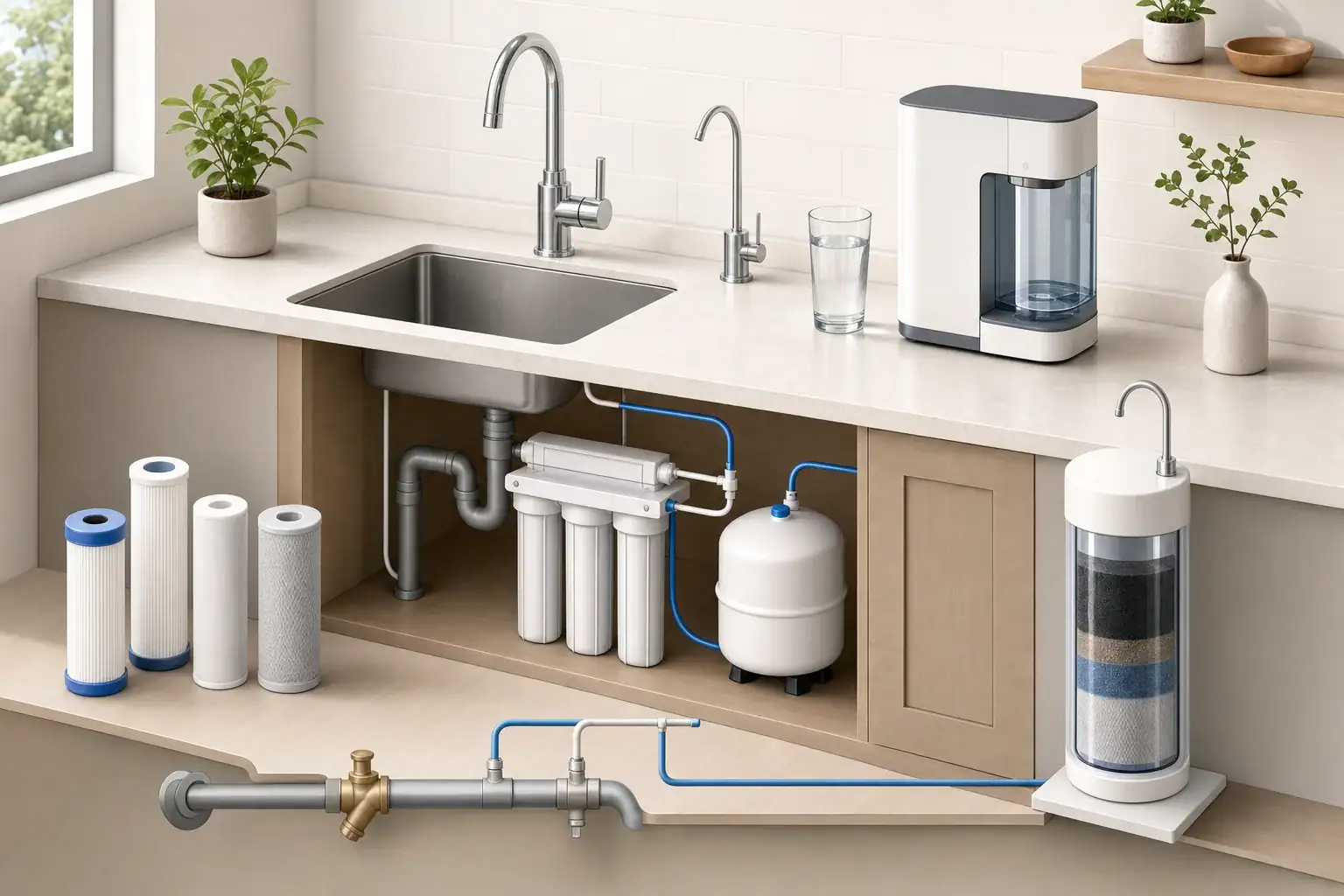
A water filter micron rating describes the approximate particle size a filter is designed to capture. It is an important specification for sediment filtration, but a lower number is not automatically better. The right choice depends on the sediment present, the required water flow, the filter’s construction, and whether other treatment stages follow it.
Choosing an unnecessarily fine cartridge can cause rapid clogging and noticeable pressure loss. Choosing one that is too coarse may allow troublesome particles to pass. This water filter micron rating chart provides practical starting points while recognizing that sediment size, shape, and concentration vary among homes.
How Water Filter Micron Ratings Work
One micron, also called a micrometer, is one-millionth of a meter. Micron ratings are commonly used for sediment cartridges, screens, filter bags, and some carbon or specialty filters.
The number generally indicates the size of particles the filter is intended to retain under specified conditions. For example, a 20-micron sediment cartridge is designed for coarser material than a 5-micron cartridge. It does not mean every particle larger than the stated size will always be captured, because performance also depends on how the rating was measured.
A micron rating mainly addresses suspended particles. It does not by itself show that a filter reduces dissolved salts, hardness minerals, chlorine, lead, PFAS, microorganisms, or other specific substances. Those concerns may require different treatment technologies and performance information.
Smaller ratings create more resistance
As filter openings become smaller, water encounters more resistance. A fine cartridge may provide clearer-looking water, but it can also reduce flow sooner as sediment accumulates. Housing size, cartridge surface area, water pressure, and sediment load all affect the result.
Micron Rating Chart for Common Sediment Conditions
Sediment does not come in perfectly uniform sizes. Sand, silt, clay, pipe scale, and corrosion particles can overlap in size, and irregularly shaped particles may behave differently from round test particles. The chart should therefore be used as a selection aid rather than a laboratory classification system.
When the sediment size is unknown, inspect what collects in faucet aerators, toilet tanks, appliance screens, or an existing filter housing. A water test or particle analysis can provide better information when clogging is severe or persistent.
Example values for illustration.
| Approximate particle range | Possible sediment examples | Practical cartridge starting point | Main consideration |
|---|---|---|---|
| 100 microns and larger | Coarse sand or large rust flakes | 100- to 200-micron screen | Useful for heavy, coarse material |
| 50-100 microns | Fine sand or pipe debris | 50- to 100-micron screen or pleated filter | Often used as an initial prefilter |
| 20-50 microns | Visible silt or corrosion particles | 20- to 50-micron pleated cartridge | Balances particle capture and flow |
| 10-20 microns | Smaller silt and suspended debris | 10- to 20-micron pleated or depth cartridge | May clog quickly under heavy loads |
| 5-10 microns | Fine silt or fine particulate rust | 5- to 10-micron depth cartridge | Common polishing range |
| 1-5 microns | Very fine suspended particles | 1- to 5-micron depth or high-area cartridge | Requires adequate area and pressure |
| Below 1 micron | Specialty fine-particle applications | Rated submicron specialty filter | Verify performance method and flow limits |
Nominal and Absolute Micron Ratings
Two filters carrying the same micron number may not perform identically. The terms nominal and absolute describe different approaches to particle retention, but manufacturers do not always use identical test methods.
Nominal ratings
A nominally rated filter captures a stated percentage of particles around its listed size under particular test conditions. It may allow some particles at or above that size to pass. Nominal cartridges are widely used for general household sediment control because they can offer useful capacity and moderate pressure drop.
Absolute ratings
An absolute rating generally indicates a more tightly defined level of retention at the specified particle size. Even so, the rating should be read with its efficiency percentage, test method, flow conditions, and other supporting data. The word “absolute” alone does not establish performance for every contaminant or operating condition.
When comparing cartridges, look for consistent test information rather than comparing micron numbers in isolation. A clearly documented nominal filter may be easier to evaluate than a product displaying an unexplained absolute claim.
How Cartridge Type Changes Sediment Performance
The filter material and structure influence capacity, flow, and the kinds of particles captured. Micron rating is only one part of cartridge selection.
Screens and washable prefilters
Mesh screens are suited to coarse sand, grit, and large debris. They can protect finer downstream cartridges from premature loading. Screens generally do not remove fine silt, and cleaning frequency depends on how much sediment enters the system.
Pleated surface cartridges
Pleated cartridges provide a large surface area within a compact housing. Particles are collected mainly near the media surface, making this design useful for relatively uniform sediment and moderate-to-high flow. Some models are washable, but washability does not mean indefinite reuse.
Spun or melt-blown depth cartridges
Depth filters trap particles throughout a thick layer of media. Many have larger openings near the outside and finer openings toward the core. This graded structure can hold mixed particle sizes effectively, although trapped material is not normally removed by rinsing.
String-wound cartridges
String-wound filters use fiber wrapped around a central core. They can handle varied sediment loads and are available in multiple micron ratings. Performance depends on winding pattern, material, and construction quality.
Carbon and specialty cartridges
Carbon blocks may carry micron ratings because they also provide mechanical filtration, but their primary purpose is often taste, odor, chlorine, or specified chemical reduction. Sending heavy sediment directly into carbon can block its surface early. A separate sediment prefilter often helps preserve the useful capacity of downstream media.
Specialty membranes and ceramic elements may have very fine ratings, but they are not direct substitutes for a high-capacity sediment stage. Their flow and maintenance requirements must suit the intended application.
Balance Micron Size With Flow and Replacement Frequency
A cartridge should provide acceptable sediment control without creating excessive pressure loss. Whole-house systems generally need more flow capacity than a drinking-water filter serving one faucet. The same micron rating can behave differently in a small cartridge and a larger, higher-area cartridge.
Use staged filtration for mixed sediment
When water contains both coarse sand and fine silt, staged filtration is often more practical than relying on one very fine cartridge. A coarse screen or pleated filter can capture larger debris, followed by a finer depth cartridge. This arrangement distributes the sediment load and can extend the service life of the final stage.
Adding stages also adds resistance, so cartridge dimensions, housing flow ratings, available pressure, and peak household demand should be considered together. Plumbing changes should follow applicable codes and manufacturer instructions.
Replace by condition, not only by the calendar
Replacement intervals are affected by water use and sediment concentration. A cartridge that lasts several months in one home might clog much sooner in another. Reduced faucet flow, a rising pressure difference across the filter, or visible loading can be more informative than a fixed date alone.
A sudden increase in sand or sediment may indicate a source problem rather than normal filter loading. Well components, water-heater debris, deteriorating pipes, and utility work are possible contributors. Persistent or abrupt changes warrant appropriate inspection instead of repeatedly installing finer cartridges.
Example values for illustration.
| Observed condition | What it may indicate | Practical response |
|---|---|---|
| Normal flow and lightly loaded media | Cartridge remains serviceable | Continue routine checks |
| Gradual flow decline | Expected sediment accumulation | Plan cartridge replacement |
| Rapid flow decline after installation | Rating may be too fine or sediment load is high | Review staging, size, and source conditions |
| Fine sediment passes through | Rating may be too coarse or media may be damaged | Inspect installation and compare a finer rated option |
| Coarse filter repeatedly fills | Heavy sand or debris is entering | Investigate the source and prefilter capacity |
| Sudden pressure change | Possible blockage or system issue | Follow system guidance and arrange inspection if needed |
| Recurring odor or discoloration | May involve more than suspended sediment | Use suitable water testing to guide treatment |
Related guides:
Best Whole House Sediment Filters: Clear Up Cloudy Water •
Spin-Down Sediment Filters: When a Reusable Screen Makes Sense •
Whole House Filter Flow Rate: Sizing by GPM and Household Count •
Clogged Filter Too Soon: Common Causes
Choosing a Micron Rating for Your Home
Start with the problem you are trying to solve. Visible sand requires a different filter than fine haze, and neither choice alone addresses dissolved substances. If possible, identify whether the material originates at the water source, in household plumbing, or in a water heater.
- For coarse sand or grit: Begin with a coarse screen or high-micron prefilter rather than a very fine polishing cartridge.
- For visible silt: A medium-rated pleated filter can provide a practical balance of flow and retention.
- For fine suspended material: Consider a finer depth cartridge, preferably after a coarser stage when sediment loading is significant.
- For whole-house use: Confirm that the housing and cartridge can support peak household flow with manageable pressure loss.
- For drinking-water systems: Check the sediment requirements of downstream carbon, reverse osmosis, or specialty stages.
- For unexplained or changing conditions: Test the water and investigate the source before repeatedly lowering the micron rating.
The best micron rating is usually the coarsest filter that reliably controls the target sediment while preserving acceptable flow. Matching particle size, cartridge construction, filter area, and maintenance expectations produces a more practical result than simply choosing the smallest available number.
Frequently asked questions
Is a 5-micron water filter better than a 20-micron filter?
Not necessarily. A 5-micron filter captures finer sediment, but it may create more pressure loss and clog faster. A 20-micron filter can be the better choice when sediment is coarser or flow demand is high.
What micron filter should I use for sand in well water?
For visible sand or grit, begin with a coarse screen or prefilter, often in the 50- to 100-micron range. If fine sediment remains, add a finer downstream cartridge rather than using one very fine filter alone.
Does a micron rating remove dissolved contaminants?
No. A micron rating mainly describes suspended-particle filtration. Dissolved substances such as hardness minerals, salts, or certain chemicals require treatment selected for the specific contaminant.
How often should I replace a sediment filter cartridge?
Replace it when flow drops noticeably, pressure difference increases, or the cartridge is visibly loaded, while also following the system manufacturer’s guidance. Actual service life depends on water use and sediment concentration.
What is the difference between nominal and absolute micron ratings?
A nominal rating generally reflects partial retention of particles around the stated size, while an absolute rating usually indicates more tightly defined retention. Compare the stated efficiency, test method, and flow conditions rather than relying on the micron number alone.
- NSF/ANSI standards explained (42/53/401/58)
- Clear trade-offs: pitcher vs faucet vs under-sink vs RO
- Maintenance planning: cost per gallon and replacement cadence