
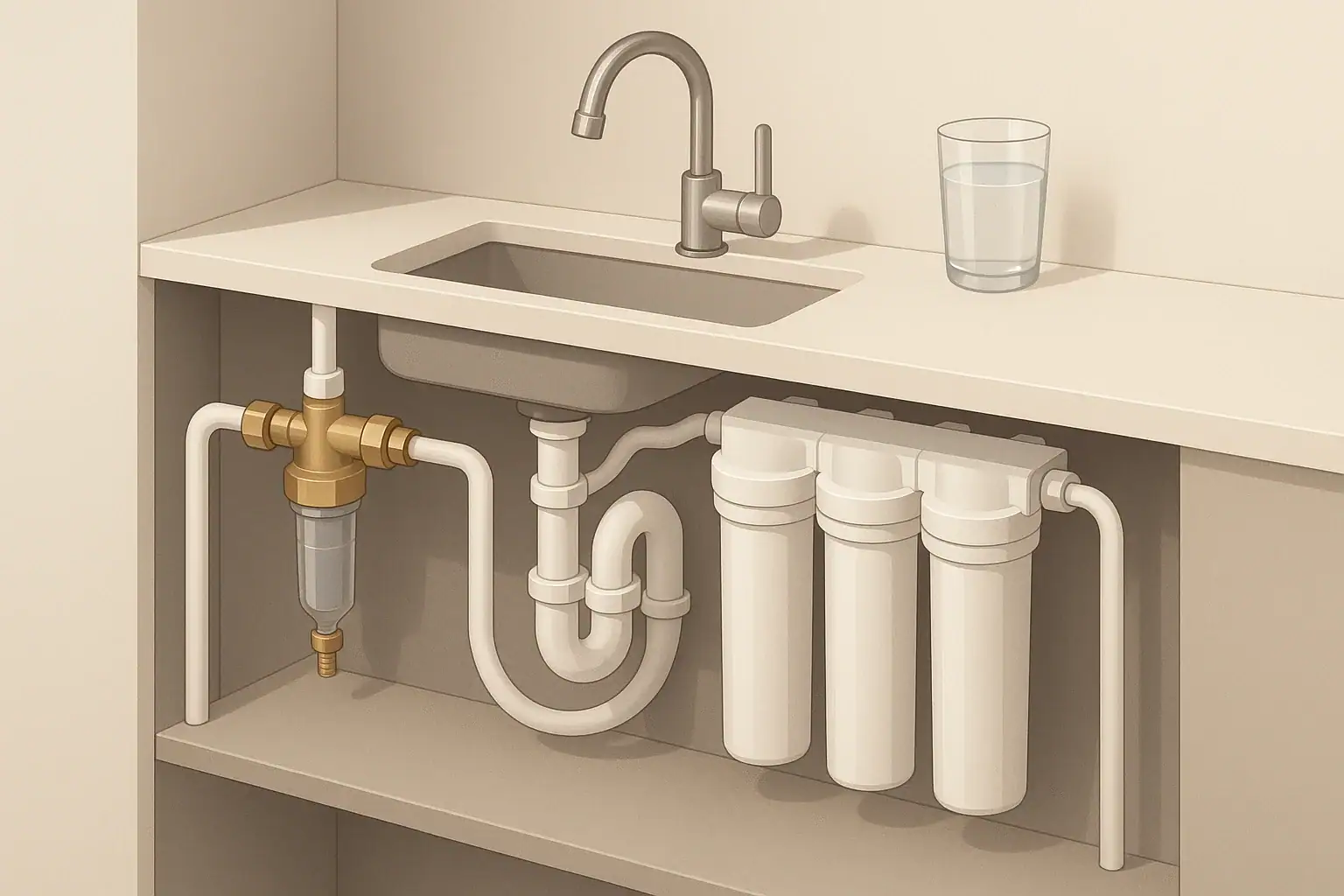
A spin-down sediment filter is a reusable prefilter designed to catch visible or semi-visible particles before they reach fixtures, appliances, or finer water filters. Instead of using a disposable cartridge as the main filter element, it uses a washable screen inside a clear or opaque housing. Water enters the housing, heavier particles are directed toward the lower portion, and the screen helps separate grit from the water stream.
These filters are most often used for suspended solids such as sand, pipe scale, rust flakes, and larger silt particles. They are common on well water systems, but they can also be used in some city water homes where incoming water occasionally carries debris from old plumbing, water main work, or corroding service lines.
A spin-down sediment filter is not a treatment device for dissolved substances. It does not meaningfully reduce chlorine, chloramine, hardness minerals, salts, lead dissolved in water, PFAS, VOCs, or taste and odor compounds. It also should not be relied on as a microbiological safety barrier. Its role is mechanical protection and coarse sediment control.
What a Spin-Down Sediment Filter Does
A spin-down sediment filter is a reusable prefilter designed to catch visible or semi-visible particles before they reach fixtures, appliances, or finer water filters. Instead of using a disposable cartridge as the main filter element, it uses a washable screen inside a clear or opaque housing. Water enters the housing, heavier particles are directed toward the lower portion, and the screen helps separate grit from the water stream.
These filters are most often used for suspended solids such as sand, pipe scale, rust flakes, and larger silt particles. They are common on well water systems, but they can also be used in some city water homes where incoming water occasionally carries debris from old plumbing, water main work, or corroding service lines.
A spin-down sediment filter is not a treatment device for dissolved substances. It does not meaningfully reduce chlorine, chloramine, hardness minerals, salts, lead dissolved in water, PFAS, VOCs, or taste and odor compounds. It also should not be relied on as a microbiological safety barrier. Its role is mechanical protection and coarse sediment control.
Why the reusable screen matters
The main advantage is that the screen can be flushed and reused. If a home has frequent gritty sediment, a standard cartridge may clog quickly and require repeated replacement. A spin-down filter can reduce that maintenance burden when the particles are large enough for the screen to catch.
The tradeoff is that a reusable screen is usually less effective at very fine sediment than a depth-style or pleated cartridge. It is best viewed as a first stage, not a complete sediment solution for every water problem.
How the Reusable Screen Works
Inside the housing is a cylindrical mesh screen. The screen has a micron rating, which describes the approximate particle size it is intended to capture. Larger micron numbers catch larger particles and tend to clog less quickly. Smaller micron numbers catch finer particles but may require more frequent flushing and can create more pressure drop.
Many spin-down housings include a bottom drain or flush valve. When opened according to the device instructions, accumulated sediment is discharged from the bottom of the housing. Some installations route that flush water to a suitable drain, while others require a bucket. Any drain arrangement should follow local plumbing requirements and avoid unsafe cross-connections.
The clear bowl found on many units is useful because it lets the homeowner see sediment buildup. However, clear housings should be protected from freezing, impact, direct sunlight, and conditions outside the rated pressure and temperature range.
Example values for illustration.
| Situation | Reusable screen fit | Practical note |
|---|---|---|
| Visible sand or grit from a well | Often good | Works best when particles are coarse enough to settle or screen out |
| Rapid clogging of downstream cartridges | Often good as a prefilter | May extend cartridge life when coarse sediment is the cause |
| Fine clay-like cloudiness | Limited | Very fine particles may pass through many screens |
| Chlorine taste or odor | Not suitable by itself | Carbon filtration is typically used for taste and odor concerns |
| Hardness scale | Not suitable by itself | Dissolved hardness minerals are not screened out |
| Protecting an RO or carbon system | Useful in some homes | Can serve as a coarse first stage before finer filters |
| Apartment with no plumbing access | Often impractical | Installation access and permission may be limiting factors |
When a Spin-Down Filter Makes Sense
A spin-down sediment filter makes the most sense when the water problem is frequent, physical, and coarse. If you can see grains in sink aerators, toilet tanks, appliance inlet screens, or filter housings, a reusable screen may be worth considering.
Well water with sand or grit
Private wells can produce sand or mineral particles for several reasons, including well construction, pump placement, aquifer conditions, or changes in water use. A spin-down filter can help keep larger particles out of plumbing and equipment. If the amount of sand is heavy or suddenly changes, it is wise to evaluate the well and pump system rather than relying only on filtration.
Protection for downstream filters
Under-sink carbon filters, reverse osmosis prefilters, refrigerator filters, and specialty cartridges can all lose flow when sediment loads are high. A spin-down filter placed upstream in an appropriate location can catch larger debris before it reaches those finer filters. This does not eliminate normal cartridge replacement, but it may reduce premature clogging.
Homes with occasional pipe debris
Some city water homes experience short periods of discolored water or small debris after water main maintenance, hydrant flushing, or plumbing repairs. A spin-down filter may catch some particles, but it should not be treated as a substitute for following local utility guidance, flushing fixtures appropriately, or replacing deteriorated plumbing components.
Where a Reusable Screen Does Not Solve the Problem
Not every water complaint is a sediment problem. A spin-down filter can be the wrong tool if the issue is chemical, dissolved, or extremely fine.
- Taste and odor: Chlorine, chloramine, sulfur-like odors, and many organic compounds are not addressed by a simple screen.
- Hard water: Calcium and magnesium are dissolved minerals. They pass through sediment screens.
- Lead and other metals: Particulate lead may be reduced by some sediment filtration, but dissolved lead requires filters designed and tested for that purpose. Do not assume a screen solves a lead concern.
- PFAS and VOCs: These are not removed by mechanical screening.
- Microbial concerns: A spin-down filter is not a disinfection system. Appropriate testing and treatment are needed when microbial safety is in question.
- Very fine turbidity: Fine clay, colloidal particles, and persistent cloudiness may require different treatment and sometimes professional diagnosis.
If the water issue is unclear, a basic water test and a visual inspection of sediment can prevent buying the wrong equipment. For private wells, testing should be part of routine ownership, especially when water appearance, odor, or flow changes.
Choosing Screen Size, Flow Capacity, and Placement
The right spin-down sediment filter depends on particle size, household flow rate, available pressure, and maintenance expectations. Oversizing or undersizing can both create problems. A very fine screen may clog often. A very coarse screen may let too much sediment through.
Micron rating
Common screen ratings vary widely. Coarse screens are often used first because they handle higher sediment loads with less pressure drop. Finer filtration, if needed, can follow with a cartridge. As a general example, a coarse screen may catch visible sand, while a finer cartridge may be needed for small silt that remains suspended.
Micron ratings are not always directly comparable between products because screen construction, nominal ratings, and flow conditions vary. Treat them as selection guides, not as absolute guarantees.
Flow rate
The filter should be sized for the flow it will actually see. A whole-home installation must handle simultaneous uses such as a shower, laundry fill, or kitchen faucet. An under-sink protective installation has lower flow demands but may still need enough capacity to avoid frustrating pressure loss. For sizing context, it can help to review whole house filter flow rate guidance before choosing a model.
If the existing system already has low pressure, adding any filter can make the problem more noticeable. Pressure gauges before and after filtration can help identify whether the filter is contributing to restriction, but installation should be done in a safe, code-compliant way.
Placement in the system
For whole-home use, spin-down filters are commonly considered near the point where water enters the home, before softeners, carbon tanks, or cartridge housings. For point-of-use protection, they may be considered before under-sink treatment equipment if space, pressure, and plumbing layout allow. If you are comparing whole-home setups more broadly, whole house filters vs water softeners explains how these systems serve different jobs.
A spin-down filter should be installed where it can be accessed for flushing, inspected for leaks, and serviced without strain. It should not be hidden behind finishes or placed where a leak would go unnoticed for long periods.
Installation and Safety Considerations
Most homeowners should treat installation as a plumbing project, not just a filter purchase. The housing must be compatible with the water pressure, temperature, pipe material, orientation, and intended flow. Local plumbing codes may require specific shutoff valves, pressure control, backflow protection, or drainage arrangements.
Do not bypass pressure relief devices, remove required backflow protection, or connect a flush line directly to a drain in a way that could allow contaminated water to enter the plumbing system. If a permanent drain connection is desired, it should be designed with proper air gap or other code-compliant protection by a qualified person.
Freezing is another important concern. Water expands when frozen and can crack housings or fittings. Filters in garages, crawl spaces, cabins, or exterior utility areas may need freeze protection or a different location.
Leak awareness matters. A sediment filter is part of the pressurized plumbing system. It should be installed where the bowl, fittings, and drain valve can be checked regularly. Many people also use a catch pan or leak detection device in vulnerable areas, but any device should complement, not replace, periodic inspection.
Maintenance Pattern and Replacement Planning
The reusable screen reduces cartridge waste, but it is not maintenance-free. The screen must be flushed, inspected, and sometimes removed for cleaning. How often depends on sediment load, screen size, water use, and whether the filter is protecting sensitive downstream equipment.
At first, homeowners often need to check the bowl frequently to learn the pattern. If sediment accumulates quickly, the filter may need regular flushing. If little collects over several weeks, the interval can be adjusted. Any sudden change in sediment volume, color, or odor deserves attention, especially on a private well. A simple whole house filter maintenance routine can make this easier to track.
Parts also wear. O-rings can flatten or dry out, drain valves can seep, and screens can become damaged or coated with minerals. Keeping compatible replacement seals and following the manufacturer maintenance instructions is part of responsible ownership.
Example values for illustration.
| Task | When to consider it | Why it matters |
|---|---|---|
| Visual bowl check | Weekly at first | Helps establish the home sediment pattern |
| Flush accumulated sediment | When buildup is visible or flow drops | Restores screen area and reduces restriction |
| Inspect downstream cartridge | During normal cartridge service | Shows whether coarse prefiltration is helping |
| Clean the screen manually | When flushing no longer restores flow | Removes clinging silt or mineral film |
| Check O-rings and seals | At service intervals | Reduces risk of seepage after reopening the housing |
| Review pressure drop | If fixtures slow noticeably | Helps identify clogging or undersizing |
| Reassess well or plumbing | If sediment suddenly increases | May indicate a source issue rather than a filter issue |
Related guides: Best Whole House Sediment Filters • When You Need a Sediment Prefilter Under the Sink • Whole House Filter Flow Rate • Whole House Filters vs Water Softeners
Practical Takeaways Before You Choose One
A spin-down sediment filter is most useful when the problem is recurring coarse sediment and you want a washable first stage. It can be a practical way to protect finer filters, appliances, and fixtures from sand, rust flakes, and larger debris.
It is not a universal water purifier. It does not replace carbon for taste and odor, reverse osmosis for many dissolved substances, softening for hardness, or disinfection when microbial safety is a concern. In many homes, the best use is as part of a staged approach: coarse reusable screen first, finer cartridge or specialized treatment only if the water conditions call for it.
Before choosing a model or screen size, identify the sediment you are trying to control, estimate the flow the filter must handle, and make sure the installation location allows safe service and leak monitoring. If the source of sediment is severe, new, or unexplained, filter selection should be paired with basic troubleshooting of the well, plumbing, or municipal supply conditions.
Frequently asked questions
How often should a spin-down sediment filter be flushed?
It depends on how much sediment the water carries. Many homeowners start by checking it weekly, then adjust the schedule based on buildup and flow changes.
Can a spin-down filter remove fine silt or cloudy water?
Sometimes it can reduce some cloudiness, but very fine silt or clay may pass through many screens. In those cases, a finer cartridge or different treatment may be needed.
Is a spin-down filter good for well water?
Yes, especially when the well produces sand, grit, or rust-like particles. It is most helpful as a first stage before other filters or equipment.
Does a reusable screen replace a cartridge filter?
Not usually. A reusable screen is better as a coarse prefilter, while cartridge filters are often used to catch smaller particles.
Where should a spin-down filter be installed?
It is often placed near the point where water enters the home, before softer or finer treatment equipment. It should still be easy to access for flushing and inspection.
Can it improve taste or remove chlorine?
No. A spin-down filter is for sediment only and does not meaningfully reduce chlorine, taste, or odor issues.
Recommended next:
- Whole House Filters vs Water Softeners: Different Jobs Explained
- Best Whole House Sediment Filters: Clear Up Cloudy Water
- Whole House Carbon Filters for Chlorine & Taste: What to Expect
- Whole House Filter Flow Rate: Sizing by GPM and Household Count
- Backwashing Filters Explained: Pros, Cons, and Maintenance
- Installing a Whole House Filter: Placement, Bypass, and Leak Prevention
- More in Whole House Filters →
- NSF/ANSI standards explained (42/53/401/58)
- Clear trade-offs: pitcher vs faucet vs under-sink vs RO
- Maintenance planning: cost per gallon and replacement cadence