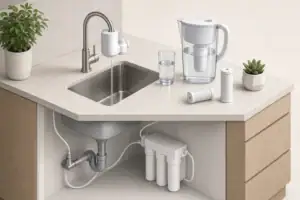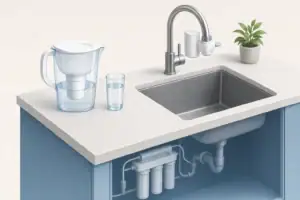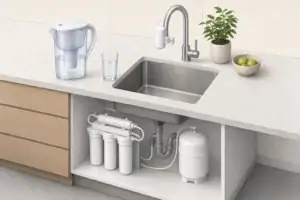
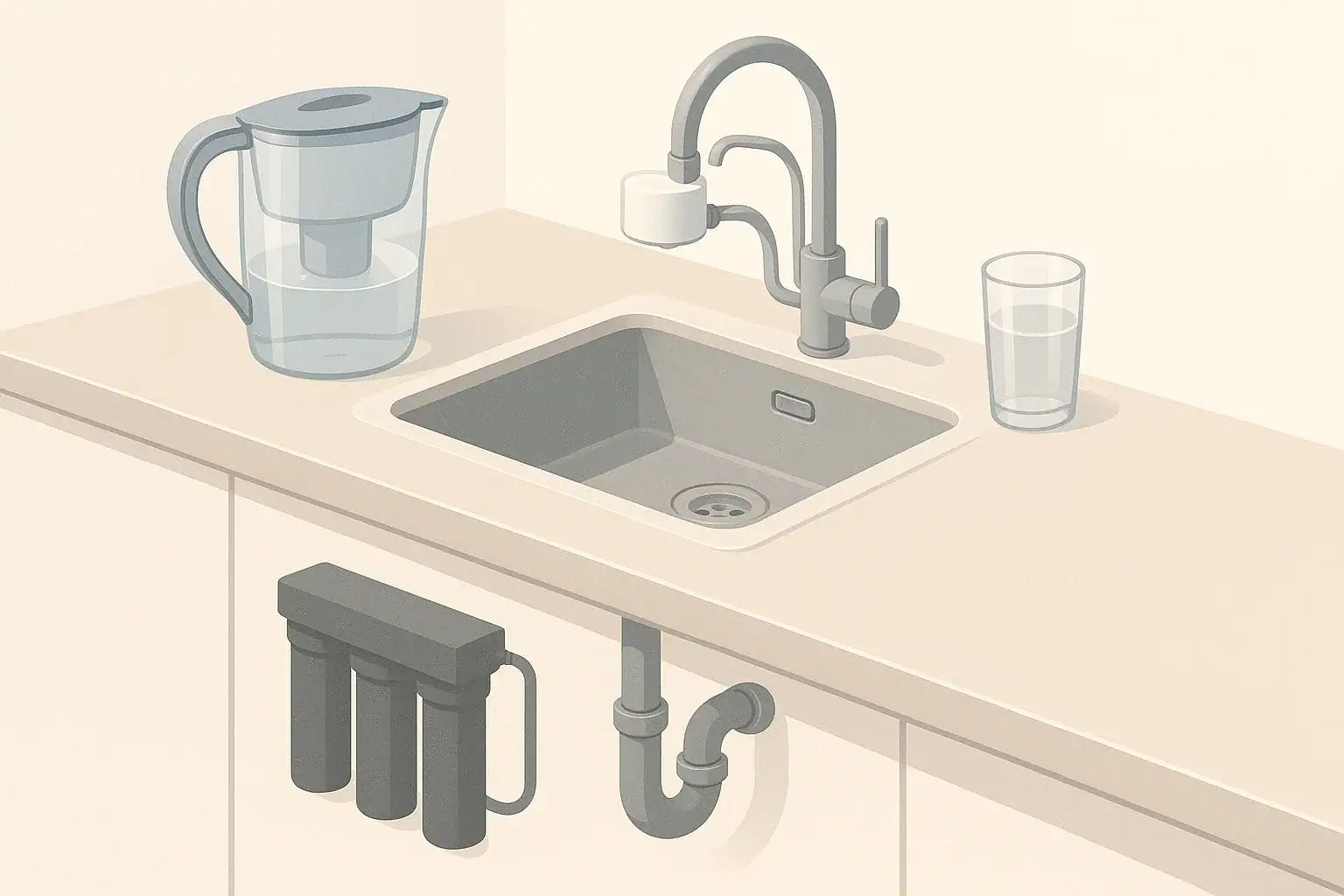
Reverse osmosis systems send two streams of water in different directions. Treated water goes to a faucet or storage tank, while reject water carries concentrated dissolved minerals and other dissolved substances to the drain. The small fitting that connects this reject-water line to the sink drain is commonly called a drain saddle.
RO drain saddle placement is easy to overlook because the fitting is small and often hidden under the sink. However, its location can affect noise, drainage behavior, odor complaints, and the chance of wastewater backing toward the RO drain tube. A good installation does not require unusual plumbing shortcuts. It usually depends on putting the drain connection in the correct part of the drain assembly and respecting basic drain and air-gap principles.
Why RO Systems Need a Drain Saddle
A residential RO membrane separates water into product water and concentrate. The concentrate stream is not sewage, but it is still wastewater and must go to an approved drain connection. The drain saddle provides a controlled point where the small RO drain tube can discharge into the sink drain piping.
Most under-sink RO systems use flexible tubing for this connection. The saddle clamps around a section of drain pipe, and the tubing enters through a small hole in the pipe wall. When the system is making water, a slow, steady stream may enter the drain.
Why location matters
The drain under a kitchen sink is not just an empty pipe. It includes a trap that holds water, horizontal and vertical sections, branch connections, and sometimes a dishwasher tailpiece or garbage disposer. Flow, air movement, and pipe geometry all influence how quietly and safely the RO reject water enters the drain.
Poor placement can create symptoms that seem like a filter problem even when the RO unit is working normally. Examples include gurgling sounds, a vibrating drain tube, intermittent clicking, foul odors near the RO faucet, or unexplained water at the cabinet floor.
What Good Drain Saddle Placement Does
Good placement gives the RO reject line a reliable path into the drain without interfering with the P-trap, dishwasher discharge, disposer outlet, or sink bowl drainage. It also helps reduce the chance that dirty drain water can splash toward the RO drain tube.
In many common under-sink layouts, the drain saddle is placed on the vertical drain tailpiece above the P-trap and away from the garbage disposer discharge path. The exact suitable location depends on the sink configuration and local plumbing requirements. Manufacturer instructions and local code should be followed.
Noise control starts with predictable flow
A small RO drain stream can become surprisingly audible if it drops into the wrong section of pipe, hits a bend, or shares space with turbulent wastewater from a disposer or dishwasher. Placing the connection where the reject water can enter smoothly helps reduce splashing, gurgling, and vibration.
Backflow control starts with separation
Backflow risk is about keeping drain water from moving into places it does not belong. Many RO faucets are designed with an air gap, which provides a physical break between the RO drain path and the household drain. Some systems use non-air-gap designs with other safeguards. The drain saddle should never be treated as a substitute for required backflow protection.
Example values for illustration.
| Placement factor | Generally preferred approach | Why it matters |
|---|---|---|
| Relation to P-trap | Above the trap, not after it | Helps discharge into the waste side while preserving normal trap function |
| Pipe section | Straight, accessible section | Makes alignment easier and reduces strain on tubing |
| Disposer discharge | Away from high-turbulence discharge paths | Helps limit splash noise and pressure pulses |
| Dishwasher connection | Not competing with dishwasher drain flow | Reduces gurgling and possible cross-flow issues |
| Tubing route | Short, smooth path without kinks | Supports steady reject flow from the RO system |
| Service access | Visible enough for inspection | Makes leaks and loose fittings easier to notice |
| Code and instructions | Follow local rules and system documentation | Protects against unsafe or noncompliant modifications |
Common Noise Problems Linked to Drain Saddle Location
Some RO noise is normal. During production, water may trickle to the drain for an extended period, especially with a traditional tank system. A quiet hiss or gentle running-water sound may simply mean the membrane is operating.
Placement-related noise is different. It is often louder, more intermittent, or connected to other water use under the sink.
Gurgling from the sink drain
Gurgling can occur when the RO drain line discharges into a section of pipe where air and water are already moving irregularly. It may also happen if the sink drain is partially restricted. The RO connection can make an existing slow-drain problem more noticeable because it introduces water when the sink is otherwise not being used.
Vibration or tapping
Vibration may come from a drain tube that is stretched, kinked, or pressed against the cabinet wall. It can also occur if the saddle is placed where larger drain flows create pressure pulses. A dishwasher or garbage disposer can temporarily change conditions in the drain branch.
Water dripping sounds after the tank fills
Traditional RO systems may continue sending water to the drain until the storage tank reaches shutoff pressure. If dripping continues indefinitely, the issue may be a valve, tank pressure, membrane condition, or drain connection problem. The saddle location is only one possible cause.
Backflow and Cross-Connection Basics
A sink drain can contain food particles, soap residue, and wastewater. The RO drain line must be connected so that drain contents cannot be pushed back toward the filtration system or faucet. This is why plumbing design is about both convenience and separation.
Air-gap and non-air-gap systems
An air-gap RO faucet routes the reject water through a visible break before it enters the drain line. If the drain becomes blocked, water may come out of the faucet base or air-gap opening rather than being forced backward into the RO unit. This can be inconvenient, but it is a warning sign that the drain path needs attention.
A non-air-gap RO faucet does not provide the same visible break at the faucet. These systems may use check valves or other design features, but installation still needs to follow the system instructions and local requirements. Do not remove, bypass, or defeat backflow-prevention parts to stop noise.
Why the P-trap is not the connection point
The P-trap holds water to block sewer gases from entering the living space. The RO drain saddle is generally not placed on the trap bend or downstream of the trap. Incorrect placement can create odor, service, and sanitation concerns. If the only available pipe appears to be the trap or an unusual fitting, it is a good time to ask a qualified plumber.
Practical Placement Guidelines Under a Kitchen Sink
Most homeowners evaluating an existing installation can start with simple observation. You do not need to disassemble the drain to identify many placement problems. Look for where the RO drain tube enters the drain, what other fixtures connect nearby, and whether the tubing is strained.
Prefer a straight vertical tailpiece when appropriate
A straight vertical tailpiece above the P-trap is often a suitable location when it is accessible and not crowded by other drain branches. The saddle should sit squarely on the pipe, and the tubing should enter without sharp bends.
Avoid turbulent zones
Garbage disposers and dishwashers can discharge rapidly. Their flow may create splashing and temporary pressure changes. Placing an RO drain connection too close to these discharge points can increase noise and may make backflow prevention more important.
Keep the drain tube supported but not pinched
Flexible tubing should have gradual curves. A kink can restrict the reject stream, which may stress the RO system and create unusual sounds. Tubing should not hang where stored items can pull on it or push it loose.
Do not create unapproved drain openings
Drilling, modifying, or relocating drain piping should be done only in ways allowed by the RO instructions and local plumbing rules. Avoid improvised connections, open tubes, or unsealed fittings. They can leak, release odors, or create sanitation concerns.
When Existing Plumbing Makes Placement Tricky
Some under-sink spaces are crowded. Double-bowl sinks, disposers, dishwasher branches, pull-out trash bins, instant hot water dispensers, and compact RO systems can all compete for space. In these situations, the best answer may not be to force the drain saddle into the only open spot.
Double-bowl sinks
With two sink bowls, the drain assembly may include horizontal branches and baffle tees. The RO saddle should not be placed where water from one bowl can rush directly across the RO opening. A plumber can often identify a quieter and more stable section of tailpiece.
Garbage disposers
Disposers can create strong bursts of water and food residue. If the RO drain connection is on a section affected by disposer discharge, noise and odor complaints may be more likely. The solution may involve a different approved drain section rather than tightening the saddle harder.
Apartments and rentals
Renters should get permission before modifying drain piping. Some leases limit under-sink installations, and some buildings have specific rules for water treatment equipment. A countertop or faucet-mounted option may be more practical where permanent changes are not allowed.
Post-Installation Checks That Help Catch Problems
After an RO drain saddle is installed or inspected, a few practical checks can help identify trouble early. These checks are observational and should not replace the system manual or professional service when needed.
- Run the RO system and listen for loud gurgling, tapping, or vibration.
- Run the sink faucet and watch for leaks at the saddle and nearby slip joints.
- Operate the garbage disposer if present and listen for new drain-line noise.
- Run the dishwasher drain cycle if practical and check for water movement near the saddle.
- Look for kinks, flattened tubing, or tubing pulled tight across the cabinet.
- Check again after the RO tank has filled to see whether drain flow stops as expected.
If water appears at an air-gap faucet opening, do not block the opening. It is usually a sign that the drain path is restricted or the air-gap tubing is not routed correctly. Blocking the opening can defeat the warning function and may cause water damage elsewhere.
Troubleshooting Symptoms After Installation
Drain saddle problems can resemble other RO issues, so it helps to match symptoms with likely causes rather than assuming the saddle is always responsible. A noisy system may have normal reject flow. A system that never stops draining may have a shutoff, tank, pressure, or membrane issue. A bad odor may come from a sink drain that needs cleaning rather than from the RO membrane.
When to stop and get help
Professional help is appropriate if the drain layout is unusual, if there is repeated leakage, if drain water backs up through an air-gap opening, or if moving the saddle would require cutting or reconfiguring household drain pipes. Plumbing rules vary by location, and safe installation matters more than hiding a sound.
It is also wise to seek help if the home has recurring slow drains. A drain saddle should not be used to work around a clogged or poorly vented sink drain. Fixing the underlying drain issue is the practical first step.
Example values for illustration.
| Observed condition | Possible explanation | Practical next step |
|---|---|---|
| Gentle trickle during water production | Normal reject flow | Confirm it stops when the tank is full |
| Loud gurgle when sink drains | Turbulence near saddle or slow sink drain | Inspect placement and check for drain restriction |
| Air-gap faucet spits water | Blocked or restricted drain path | Do not block opening; clear routing or get service |
| Drain tube vibrates | Kinked, stretched, or poorly supported tubing | Look for sharp bends and contact points |
| Drain flow never seems to stop | System shutoff or tank pressure issue may be involved | Review manual checks or call for service |
| Odor near cabinet | Drain leak, trap issue, or residue in sink drain | Check for leaks and proper trap condition |
| Leak at saddle | Misalignment, loose clamp, or damaged pipe surface | Stop using if needed and correct safely |
Related guides: Reverse Osmosis 101: What RO Removes (and What It Doesn’t) • NSF/ANSI 58 Explained: What It Means for RO Systems • RO System Installation Guide: Space-Saving Layout Under the Sink • Noisy RO System: Common Causes and Fixes
Long-Term Maintenance and Practical Expectations
An RO drain saddle is not a filter cartridge, but it still deserves occasional attention. Each time cartridges are replaced, use the opportunity to look at the drain tube, saddle, and surrounding cabinet floor. Small leaks are easier to address before they damage cabinet materials.
Keep stored items from pushing against tubing or fittings. Heavy cleaners, trash bags, and bins can shift over time and pull on RO lines. If the sink drain is serviced, remind the plumber or technician that an RO drain saddle is connected so the tubing is not accidentally twisted or left unsupported.
Some sound from an RO drain is normal, especially while the system is refilling a storage tank. The goal is not complete silence in every installation. The goal is a stable, code-conscious connection that drains predictably, avoids unnecessary splashing, and preserves required backflow protection.
When in doubt, follow the RO system documentation and local plumbing requirements. A properly placed drain saddle is a small detail, but it helps the entire under-sink system operate more quietly and with fewer avoidable drain-related problems.
Frequently asked questions
Where should an RO drain saddle usually be installed?
It is often installed on a straight section of drain pipe above the P-trap, where it can discharge into the waste line without interfering with other connections. Exact placement depends on the sink layout and system instructions.
Can I put the drain saddle on the P-trap?
No, the P-trap is generally not the right location. The trap needs to function normally to block sewer gases, so the saddle is usually placed elsewhere on the drain pipe.
Why does my RO system make gurgling noises at the drain?
Gurgling often points to turbulence, a crowded drain branch, or a slow sink drain. The saddle location can contribute, especially if it is close to a disposer or dishwasher discharge path.
Does an air gap eliminate backflow problems?
An air gap helps prevent wastewater from being forced back into the RO system, but it does not fix a blocked drain. The drain path still needs to be clear and routed correctly.
What if the tubing is kinked or stretched?
Kinked or stretched tubing can restrict flow and create noise or stress on the connection. It should be rerouted so it follows a smooth path without sharp bends or tension.
When should I call a plumber?
Call a plumber if the drain layout is unusual, if leaks keep returning, if the sink drains poorly, or if changing the saddle would require altering existing drain piping.
Recommended next:
- Reverse Osmosis 101: What RO Removes (and What It Doesn’t)
- NSF/ANSI 58 Explained: What It Means for RO Systems
- RO vs Carbon Under-Sink: Taste, TDS, and Maintenance Compared
- RO System Installation Guide: Space-Saving Layout Under the Sink
- RO Waste Water Ratio: What’s Normal and How to Reduce It
- RO Filter Replacement Schedule: Prefilters vs Membrane
- More in Reverse Osmosis (RO) →
- NSF/ANSI standards explained (42/53/401/58)
- Clear trade-offs: pitcher vs faucet vs under-sink vs RO
- Maintenance planning: cost per gallon and replacement cadence